How to Save Money When Renewing the Dreaded City Business Permit

Every time we enter a new year, many of us reflect on the past and make resolutions for the future. 

When the first working day arrives, however, we face reality. 

One of those realities is the dreaded city business permit renewal. 

Town and city governments in the Philippines require enterprises to register before they can conduct business in their areas of jurisdiction.  Renewing a business permit is mandatory by every third week of January of every calendar year.  It doesn’t matter if the business is big or small, profit or non-profit, every enterprise is required to register and renew their permits annually; there are very few exceptions

The responsibility to register falls mainly on the enterprise.  It’s one more task in an enterprise’s list of things-to-do to comply with the myriad of laws and regulations inherent in doing business in the Philippines. 

The city/town business permit is also known as the mayor’s permit.  To get one, whether new or renewed, the enterprise has to fulfil several prerequisites.  These include:

  • Clearance from a barangay or village;
  • Securing a sanitary permit;
  • Getting an environmental permit;
  • Showing a fire department permit;
  • Clearance from the city’s zoning office;
  • Paying & getting a community tax certificate.

Each prerequisite in turn has its own requirements to meet.  These include:

  • Proof of comprehensive general liability insurance coverage which is insurance to cover for anyone getting injured in an enterprise’s premises;
  • Physical medical examinations of the enterprise’ s employees including x-rays, blood tests, and doctors poking your people’s bodies;
  • A certificate from a licensed pest control exterminator certifying that there are no pests (insects not humans) in the enterprise’s premises;
  • A certificate from a national government agency that you’re complying with environmental laws.  If the enterprise is exempted, it would need to get a certificate that the enterprise is exempted or a certificate that one that does not need a certificate (yes, it’s red tape at its worst);

The enterprise would need to pay fees for each clearance and permit it secures.  The expenses can be hefty.  A community tax certificate can cost up to PhP 10,000 ($USD 200) which is significant for many small businesses.

When an enterprise presents all the clearances and permits to the city/town business permit & licensing office, it will then have to pay the local tax which is based on the enterprise’s sales and spend for fees such as:

  • Garbage fee;
  • Signboard fee (even if you don’t have a signboard);
  • Electrical & mechanical inspection fees;
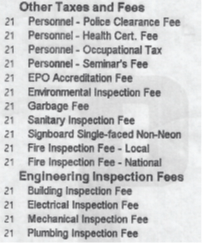
  • Personnel inspection fees (fees to pay for the medical, police, occupational tax, and seminars of the enterprise’s employees no matter what topics they cover);
  • EPO accreditation fee (EPO is the environmental protection officer of the enterprise and the fee pays for the city’s accreditation or certification of that person);
  • Environmental inspection fee;
  • Sanitary inspection fee;
  • Fire inspection fee – local;
  • Fire inspection fee – national (enterprises pay for the local and national fire departments);
  • Engineering inspection fees.
Sample of a city’s fees other than the tax

These fees seem to cover all the costs of city hall and then some so one wonders where the taxes enterprises pay go to.    

Cities earn a lot of revenue from these business taxes and fees.  Yet, they don’t make it easy for enterprises to renew their permits and pay for them. 

It would take enterprises up to six (6) months if they are getting a business permit for the first time.  And it would come at great cost and time.  Cities and towns would require new businesses to undergo inspections (getting signatures from local agencies, engineers, and other authorities) and submit a lot of paperwork such as tax documents, business registration papers, as-built construction plans, and corporate licenses.  Note that these are requirements for new businesses.  The enterprise is applying for a permit to do business but has to first submit paperwork as if it has already been in operation for years. 

Renewing the business permit every January of every subsequent calendar year isn’t as lengthy but it is a hassle.  Renewing a permit is similar to getting a new one altogether.  One has to submit documents, fill out application forms, and go to one local agency after another to get a city officer to sign the forms saying the enterprise fulfilled its requirements but still is subject to inspection. 

Even if the city puts up what they call a “one-stop-shop” where all the agencies are located in one place, the enterprise’s representative still has to walk and stand in line at each agency’s desk.  The total distance of walking within a “one-stop-shop” can run up to several kilometres, not including the walking after the desk officer tells you that you need to photocopy more of the documents you submitted and you’d have to run outside to the nearest photocopier several hundreds of metres away which also has a line of people waiting. 

There is no value-added benefit in getting a business permit.  At least to the enterprise.  All the value goes to the city.  The enterprise does most of the work preparing & submitting documents and paying for all the taxes and fees for services which mostly one will never really see. 

It’s all part of compliance to laws and regulations that govern enterprises in the Republic of the Philippines.  One has to follow the processes and pay for them for the sake of building the nation and uplifting the lives of citizens (as to which citizens we don’t seem to have any business to know).  As the saying goes, “you can’t fight city hall.”

Enterprise executives delegate much of government compliance work to their employees, such as their bookkeepers, their in-house paralegals, and their administrative staff.  More often than not, compliance is not on an executive’s strategy list.  It is not a competitive priority

If at all, executives rather not spend time thinking about compliance, even so for bothersome local business permits at the start of a new year.  Executives would rather be busy on more so-called important things such as sales, operations, and investments. 

But whether they like it or not, compliance is a priority that executives should not outright ignore.  Because if and when they do, they can pay a high price.

Examples:

  • A city mayor shut down several businesses after inspection showed they were operating without permits;
  • A factory paid a heavy fine after it failed to prove it was complying with local environmental laws (it didn’t have a required bicycle rack and poster that showed the picture of the mayor saying there’s no smoking allowed in the premises);
  • A town billed a trucking company thousands of pesos for delivery vehicles that the latter did not disclose when it renewed its mayor’s permit;
  • A city zoning office refused to give clearance to an enterprise that was operating in a residential area where zoning laws didn’t allow business to be conducted.

We can avoid the unnecessary costs from business permit renewals not only by following procedures but also by looking out for some savings. 

For instance, some cities and towns offer discounts if an enterprise pays one full year’s worth of tax instead of remitting every three (3) months.  An enterprise saves not only from the discount but also from having to send staff to pay every quarter.  (Some cities negate this benefit when their agencies require the enterprises to renew certifications such as environmental & sanitary permits every quarter).

It’s sometimes worth it for an enterprise to examine what it pays for in a business permit.  For example, a commercial building for years has been paying a private company a monthly fee to take away the trash.  The building’s board of trustees realised later that it was paying thousands of pesos in garbage fees to the city.  When the board brought it up to the city sanitation office, the latter instructed the city’s trash hauler to pick up the trash.  The board then cancelled the contract with the private company and stopped spending for something already paid for with the city. 

Enterprise executives always like to enter any new year with confidence and initiative to grow their businesses.  Growth, however, entails meeting obligations such as renewing city permits at the start of every year.  It’s a hassle and it costs a lot but enterprises need to do it else they will pay more in fines or risk being closed down. 

Compliance is a must when it comes to laws and regulations but enterprises can avoid spending too much by examining what they’re charged for and availing of discounts when offered. 

Compliance comes with a cost but we don’t have to spend more than we should.

About Overtimers Anonymous

Four (4) Guidelines for Available Transportation

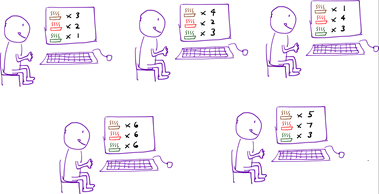
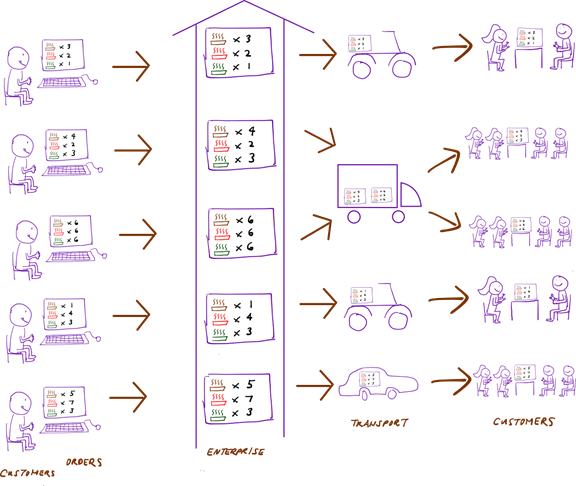
Many small business enterprises don’t put too much thought into deliveries.  For those who are into e-commerce and sell one or very few items via the Internet, the enterprise’s flow of work is typically receiving orders, preparing the items, and booking & delivering via a 3rd party service (e.g., Grab, Lalamove).

Many enterprises have seen their businesses grow thanks to e-commerce.  Some have seen their markets surge in terms of number of customers and deliveries.    

E-commerce has been a godsend to enterprises reeling from the coronavirus pandemic of 2020.  Some have not only survived but also made good money. 

As some enterprises grew, they expanded their product lines and gained more customers.  Some have seen demand for their products come with greater variability as they cater to customers with varying needs. 

Nevertheless, most e-commerce enterprises have done well despite the growing demand.  They have had no issue delivering versus demand (customer orders), thanks largely to sufficient capacity and availability of transport providers.     

But as businesses expand even more, they can begin to encounter issues. 

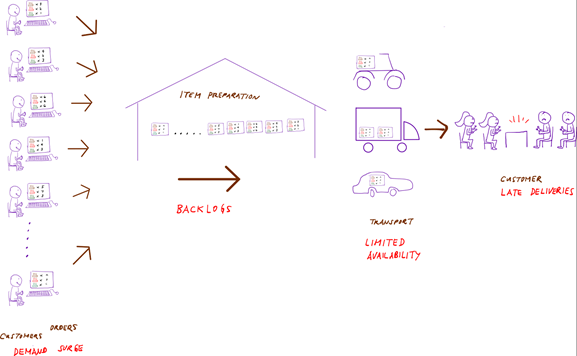
Transport availability and operating capacities show their limits when business multiplies.  Enterprises realise e-commerce becomes more of a supply chain issue, than just an adoption of an app. 

Some enterprises end up turning away customers when they lack the capability to deliver. 

Turning away customers means turning away opportunities.  When times are tough, enterprises can ill afford to turn away customers. 

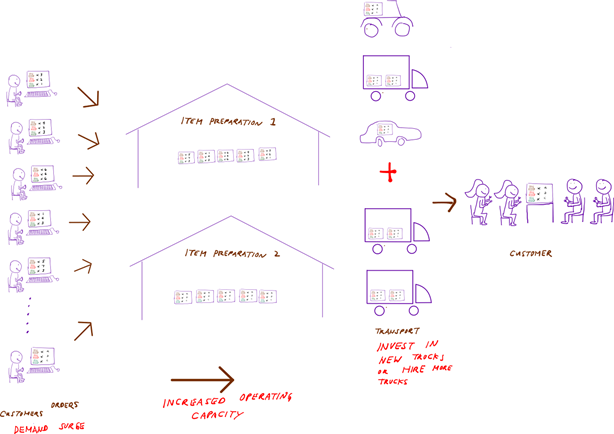
Which is why it’s wise to study and pinpoint where one can invest in capacity and allow the business to grow. 

There are means to determine how to increase operating capacities.  It’s another story when it comes to transportation availability.  How does one procure more transportation?  Should the enterprise buy more trucks or source more 3rd party providers? 

The following are some suggested guidelines:

A. Own Vehicles for Demand Surges

Most enterprises experience demand surges.  Food shops sell more during the Yuletide season and not much afterward.  Gift & flower shops sell a lot before and on Valentine’s Day.  Convenience stores sell plenty of beverages and snack foods during long holiday weekends when most people stay home. 

An enterprise can assess its transportation needs for demand surges.  It might be a good idea for an enterprise to have its own transportation to pick up the slack when 3rd party providers may not be available, such as during holidays when many drivers and riders go on leave or are fully booked.

B. Have Back-Up Drivers

Nothing is more frustrating than to have a delivery ready to go but no one to drive the vehicle to transport it. 

Enterprises usually train several people to operate equipment such that if the operator is absent, another can take over. 

The same should apply for delivery vehicles.  Even if a shop relies almost 100% on 3rd party riders to deliver, it not only may be a good idea to have one’s own vehicle on standby but also to have more than one employee who knows how to drive it.  It’s not worth the risk of having no transport available to deliver all because there was no one to drive the vehicle that’s already there. 

C. Get to Know the Riders

They’re not your employees but it may be nice to get to know the riders who pick up your products and deliver them to your customers. 

Some riders come back again and again to deliver for an enterprise.  One reason is because some of them live nearby so they’re readily available every day.  It’s therefore nice to establish a professional rapport and even share contact information. Having a rider that you’d know and who’d you know will surely be there for your business every day adds a plus to ensured availability.

D. Take Advantage of 3rd Party Promotions & Programs

Some 3rd party services offer programs wherein client enterprises can not only avail discounts but also provide greater priority for package pick-ups and deliveries.  The enterprise can estimate the packages it will ship daily and see how a 3rd party’s offered program fits in terms of price and available transport. 

Pandemic or no pandemic, enterprises are growing through e-commerce.  They are seeing exponential growth and so far, many are coping well and making profits. 

Growth at a point, however, reveals the limits of enterprises.  When it comes to e-commerce, it usually shows not only in operations but especially in transportation. 

It may be good for enterprises, therefore, to invest in one’s own transport especially for demand surges, have enough back-up drivers, and establish relationships with 3rd party providers, like with the riders and/or availing programs & promotions 3rd party services may offer.

Better to be ready to deliver than to be unable to. 

About Overtimers Anonymous

Lessons Learned from E-Commerce

December 28, 2020.  We ordered the food but couldn’t find the riders to deliver them. 

Our family of cousins, uncles, and aunts couldn’t be together for New Year’s Eve.  Reunions and parties were not allowed in lieu of ongoing restrictions brought on by the CoVID-19 pandemic.  Instead, we ordered food from a food shop and was counting on available motorcycle riders to deliver them hot and fresh to our relatives on December 31, New Year’s Eve.

But starting December 23, we noticed available riders were getting fewer and fewer.  By the 30th of December, there were practically no riders available.  I ended up driving to the food shop to get the food packs and deliver them to my cousins’ residences on New Year’s Eve. 

We used to sit at a restaurant, order via a menu, wait as the restaurant’s kitchen prepared our meals, and enjoyed our food as waiters brought them to the table. 

No more.

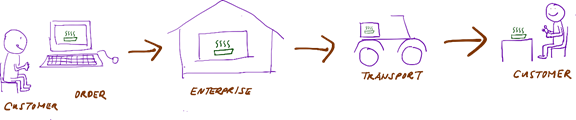
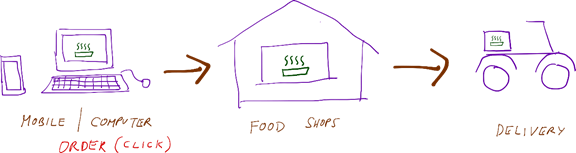
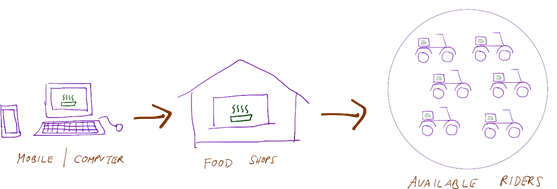
Because of the pandemic, we had to opt via the e-commerce way, which was sit at home, order via mobile phone or tablet, wait for the food shop (a former caterer) to confirm that our meals were prepared, and then book a 3rd party rider service (motorcycle delivery courier) to bring our ordered food to our home. 

The success of e-commerce relied on a seamless process of order taking, preparation, and delivery.  Most of the time, there were no problems.  As long as the internet stayed fast and continuous, the food shops had the capacities, and there was an abundance of available delivery riders, we made our orders and had gotten them when we wanted them.

The December 2020 holidays, however, reminded us that e-commerce did have its limits. And the first place it manifested itself was in the riders.  We had no clue that riders will be rare a week before New Year’s Eve. 

We always assume there’s enough capacity throughout the e-commerce process. 

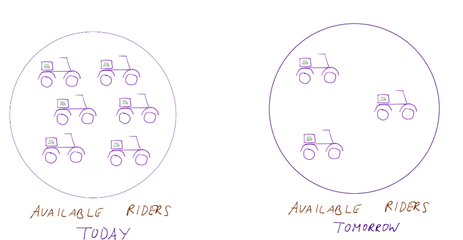
But we can never tell how many riders there’d be today or tomorrow.

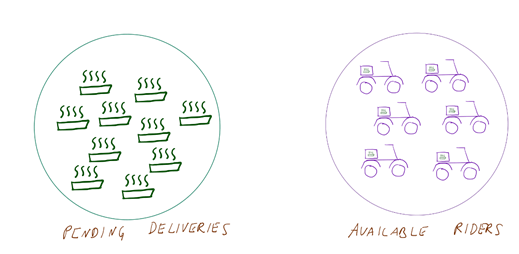
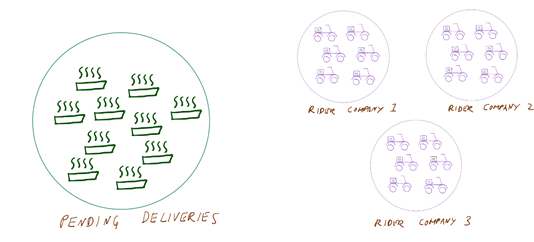
Availability of riders is not only due to factors such as absenteeism and driver population but also very much in lockstep with the number of pending deliveries.

Since it was the holiday season, riders weren’t only tired and taking leave but pending deliveries were at their peak. 

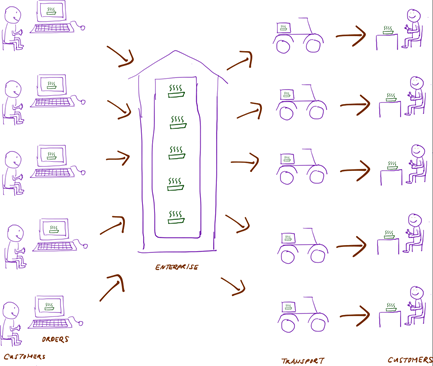
As food shops were managing through the high demand and the Internet remained steady and speedy for customers who ordered, the bottleneck in the e-commerce supply chain was in the available riders to deliver the orders. 

There were several companies in the rider business, at least three (3) major ones in our city, Manila, to count on. 

If one couldn’t take the orders, we would resort to another. 

This worked most of the time but the holiday season of 2020 crimped the capacities of just about everyone.  

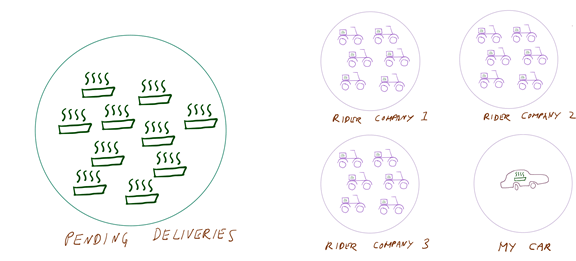
In the end, I (and probably a significant number of families) just had to pick up our orders ourselves.

I don’t know if this is going to be the new normal of the food e-commerce business in which I’d have to pick up my own orders when there are no riders available.  But there are lessons coming out that I’m learning.

Lesson #1:  E-commerce is Different.

E-commerce does not follow the same process as what we are familiar with order fulfilments.  For food shops, it’s click, prepare, and deliver.  It’s no more the sit-in-restaurant, order by menu, cook by kitchen, and meals placed on a table.  We pay online not in person.  It’s a total change from the traditional face-to-face transaction.

Lesson #2:  The Customer Experience Has Become Mutual

The e-commerce experience is a sea change from in-person interaction.  With e-commerce, it’s about ordering products by ourselves and getting our order in the right quality and quantity by ourselves.   The onus of ordering and the method for delivery has passed more to the customer from that of the enterprise.  The experience has become more dependent on a mutually beneficial collaboration between customer and enterprise. 

Lesson #3:  Customers Can Be Choosier but Can’t Get All of What They Want

Customers can be choosier as e-commerce opens the door to a multitude of enterprises into the market.  There are more food varieties, for instance, to choose from as restaurants, caterers, and want-to-be-chefs advertise themselves side-by-side on the worldwide web.   At the same time, customers can’t dictate how orders would be fulfilled or delivered as it’s what-you-see-is-what-you-get when it comes to transacting online. 

Lesson #4:  Management Has to Learn to Change

It’s not just enterprise executives have to change how they manage their operations but also that they have to learn to manage in an actively-changing environment.  No longer can enterprises expect a daily steady crowd of customers or expect to have the same capabilities in production and delivery.  E-commerce allows more competition and innovation as it expands the marketplace and connects more enterprises and customers.  Both enterprise owners and customers would need to be ready to adapt and change quickly as new products and services are introduced frequently

Lesson #5:  E-Commerce is Not IT; It’s Supply Chain Management

Last but not least, if we don’t already know, e-commerce is a supply chain thing.  It’s not an information technology (IT) thing.  A lot of entrepreneurs are spending a great deal of time on development and programming of applications but not much on engineering and managing operations.  E-commerce is one-side IT (clicking on an app and paying online) and one-side physical work (product preparation & delivery logistics).  It is therefore elementary that entrepreneurs learn how to optimally serve their products as much as to have  user-friendly efficient web applications. 

These are just some of the lessons.  There probably will be more as e-commerce gets off the ground. 

Meanwhile, I’ll just make sure my car is ready to pick up my family dinners in case no riders are available again. 

About Overtimers Anonymous

Behold The PSI: A Basic Tool for Supply Chain Planning

The PSI or Production-Sales-Inventory is a basic spreadsheet template for supply chain planners. 

It looks like this:

The PSI typically has three sections:  production, sales, and inventories. 

Production represents the in-flow of an item or what’s going into inventory.  A basic example is finished goods input coming from a manufacturing operation’s output.  We can also call it supply. 

Sales is the out-flow of an item or what’s going out from inventory.  An example is a shipment to a customer.  We can also call it demand. 

Inventory is the stock of an item on-hand in storage, such as how much of an item is in a warehouse. 

The PSI makes visible production, shipments, and inventories over a range of time periods or what we can call time-buckets.  It’s an outlook for planning.  It’s up to the planner if he or she wants to use weeks, months, or even days for the time buckets.  It’s also up to the planner how many time buckets to plan for.  It doesn’t have to be just three as in the figure below.  It can be any number.  Some enterprises use six (6) buckets for a 6-month outlook; others go up to 12.  It is the planner and his superiors that decide what periods to cover (e.g., weeks, months) and how many. 

The PSI’s horizontal rows list the items or products.  Each row shows the production, shipments, and inventory outlook for each item via the quantities in the respective columns or time buckets. 

An item can be a product, material, or a supply or spare part. It is recommended to select an enterprise’s most important items to the PSI.  By very important, that would mean those that executives often keep an eye on. 

Working the PSI starts with a beginning inventory at the zero (ø) column of the inventory section. 

The planner’s basic aim is to track the inventories from one time-bucket to the next.  In the figure below, the planner notes that inventories at the end of week 1 becomes fewer as a result of sales in the same week. 

When the planner, however, inputs the production and sales of week 2, the inventories end with zero (ø) on week 2. 

To put what I just said in a formula:

and to put it to represent every time bucket:

where x is the time-bucket number.

The aim of the supply chain planner is to ensure there will always be available inventory for sales.  Hence, supply chain planners typically prefer there’d be extra stock at every time bucket.  

Supply chain planners typically set inventory targets for every time-bucket in line with their superiors’ policies and strategies.  Sales for each time-bucket usually are based on forecasts and customer orders. From the inventory targets, the planner computes the production or sales needed and still have enough left to meet inventory targets.

Planners focus on either how much to sell or how much to produce to meet inventory targets. 

If it’s production, planners would adapt the ending-inventory formula and make it look like this:

For a desired ending inventory of five (5) units of items A and B, the planner would set production numbers that would match sales but leave at least five units at every ensuing time-bucket. 

When the enterprise wants to plan how much of an item to sell given inventory targets and ongoing production, the supply chain planners would adopt the following formula: 

Which in the PSI would look like this:

…which looks just like the PSI for production.  😀

The PSI in the above diagrams shows the same numbers but illustrates a different approach.  The planner either figures out how much to produce or calculates how much to sell for the ultimate purpose of having enough inventories at every time-bucket. 

The insight here is you can tailor a PSI for your particular business. 

For an enterprise that buys finished goods and directly sells to customers, for instance, a planner can adapt a PSI from a production-sales-inventory template to one that is purchases-deliveries-inventory:

An enterprise that imports items and converts them to finished goods, a PSI may look like the one below. 

I found this especially useful in a metals manufacturer that was importing stainless steel coils that then were being cut up and converted into steel sheets, plates, tubes and pipes.  As the stainless steel coils were the key components of the manufacturer with their weights in metric tons as the standard of measure, the PSI enabled the manufacturer’s managers to plan the quantities and timing of importing and converting expensive metals without having too much on floor for too long. 

When enterprises use a common measure from key materials to finished product, the supply chain planner could expand the PSI to a 4-column spreadsheet consisting of purchases-production-sales-inventories:

A 4-column PSI would be particularly effective for enterprises with few but predominantly high-volume products such as those in commodities.  And it opens up participation of practically the four (4) core disciplines of the supply chain:  purchasing, production, logistics, and planning. 

The PSI doesn’t require sophisticated software or hardware.  One can use an ordinary spreadsheet program (e.g. Excel) or even do it by hand with or without a calculator (or abacus). 

The PSI gives visibility to an enterprise’s supply and demand picture from present to future for key items, whether finished goods, materials, or parts. 

The PSI’s limit is that the more items an enterprise has, the more tedious it becomes to plan and track.  ERP systems coupled with up-and-coming artificial intelligence (AI) software can make up for that.  Many enterprises, however, stick to simple spreadsheets to plan the items they carry.   

Even with its simplicity and features, it’s hard to find an enterprise that actually uses a PSI.  Many planners tend to devise their own templates, using spreadsheets mostly, despite the availability of integrated planning tools provided by expensive software. 

Most of the planning spreadsheets I’ve seen are hard to understand or are very specialised.  When I present the PSI template to planners, however, I’ve gotten very positive feedback with executives welcoming its application and visibility. 

A PSI is a basic manifestation of what a supply chain planner does, which is to plan production or estimate the demand needed with a minimum amount of stock at every time period.  It is a basic tool for supply chain planners.  It’s simple to set up and provides a comprehensive canvas of what an enterprise’s supply and demand would look like in the present and future.  It has its limitations in the complexity of an enterprise’s items and operations. But at the very least, it provides a foundation for planners to manage inventories and optimise supply chain productivity. 

Find Ellery

Why Shifting from the Month-End Surge to Delivery by Demand is Common Sense

“We just have to live with it,” the General Manager replied. 

The GM was responding to my comment that month-end surges in sales orders were causing inefficiencies in the company’s logistics operations. 

I was presenting an operations assessment report to a company that distributed name-brand computer printers and accessories.  One of the key observations from my report was that the majority of sales orders (more than 50% of monthly sales) came at the end of every month.  Staff from sales, accounting, to logistics rushed deliveries to fulfil the orders and meet revenue targets.  Sales personnel counted on the deliveries to achieve if not beat their quotas and benefit from incentives. Not attaining the targets and quotas was simply not acceptable.  

The company is an exclusive distributor for a large name-brand supplier of printers.  The supplier dictated the monthly sales targets.  The supplier expected the company to meet those targets from month to month, no questions asked.  Hence, the company’s General Manager said that month-end surges were something they could do nothing about.  It was something they had to live with. 

Many executives do not want to shift from the practice of month-end selling and delivery.  “It’s not for discussion,” a consumer goods wholesale executive once told me when I said the monthly surge in deliveries was causing her firm’s transportation expenses to rise.  The executive did not want to change a practice which has become so ingrained in the company’s culture.

Executives don’t dispute that month-end surges bring about inefficiencies and high costs throughout the supply chain.  Surges cause stock run-outs as inventories deplete quicker than suppliers or manufacturing lines can replenish.  The surges also drive up inventories of customers which result in increased product returns especially for products with limited shelf lives.    

Logistics expenses increase as month-end surges strain storage and transport capacities.  Some firms rent additional storage to stockpile products in anticipation of sales surges.  Transport providers tend to sub-contract additional trucks to ensure there are enough vehicles to meet the demand.  Both the additional storage and transport capacities result in higher delivered costs for products.    

Month-end surges are sometimes coupled with periodic sales promotions and price changes which fuel more spikes in orders and delivery volumes.  Surges thus cause a “bullwhip” effect in which the up-and-down delivery volumes and resulting peaks and valleys in inventories amplify speculations throughout the supply chain. 

Executives are reluctant to move away from month-end surges because they fear lower sales will result.  They are afraid shifting from month-end sales would cause a decrease in revenue which they can ill afford in organizations that especially measure performance by monthly targets.

Moving from month-end sales to just deliveries driven by demand is common-sense logical.  It’s just not accepted given the anxiety it would cause among executives. In a demand-driven supply chain, one delivers only what and when it is needed.  The fear is the demand and the subsequent sales might not be up to par with immediate targets.

A downturn in sales would indeed be expected as customers would exhaust overstocked inventories from any previous surge.  In succeeding months, demand would pick up and sales would average closer to what would have been with month-end surges.  But executives would have to have faith that that will happen and executives don’t like to count on faith. 

Stakeholders in many companies measure executives via short-term targets.  Stakeholders want to see continuous growth in their company’s finances especially if they expect dividends and bonuses every year.  Creditors, such as banks who provide loans, also want to see continuous short-term gains to assure themselves that they will be paid the interest and principal of what they lent. 

The month-end surge is a manifestation of short-term thinking.  Shifting from the month-end surge requires changing one’s mindset from short-term to long-term management.    

When delivering only what is needed and when it is needed, all functions of the organization have to work closely together.  Sales needs to forecast future demand from the grass-roots level or from the end-user, whether that be the customer or the customer’s customers.  Marketing would support sales where it sees demand is lacking or where there is potential.  The supply chain from logistics, manufacturing, and procurement would have to build in a capable system and structure to anticipate the demand.  Sales, Marketing, and the Supply Chain, most of all, would need to communicate and come out with a consensus of action every time they review actual and forecasted demand. 

Attaining higher sales is not a product of individual sales persons or a result of incentives for just one group.  It is the product of teamwork.  Any challenge in fulfilling demand and achieving targets can be met if the organization works as a team. 

And isn’t that what organizations are supposed to be doing in the first place?

About Overtimers Anonymous

Originally published in LinkedIn May 06, 2019

A Letter to the IE: More than Ever, We Need to Lead the World to Productivity

:

Dear Industrial Engineer*

The year 2020 ended without a happy ending. The SARS-CoV-2 virus had not gone away. It continues to be a global threat going into 2021.

Political and enterprise leaders have done all they can to defeat the virus. 

There was hope. 

Thanks to record-breaking world-class collaboration efforts, vaccines have become realities and are on their way to inoculate millions.  We are grateful to the scientists, engineers, health-care professionals, executives, and numerous support personnel who have done so much and continue to do so.

But there was frustration. 

The pandemic, however, had spread to every continent, including remote Antarctica.  It continues to infect and force governments to restrict movement and distance.

We have become more lonesome and insecure.  Some of us had pushed back but to no avail.  The virus retaliates without discrimination.  More had gone sick.  More tragically had passed away. 

Throughout the war against CoVID-19, we industrial engineers have been conspicuously left out.  We don’t really know if it’s because leaders are ignorant of what we can offer or if it’s because many executives think they have enough expertise.   Whatever the reason, we could have done more. 

Most of us industrial engineers are hard at work in different careers and jobs around the world.  Many of us have made big differences to the enterprises and organisations where we are employed or engaged. 

But for whatever we have done, whatever we continue to do, it hasn’t been enough. 

Long before the pandemic, productivity growth has been on a decline.  The gap in productivity year-to-year between advanced economies and developing nations has widened.  Disruptions ranging from natural disasters to socio-political upheavals had taken a toll on enterprises.  Growth has been curtailed.  Many enterprises, notably small businesses, have lost ground in competitiveness. 

The 2020 pandemic hit global productivity when it was already down.  It’s the culmination of its decline.  And we have felt the impact like a hammer driving down on the nail. 

We need to do better.  We need to make our world more productive.

Productivity is a misunderstood measure.  Unlike financials like profit, sales, costs, and cash-flow, it is not easy to describe productivity in one metric.  Economists try to do that by defining productivity as the output of a person; but doing so makes it incomplete and inaccurate. 

Productivity is delivery versus consumption; how much one delivers correctly to customers against how much resources and time are consumed in doing so.  Productivity requires direction.  What are we delivering, how many or how much, how close to what customers want, and when?  What are we going to use to make and deliver, how long it should take, how it will be conveyed, and with how much support?   It’s not efficiency which measures how fast we’re going; it’s more like velocity which measures how much nearer we are to our objectives given the resources we spent.

Productivity drives value.  It connects to the priorities of the enterprise.  It’s what gives us industrial engineers purpose because we’re in the best position to understand it and improve on it.  Productivity is our watchword. 

In an age where supply chains and operations are in the midst of crisis,

we find ourselves in an unprecedented position to make a significant difference. 

I don’t suggest a political campaign or a public relations drive.  We just need to demonstrate.  We don’t need to debate our proficiencies; we have the skills.  We know what we have and what we can contribute

How we can show what we got can be summarised in four approaches:

First, Point Out Problems and Volunteer to Fix Them

We shouldn’t wait to be assigned.  We should point about problems, make visible opportunities, and offer ideas and solutions.  In short, we should be proactive, i.e., act on our own without waiting for someone to tell us about problems.  We know more than a lot of people when there’s a problem. 

Second, Drive the PDCA Cycle

We should drive the Plan-Do-Check-Act (PDCA) cycle, the basic process of carrying out solutions.  What many people don’t realise is that it’s a cycle, not a model for a one-time project.  We don’t stop after implementing a solution; we seek opportunity for something even better.  It’s why we also call it continuous improvement.  PDCA is a wheel that we keep spinning to keep productivity moving and growing. 

Third, Stand Up and Be Heard on Strategy

Keeping the PDCA cycle spinning requires leadership.  We are those leaders.  Our superiors are our audience.  Feedback, justification, and assertion are therefore essential.  We should have a say on strategy because productivity depends on direction.  It doesn’t just ensure the PDCA cycle keeps spinning but  that we spin the right cycles; we address the problems that are most important. 

Fourth, Promote Productivity

As industrial engineers, we promote productivity.  No one else will.  Not the economists, not the post-graduate business administration executive, not other engineers.   It’s us because our education and experience have us focused on productivity more than anyone else. 

Productivity has become a forgotten term in the decade of 2010 to 2020.  Its growth has fallen by the wayside.  It is on us to remind everyone about it, show how important it is to the viabilities of enterprises and competitiveness of organisations, and reveal its potential in the fight against disruptions, especially versus seemingly insurmountable ones like the pandemic. 

The anchor of our IE vocation is productivity.  It’s our unwavering principle we base our accomplishments on.  It is the flag we wave amid disruptions and difficulties. 

Let’s get going. 

About Overtimers Anonymous

*I had suggested we change our titles to supply chain engineers.  😊

Acknowledgment:

Alistair Dieppe. 2020. Global Productivity: Trends, Drivers,
and Policies. Advance Edition. Washington, DC: World Bank. License: Creative Commons Attribution CC BY 3.0 IGO.

How Important Productivity is to the Value Chain

The fast-food restaurant drive-thru I go to every Sunday morning hasn’t been serving the liquid creamers that accompany the coffee I order with my meals.     

At first, they said the creamers were out of stock.  A week later, they said they can only serve one (1) creamer instead of the two (2) that should come with every coffee order.  Finally, they substituted the coffee creamer with a non-dairy powder cream in a sachet. 

The fast-food company saved money in all three (3) instances.  They saved when they served coffee without any creamer or with just one instead of the usual two.   They also saved when they started serving the powdered creamer in sachets as the liquid creamer is more expensive.   

The fast-food company can claim savings but did it deliver value? 

In his seminal book, Competitive Advantage,[1] Michael Porter introduced the value chain, a representation of a firm’s “collection of activities that are performed to design, produce, market, deliver, and support [the firm’s] product.”

Value is the “amount buyers are willing to pay for what a firm provides them.”  The typical strategy of the firm is to create value that “exceeds the cost of doing so.”  According to Porter, value is the key to competitive positioning.

The fast-food company normally served two (2) 10-ml cups of imported liquid creamer with every coffee order.  It was something I look forwarded to and expected whenever I went to the fast-food company’s drive-thru.  When the fast-food drive-thru stopped serving the creamer, I was not happy.  I felt I was no longer getting my money’s worth from my coffee order.

Bundling two (2) 10-ml creamers and two (2) packets of sugar was standard for every coffee order, according to the drive-thru attendant.  Unfortunately, the fast-food drive-thru no longer had the stock and substituted the creamer with a cheaper sachet of locally produced non-dairy powder. 

The fast-food company apparently thought substituting the imported creamer with a cheaper local product would be no big deal.  The management of the fast-food company probably didn’t believe its customers would buy less of its coffee, even with the downgrade. 

The cost of all the activities in the value chain must be less than the price of the product.  The difference between the price and the cost is the margin.    Enterprise executives tend to cut costs or differentiate their products to maximise margins. 

The problem arises when customers like me perceive a lower worth of the product as a result of the enterprise’s cost-cutting.  Perceived lower worth leads customers turning away from the enterprise and opting for alternatives from the competition, resulting in lower demand for the enterprise’s product.    

Many enterprises see-saw between cutting costs and differentiating their products as they struggle to maintain their products’ profit margins.  When they see costs going up, some enterprises buy cheaper materials and services.    When they see demand slowing, they spend more for product development and advertisement of their product’s features.  In either case, the enterprise ends up losing customers or spending more than it should.    

All functions in an enterprise make up its value chain.  Whether it be purchasing, marketing, logistics, sales, manufacturing, finance, accounting, human resources, information technology (IT) services, legal, public relations, research & development, etcetera–every department and individual play a part in delivering value for the enterprise.  Every one in an enterprise contributes.  There is no exemption.  If the value chain is to be competitive, everyone has to work and to work together toward the common cause of maximising the margins of the enterprise’s products. 

Every part of the value chain must be productive.  Productivity drives value. 

Productivity is output over input.  In the value chain, productivity is the output as delivered and accepted by customers versus how much was inputted in doing so. 

That means whatever function we work in, we must deliver output that would benefit the enterprise’s product margins.  Our performance, no matter how seemingly small or irrelevant, contributes to the value chain. 

Some of us equate value chains with supply chains.  This is wrong thinking and it is detrimental to an enterprise’s productivity.  Whereas the supply chain’s basic functions like purchasing, manufacturing, and logistics directly add value to a product, roles such as legal, human resources, marketing, sales, engineering, information technology, and research & development (R&D) are just as equally important. 

Human resources professionals hire talented people to staff the enterprise’s organisation.  In-house legal counsels ensure products are compliant to local laws and regulations and defend the enterprise’s products’ intellectual properties.  Finance executives ensure the capital needs for products.  Marketing cultivates ideas for R&D to develop into reality.   

A condiment such as a coffee creamer may seem trivial.  For value chains, nothing is trivial.  Every detail and process have a bearing on how a product’s value chain will bring worth to customers. 

The fast-food company may dismiss my disappointment if it turns out I’m alone in complaining about a downgraded coffee creamer.  If a vast majority of its customers continue to consume the fast-food company’s coffee, then well and good, the enterprise would have saved money without any dent to its coffee’s perceived value. 

But if my sentiments are shared with many coffee drinkers who decide to turn away and find alternatives, then the enterprise would no doubt be strongly encouraged to improve the productivity of its value chain.  Perhaps it will study how better to source its imported creamer to ensure it will always be bundled with the coffee it sells. 

In the meantime, I decided to get my Sunday morning coffee from the fast-food company’s competitor. 

About Overtimers Anonymous


[1] Michael E. Porter, Competitive Advantage,  (New York, N.Y. : The Free Press, 1985), pp. 36-38

Logistics Solutions Can Be Simple

A medium sized retailer of health food items imports products from abroad.  The retailer prides itself with a very well organised warehouse and a crew of workers that swiftly repack the imported products and send them to the retailer’s stores all over the country. 

The retailer’s sales department, however, has constantly complained about lack of enough fast-moving products to stock store shelves.  They frequently request for more items which the retailer’s purchasing department promptly orders.  Yet, the sales people still complain.  Why are store shelves empty despite the inbound volume of imports?

A consulting team the retailer engaged found that the retailer’s warehouse was indeed quickly repacking and delivering needed fast-moving imported items to stores.  Once they arrive at the stores, the fast-moving products were sold within days. 

But the warehouse inventories showed almost no stock available of the fast-moving items at the beginning of every work week.  How can this be since imports via container vans were arriving every week?  The stocks have been arriving but the warehouse says they are not on inventory.  Where were the items? 

It turned out that when container vans of imports arrived, it would take as long as ten (10) days to completely unload, put away, and enter items into the warehouse inventory records.  Every container van would have a mix of as many as a hundred products totalling to as much as a thousand cases or packages.  Some items like paper products were bulky, some like food supplements were tiny.  The warehouse’s personnel would unload products from the container van into pallets, but it would take several days to sort the items, inspect them, and scan them into inventory.

Hence, even as the imported items had arrived, they were still “in-transit” on the retailer’s inventory system.  The warehouse didn’t repack and deliver products until they were entered into the system. 

To complicate things further, sales people would ask the warehouse to put priority in receiving items that were running low on stock at stores.  That resulted in warehouse staff in receiving some items from inbound container vans and putting others in a holding area, in which these latter items would sometimes sit there for as long as one (1) month before anyone sorts and scans them.  This resulted in a vicious cycle where products were alternating in out-of-stock as warehouse staff switched priorities in receiving one item to another. 

The solution to the problem was simple.  Management just had to re-enforce the retailer’s policy of unloading every container van completely before receiving another one.  Management also had to shorten the time to receive inbound imports.  More than a week was too long.  It turned out that the employees assigned to receive inbound container vans sometimes were pulled to do other jobs in the warehouse.  Management only had to put a stop to that and have the assigned employees work full-time in receiving the vans. 

The consulting team also suggested the management review the retailer’s purchasing and inventory policies.  It wasn’t that the purchasing department was buying enough; it was that they weren’t buying frequently enough. 

The purchasing management preferred to buy items in bulk to take advantage of pricing discounts.  They would order only once a month or even less so.  As inventories ran down, the next scheduled arrival of vans would sometimes be weeks away.  Planners and purchasers ended up rushing the dispatch of container vans which sometimes delayed the delivery of other items and again brought on a vicious merry-go-round of items running out of stock. 

Purchasing just needed to balance buying in bulk and scheduling shipments to arrive more frequently, such as weekly versus monthly.  Purchasers could negotiate contracts with vendors to commit to buy in bulk at competitive prices but ask that deliveries arrive in smaller quantities more frequently. 

Logistics is about ensuring a smooth supply of materials and products from one point of the supply chain to the next.  It’s about planning, buying, and transporting enough.  Not too much to cause pile-ups of stock that tie up space and cash.  And not too few that risk run-outs that interrupt production and compromise services.

Logistics is broad.  It covers what comes in, what comes out, where it goes, and where it leads to.  One may say it covers all the things that sales, marketing, and manufacturing do not. 

Logistics is not the supply chain.  It’s a big part of it but not the whole of it.  Logistics is the life-blood that courses through the supply chain but it isn’t the supply chain.  It works with counterparts such as planning, procurement, and production to make sure merchandise moves through suppliers and manufacturers to meet the demands of customers. 

Improving logistics is about improving the flow between points in the supply chain.  That means minimising bottlenecks and focusing resources to move things where they are slowest.  It means making sure stuff are put away and at least cost and risk of damage, at the same time making sure they don’t over-stay in one place.  Scrap and out-of-stock are what logistics practitioners avoid as much as they could.  For when there is scrap or out-of-stock, it’s a failing mark for logistics. 

As the case of the health food retailer illustrated, logistics solutions usually come back to basics.   Inbound receipts were moving too slow and caused stocks to run out at stores.  What was needed was re-enforcing policy and focusing on finishing every job of unloading the container van and putting away the items.  With items flowing with fewer delays, the warehouse would be able to repack and deliver to stores the items they sorely needed week to week. 

Logistics can look complicated but the solutions can often be simple. 

About Overtimers Anonymous

How to Deal with Insults

I was insulted the other day.  A senior director on the board of trustees of a high-rise building said I lacked technical education and experience.  For a person who is an engineering graduate and has been in business for almost 40 years, that sounded very much at least like an insult. 

It’s not the first time.  The same senior director accused me of being out of touch and living in an “ivory tower.”   A priest once called me a liar.  Others have called me “stupid” and an “idiot.” 

As we get older in our jobs, conflicts are inevitable.  We will have disagreements with people we work with.  There will be debates that lead to heated arguments.  Almost always, the parties involved will be professional and will focus on the issues.  Once in a while, however, the conflicts would escalate into quarrels that would result in name-calling and insults, and sometimes fist-fights.

People have gotten angry at me and have scolded me.  Some of them I deserve for errors I made; some because I took a stand on an issue. 

We as professionals know better not to insult others.  Yet, it happens, sometimes unintentionally due to emotional outbursts, and sometimes unfortunately because the person doing the insulting is just plain bad.     

We were taught that insults are wrong.  Most religions tell us to respect our neighbours.  Social and legal norms urge restraint and resolution with the help of third parties. 

The latest trend is to exercise empathy, that is, to foster understanding of the points of view of others.  Understanding others would cool any conflict down. 

Exercising empathy is a skill.  It requires practice and it takes time to master.  There’s also no clear standard to know if one has even mastered empathy.  We’d have to rely on the results. 

In this cut-throat world we live in, we play to win.  We therefore become defensive or frustrated when someone else disagrees with us and seems to be putting up barriers to where we want to go.  When that happens, we sometimes lose our cool and we end up insulting others. 

There are also people who just have that personality to insult others.  It’s like they adapted a policy to insult others so as to overcome and step over them.  Whatever we do or say, as much as we try to empathise, they just go on to insult us.  We respond by either avoiding them or insulting them back.  The first is an escape; the other leads to war. 

There are people who don’t let insults affect them and are very good in cultivating relationships with difficult people.  We call these people charismatic and gifted.  We try to emulate them.  But they seem to be in a class by themselves. 

Insults, left by themselves, escalate conflicts and cause wars.  We can avoid those who insult us or become like them and insult them back.  Or we can somehow patiently learn and practice the skills of empathy and become impervious to insults.

It’s our call. 

About Overtimers Anonymous

Six (6) Principles to Successful Flexibility

Flexible manufacturing was popular in the 1990’s.  Twenty years into the 21st century, we don’t hear much about it anymore.  Instead, we hear a lot more about digital and connectivity.  Amid a raging pandemic, people also talk about resilience.

Whatever the buzzword, what matters in the end is how well enterprises deliver versus customer demand.  It’s nice to have a robot that does twice the job of an ordinary person, but it’s another thing when an enterprise didn’t make available items when the customer needed them, which happens more often than not. 

Flexibility is the capability to change quickly and adapt to fickle demand.  It is the ability to switch from one product to another or the means to swiftly tweak a service to meet a customer’s unique needs.    

Flexibility does not happen by itself.  It’s the result of a strategy or a policy.  An enterprise becomes flexible because it decides to do so.

Flexibility is not agility and it isn’t responsiveness, although all three work well together.   Versatility is the combination of flexibility, agility, and responsiveness and is an ideal an enterprise wouldn’t mind having.  But we’re getting ahead of ourselves. 

Flexible systems are applied popularly in manufacturing.  They come in different forms.  The following are some examples:

  • Cells.  Groups of machines run by one to three operators.  For instance, a machine shop that has several groups in which each consists of a lathe, drill, and milling machine run by a single operator.  Each group does its own product from start to finish. 
  • Parallel Lines. Several identical production lines in which each makes a variant of an item.  For instance, three to four soap lines in which each produces a different colour of soap. 
  • Fast Change-Overs.  A production line in which operators can quickly change from one item to another.  For instance, a steel pipe manufacturer which is equipped with jigs and fixtures that are easily adjustable that allows operators to change from one diameter of pipe to another within minutes;
  • Common Core. A product line that has a common base or module to build varieties of items on to.  For instance, an auto assembly line that uses the same chassis for different models of cars and vans;
  • Modular Manufacturing. Using pre-assembled or pre-fabricated modules and assembling them into varieties of products.  For instance, suppliers to an aircraft manufacturer deliver pre-assembled portions such as the fuselage and wing such that the aircraft manufacturer can not only quickly put together an airplane but also mingle the parts differently to produce a different variant (such as a longer fuselage for one aircraft and a shorter one for another). 

Successfully implementing flexibility relies on a few principles:

Think Small

The larger the manufacturing group, the more complicated and rigid the operation.  The smaller the group, the more flexible it becomes.  Having multiple small groups such as cells allows more leeway to customise items of different specifications, at smaller lot quantities, and in shorter time.    

Balance Integration with Autonomy

Integration means connection toward a common goal of delivering value for the finished product or service. It is not centralisation. An enterprise would do well to give individual managers some freedom and authority to design their operations without sacrificing coordination with others. 

Innovate to Invest

Enterprises sometimes have it the other way around.  They invest to innovate.  They pour resources to consultants and outsiders to design the flexibilities.  The enterprise’s stakeholders are supposed to be the experts, so shouldn’t the innovation come from within and not without?  Wouldn’t it better to first tap home-grown expertise and then invest in the innovations that are brought forth?

Cultivate Talent, Not Acquire It

Likewise, with talent.  Enterprises sometimes try to hire the best talent outright.  But those in the organisation know its workings better than anyone else.  We don’t have to limit an operator to one machine; we can train her with another and reward her for the skills she gained on top of the performance she will contribute.  The enterprise reaps productivity as a result.    

Use Multiple Measures

Flexibility has that quirk that it’s not measurable by one metric.  We can measure capacity and service because they are singular.  Flexibility is multi-dimensional.  It requires several metrics and analytics to see. 

Everyone is a Member of the Team

We hear it again and again.  Top management support.  Commitment by everyone.  At the same time, we form task forces that include only a few and leave out the others.  When it comes to flexibility, that one cell, production line, or module does not perform alone.  It needs coordination and synchronisation as much as it needs the space and design to work freely within itself.  The operators in a group are a team, yes, but the group is part of a larger team that puts the groups together toward one goal.  It may have been difficult then, but modern day technology has allowed everyone to stay in touch and be a member of the overall enterprise team. 

Flexibility may be a bygone buzzword.  But it still is very much applicable for enterprises seeking to stay in business amid the challenges and disruptions of the present-day.  They are ways to be flexible, such as via cells, parallel lines, fast change-overs, common cores, and modular manufacturing.   Following some principles, enterprises can progress in productivity and remain on top of the heap.

About Overtimers Anonymous