Three (3) Real-Life Cases of Demand Fulfilment

We fulfil demand in different ways. 

For instance, we make products available such as at store shelves.  Another example is we customise and deliver based on what our customers order. 

We encounter challenges in fulfilling demand, however.  And we sometimes don’t know we do.     

  1. The Case of the Missing Dumpling

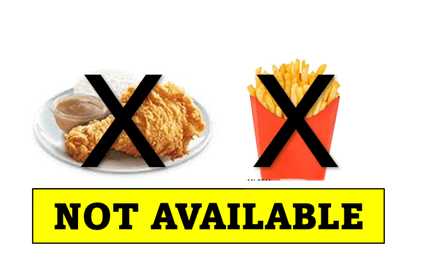
I went to a newly opened convenience store one Sunday morning.  I wanted to buy a siopao (an oversized steamed dumpling).  Despite the advertisements posted, the store attendants said there was no siopao available.  When I looked for a hotdog sandwich instead, the attendant also said there was none.  I ended up just buying a bottle of water. 

The convenience store attendants said that the central warehouse that supplies all the store branches had not yet delivered the items they requested and thus, they were unable to restock the shelves.  The attendants, however, were not apologetic and they just shrugged their shoulders when I asked when they would receive their items.  The attendants didn’t know, and they didn’t care.  I left the store with a bad impression and I had been reluctant to go back to the store ever since.  Meanwhile, the president of the convenience store company brags on social media that their business has been growing rapidly. 

The convenience store failed to fulfil my demand.  That was obvious.  It didn’t make available the items as advertised.

The question is:  who’s at fault?  Is it the store, the warehouse that supplies the store, or the vendor that delivers to the warehouse? 

The answer to the question is: all of them.  The store, the warehouse, and the vendor are links in the supply chain and they each are responsible in fulfilling the demand of the consumers at the end of the chain. 

But as much as we may blame all three for any fulfilment failure, solving the issue starts with all three working together to see what went wrong. 

2. The Case of the Cancelled Flight:

My sister-in-law booked a flight from Manila to Taipei on New Year’s Day.  She checked in at the airline counter at 10am for a 12nn departure.  But an equipment failure at the airport’s traffic control centre at 9:45am forced her and all other flights to be delayed indefinitely.  The airline insisted she and the other passengers wait.  She decided to cancel and rebook.  The airline’s ground staff helped her reclaim her luggage and exit the airport.  I picked her up from the airport arrival area and she was able to depart the next day to Taipei. 

My sister-in-law was very impressed with the assistance of the airline staff.  Aside from the help they gave to speedily leave the airport, the ticketing call agents were fast in finding another flight for her to rebook and leave Manila for Taipei the next day. 

It wasn’t the airline’s fault that the air traffic control system failed that New Year’s Day but the staff did all they could to assist the passengers.  The airline, however, didn’t notify passengers of the equipment failure and possible flight delay as the latter were checking in.  And the airline didn’t tell passengers until hours later (and hours after my sister-in-law left the airport) that their flight was cancelled. 

Airlines have a basic demand fulfilment mission:  fly passengers to their destinations.  Airlines, however, are at the mercy of disruptions beyond their control.  Bad weather and air traffic control glitches can ruin any flight’s schedule and airlines would be unable do anything about them. 

But airlines can mitigate the impact via the services and support they can provide and have control over.  As much as we passengers just want to go wherever we are going at the fastest means possible, we also want our travel to be convenient.  We want to book & get our tickets easily, we want to ride in planes with comfortable seats, and we want to be informed about any changes.    

Demand fulfilment in air travel isn’t just about conveyance, it’s about the process of conveyance meeting the terms & conditions of what the airline advertised and in the ticket we bought.  Airline tickets dictate limitations in case of disruption, but they also advertise comfort and service.  We as passengers therefore expect that comfort and service to include some support & up-to-date information when our flights get cancelled. 

3. The Case of the Suit That Wasn’t Done and Wasn’t Needed

I went to a clothing alteration shop to have my suit re-fitted.  The tailor said he can have my suit altered and ready in ten (10) days, which would be on a Friday.  I said that was all right as I told the tailor that I would need the suit two (2) days from then, a Sunday, to wear in a wedding I will attend.  I advanced my payment and promised to be back in ten (10) days.  I caught the CoVid virus, however, and because I was ill, I was unable to get my suit that Friday, ten (10) days later, and I did not attend the wedding the following Sunday.  When I went to pick up my suit on Monday, the tailor said the suit was not ready.  He never worked on it at all. 

I didn’t need my suit anymore, so I no longer needed my suit to be altered.  The tailor didn’t have enough cash to refund my advanced payment, so we ended up agreeing to have the suit altered anyway.  In a week, I had my suit altered and returned.

The tailor failed to serve my order but did I deserve a refund? 

As a customer, I believe I did deserve a refund even if I no longer had demand for an alteration of my suit.  I had a pending order and the tailor agreed to the terms & conditions and schedule for service of the order.  He didn’t fulfil the order such that I didn’t get my money’s worth from the advance payment.  It doesn’t matter that I no longer needed my suit; the tailor didn’t meet his end of the bargain. 

But as much as there was failure on his part, the tailor made the effort to negotiate and offer to do my suit within a week.  He also offered to alter any other attire I may bring to his shop equivalent to the value of my advanced payment.  It didn’t make up for his failure to serve my order but I did appreciate his offer.  We ended up settling to just have my suit altered anyway. 

Demand fulfilment success, from our perspective as customers, depends on three (3) factors:

  1. on-time & complete delivery
  2. product quality
  3. service

In all three (3) aforementioned cases, the suppliers failed to deliver. 

The convenience store in Case #1 failed to deliver and didn’t really do much more for me, the customer. 

In Case #2, the airline’s ground staff assisted my sister-in-law when her flight was cancelled but the airline could have done better in the way of notifications and information.  The airline didn’t really provide convenience for their customers, which they constantly advertised.    

In Case #3, the tailor offered to alter my suit within a week or alter any of my other attire to make up for the value of my advanced payment.  He could have simply returned my suit and told me to come back to get a refund.  Instead, we negotiated for a compromise in which both I and the tailor came out satisfied. 

Demand fulfilment, indeed, can be complicated what with we as customers look for and the disruptions & limitations we and our suppliers experience. 

We may not be perfect when we as suppliers fulfil our customers’ demands.  We may not deliver completely and on-time all the time and we may have issues with disruptions that affect the quality of our products & services, but we can make it up or at least mitigate our imperfections via the services we provide and which we agreed with our customers.

It’s not so much as going out of our way to help our customers when there are failures in fulfilment.  Sometimes, just doing what we are supposed be doing as we agreed and advertise can be enough. 

About Ellery’s Essays

Demand Fulfilment Begins Before the Order, Not After

As managers of our enterprises. we entice our customers to select our products & services.  Once our customers show interest in the items we are selling, the demand creation process comes closer to ending, and the demand fulfilment comes closer to beginning.  Hence, we don’t wait for customers to order when we start the fulfilment process.  We act to make available our products and services as soon as customers indicate their preferences for them. 

Customers (i.e., clients, buyers, patrons) show preference for our products and services in different ways, depending on the business we’re in.  Examples are:

  1. contracts, or written agreements;
  2. requests for quotations;
  3. items in online shopping carts;
  4. a shopping list of groceries
  5. a winning bid for a service or product. 

When customers choose the items we are selling such as via these examples, our job as operations managers is to make those items available.  We do so first and foremost via planning. 

Planning involves the scheduling of production and services, the procurement of requirements such as materials, labour, & supplies, and the preparations for needed operating capacities. 

Planning is not dependent on orders, which are final manifestations of the customers’ choices for our products and services.  The purpose of planning is to anticipate the orders and make ready the products & services consistent with the terms & conditions of the customers’ orders. 

Planning speculates on the actual demand manifest by orders; hence we tend to build in allowances or contingencies.  When it comes to tangible products, these allowances or contingencies are in the form of inventories.  When it comes to services, these allowances or contingencies come in the form of preparations of resources such as labour, equipment, utilities, and supplies. 

In the fast-moving consumer goods (FMCG) industry, companies would rely on demand forecasting or market research surveys of consumers.  The companies would produce and stock items at the shelves of retailers such that consumers can immediately avail of products.  Success in FMCG demand fulfilment therefore depends on the complete availability of items that the FMCG is selling.  Out-of-stock and the consumer’s inability to avail the item is a lost opportunity as much as it is a failure to fulfil demand. 

Managers of job shops, like woodworking and machine shops, would stock up on raw materials such as lumber and steel bars based on the requests for quotations of potential customers.  Quotations would include the times of availability as much as it would include the prices and quantities of the items customers are requesting quotations for.  Lead times of job shops are significantly shorter when they have the raw materials ready once customers make their orders and this can be competitively advantageous versus rival shops who procure materials only when they receive orders. 

Utility companies, like those which distribute electricity to consumers, forge contracts with power generation enterprises.  The utility companies look at trending demand and negotiate agreements for the supply of power to their grids.  The utility companies would agree to a minimum power supply available during the day and pay for it regardless of whether their consumers use all the electricity or not.  On one hand, utility companies would like to ensure consumers have electricity at the flick of a switch; power failures are not an option.  On the other hand, the utility companies would want to minimise any excess unused power they would have to pay for and avoid having to pass it on to consumers sensitive to what they would be charged for.   

Online sellers of tangible products like groceries and hardware invite and accredit multiple vendors to ensure there would be a high chance of items available for buyers who likely would instantly order.  Online sellers also monitor the online shopping carts and wish lists of buyers who have yet to click the order button.  The data from these yet-to-be-purchased items provide some basic information on future demand. 

Demand fulfilment begins as soon as our customers indicate a preference for our products and services.  We don’t wait for orders.  We plan materials and operations as we await the orders which we believe will be coming.  We do speculate what we think customers will order so we build in contingencies and allowances, such as inventories for tangible items and labour & supplies for our operations. 

How we plan varies from industry to industry, enterprise to enterprise, but in a nutshell, we anticipate the orders from the contracts, the market research surveys, and the quotations which our customers request.  We then prepare for the orders and fulfil them completely and on-time to what our customers expect, and much better than what our rivals would. 

About Ellery’s Essays

The Order-Winning Operations Strategy

We, whether we are executives, entrepreneurs, or employees, face challenges and disruptions every day.  Most of us have goals or at least have things we want to realise or get done.  We hate it when we run into obstacles.  We therefore develop strategies to anticipate and overcome them, if not get around them.

Goals are what we keep an eye on when we work.  Otherwise, we risk becoming aimless.   One thing we shouldn’t be is lost. Getting lost is not a good thing.  Imagine finding ourselves lost in a forest.  We don’t know where to go, what to do, and night is coming.  Fear sooner than later sets in.  It’s not only an unpleasant fear that takes hold of us but also the sense of futility as we expend whatever we have left trying to get out.

For many months from early 2020 to late 2022, we had been lost in a forest of fear, futility, and frustration from the coronavirus pandemic and subsequent disruptions caused by wars, natural disasters, political strife, and inflation. 

Like a broken record, we had experienced waves of bad news about supply chain shortages, transportation delays, inventory overruns, out-of-stock, and tighter trade policies.  We also felt the despair of enterprise owners who had to throw away rotting fruits & vegetables, cull sick livestock, dispose excess vaccines, lose precious cargo from ocean-freight mishaps, deal with labour conflicts & understaffed organisations, comply with stricter laws, and resign to runaway prices of just about everything. 

Many of us were fire-fighting crisis after crisis in supply chains that had become burning platforms.  We felt we were in an unwinnable battle. 

To win in a game like chess, we should first gain the initiative.  We should be calling the shots, not taking them.  We should always have the upper hand. 

Many of us don’t have the upper hand in our supply chains and we suffer as a result.  And a reason for this is we don’t have an operations strategy, an order-winning operations strategy

An operations strategy should win orders, not just qualify for them. 

We fashion our operations strategies based on what our customers want.  We first make sure our operations will qualify, that is, meet prerequisites & standards set by customers, clients, industrial groups, agencies, etc. 

The common mistake we make is we end there.  We formulate strategies to qualify, to comply, but we don’t formulate strategies to win repeat orders, to generate new demand. 

The ideal operations strategy not only meets customers’ requirements but also pleases the people served such that we become the preferred suppliers.  The operations strategy doesn’t close the cycle of demand creation to fulfilment but instead, regenerates it. 

An order-winning operations strategy addresses six (6) competitive priorities, or those that contribute directly to value for customers, clients, and end-users: 

Delivery deals with the timeliness and completeness of demand in terms of product volume or services rendered. 

Quality is the level of satisfaction of specifications or standards agreed to with customers.

Cost is the expense for resources, activities, overhead, and capital investments that contributes to the value of products and services. 

Service is how well we adapt and respond to customer needs.   It’s not to be confused with services in the delivery of products.  It pertains to how we communicate with our customers, responding to changes in requirements, and in how we tailor our items toward specific needs. 

Risk is our level of readiness and responsiveness to disruption, those that not only originate particularly from adversity but also those that result from any abrupt unexpected change in our surroundings.  Risk expands from the management of safety & security to anything that potentially challenges our status quo. 

Environmental-Social-Governance (ESG) is about sustainability and being ethical in the things we do.  It’s how we manage limited resources and collaborate with communities in ensuring mutually beneficial relationships. 

It is from these six competitive priorities that we formulate the operations strategy, one that not only qualifies us to customers’ expectations but also wins their favour. 

The operations strategy puts together our offensive plan to overcome obstacles and win repeating demand from customers, which manifest in more orders.  It is the compass and the lamp that provides direction when we feel lost. 

About Ellery’s Essays

Formulating the Operations Strategy

Every enterprise has a strategy.  Not all have an operations strategy. 

A strategy is not a vision nor is it a mission.  A strategy is also not a goal and nor is it an action plan. 

A vision is a desired future state.  Where do we want to be 1 to 5 years from now?

Example:  We want to be a publicly listed corporation that sells a billion dollars of widgets annually. 

A mission is a statement of purpose. What is it that we do or want to do?  What and who for? 

Example:  We sell state-of-the-art widgets for families to use to clean their homes.   

Goals are objectives and targets.  They are accomplishments we aim for on the way to meeting our missions and fulfilling our visions. 

Example:  We will sell a million dollars of widgets in the first year of our business. 

Action plans are the things to do, the steps to achieve goals.  They are defined methods to get something specific done by a certain time by an individual or group. 

Example:  The marketing team will finalise an advertisement proposal for approval by Monday

A strategy is a game plan.  How are we going to do the mission and achieve the vision?  Strategy narrates the how in getting what we want and to where we want to be.  How are we going to make our dreams come true?

When we do a strategy, we outline a methodical plan that considers challenges and realities.  As visions describe our dreams, strategies bring us back down to Earth. 

A strategy is the path we take to reach milestones and achieve our goals on the way towards fulfilling our vision, mission, and ultimate objectives.  Milestones are the points on the strategic path that tell us how far we’ve reached towards our vision, our destination.  Goals are what we aim to achieve or attain at every milestone we reach. 

Selling a million cases of product, for example, is a milestone.  Selling a million cases of product at 10% profit margin is a goal.  The next milestone could be selling two (2) million cases.  Selling two (2) million cases at a 12% profit margin one (1) year from the first milestone could be the succeeding goal. 

We can reach a milestone but don’t meet a goal.  If we sold a million cases at 5% profit margin, instead of the targeted 10%, we didn’t meet the goal.  We’d have to do better before the next milestone and goal of two (2) million cases at 12% margin.  If we believe it’s too hard, we’d have to revise our strategy. 

We formulate overall strategies that cover functions such as marketing, finance, operations, and people—the four basic (4) pillars of management.  Aside from these, we may have strategies for research & development, engineering, sustainability, and governance. 

For those of us who are entrepreneurs, we tend to break into our markets by first and foremost developing marketing strategies.  Naturally, this is because we want to seize market share and grow sales quickly as we start up our businesses.  Strategies for finance and people would follow as we accumulate wealth and grow our organisations. 

What often is last on our list in strategic planning is operations.  Sometimes, we don’t even form one.

Operations consists of those activities that fulfil demand.  Whereas marketing works toward creating or generating demand, the operations function is about fulfilling it.  Fulfilment happens when the segment of the trade the enterprise serves expresses satisfaction and an ongoing preference for its products and services. 

The operations strategy is not a mere offshoot of an overall strategy.  It is not subordinate to marketing or the other pillars of the business. It’s a key component in which without it, the strategy becomes incomplete and meaningless. 

Some of us treat operations as subservient to sales, finance, marketing, and research & development.  This is specifically typical when we sell in competitive markets such as consumer goods, insurance, and banking.  But it can also be prevalent in industries which are heavy in operations. 

An energy generation corporation, for example, emphasised financial performance even though it was heavily invested in operations to source fuel and generate electrical power.  Management’s mandate for operations was to scrimp on expenses to maximise profits.  The corporation’s purchasing department, therefore, favoured cheap supplies and parts which resulted in frequent equipment breakdowns. 

A conglomerate that manufactures an assortment of appliances, industrial equipment, and elevators had detailed strategies in selling and marketing but very little in demand fulfilment.  The company mandated lower costs in its operations but neglected action on inventory management and customer orders processing.  To this day, it has a warehouse full of non-moving equipment & parts that have become obsolete and ripe for scrapping. 

An absence of an operations strategy causes the enterprise to react to demand, not plan for it.  It’s one thing to market products & services and attract customers; it’s another thing to serve them. 

The method to make an operations strategy does not differ from that of formulating an enterprise’s overall strategy or those for marketing, finance, and people.  The operations strategy narrates how we will fulfil demand consistent with the provisions of the overall strategy. 

For most products and services, a supply chain strategy is the best model for an operations strategy.  Supply chains encompass all the activities from the procurement of raw materials at their origin to the deliveries of products & services to end-users. They cover all enterprises, from vendors, manufacturers, traders, retailers, to delivery services.  A supply chain strategy considers all parties and thus consists of not only how we manage our internal operations but also how we collaborate with those that we transact with. 

Operations strategies vary per the products and services of different enterprises in different industries, and to the manner of marketing each enterprise undertakes.

An operations strategy of a multinational consumer goods corporation, for instance, may focus on a build-to-stock strategy, in which operations gear towards buying materials and mass-producing & distributing products to build inventories that ensure items will always be available. 

On the other hand, a small upstart enterprise may resort to same-day deliveries of food and non-food items via customers ordering through an e-commerce portal or smartphone app.  The upstart enterprise would procure goods that match demand to save on working capital and conserve cash.  The upstart enterprise would compete with established multinationals via price and speed of delivery. 

An important facet of the operations strategy is its comprehensiveness.  The operations strategy is effective only as far as its coverage.  Leave an activity out and the operations strategy would be deemed incomplete and in risk of failure. 

For example, a dental laboratory has an operations strategy that stresses product quality excellence.  The laboratory’s organisation from the technicians who painstakingly assembled dental products to the general manager who personally inspected and approves every finished product for shipment made sure that every item delivered will meet customer specifications.  The laboratory’s strategy, however, failed to factor in maintenance of its facilities.  Air-conditioning and machines broke down and caused downtime and delays in operations.  As much as the laboratory made excellent quality products, it suffered cost overruns in repairs. 

The operations strategy lays the foundation for policies and procedures in the demand fulfilment activities of the enterprise.  Policies in inventories, customer services, and quality assurances stem from the operations strategy.  They provide guidelines for operations professionals in their day-to-day decision-making.

The absence of a clear comprehensive operations strategy practically explains why our supply chains get messed up whenever there are disruptions.  An operations strategy is after all a plan for progress in anticipation of challenges.  Many of us have lost a lot of money because we didn’t develop operations strategies. 

Every enterprise has a strategy.  Strategies are methodical plans that answer how we will execute our mission, accomplish its objectives, and realise our vision.  

Operations strategies differ from enterprise to enterprise, industry to industry.  They rank just as important as those for marketing, finance, and people. 

We cannot have a strategy without provisions for operations.  An operations strategy at least should mention how activities to fulfil demand will be structured, developed, supported, and executed. 

When we make an operations strategy, it is highly recommended we consider the supply chain operations we oversee and relate with. 

It should encompass everything that directly involves the fulfilment of demand. 

About Ellery’s Essays

Dissecting Demand and Its Four (4) Stages

What do we think of when we discuss demand?

We tap it, capture it, deliver it, and get people to pay for it, but do we really know what it is? 

We equal demand with how long a line is at a restaurant, or by the sheer number of customers at a shop.  We say a product is in high demand when it is chronically unavailable at a store or by the higher price it fetches versus rival items. 

We categorise demand by how many items we sell or ship.  The higher the sales; the higher the demand. 

We see demand as a need.  We need food, water, companionship, and health care.  When we need to be satisfied, we demand it. 

We base demand on surveys and try to rationalise it with mathematical and economic algorithms.  We put trust in market research studies that determine what people seek. 

We talk a lot about demand, but we define it differently.  And because we define it differently, we manage our businesses differently. 

Some of us who are enterprise owners wait for demand to happen.  Supermarkets, for example, wait for shoppers to buy items off the shelves.  Retailers count on customers walking into their stores to buy items on display. Hospitals and clinics wait for their patients who seek medical assistance. 

Some of us chase demand.  Peddlers go door-to-door to sell their wares to would-be buyers.  Some send spam email or text messages to push their products, hoping a fraction will get interested and buy. 

Some of us attract demand.  Soft-drink producers pitch different variants of drinks (e.g., sweetened, no sugar, non-calorie, caffeinated) in the hopes people will find favour with their products and choose them when they shop.  Fashion companies periodically offer new clothes styles & designs to woo people to buy and wear.

Some of us create demand.  We invent items we hope people will want or need.  We didn’t think of needing personal computers before the 1960’s, before Olivetti manufactured the first desktop computer.  We really got interested when IBM in 1980 introduced its desktop computer with the Windows DOS operating system.  More than forty years later, we can’t imagine living without computers and the technologies that came with it (laptops, tablets, smartphones, the Internet). 

What is demand, anyway? 

The dictionary defines demand as:

  1. An urgent requirement;
  2. The desire and means to purchase goods;
  3. The amount of goods purchased at a specific price;
  4. The state of being wanted for purchase or use.

As a verb, demand is wanting or needing something.  As a noun, demand is the amount or quantity of what we want or need. 

For those of us who are businesspeople, demand represents what and how much people want, need, and pay for.  Demand is what our businesses depend on for revenue, income, and growth. 

We seek demand from the market, that community of people who are the potential buyers of our products & services.  We persuade people of the market to pick & buy our items.  We call it marketing and it includes the activities of inventing, advertising, promoting, peddling, and displaying our items, in which we aim to realise demand. 

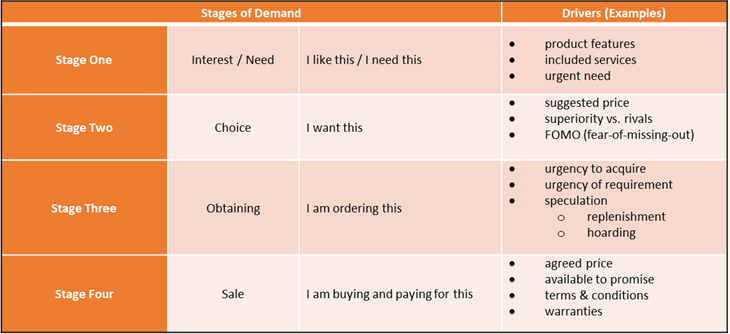
Demand begins with interest or urgent need, proceeds to choice, and moves to the act of obtaining.  It starts with “we like this” or “we need this,” to “we want this,” to “we will buy this.”  Demand does not end, however, with the customer’s desire to buy an item; it ends with the sale, the customer’s purchase, payment, and gaining possession & ability to consume or use of the item: “we are ordering this item,” “we are obtaining the item,” “we are using the item,” and “we are paying for the item.”

Marketing is about getting people to choose an item.   Sales is about getting people to buy, pay, possess, and use the item.  We call this process of marketing to sales: demand creation.  We generate demand from the market we target and translate it into sales. 

We get confused with defining and measuring demand when we are not clear which stage of the process we are talking about.  What a customer prefers (we like this) is not the same as how much a customer will buy (we are ordering this).  And what a customer may want to buy is not a sale, at least until it is paid for.  If a customer returns an item, the sale is for naught.

Each stage of demand has its own set of drivers.  A driver for demand by interest (we like this), for instance, would be a product’s features (e.g. a high-resolution camera in a smartphone).  Drivers for choice would include the offered price and an item’s superior advantage over rivals.  Drivers to obtain an item would include the customer’s urgency to acquire or satisfy a requirement.  And drivers to close the sale would be the finally agreed price, delivery promise, and agreed-to terms & conditions. 

Knowing demand at every stage is beneficial to how we manage our businesses. 

Case in Point:  Ferrari

Ferrari knows that many people like their sport cars.  Just about every young car enthusiast would just love to have a Ferrari sports car.  Demand based on preference (I love this) therefore would be very high.  But because most young drivers can’t afford Ferrari sports cars, demand in terms of choice (I want this) would be much lower.  Sales therefore would be a small fraction of how many interested people there are to own a Ferrari. 

Ferrari wouldn’t lower prices or raise production capacity to boost sales; it would rather limit availability and keep prices high.  Ferrari knows that as long as there is a large preference for its cars, it would be able to sell cars to a certain few who would choose, wait, and pay for them at a very high price (and at a very high profit margin for Ferrari).   

Case in Point: the Kornik Vendor

A vendor on a busy Manila street sells kornik, a Filipino snack food made from deep fried corn puffs.  The vendor hands out free samples and counts on passers-by to like and buy his cooked kornik, which he sells in small bags.  For so many years, even through the coronavirus pandemic of 2020 to 2022, people, both regular customers and new, have bought dozens of kornik bags from the vendor. 

The kornik vendor competes with many rivals near and far from him.  Steady demand for his kornik is due to its taste which his customers very much prefer (I like this) and the price which can go as low as PhP 20 (40 US cents) for a small bag (I will buy this).  The vendor cooks his kornik via his own recipe and counts on people preferences to continually buy his product. 

Case in Point:  The Electric Company

Before we can use the electricity in our homes, we likely need to apply to an electric utility company to get connected to the power grid.  In some countries, we can choose which electric company to source our electricity from.  We can prefer, for instance, a company that is tapping renewal energy (e.g. solar, wind) or one that uses cleaner fuel (e.g. natural gas vs. coal). 

The process of demand for electricity, thus, can begin with preference for what energy company or source (we like this), to choosing the company (we want this), to the processing of our application for an electric connection (we are ordering this much electric load capacity).  The actual sale happens when we use the electricity (i.e., turning on lights & appliances). 

The electric company would estimate demand from what energy sources customers prefer and how much load they would be applying for.   The company will invest in facilities and negotiate supply contracts based on that estimated demand.

Case in Point:  The Prescription Drug Business

When we have an ailment, we go to our doctor who often prescribes us medicine to buy from the drug store.  As the doctor’s prescription dictates the details of what drug to buy, we usually just go straight to ordering the item we need.  We hardly think about preference or choice; we just fill the prescription and hope for medical relief or cure. 

Drug companies peddle their brands and products to doctors and not patients.  The first stage of demand creation when it comes to prescription pharmaceuticals is getting doctors to like the drugs the companies are marketing.  Doctors then prescribe their preferred medicines to their patients.  Succeeding demand stages follow with their patients’ purchases at the drug store. 

Because we define demand differently, we manage our businesses differently.  Demand varies depending on what stage it’s in, from interest or requirement (we like this, we need this), to choice (we want this), to intent to obtain (we want to buy this), to the sale (we are ordering, availing, and paying for this). 

Each demand stage has its drivers which influence how we market and sell our items to potential customers. 

The stages of demand and how we translate them to sales make up the process of demand creation.  It lays down the path to the next step:  demand fulfilment

About Ellery’s Essays

Compliance is Not Service

Every year, banks notify us that we need to update our background information for the accounts we opened and deposit our money in.  They say it’s a rule of the Bangko Sentral ng Pilipinas or BSP, the governing monetary authority of the Philippines, where I live & work.  All depositors must comply to enjoy the bank’s customer services.    

That’s not true, of course.  The BSP does not require banks to compel their clients to update the latter’s records every year.  It is the banks who make such rules which probably originated from their overly cautious legal departments which are then approved by their boards of directors. 

Banks tell us that the updating of records will improve their services.  This is also not true.  It’s the other way around.  If we don’t update our records, the bank threatens to make it hard for us to enjoy their services. 

The updating of records is a burdensome & time-consuming task.  There are always so many requirements to work out.  Documents must be signed & submitted.  For corporations, notarised certificates & resolutions are needed.  It can take up to a month to get all the stuff together.  But the banks don’t care.  They insist their clients comply, or else. 

Banks compel clients to update records because they fear liability if scammers steal from their depositors’ accounts.  The updating of records strengthens security measures such as the depositors’ authority for withdrawals and the verification of signatures.  Banks would rather put clients through the inconvenience of updating records than to risk security breaches in financial transactions.  Scammers and fraudsters are the reasons why institutions such as banks, push for compliance. 

Compliance is not service.  As much as banks & institutions try to spin compliance as a way of getting good service, it’s not. Whatever benefits there are in complying with whoever’s rules, we as clients don’t get them; the banks & institutions only do. 

Compliance is beneficial to the banks, or in general, to the enterprises or institutions mandating it.  Service, on the other hand, is for the benefit of clients or customers, aligned with the fulfilment of our needs & wants. 

When enterprises or institutions, such as banks, require compliance, they impose burdens on us as clients on top of whatever we already are paying for in prices or fees.  We can say that the work we put to comply is a hidden charge tacked on to whatever we’re paying for. 

Many enterprises & institutions give a lot of lip service when they say they prioritise service above all else.  Nothing could be further from the truth.  They don’t.  They treat customers like us as nothing more than numbers for statistical measures.  Banks see us as account numbers.  Airlines see us ticket numbers or as boarding passes.  Governments see us as taxpayers with identification codes (e.g. tax IDs, social security numbers).  We are just shopping carts of items at grocery check-out lines. 

Entrepreneurs have capitalised on poor customer service as they break into markets traditionally held by big business firms.  They do so via innovative strategies that get around the barriers the big businesses put up to keep rivals out. 

Small upstart banks, for example, have grown big for putting customer service first over compliance.  One bank, for example, reduced the number of requirements for compliance while another offered the service to assist clients in preparing and picking up the needed documents.  Another bank waived fees for online transfers and added tellers to shorten the waiting times of depositors.  These banks grew as clients appreciated the extra mile they invested in for service; some have beaten rivals who refuse to prioritise service over compliance. 

But it’s not just banks where entrepreneurs innovate. 

The Zoom app for virtual conferences gave us the opportunity and option to not having to go through the inconveniences of air travel to meet with counterparts at different locations. 

Ride-sharing services such as Uber, Lyft, and Grab broke the monopolies of taxicab companies & traditional couriers in major cities thanks to the conveniences they provide via their mobile apps and their quick service. 

The start-up e-commerce fashion company, Shein, became a worthy challenger to Zara and Uniqlo via its low-price offerings of various items coupled with fast delivery services. 

When businesses like banks become big, they tend to sacrifice service for compliance to rules that benefit them more than us, their clients.  As much as they may try to rationalise, compliance is not service.  We as innovative entrepreneurs recognise this and capitalise on this.  We as customers won’t hesitate to switch the moment we could when someone else offers less of a burden for the services we insist on. 

About Ellery’s Essays

The Supply Chain Orchestra

In August of 1990, Iraq invaded Kuwait.  The United States of America led a coalition of nations to counter the invasion via a military campaign that started with Operation Desert Shield and then with Operation Desert Storm

In November 1990, General Fred Franks, Jr., commander of the US Army VII Corps, deployed the Corps’ five (5) army divisions and support groups to Saudi Arabia, to prepare for an offensive into Iraq and Kuwait. 

It was a deployment that was far from perfect.  

The VII Corps encountered a slew of issues as it deployed to forward bases in Saudi Arabia.  There were delays in transportation of supplies and troops from Europe.  Soldiers, supplies, weapons, and equipment got stuck in traffic snarls at ports.  Troops received the wrong camouflage uniforms.  Tanks, trucks, and spare parts were mixed up during shipment such that logistics officers had to sort them out upon arrival.[i]

The deployment of the US VII Corps can be likened to moving a small urban city to a different country thousands of miles away.  The Corps had to move almost a 150,000 men & women, 1,487 tanks, 1,384 infantry fighting vehicles, 568 artillery pieces, 132 multiple rocket launchers (MLRS), 8 missile launchers, and 242 attack helicopters. Logistics commanders had to synchronise and transport aircraft such that the divisions that left from their point of origin would swiftly deploy as soon as they arrived at their destination. 

General Franks and his logistics commanders got the job done despite the snags and their soldiers were ready to attack by February 1991.  Within a few weeks, the VII Corps all but annihilated the Iraqi opposition. 

One of the lessons learned from the deployment of the VII Corps in the Gulf War was that for it to be successful, there had to be synchronisation and collaboration.  No matter how much planning was put in, if stakeholders don’t sync and collaborate, any operation would fall apart. 

We invest a lot into the operations of our businesses.  We buy state-of-the-art enterprise resource planning (ERP) systems.  We hire talented people.  We build warehouses and factories.  We invest in what we believe are the most efficient and cost-effective equipment. 

With all the talk about artificial intelligence, automation, and e-commerce, we are contemplating further investments into more technology to make sure our supply chains will continue to run well and contribute to our businesses. 

Supply chains, however, don’t run well just because they have the latest technologies.  They run well when functions like procurement, manufacturing, and logistics synchronise harmoniously and actively collaborate between themselves and with their links, that is, vendors, customers, 3rd party service providers, and the other departments of the enterprise (e.g., finance, human resources, R&D).    

Harmonious synchronisation and active collaboration are two must-have characteristics of a successful supply chain.  Getting to demonstrate them requires not only capable structures and systems, but also a great deal of preparation.

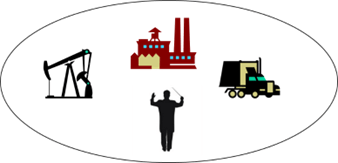
Supply chains are like musical orchestras.  For an orchestra to successfully perform at a concert, it must not only play good music but also prepare well. 

An orchestra preparing for a concert is very challenging, more so at times than the performance itself.  There are the auditions to select the musicians, the tuning and maintenance of instruments, the rehearsals, the checking of acoustics & sound systems, the lighting & ambience of the venue, the marketing & selling of tickets, the ushering of the audience, the catering of food & beverages, the accounting & finances, and even the negotiations & legal reviews of contracts & agreements. 

How well an orchestra prepares itself determines how well it will perform.  All the preparations that go into a concert must lead to successful results in six (6) categories:

  1. The successful execution of the music (delivery);
  2. A performance the audience delights in (quality);
  3. Expenses that didn’t exceed the budget (cost);
  4. Comfort and convenience enjoyed by the audience (service);
  5. Safety and security throughout the preparations & performance (risk);
  6. Compliance to regulations & good relations with local communities (environment-social-governance [ESG]);

Supply chain management covers these same categories and calls them competitive priorities, in which we perform vis-à-vis the successful execution of the enterprise’s operations strategy.  Delivery, quality, cost, service, risk, and ESG are our modern-day priorities in our highly competitive and challenging world. 

Supply chains are like orchestras.  They need to be prepared to operate harmoniously and to do that requires management via synchronisation and collaboration.   It requires the engineering of systems and structures to become capable to sync and collaborate effectively. 

We, however, often fall into the trap of managing each category separately.  We set up, for example, separate departments for delivery, cost, quality, risk, and services.  And we sometimes pass on the responsibilities of ESG to someone else not in the supply chain.  When we delegate any of the six (6) categories, we end up arguing for one category’s importance over another.  We end up fighting each other rather than working together for all.  Synchronisation and collaboration go out the window. 

It is therefore important to have structures and systems that would bring about synchronisation and collaboration.  Building these structures and systems do require some engineering and when they are set up, would still require much in the way of preparation, such as hiring the right people, purchasing the best equipment, and planning the correct policies. 

The individuals of an orchestra work together.  They collaborate and they synchronise.   What matters is the orchestra gets their desired results manifested in an audience happy with the performance. 

Gen. Franks led like a conductor of an orchestra. He and his staff were successful because they stayed on top of the situation in real-time and persisted to synchronise and collaborated with all parties involved.  Everybody played their part, and they got what they wanted and more so. 

So must we when we manage our supply chains.  No state-of-the-art artificially-intelligent automated-robotic system can substitute for the engineering of capable structures & systems that lead to synchronicity and collaboration in the pursuit of meeting our priorities. 

We are the conductors of our supply chains as well as we are the builders of them. 

About Ellery’s Essays


[i] Tom Clancy with Gen. Fred Franks, Jr. (Ret.), Into the Storm, A Study in Command (New York: Berkley Books, 1997), Chapter 8.

Developing the Right Demand Fulfilment Strategy

A large fast-food chain hired executives from a fast-moving consumer goods (FMCG) multinational.   The owners of the fast-food chain wanted the best and the brightest and they thought that the former executives from the multinational FMCG would best meet their expectations. 

They were almost right.

The former executives spent a lot of time revamping the fast-food chain’s marketing strategy.  They introduced changes in the menu, renovated branches, as well as added new ones.  They also initiated an aggressive advertising campaign to combat the competition.

The executives’ marketing strategy resulted in higher sales growth and gains in market share, to the extent it became the number one fast-food chain in the country. 

The chain’s branch operations were deemed efficient. Employees served customers within a few minutes.  To further improve operational efficiencies, executives invested in a new information system to integrate branch operations with the commissary and the finance department.  They thought that a new information system would streamline communications between the branches and the commissary, which would result in reduced waste and lower costs. 

Within weeks of implementing the new information system, the chain was in crisis.  The commissary complained the information system was slow and complicated to use, which resulted in delays in deliveries to branches.  Branches ran out of food and ingredients, and they were unable to serve customers looking for their favourite items.    People complained in social media about the fast-food chain’s poor service. 

The executives temporarily closed the fast-food chain’s branches for a week.  Officially, they blamed shortages in supplies from vendors.  The real reason was they used the time to fix the information system.  When the fast-food chain resumed operations, services were a little better.  But some items occasionally went out of stock.  Competition, meanwhile, picked up market share and the fast-food chain had to market aggressively to regain what they lost.      

We have two (2) tasks as managers of our enterprises:

1) create demand;

2) fulfil it.

We can’t do one without the other.  We cannot survive just by creating demand without fulfilling it.  And we cannot fulfil demand that is not there in the first place. 

Demand creation is about convincing a targeted market to choose an enterprise’s products and services.  The aim is to not only sell to obtain revenue but also to persuade people to prefer its products and services. 

Demand fulfilment occurs when the enterprise satisfies the demand created.  It is not only about delivering products & services to customers completely and on-time.  But also, it is about end-users availing of the enterprise’s products and services, utilising them, benefiting from them, and compensating the enterprise for purchasing them.  Fulfilment happens when the segment of the trade the enterprise serves expresses satisfaction and an ongoing preference for its products and services. 

Demand creation to fulfilment is a cycle which taps the drivers to enable continuity.  Marketing managers work to create demand.  Operations managers work to fulfil it. 

Most of us may have a comprehensive demand creation strategy but chances are we don’t have one for demand fulfilment.        

The newly hired executives of the fast-food chain transplanted marketing strategies from their experiences with their previous FMCG employer.  The new executives felt what worked at an FMCG company will also work for the fast-food chain. They implemented a successful marketing campaign that created demand.  Unfortunately, their also-transplanted fulfilment strategy fell flat, resulting in a reversal of demand, not to mention costly losses.    

The FMCG executives the fast-food chain hired thought that a simple transplant of strategy from their former employer would work.   But fast-food isn’t FMCG.  While they may have succeeded in demand creation, they didn’t in fulfilment.  The cost-centred fulfilment strategy they copied from their former FMCG employer didn’t work for the fast-food chain. 

Our enterprises are as different from each other as every industry is from one another.  While it is true that many of our enterprises have captive markets and sell identical products, such as commodities (e.g. wheat, rice, metals) or offer the same services (e.g. medical clinics, funeral homes, automotive maintenance), our customers will opt for those who can fulfil closest to their preferences, expectations, and at best value for their money. 

Hence, our success counts on the strategies we adopt for demand creation and demand fulfilment. 

It’s easy to transplant a system we’ve been accustomed to a new employer, never mind if the system is coming from a starkly different business.  If it worked where we came from, why shouldn’t it work where we go to?  And because we were the successful experts there, why can’t we also be experts for any new employer? 

Demand creation requires a strategy tailor-fitted to the enterprise’s products and services.  The demand creation strategy must consider a product’s nature, features, and the segment of the market it targets.  Services should be catered to the clients they are specifically for.  The demand creation strategy is therefore unique to the enterprise as it should be.  Successful marketers know this, and we see this in the differences in advertisements and methodologies they execute. 

The same logic applies to fulfilment. It must also be tailored to our products and services. And not just how orders are received, processed, and delivered but also how the supply chains of our products and services are set up and run. 

And transplanting or copying from other industries or enterprises isn’t the best way to manage operations to fulfil demand.

We, unfortunately, don’t develop a demand fulfilment strategy as much as we make one for demand creation.  We believe that fulfilment comes naturally.  Just deliver the goods when there’s an order.  It’s harder to create demand so more resources and planning should be put into it.  Fulfilment is easy and straightforward.  We think that automation and computerisation already are enough as operations strategies.  The case of the fast-food chain shows that this kind of thinking results in messy outcomes. 

The factors that lead to failure in fulfilment include we as leaders not formulating a strategy at all.  We would just tell middle managers to serve orders.  We would sign contracts with 3rd party logistics providers to manage inventories and deliver the goods.  We would leave it up to information technology (IT) vendors to install new computerised systems to automate operations.    In effect, we delegate the operations strategy to subordinates or 3rd parties.  We would focus on creating demand as the one and only important task of the enterprise. 

When it comes to managing the enterprise, we need to have two (2) clear answers to two (2) questions:

  1. What’s the strategy to create demand for our product and services?
  2. How will we fulfil it?

Many of us have succeeded in answering the first question.

And many of us have fallen flat in answering the second.

To develop a demand fulfilment strategy, we just need to start with the demand creation strategy.  And from there, tailor the strategy to the language of its operations.

In FMCG, a demand creation strategy can be marketing low-cost fast-moving consumer goods that meet daily household needs.  The demand fulfilment strategy would be mass producing and deploying finished products that would available everywhere in targeted locales. 

For fast-food, the demand creation strategy can be setting up a network of branches that would serve communities in a wide geographic area that would offer a variety of food and beverages in-store or via delivery.  Demand fulfilment would be via always having in stock ingredients and condiments coupled with efficient serving systems and an organisational structure supported by an always ready and responsive delivery transportation fleet. 

And not just for fast-food and FMCG.  We can tailor strategies of creation to fulfilment to other enterprises as well.  We just have to tie in the cycle of demand creation and fulfilment. 

Demand fulfilment applies to, at minimum, the enterprise’s supply chain, those operations we have influence over.  Ideally, we and our vendors and our mid-tier trade customers (e. g. distributor, dealers) should be enrolled in a collaborative demand fulfilment strategy

The supply chain offers the most splendid platform for a coherent demand fulfilment strategy.  It not only links operations from raw materials procurement, manufacturing, and logistics toward a common purpose but also unites them to execute a fulfilment strategy.  There are no varying goals among functions; everyone has the same idea, same objectives.  

We adapt the enterprise’s operations to the demand fulfilment strategy we develop.  Not the other way around.

For every industry, every enterprise, it’s always the same two tasks.  Create demand; fulfil it. 

We are familiar with creating demand and focus a lot on it.  We, however, neglect the fulfilment of demand by either transplanting it from other enterprises or delegating it to subordinates or third (3rd) parties.  As a result, the demand cycle fails, and we suffer.

Supply chains offer the best platform to develop a demand fulfilment strategy.  It’s applicable to whatever the enterprise, whatever the industry. 

But as much as we may have realised the importance of supply chains, we first need to accept that fulfilling demand is just as important as creating it. 

About Ellery’s Essays

What to Do with Unserved Orders

A global fast-moving consumer goods (FMCG) corporation had set up a contact centre in Singapore to centralise sales orders management in the Asia-Pacific region.  Customers and field sales of the Southeast Asian market of the FMCG company would inquire or send their orders via email, SMS, or via internet calls to the Singapore office.  The Singapore office would screen the inquiries and orders versus available inventories at different distribution centres around the region.  The contact centre staff would edit orders by deleting unavailable items or cancelling any that didn’t meet the corporation’s terms or conditions.

The FMCG corporation was able to fill 99% of orders on-time and completely after the centralisation of order entries at the Singapore office.  There practically were no unserved orders at the end of every working day.  The FMCG logistics team delivered practically all the orders that the Singapore office entered within 24 hours.   The FMCG’s Asia-Pacific executives lauded their order fulfilment performance and boasted to the corporation’s global headquarters.

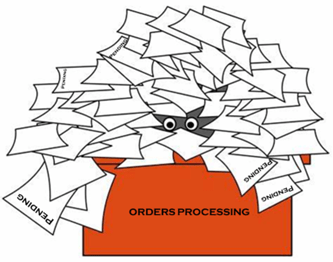
The FMCG corporation’s Singapore order-entry office claimed success in addressing pending unserved sales orders.  In the past, salespeople would submit order after order for items even if some products were not available or even if the account executives were unsure customers would meet sales terms & conditions.  For several years, executives would always see a pile of pending customer orders that remained unserved or waiting for approval for as long as a month.  Marketing executives and salespeople complained about the unserved orders and impatient customers would cancel or penalise the FMCG corporation for the poor servicing of their orders.  The Singapore order-entry office emerged as the saviour that eliminated the unserved order pariah. 

But as the FMCG corporation’s executives patted themselves on the back for the purging of unserved pending orders, many of the company’s customers weren’t any happier.  Customers weren’t getting all the items they wanted as Singapore edited out unavailable items from their orders.  Customers also didn’t like they had to pay for deliveries that didn’t include all the items they asked for.  Some customers as a result shifted to competing brands and the FMCG executives realised too late it was losing market share in some of their best-selling products. 

Pending unserved orders are customer orders that are either waiting to be serviced and delivered and if not, become destined for cancellation.  They could be incompletely delivered orders, or orders just waiting for go-signals for dispatch.  They could be orders waiting for specific instructions to be carried out or they could be orders that enterprises had put on hold because customers didn’t meet pre-agreed terms such as remitting a down-payment. 

Unserved orders are often what are brought to our attention as supply chain managers.  If our subordinates don’t bring it up, our executive superiors will.  When our customers don’t get their orders, they will inevitably complain, and some would penalise our businesses via deductions in payments or by rejecting late deliveries.  Pending unserved orders are obviously hindrances to our strategic performance since business success counts on customer satisfaction.

We tend to push outbound logistics managers (i.e., shipping supervisors, distribution centre managers, or those in charge of processing customer orders) to address unserved orders, even though it isn’t outbound logistics who really have full control over fulfilling unserved orders.  When it comes to demand fulfilment, responsibility lies with whoever oversees the supply chain, typically the chief supply chain officer (CSCO).  Unfortunately, in the real world, we don’t have CSCOs and the reason for such is that we don’t have structures and systems that support supply chain management.

The supply chain is the core of many enterprises’ s operations.  Operations is one of four (4) basic pillars of business, which stands alongside with Marketing, Finance, and People. In an enterprise that markets products & services, the operations manager is charged with the activities that fulfil market demand and many, if not all, of these activities are inter-connected in the supply chain. 

Unserved orders are symptoms of flaws in supply chains.  They are not the problems but their effects.    They are the tips of structural and systemic icebergs that inhibit the productive flow of merchandise and services from the sources to end-users.   

We, however, believe supply chain problems like unserved orders can be managed via directives and policies.  We would, for example, increase production and build up inventories to ensure most, if not all, items would be available anytime.  We may, just like the FMCG corporation, establish policies where orders would be based on available items and strict customer service terms & conditions. 

But experience has shown that these management mandates don’t solve the problem.  We may eliminate the pending unserved orders, but we don’t actually resolve the underlying issues such as stock-outs and incomplete deliveries. 

There are two (2) very basic tasks in running a business: 

  1. Create Demand;
  2. Fulfil It.

Pending unserved orders are symptoms of not being able to successfully do number #2.  As much as we may manage pending unserved orders, we may not be tackling the bigger problem that it represents, which is the failure to fulfil market demand. 

Getting rid of pending unserved orders is, thus, a starting point to improving our basic task of demand fulfilment.  It begins with working on the system of how we detect and respond to demand, translating that demand into valid orders, and finally in planning and executing the activities to serve those orders.   It gets away from piecemeal solutions to one that attempts to address the big picture of a supply chain’s operations. 

Knowing the supply chain’s role in fulfilling demand, not just eliminating pending unserved orders, is a basic first step.  The second step is accepting that mere management isn’t the best way to set up structures and systems to support a productive demand fulfilment strategy.  What are needed are skills grounded in problem-solving and engineering. 

It may sound intimidating and expensive.  But it doesn’t have to be.  We invest in talented people in our organisations.  When we utilise the talent we have in demand fulfilment as much as we do for demand creation, we are on our way to making progress. 

About Ellery’s Essays

Tackling Our Fears Through Trust

I attended a condominium owners’ meeting in late August 2022. It was the first meeting of the condominium’s owners in more than two (2) decades.  For so long, I and my fellow condominium unit owners have had no issues to contend with.  We (most of us anyway) paid our dues and everyone lived in peaceful harmony. 

A meeting of the owners was held after so many years because one unit owner refused to pay her dues and she was raising a ruckus.  She accused the present association as illegitimate and she via a lawyer demanded action on her complaints.    

During that owners’ meeting, the complaining unit owner griped that the association lacked legal ground.  She produced copies of documents to back her case but refused to share them.  And she refused to pay her dues until her demands were met, which included re-organising the association (with herself preferably as president or chairwoman).  To most of the owners, the griping unit owner was an annoying person. She often complained but did not pay what she owed for the upkeep of the condominium. 

The chairman of the owners’ meeting promised the complaining owner that the condominium association board would act on her demands.  More than a month later, however, nothing had happened.  The condominium’s board had yet to release the summary of the meeting.  Most of the owners meanwhile continued with their routines and just about forgot what had transpired during that meeting.  It would probably take another crisis for the condominium owners to convene another meeting. 

We human beings have a propensity to prioritise tasks when we perceive them as urgent and pressing.  When we think we need to do it, we will.  If we think we don’t need to do anything, we won’t. 

The late Carl Sagan in a 1990 speech lamented that the United States had budgeted and spent a total of 10 trillion US dollars during the Cold War which lasted almost five decades.     

He wonders how political leaders could allocate so much money for military budgets when the United States and the Soviet Union dealt with each other peacefully during the Cold War and it seemed unlikely they would get into armed conflict that would lead to mutual destruction.  And even if there may have been times where both sides were disagreeing with each other, was it necessary to spend ten trillion dollars for weapons which had the cumulative capability to wipe out human life on Earth many times over?  

Carl Sagan was perplexed that leaders would not hesitate to spend so much for the possibility of war but would balk at spending to fight global warming* which many scientists agreed was quite likely the way things were going.   

We human beings will pay a lot of money for security.  Security is a basic need, one among Abraham Maslow’s Hierarchy of Needs.  It manifests as the need for having more than enough to protect ourselves from danger and to keep safe our comfort zones. 

We base how much security we need on how dangerous we perceive our surroundings.  During the Cold War, politicians from both sides preached the threats of the other.  They used mass media showing images of weapons of their opponents to justify the need to develop superior ones.  Politicians persuaded taxpayers that their nation’s armed forces needed to be stronger than their opponents.  They justified military budgets based on the need for security. 

Climate change, however, was another story.  When Al Gore presented the award-winning documentary, The Inconvenient Truth, in 2006, it visualised the threat of man-made climate change. Mr. Gore’s brought climate change to the forefront of public attention, to the extent that nations came together to draft manifestos of commitment for environmental protection.   

But unlike the threat posed by the Cold War, climate change didn’t bring about massive investment.  Instead, it brought debate as climate change doubters fought climate change protagonists on the grounds that it was not really a threat.  The science behind climate change was flawed and needed to be reviewed.  There was no justification for investment and immediate change in economic policies. 

Persuading people to acknowledge a threat requires them to perceive the probability of harm.  One way to do this is via fear.  The Cold War scared people in Russia and the United States about each other’s capacity to destroy their respective countries, not to mention their ways of life, whether it be communist or capitalist.  Climate change, however, was seen more as a potential disruption more than a threat.  People didn’t find climate change as fearful as that of the Cold War. 

When we are scared, we either act or look for people to act against what is causing us to be scared.  Citizens scared about another superpower’s weapons therefore would look to their governments and armed forces to protect them.  People who would be scared about climate change would look to the scientists for solutions. 

But before anything is acted upon, there must first be the fear, or at least a level of insecurity enough to prompt us or somebody else to do something about it. 

In that condominium owners’ meeting, the people in attendance were glancing at each other and hoping someone would volunteer to do something about the complaints raised by the annoying unit owner.  A few did step up albeit reluctantly even as the owners as a majority agreed there was a need to do something.  They were willing to put some trust into any individuals who they wish could be counted on. 

Fear and insecurity typically underlie what we determine as urgent and requiring action.  We may act on our own but usually we’d seek someone we trust that would have the knowledge and competence to take care of what’s causing us to be scared. 

We express our faith in the talents of the people we trust.  We therefore seek those who we feel would have the talents relevant to resolving what is making us insecure or fearful. 

The Cold War ended shortly after Carl Sagan’s speech in 1990.  The coronavirus pandemic, climate change, and supply chain snarls emerged in 2022 as issues that got everyone’s attention.  We live in a complicated world in which we are anxious about disruption and uncertainty.       

Hope lies in the talents of the people we trust to resolve these issues.  We just have to decide what we should really fear most and find the people with the right talents to trust and somehow help us solve our problems.   

About Ellery’s Essays


*Global Warming was the 1990’s moniker for climate change.