Nothing Matters More Importantly than the Delivery

In the final scene of the 1975 movie, Three Days of the Condor, Deputy Director Higgins (played by the late Cliff Robertson) of the CIA tells Turner (played by Robert Redford) that when faced with shortages of basic necessities like oil and food, people won’t be asking but will be demanding there will be supply. 

They won’t want us to ask them.  They’ll just want us to get it for them.”

-Higgins (Cliff Robertson), Three Days of the Condor, 1975

The movie surmises when people are in need, they won’t care what are supply chains and how they function.  People will just expect governments and private enterprises to deliver. 

When it comes to making supply chains work productively, the only interested parties will be the ones who will have responsibilities over them.  Customers, consumers, and stakeholders won’t care how it will be done. 

They’ll just want the products delivered and services rendered.  Nothing else matters more importantly. 

About Overtimers Anonymous

Why We Need Engineers

I spent fifteen (15) minutes one morning pounding several pills into powder.  The powdered pills are medicinal supplements for my pet cat, to fight against liver ailments. 

One of my cats tested for high SGPT, an enzyme when found high in a blood test, indicates problems with the liver.  The vet prescribed the cat needed one tablet of liver supplement a day.  But since I found it impossible to force feed the cat with a tablet, the vet said it was okay to crush the tablet into powder and mix it with the cat’s food. 

The vet gave me the prescription and told me in what form I can give the pills to the cat.  She didn’t tell me how to do it.  That’s for me to figure out.  I used a kitchen hammer to crush the pills, put the powder in a bottle, and sprinkle close to the prescribed dosage on the cat’s food every morning.  I crush as many pills I can altogether to avoid having to use the hammer frequently and save time. 

The vet prescribed; I administered.  The vet tells me what’s needed and I do the work of planning and implementing.  And this essentially is a small-scale example of what spells the difference between scientists, doctors, & executives and engineers.  The former group formulates; the latter makes it work. 

Sometimes, however, the former group of scientists, doctors, and engineers believe engineers aren’t needed in some cases.  The former people try to work things out by themselves in the hope of saving time and money by not engaging the latter, the engineers.  Sometimes it works, sometimes it doesn’t. 

And when it doesn’t, it can be disastrous.

A beach house in Florida was seen the only one left standing and intact after a hurricane.  The owners foresaw the risk of storm surges and invested in a super-strong foundation and superior construction materials.  The owners wanted a strong house on soft ground on a beachfront.  They invested in engineering to make their house withstand the risks.  It paid off as seen from the picture. 

Unfortunately for the beach house neighbours, it didn’t turn out so well.  They obviously didn’t engage engineers when they built their houses.  They lost their homes as a result. 

Enterprises & organisations don’t need engineers for every problem.  We can agree with that.  Many problems can be solved by common sense.  Many problems aren’t engineering related.  Many are rooted in economic, legal, and personnel issues. 

There are problems, however, engineers are in the best position to solve. 

When the World Health Organisation (WHO) declared a pandemic stemming from the SARS-Cov-2, popularly known as CoVID-19, political leaders and executives instituted strict health protocols in their respective communities and enterprises.  Borders were shut; people were told to stay home; factories were closed; deliveries were delayed.

Shortages happened.  Hospitals ran out of supplies such as face masks and personal protective equipment (PPE).  Supermarket shelves emptied.  Undelivered perishable food was thrown away.  Factories didn’t get their materials or didn’t have enough workers to run production lines. 

And when vaccines became available.  No one figured out how to distribute them.  Executives made promises that they couldn’t keep especially when supply ran short.  Contracts were broken as national leaders of countries where the vaccines were manufactured decided to keep the limited supply for their own people. 

Leaders appointed czars and task forces.  But because they were mostly made up of doctors, scientists, politicians, and even soldiers, the appointees could only go as far as making manifestos and policies.  There was hardly anyone figuring out the planning and implementation of what these appointees wanted to do. 

Leaders and executives probably thought they just needed scientists and a few good managers.  They didn’t figure they needed the people who’d have the expertise to set up structures and systems to make their ideas realities. 

That’s what engineers do.  Make ideas into realities.  But many leaders don’t know that or haven’t accepted that. 

And that’s how managing the pandemic became one big tragic mess.  More than 300 million reported infections. More than 5 million people dead.  Billions of dollars and euros spent.  Millions of people out of work.  Thousands of enterprises closed, some forever.  And shortages and disruptions in supply chains continuing.

Scientists make formulae.  Executives develop policies.  Engineers build and help implement solutions. 

In many cases, many leaders deliberately forget the last sentence of the above paragraph.  And just like the beach house, the few who do remember are left standing while the others are swept away. 

About Overtimers Anonymous

The Value a Small Table Can Bring

I was in a bad mood that morning.  The bank I always go was closed.  The manager said the staff was sick with the coronavirus so I had to go to another branch further away.  I didn’t like my time being wasted but I had no choice if I wanted to finish my transactions that day.  I went to the other branch not feeling happy. 

When I went to the branch, the security guard helped me park and greeted me.  The staff nearest to the door also greeted me a good morning.  So did the tellers.

Approaching the teller counter with my deposit bag, I noticed a table beside the counter.  It had a spray bottle of alcohol and it gave me a place to put my bag on.

The table was a pleasant surprise of convenience and it lightened my mood that morning.

Having a table beside a service counter is a blessing.  I wish banks and other service institutions would also have tables so we clients can have a place to put our stuff on when we’re transacting.

In Japan, tables beside service counters are a common sight, especially at hotels.  The tables allow registering guests a place to put their bags on which makes it convenient to get their paperwork for the hotel reception. 

hotel registration desk at Japan with tables beside the counter
Banks in Japan offer small tables for clients as they transact with tellers. 

But it’s only in Japan where I’ve seen tables beside service counters.  I haven’t seen the same thing anywhere else.  At least I’ve not seen it where I live or anywhere other than Japan. 

Until this visit at the branch of my bank here in Manila where I live. 

Maybe the bank staff intended the table to be a place for clients to disinfect their hands before transacting with the tellers.  Whatever the intent, I found the table very welcome and told the tellers I loved it. 

Now if the bank can only duplicate it in their other branches.

Bank executives train their staff to greet clients and to always be polite.  They don’t do a good job, however, when it comes to minimising transaction and wait times.  They also scrimp in investing in chairs for waiting clients.  Many times, we clients have to stand while waiting and carry our bags.  When we reach the counter, there would be hardly any space to put our deposits or cash on, especially if there were plastic transparent barriers taking much of that space.   Bank executives just don’t see what customers are experiencing and they make it like they don’t care. 

That small table beside the teller counter at that bank branch was a simple convenience apparently thought of by the staff there.  It was a small thing but combined with the greetings of the guard and the staff, they all made for a big thing for me.  It symbolised a little empathy from the part of the bank, at least from the people that worked in the branch.  And that was enough to make my day and think of good things about the bank.

I hope the branch that I always go to thinks of the same thing someday. 

About Overtimers Anonymous

Negotiating Needs Time

One important thing the expert hostage-negotiator, Chris Voss, teaches in his book, Never Split the Difference, is to exercise empathy with whom we negotiate with.  Mr. Voss advises we listen intently, ask questions, and mirror what the other party says as the latter cites whatever demands he or she puts on the table.

Easier said than done.  What I’ve learned is that when it comes to listening, the hard part isn’t only keeping quiet and hearing what the other side is saying but also spending time to patiently understand what the other side is trying to convey. 

Investing time to listen is hard because we don’t have much of it.  True, we waste a lot of time, but we also have lots of things to do. 

It’s not that the world is fast-paced, it’s that we demand a good deal from ourselves.  We want to work hard to get that promotion.  We want to do our hobbies.  We want to cook good food and clean the clutter out of our living spaces.  We want to fix our faces and work out our bodies to look good. 

There are so many things we want to do such that the last things we think we need include negotiating with people who stand in our way or are disrupting our plans. 

A tenant renting an office space my employer owns is two (2) months late in paying rent.  Applying Chris Voss’ negotiating principles requires I show empathy, via listening, mirroring, and asking questions to fully understand my tenant’s side (and unravel any secret that might be useful for me to gain an advantage). 

The trouble is the tenant tries to dominate the conversation by talking continuously and not letting me get a word in.  I have to let him talk and talk and listen patiently.  When the tenant pressures me for a favourable answer, I’d acknowledge what he says and attempt to state my position.  But he’d cut me off and I’d be listening to him talk and talk again.  

The tenant would try to close the conversation by asking me to agree to whatever he says, which in this case is accepting delay in his rent payment.  I’d say no, but he still tries to win over the conversation. 

In our last conversation, I lost my cool and told him I’ll lock up the office unit he’s renting.  Because he has a web server in the office, he adamantly argued I can’t do that.  I insisted angrily that I could and we ended up in a heated argument.  So much for me applying empathy and following the advice of Chris Voss in negotiating successfully.    

Investing time to listen is one thing that Chris Voss and other gurus don’t really stress in their teachings.  Not that they neglect to mention it, I think they see it as obvious we should put time to do it.  After all, any lesson we adapt and apply requires investment of some sort, right? 

But is there an alternative?  Is there a better way to save time when it comes to negotiating with people?  The following are some of my ideas:

  1. IT’S A TIME MANAGEMENT THING

Having little time to invest in any activity I dedicated myself to do is a sign that my time management strategy is in shambles.  In short, I need to schedule better.  In my last conversation with that tenant, I scheduled myself to be at my office one afternoon so that I’d have time to listen to him.  My mistake was I scheduled too little time.  When the conversation ran beyond my budgeted time, I became impatient, I stopped listening, I interrupted the tenant, and we ended up arguing heatedly.  The discussion ended with both of us feeling hostile. 

  • DO MY HOMEWORK

By scheduling the conversation with my tenant, I gave myself time to prepare.  I organised the data such as how much my tenant owes and what terms and conditions of the tenant’s contract he was violating.  Unfortunately, I wasn’t able to use the data to my advantage because I ended up losing my cool. 

  • BE READY WITH A STAND

Going into the conversation, I had a firm position.  This would be the position I’d stick with no matter what the tenant would say.  I’d be willing to work out any innovative ideas with the tenant as long as I get what I wanted in the final outcome.  At the end of the heated argument, the tenant agreed to pay his rent by the end of the month, a deadline that I firmly set.  But because we ended the talk with some hostility, I didn’t trust my tenant to meet the deadline.    

  • GET READY TO DO IT AGAIN BUT BETTER

The tenant didn’t pay at the end of the month as he promised but showed me proof he had the funds to remit for the back rent.  Since the end of the month was a Friday, he asked if he can just please remit on Monday?  I decided to give him that grace period since I wanted to reverse some of that hostility from the last conversation.  But because the tenant has a poor track record, I’m anticipating that he will try to talk me again into giving him more leeway.  He’d again try to dominate the discussion and get me to quickly see it to his way.  I’d have to be ready with my stand (which is a flat “no” to any delay) but I’d need to schedule the conversation in which I’ll once again have to prepare my data and have ample time to listen. 

  • BE COOL

And of course, this time, I should keep my cool as well as my wits.

Negotiation, just like most subjects we learn about, is never really easy.  Many gurus don’t really tell us that but it should be obvious to us.  Investing our precious time is a price we pay when it comes to becoming good at something and that includes negotiation. 

But because negotiation is a skill that involves listening to people, I’d likely be better off if I schedule enough time for the task, be well informed with the relevant data, be ready with an unwavering stand, realise that I may have more discussions afterward, and most of all, keep my cool. 

It’s always best to negotiate than it is to fight. 

About Overtimers Anonymous

Products & Services: What’s the Difference and How Do We Maximise Their Value?

What’s the difference between a product and a service? 

A product is an item of value that benefits a user. 

A service is an activity that leads to the benefits for those availing of it.          

Products are tangible, i.e., as in solid, liquid, gas, or energy, or as virtual (e.g. software, streaming videos, speeches, images).

Services are intangible; we can’t see, hear, smell, taste, or touch them.

Products are things which when used provide specific experiences or add value to activities such as materials for manufacturing.

Services are not only activities which also result in experiences but also are those that provide value to other activities such as freight services for deliveries.   

Products are mostly straightforward items we can easily identify with:  soap, food, metals, books, toys, cars, and movies. 

Services are not as obviously straightforward.  To experience a service, the service provider has to make us aware of it.  

Services are unseen but advertised

Products and services aren’t mutually exclusive, that is, they both can work as a tandem in what enterprises offer.  An appliance like a refrigerator (product) may come with a warranty (service).  A hotel offers rooms (products) and dining & housekeeping (services).  Shipping lines transport (services) containers of merchandise (products). 

Services are value-added experiences aimed at people for them to appreciate.  A fine-dining restaurant, for instance, would invest in air-conditioning and interior décor, and train waiters to be polite and formal to provide a service of ambience for patrons. 

Products offer value-added experiences from their usage.  The food of the fine dining restaurant, for instance, is the product that gives patrons that experience of excellence in taste. 

Supply chain managers sometimes swing their focus from service to product and vice-versa.  SCMs can sometimes become so process-oriented about the product and end up sacrificing service. 

A supply chain manager of an enterprise that makes floor tiles, for example, instils a policy in which freight trucks must be fully loaded before they will deliver to customers.  A customer who doesn’t order a full load of tiles would have to wait for the floor tile company to process other customer orders that would fully load the delivery truck.  The waiting customer wouldn’t appreciate the delay and wouldn’t rank the service as satisfying, never mind that she likes the product. 

It may not be beneficial if the SCM decides to put more stress on service than the product.  If the floor tile enterprise delivers less-than-truckload (LTL) to customers, the customers would no doubt be thrilled by the service but the enterprise would lose more from the cost and not turn a desired profit margin.  The enterprise may then raise prices which may erode their customers’ appreciation of the product. 

It is therefore important to have policies that consider both products and services.  Policies for products and services should govern the scope of supply chains, that is, they shouldn’t be limited to just deliveries or purchases.  The policies should be shared and owned by all who plan, buy, make, and deliver the products and provide the services. 

SCMs have to take care that the policies are people-oriented as much as they would be customer-oriented.  Airlines have made strides to avoid forcing passengers out of planes because of overbooking of flights; it doesn’t look good when one sees uniformed security personnel hauling a hapless passenger off a plane.  On the other hand, airlines also have made progress in supporting their pilots and attendants such as ensuring the latter have rest days between flights and the authority to discipline misbehaving passengers.  Policies are for people, whether customer, employee, or stakeholder. 

The overall value of products and services, whether done individually or in tandem, is always a result of people (workers) doing their jobs and people (customers) appreciating (and paying for) them. 

Products and services are different from each other but both add value for the enterprise.  Supply chain managers play an essential role in how products and services become realities.  They should take care that the policies they develop for each not only cover the scope of all activities behind them but also are centred on the people who are instrumental in bringing and appreciating value to those activities.  

About Overtimers Anonymous

Why Responsibilities are Important in Time Management

We don’t control our time. 

Every morning I wake up at 5am.  It doesn’t matter what time I sleep.  My eyes open at 5am.

Sometimes I oversleep but that’s more of the exception than the rule.  I wake up at 5am, Mondays to Sundays, and holidays.  It’s rare I don’t. 

I wake up at 5am because I have a routine.  I feed my pet cats and birds first thing in the morning.  I blog or work out afterwards.  I then eat breakfast, change, and go to work. 

Can I change my routine?  Sure.  But there’s a price to pay if I do.  Waking up later would put me on a rush to finish my routine and likely make me late for work.  Waking up earlier would deprive me of needed sleep and that would be just outright unhealthy; I’ll end up sick. 

People who say we can take control of our time say we have the freedom to choose what time we wake and what we can schedule for our day.  They are probably people who have routines that don’t have much in the way of responsibilities.  But most of us have responsibilities and because of these, we trade off control of our time to fulfilling them. 

Can we change our responsibilities?  Sure.  But again, there’ll be a price to pay. 

Part of my routine is to spend an hour every evening after dinner to play a game with my sister and 93-year-old mother.  It is an hour that I could have used for myself such as surfing social media on my smartphone.  But I don’t opt for that because my routine includes a responsibility I’ve adopted to bond with family at least for an hour a day. 

When so-called time management experts say we can take control of our time, they don’t mention that there are trade-offs when we do.  Whatever decision we make about how we spend our time will involve trade-offs.  And in many cases, they are costly. 

If I wanted to, I can find my own place, where I can sleep and wake whenever I want, and I can schedule whatever time to eat and what to do at nights.  What I have to trade off to do so would be not caring for my pet animals, not working out or blogging, not being at the office on schedule, and not spending time with my mother and sister, all of which are what I’ve defined as my responsibilities. 

Time management experts may say we have choices about what to be responsible for.  What they don’t say is we need to choose what our responsibilities are before we manage how we will plan and decide our days. 

Responsibilities are the results of knowing what truly are the more important things in our lives.  We define our values first, set standards and goals, and then plan our routines.  We decide what we want to do based on what we want within (our values). 

I didn’t make this up by the way; Stephen Covey did. 

Stephen Covey (+), creator of the 7 Habits of Highly Effective People, espoused the freedom to choose via proactivity, the development of a mission in life, and time management by doing things important to that mission first. 

When we manage our time relevant to our values and mission, we go on a track towards independence and fulfilment. 

The routines we set are acts of decision we freely chose.  As we get to do them, we commit ourselves to doing them habitually day in and day out. 

There would be times we’d wonder if we had lost control of our time as we do the same things over and over.  We’d wonder if we have become trapped in which it would seem our routines have taken over us.  This curiosity and eventual soul-searching become even more pronounced when we seem to be not achieving much over a period of time or when we turn down invitations to events because our routines would be in conflict.  We’d ask ourselves if we’re on the right track or if we’re doing the right thing.  We question if we had lost control of our time.

Stephen Covey would remind us that not only setting routines but also being proactive and having a mission are habits, that is, they are practices we do repeatedly.  We just don’t do routines.  We also either re-commit to them or change them as per the values which we review and the subsequent choices we make towards them. 

In short, we adopt our responsibilities because we chose to do so not just once but repeatedly over time.  When we take on responsibilities because we want to, we then edit and commit to our routines.  Our freedom does not lie in the controlling the here and now but what we commit to be responsible for. 

We don’t control our time.  We control our responsibilities. 

About Overtimers Anonymous

Five (5) Lessons from Frescoes

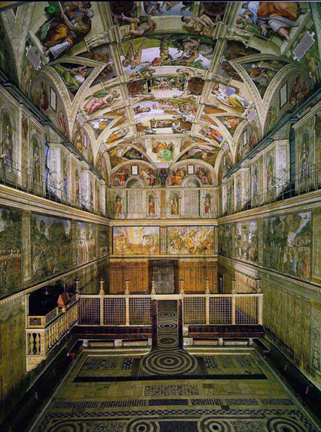
The Sistine Chapel is a highlight for visitors at Vatican City in Rome, Italy.  Located adjacent to St. Peter’s Basilica, the relatively small chapel attracts thousands of tourists who wish to get a glance at its frescoes especially the ones painted by the renowned medieval artisan, Michelangelo, from the years 1508 to 1512. 

The Sistine Chapel, Vatican City

In a time where there was no radio, television, Internet, or magazines, frescoes, sculptures, and paintings served as the media of imagery in Europe.  For the not-so-wealthy people, the artworks were mostly found in churches.  People who entered a medieval church would be awed by the masterpieces painted on the walls and ceilings of churches and chapels. 

The beauty of medieval art in churches is that the message they convey is timeless.  Even in the 21st century, gazing at the painted ceiling and walls of a church built during medieval times, such as those found in the Sistine Chapel, one still sees the message.  One sees how each panel’s small picture connects to its counterparts to form a very big picture of a religious teaching. 

Most frescoes in medieval churches told stories from the Bible.  A row of frescoes painted side by side in a row for example may tell the story of Christmas.  Another would narrate the story of the Crucifixion.  The aim was to supplement the teachings the priest would preach from the pulpit.  

And it worked successfully.  The Roman Catholic Church became the dominant religious (and even political) authority through most of the medieval ages.  The Church’s faithful followers flocked to the churches.  All were awed by the frescoes, housed in church buildings with ornate architecture and complemented with sculptures.    

Fast forward to the 21st century, where exposure to media is everywhere.  Streaming videos, podcasts, social media posts on top of traditional radio and television programming besiege our smart-phones, tablets, and desktop computers.  Media imagery is virtually available to our senses with or without our permission. 

The frescoes and artwork of the medieval churches have long lost their monopoly of people’s attention.  But even today, they still attract thousands of tourists who continue to be awed by the timeless masterpieces and the common message they convey.   The Roman Catholic Church, despite the competition of the Information Age, still manages to flourish thanks partly to the preserved artwork in their old but sturdy medieval churches.   

The frescoes of the Sistine Chapel and those in other Catholic churches teaches us a valuable lesson about conveying a message.  One best way to communicate a message is to tell a story.  And when telling the story, a good way to do so is via small pictures that altogether form a bigger picture. 

And when drawing a picture, make it a masterpiece.

Catholic Church leaders in the medieval ages engaged the best masters of art. Aside from hiring Michelangelo, who was considered one of the best, if not the best, artisan at the time, Church leaders also engaged architects and other famous painters (e.g. Domenico Ghirlandaio, Sandro Botticelli, Pietro Perugino, and Cosimo Rosselli) together with their teams to design the interior of the Sistine Chapel and paint the walls and ceilings which weren’t included in Michelangelo’s scope of work. 

Hiring Michelangelo and other famous painters immediately brought reputation to the frescoes of the Sistine Chapel.  It added to the attraction which brought many to visit the chapel and admire the frescoes even to the present-day. 

The masterpieces of the frescoes were both influential and innovative in that they told stories via pictures and they told stories from artisans who had a far and wide reputation of making great art. 

So, not only did the Catholic Church send their message by telling a story and making masterpieces.  The Church also told their story via the influential and highly reputable masters of art whose works everyone wanted to see.   Not only the Sistine Chapel but also many medieval churches conveyed the Catholic Church’s message via frescoes and supporting art and architecture throughout cities and small villages in Europe.  It was a successful strategy in marketing, one that helped prop the Catholic Church as the largest religious institution through the centuries.   

  1. Tell a story;
  2. Do it by small pictures that together form a big picture;
  3. Make each picture a masterpiece;
  4. Get someone talented and influential to make the masterpiece;
  5. Duplicate it at different locations. 

That’s how the Church of medieval times conveyed her message.   And it worked.    

About Overtimers Anonymous

Is Honesty Really the Best Policy?

The boss was angry.  She just had an argument with a board member.  She then told me not to sign documents the board member forwarded me for my signature.  But I had already signed the documents.  When she asked if I did, I said, “no.”  Meanwhile, I put away the documents in my desk drawer. 

My boss would have gone ballistic if I told her I had signed the documents.  Rather than let her high blood pressure go up, I decided to mislead her. 

Did I lie? 

Roman Catholic doctrine dictates it is “never allowable to tell a lie, not even to save human life.”  Lying is evil and because nothing good ever comes from evil, “we are never allowed to tell a lie.” 

On the other hand: 

However, we are also under an obligation to keep secrets faithfully, and sometimes the easiest way of fulfilling that duty is to say what is false, or to tell a lie. Writers of all creeds and of none, both ancient and modern, have frankly accepted this position. They admit the doctrine of the lie of necessity, and maintain that when there is a conflict between justice and veracity it is justice that should prevail. The common Catholic teaching has formulated the theory of mental reservation as a means by which the claims of both justice and veracity can be satisfied.

Slater, T. (1911). Mental Reservation. In The Catholic Encyclopedia. New York: Robert Appleton Company. Retrieved November 25, 2021 from New Advent: http://www.newadvent.org/cathen/10195b.htm

We can lie but only if it’s absolutely necessary such that it is for good (“justice”).

The Catholic Church calls it mental reservation.  My Jesuit English teacher from high school called it equivocation.  The more common term is the white lie

An example is a homeowner who gave sanctuary to Jews in his house as Nazi soldiers during the Second World War searched for them to ship to concentration camps.  When the Nazi soldiers asked the homeowner if there were Jews in the church, he said “there was no one here.”  The Nazis left. 

The homeowner did not lie.  He said the Jews were not here which to him meant they were not available.  But the Nazi soldiers took it to mean the Jews were not there physically so they left.  The priest deliberately misled the soldiers.  But he did it to save the lives of the Jews and that was enough to justify the white lie.  The homeowner did not sin. 

But in my case of not telling the boss I signed the documents; the Catholic Church would say I had no compelling justification to equivocate.  No life was at stake, only my career.  My boss would have just gotten madder and I would have had to suffer a long scolding. 

The Catholic Church would say I lied when I shouldn’t have.

In this complicated world we live in, people lie a lot.  The people who lie would say it’s for good reasons.  We don’t want to hurt other people’s feelings.  We don’t want to aggravate a crisis.  We want to avoid conflict. 

When my boss cooled off and finally said I could sign the documents, I then took them out of the drawer and sent them, already with my signature, on their way. 

Since the issue was resolved, I did not bother to tell the boss what happened. I rationalised that it would just be for naught if the boss found out, got mad again, and subjected me to a scolding.  The case was closed, that was it. 

The Catholic Church would warn that my behaviour can lead to abuse.  It was already lying, first of all.  Doing it as a habit and excusing it as mental reservation, equivocation, or white lying, and saying it’s for good reason may result in more long-term harm than any perceived benefit whatsoever.

It’s like the motorist who is driving home in the middle of the night and decides to run a red traffic light.  There’s no other vehicle around at the intersection so the motorist rationalises that there’s no harm to disobey the red light. 

Over time, however, the motorist does this more often.  He runs red lights every night and even during the day whenever he sees no other vehicle around.  It becomes a habit that one day, he doesn’t notice an oncoming vehicle and he gets into an accident.  

To many of us, honesty is not always a best policy.  Being too honest can get us into trouble, so we bend the truth.  We spin our speeches, avoid addressing questions, or just plain lie.  We see many people doing it (e.g. politicians, executives) so we believe we can do it too. 

It is true that religions like the Catholic Church give us some leeway to lie.  But it’s more of the exception than the rule.  We should realise the more we bend the truth, the more likely it will break.  And more harm will come than good as a result. 

Honesty is still a best policy, exceptions notwithstanding.

About Overtimers Anonymous

Six Reasons Why We Don’t Need A Purpose in Life

My life has no purpose, no direction, no aim, no meaning, and yet I’m happy. I can’t figure it out. What am I doing right?  –Charles M. Schulz

Do we need a purpose in life?

Many so-called gurus would say yes.  We need to have one in order to have a direction.  A purpose gives rationale to our life.  A purpose gives each of us a unique reason for existence.  

Some of us, however, don’t have a clear purpose. If we were asked and if we answer in the negative, sometimes we would be chastised for not having one and the one asking would insist we have one and we should spend a considerable amount of time formulating one. 

Rather than wracking our brains finding a purpose, some of us plainly don’t need one for six (6) reasons:

First:  We’re not beholden to any person, group, or cause.

Some people say we should have a purpose and the people who usually say this are those who are looking for followers for their own causes.  Religious groups, for instance, have been notorious throughout history for preaching that we all have the purpose of being a follower of their god or gods.  If we follow them, we would be rewarded with eternal life and a place in heaven. Not following would doom us to hell or eternal punishment. 

Political activists also attempt to enroll individuals to their cause.  And similar to religious organizations, they would work hard to convince us to submission. 

Endless streaming of information in the internet age bombard us constantly about causes we should support, if not join.  We should fight climate change.  We should combat hunger.  We should help refugees.  We should change our lifestyle.  We should join a network to get rich.  The messages that pressure us go on and on. 

We aren’t beholden to anyone’s causes or dogma.  We don’t owe anyone anything in the first place.  We as individuals have the freedom to choose what we want or how we want to lead our lives (within the bounds of whatever rules at wherever we live in of course).  We also have the choice of whether we want to have a purpose or not.    

Second:  On the other hand, some of us are really meant to be followers.

Not all individuals are meant to be leaders.  Not all of us want to be leaders.  Some of us would just rather follow someone else. 

This doesn’t mean that we are enrolled mind and heart to the mission of someone else.  We follow because of the benefits. 

Many employees of businesses go to work because they simply need the money and the benefits that go with it.  We do what our bosses tell us to do and we nod when our employers preach about the business’s visions and ideals.  But when it’s time to go home, we leave all of that behind. 

Some of us join religious or political groups because we just want to meet friends.  Some of us like to join groups because there’s free food in meetings.  (I’m not kidding, I’ve met people who go to Sunday church services just because of the free food). 

Some of us join as followers because it makes for a better alternative than to have a purpose of one’s own.  Some people would say these people have nothing better to do.  I would say these people have chosen something they believe gives them the benefits they want.  They may not have their own direction but they did make their own choices.  And maybe that’s all that matters.

Third:  Not everything is certain.

Life is what happens to you while you’re busy making other plans.”  -John Lennon

There is nothing certain in life.  Tomorrow is another day.  We don’t know what will happen next year, the next day, or the next minute.

We believe in these principles but yet pro-purpose-in-life people still think we should have a rock-solid purpose to determine our direction. 

We can make a purpose that visualizes our values, principles, and goals, and we can write them down in one beautiful statement.  But all it would take is one swoop of reality to tear them all apart. 

Okay, a well-made purpose, according to the pro-purpose people, is supposed to act as an anchor against what life hurls at us.  It should form a foundation of where we stand in making decisions or when we are facing tests and temptations. 

But if we adopt a purpose just for the sake that we think we need one, chances are we would be tying ourselves down to stuff that we are not really interested in the first place. For example, if a person adopts a purpose to do social work for his local community, he might make himself too busy with obligations in his neighborhood that he’d have no more time to travel out of town which might be something he originally wanted to do.    

Fourth:  Life can be just as much fun acting on a whim than having to pursue a purpose

Many of us like to travel.  Some of us change careers every few years.  Some of us like to taste new food or appreciate art.  And some of us just want to escape and be left alone somewhere.   But we don’t do it because we say we are too busy or we don’t have the money.  Sometimes we say it’s because our parents won’t allow us even if we’re already 50 years old. 

We then adopt a purpose to try to define our own direction or escape route.  By experience, it doesn’t work.  No matter how desirable we make our dream via an adopted purpose, a purpose for the sake of finding a way out of our current life offers no respite from the realities we dread. 

We’re much better off acting sometimes on a whim.  I’ve known happy people, young and old, who travel without much planning.  I’ve known happy people who decide to learn a new craft, like pottery.  They sometimes do it with their children and it becomes a happier experience.  And I’ve known families who decide to drop everything out of the blue so they can go to the beach. 

Some people frown when we do things on a whim or for no rational reason.  Travelling for example several times out of the year can be criticized as spending too much time or money from what we should really be doing.  Critics would say we should be doing something more useful for society rather than just gallivant aimlessly around the world.

But being aimless is sometimes good for us. Going to other places, doing different things help us gain new experiences.  And if it makes us happier, then who cares?

Fifth:  Being aimless can lead us to success

A good friend of mine had no clear direction in her career.  She started out as a temporary worker.  Next thing I knew she was in Japan doing on-the-job training.  Someone liked her personality and hired her to come back home to sell software to banks.  After a couple of years, she moved to the United States to work as a web developer.  After another few years, she set up her own audio-visual production business.  Today she helps her local parish church and earns a living as a real estate broker. 

My friend is happy.  She met very good friends from Japan and the US.  She developed new skills and is presently gaining new ones as a real estate broker.  She finds fulfillment helping people at church.  And she is financially secure. 

She didn’t set any limits or boundaries to what she can do.  Her life’s path seemed aimless but that didn’t stop her from pursuing fulfillment by trying new things. 

Sixth: There is no need to be ambitious or that passionate.

Some of us just want peace of mind or are happy with what we have. Some of us just want a simple life without any complications or too many obligations. 

Being too passionate about a purpose can cause us to lose focus on the simpler things in life.  We’d be spending much time chasing something we think we believe in and less time smelling the flowers or just living well with what we have. 

We hear about executives who retire early so they can spend more time with their families.  Many people from Europe allocate weeks or months to travel to Asia and South America to see or experience new places. 

We also hear about ambitious managers who work very long hours to try to get that promotion at work.  Or that environmental activist who risks life and limb to defend a forest in the middle of nowhere. 

Being driven with ambition can actually be good especially if it will end up helping society but sometimes we just have to pause, take a break, and ask if it’s really worth it.  In some cases, it’s not. 

Don’t get me wrong.  I’m not saying having a purpose is bad.  What I’m saying is we shouldn’t be pressured to have one because maybe we don’t really need one.  No matter what other people say, sometimes we can live without a purpose and still enjoy life and even help society at the same time. 

About Overtimers Anonymous

Delegating is a Subset of Teamwork

The following are some lines I’ve heard bosses tell their subordinates when the latter are feeding back about difficulties in their jobs: 

  • “Be creative.”
  • “Just do it.”
  • “Don’t give me problems.”
  • “If there’s a will, there’s a way.”
  • “I can count on you.”
  • “That’s what I pay you for.”
  • “That’s what I hired you to do.”
  • “You have to be a team player.”

When bosses give responses like these, chances are they themselves have no clue on what to do.  Chances are too that these bosses don’t want to bother spending time helping their subordinates. 

Some bosses have the mindset that subordinates are nothing more than minions, followers on a payroll who are meant to do dirty work the bosses would rather not be doing. 

Bosses who think this way risk unfavourable repercussions. 

A middle-aged businessman thought he had a good life.  His packaging business was doing well.  He had long-term contracts with clients that assured steady revenue for succeeding years.  He had no problems procuring materials and his work force was productive as they met delivery targets to customers without fail.   

The businessman one day delegated most of the day-to-day administrative work to his accountant.  For many years after, he would hardly report to the office.  The accountant took care of everything. 

The accountant would occasionally ask the businessman to sign documents and checks, and report that all is well with the enterprise. 

The businessman would spend most days at a nearby cafe, sipping his favourite coffee, reading the newspaper, and chatting with friends.  The businessman had a steady source of income as the accountant would regularly deposit his salary to his bank account.  Life was good. 

One day, one of the businessman’s office staff reported that the bank called saying there was not enough money to fund one of the checks he signed.  The accountant was absent, so the businessman called the bank.  He found out that his cash balance at the bank was low.  He went to the office and found out most of the enterprise’s money was gone.  The accountant had fled, she apparently had been embezzling cash from the enterprise for years. 

The businessman had no cash to pay his workers and vendors.  The businessman had to lay off his workers, renegotiate debts, and cancel contracts with clients.  The businessman spent years afterward to rebuild his reputation and re-start his business from scratch.  To this day, the businessman goes to work every day to manage the day-to-day operations of his company, no longer entrusting money matters to anyone. 

It’s one thing to assign work to employees and trust them to be stewards of important tasks.  It’s another thing to assign work to employees and leave them on their own. 

Delegation is not about giving work to other people so the boss can relax and forget.  Delegation is about working together with employees to spread workloads to capable people for the sake of productivity and innovation.    

Delegation is a subset of teamwork.  Team leaders assign jobs but don’t leave the team.  When team leaders delegate, they work with team members.  Not so much in looking over their shoulders but more in communicating, responding to feedback, and helping secure needed resources.  It’s about entrusting employees to do important jobs and treating them as partners. 

When we treat employees not as minions but as partners, we not only boost productivity but we open doors for opportunities via new ideas that employees with their expertise and feedback would bring. 

We delegate not to evade work but to improve it. 

About Overtimers Anonymous