When Increasing Capacity Becomes a Priority

One Sunday morning, a homeless woman at a traffic intersection was approaching cars and begging for alms.  Some drivers give but most don’t.  But the woman persists anyway; she shows a sign saying she’s homeless and asks for money for food. 

I thought as I observed the homeless woman:  if the government could spend so much setting up facilities to quarantine patients infected with the CoVID-19 virus, couldn’t it also spend a little more to house the homeless who roam the streets?  At least the government could provide a place to sleep and some food and water to homeless people even for a brief time so they’d be able to find work or resolve whatever issue that brought them there in the first place? 

The frequent answer to such a suggestion is a lack of resources.  The government would say they don’t have the budget to provide such for homeless people. 

How then were they able to provide for CoVID-19 infected people?  That’s different, a government person may say.  It was a national emergency and the virus is dangerous and life-threatening. 

But isn’t being homeless and without food dangerous and life-threatening too? And at this point, the government would not pursue the argument.  With a wave of a hand, they’d just say there is no justification to provide the resources. 

Not only governments but also enterprises hesitate to provide resources even when the demand would be there.  Executives would cite limitations in budgets or capital.  They would prefer that the operations spearheading supply reach their points of maximum capacities before asking for any investment in additional capacities. 

And even if they are at that point of maximum utilisation, executives would require proof that operations are also at their highest efficiencies.  Executives by common practice, will want an organisation to exhaust all of its means before considering any investment in additional capacities. 

If executives can avoid investing in new capacities, they will.     

This is why factories run flat-out to supply products before companies realise they need to build new production lines.  This is why airlines wait until flights are overbooked or ticket counters turn away passengers before they add new planes to their fleets.  This is why some restaurants don’t expand their dining areas or hire new staff until they see patrons waiting for tables or walking away because they couldn’t get a waiter to serve them.    And this is why internet companies don’t install new equipment until they see slowdowns in downloading speed or backlogs of subscribers. 

It doesn’t occur to many enterprises that investments in additional resources should ideally happen before operating limits are reached. 

At the height of the CoVID-19 pandemic in New York City, USA, in late March of 2020, the US Navy dispatched the USNS hospital ship, Comfort, to assist the city’s medical services. 

New York was low on available beds and staff to treat a surge of CoVID-19 patients.  New York City welcomed the Comfort, with its 1,000 beds and trained medical staff.   

But instead of helping, the Comfort would only take non-CoVID-19 patients.  The US Navy thought that by taking in patients not infected by the virus, New York could free up space in their hospitals for the CoVID-19 patients.  The Comfort’s beds were also spaced closely side by side so in the first place, the ship could not enforce social distancing for CoVID-19 patients.

The Comfort ended up treating 20 patients at its first week as New York’s hospitals continued to struggle with crowded wards and weary staff.  After so many weeks of sitting idly by hardly utilised, the Comfort departed New York City. 

The story of the Comfort was a lesson for leaders, if not an eye-opener for executives.  One should not wait till an issue becomes extremely urgent before acting.  

But nobody did learn.  Nobody did realise.  Many executives of governments and enterprises have forgotten the story of the Comfort. It has been relegated as one more passing tale of the pandemic era.  Meanwhile, wave after wave of virus infections months after the story of the Comfort have led to overcrowded hospitals and more deaths due to patients unable to be admitted for treatment.   

We shouldn’t wait till the last minute before deciding we need more capacity.  It isn’t complicated to calculate how much more we need if we can see the rate of  growing demand and anticipate when our resources will no longer be enough. 

I gave money to the homeless woman that day but I saw more homeless people begging on the street corners the weeks afterward. 

We still haven’t learned. 

About Overtimers Anonymous

Weighing the Benefits of Quantities, Streaks, and Trends

People put a lot of weight on numbers, especially those that show significance in terms of accomplishment:

  1. 100 days in political office;
  2. 10,000 followers for a social media influencer;
  3. 100,000 likes for a viral post on the worldwide web;
  4. 1,000,000 units sold;
  5. 1 billion customers served by a fast-food chain.

But as much as we pay a lot of attention to quantity, we seem to pay less notice to quality.

  1. What percentage of constituents were satisfied with the politician’s performance during his 100 days in office?
  2. How frequent did followers visit the social media influencer’s website?
  3. How many likes did the viral post author get for his other posts? 
  4. How many of the 1,000,000 units sold were defect-free or without complaints from buyers?
  5. How many of the billion customers served were satisfied with the fast-food’s service? 

We seem to have it in our human nature to celebrate quantity over quality.   

Maybe it’s because quantity is easier to grasp and recognise. 

It gets complicated if we say we sold 1,000 good quality items out of 1,050 produced.  People will ask what happened with the 50 that didn’t make the cut?  We’d end up explaining what we did wrong with 50 items rather than what we did right with 1,000 items. 

It’s our nature to see the bad more than the good.  Hence, just being one-dimensional, just by citing one simple number in quantity makes our achievements more tangible and easier to brag about. 

We also like to celebrate streaks and trends.  In sports, we take pride in winning so many games in a row.  During the CoVID-19 pandemic, nations would tally how many days they had without a single infection and cite it as a reason to loosen restrictions, at least until one comes along and causes another lockdown. 

We take what we can from quantities, streaks, and trends.  But we will hesitate to appreciate ratios and quality statistics. 

We’d prefer a manufacturing plant manager report employees worked 1,000,000 hours cumulatively without an injury rather than say there was one injury out of 2,000,000 man-hours registered.  People would ask what was the injury and how and why it happened. 

Still, we should ask ourselves:  what are the benefits of reporting quantities, streaks, and trends?  Is it to boast, make us look good, and build our reputations?  Will it increase our influence resulting in something positive and tangible in return?

We sometimes focus a little too much on what’s it about for us when maybe we should be asking what good will it also be for them—the customers, the likers, the readers, and stakeholders. 

This is my 100th blog post.  Though I rather prefer the few readers who visit my site like what I wrote than how many I posted.    

About Overtimers Anonymous

When Idle is Not Necessarily Bad

A chief executive officer (CEO) of a large corporation was touring a manufacturing facility.  As with all CEO’s touring a factory, he had an entourage of executives accompanying him as he walked and shook hands with workers on the production line.

As he strolled through the facility’s main line where the most important manufacturing processes took place, he noticed a uniformed operator sitting idly on a chair with his hardhat over his eyes. 

The CEO asked the plant manager accompanying him what the operator’s job was.

The plant manager answered: “That man, sir, is our annealing oven operator.  He watches the oven’s gauges and adjusts the temperatures when needed.”

“I’m sorry for you having to see this man just sitting there doing nothing,” the plant manager said apologetically.  “I’ll go tell him that he should be working.”     

“No, you don’t need to do that,” the CEO replied.  “The operator is doing precisely what we want him to do. Just by the fact that man is sitting there doing nothing, it means that the annealing line is operating smoothly.”

The CEO then approached the operator who quickly got up when he saw him coming.  The CEO shook the worker’s hand and said, “You’re doing a good job, keep up the good work.” 

What do we do when we see a subordinate worker doing nothing at his work-station or desk? 

Some bosses scold their employees for just sitting around.  Some bosses would chide supervisors for not assigning more tasks to employees.  A worker who’s not working is not productive, a boss may say.

On one hand that may be true especially if the idle worker in question had deadlines to meet.  But in most of my experiences, it would be the opposite.  The idle worker would actually be the most productive.   

Like the operator the CEO noticed, idle workers may have no problems to fix.  The operator had already set his equipment and did all the adjustments needed.  He had done his job making sure the annealing line wouldn’t fail and there would be no issues in the quality of items being processed.  He would of course check the gauges now and then to make sure everything is all right. 

We sometimes think that idle workers should be doing something more.  If we see an office worker taking longer coffee breaks than usual, we’d somehow try to think of giving more work to that person to make him more productive.  If we see other workers sweating away while another is just sitting around, we sometimes get the first impression that the idle worker doesn’t have enough work. 

Some bosses believe workers are just too lazy to find other better things to do or problems to solve.  We sometimes conclude that workers in general lack initiative or a sense of ownership. 

So, we try to push workers to be creative problem-solvers.  We command them or offer them incentives to take the initiative to find improvements for the workplace.  Creative ideas are starting points for higher productivity, after all. 

But we have to beware that there are pitfalls to forcing workers to find and solve problems.  Workers might end up finding and solving problems for the sake of it; they’d just identify stuff that seem like problems but aren’t.  Trivial issues that don’t offer any benefits would just be reported.  We would end up back to square one:  just finding work so an idle worker won’t be idle.    

In my experience, many idle workers are veteran workers who have by experience learned how to do their jobs so well they end up with extra time on their hands.  Because these veteran workers have accumulated much wisdom about their jobs, it has often become a good idea to assign them as mentors to younger, less experienced workers.  Veteran workers can be the best mentors. 

And more often than not, we don’t have to ask.  Veteran workers who have stayed long at their jobs usually volunteer to train their peers.  We managers just have to reinforce this by recognition and praise, by showing genuine appreciation. 

Veteran workers also have many ideas for improvement.  Rather than forcing upon them assignments to find and solve problems, it usually is a good idea to just ask them first, informally.  Questions like, “what do you think this factory needs to get better?” or “what’s your opinion about laying out the office differently?”  usually generate some interesting eye-opener responses from veteran workers.

True, some veteran workers wouldn’t offer much at the start.  And most of the time, that’s because there was some bad history involved.  A manager before you didn’t appreciate the veteran worker for a previous suggestion or a manager simply ignored an idea a veteran worker offered. 

This is where investing in listening comes in.  When one can make a veteran worker open up, one may be pleasantly surprised by the treasure trove of ideas and knowledge that come out. 

At that point, the veteran worker is no longer idle. 

About Overtimers Anonymous

Cultivating Passing Thoughts into Aha! Moments

The late Isaac Asimov was a famous author who wrote science fiction stories (e.g. the Foundation series) and essays.  

In one such essay, The Eureka Phenomenon, Dr. Asimov writes how some scientists made great discoveries out of the blue.  He cites:

  • Archimedes who, while taking a bath, solved the problem of determining the volume of a king’s crown by simply dipping it into a tub of water and measuring how much of the liquid was displaced;
  • Friedrich August Kekule von Stradonitz, who solved the ring formula of benzene by dreaming about it;
  • James Watt who overcame a design problem with his steam engine after he took a walk in the park;
  • Otto Loewi who won the 1936 Nobel prize in medicine for his findings about the human body’s nervous system in which he wrote down key formulations after waking up in the middle of the night with ideas that suddenly entered his mind. 

Asimov doesn’t know “how often does this ‘Eureka phenomenon’ happen.”  But he suspects it “happens often,” that many of what people discover come about from “real inspiration,” a result of “thinking under involuntary control.”  We get “revelation” and “insight” but leaves it to the “mystic” how it comes about. 

“Eureka” is Greek for “I’ve got it!” which is what Archimedes says the instant he solves his problem with the volume of the king’s crown via the displacement of water. 

It’s also known as the Aha! moment and I believe it happens much more often than even Dr. Asimov realised.

I tested that idea for one day.  Whenever I had a thought that seemed to be an Aha!, an insight that just came to mind for no reason, I wrote it down.  On that day, I tallied three Aha! moments. 

I tried it again the next day.  I only had one.

The day after, I had none. 

Aha! moments, they seem, don’t come in consistent numbers and frequencies.  But I found to getting three in one day as already a lot.  On that second day I had only one Aha! but I was in a bad mood, so I surmise emotions may have a bearing on why I hardly had any that day. 

We all have our Aha! moments.  They are those insights that light us up at any time.  They more often than not are seemingly small and inconsequential. 

One Aha! moment I had was I felt people I know from a job a long time ago have forgotten who I am when I meet them at a reunion.  If I let the thought prosper, the Aha!  becomes an insight in how we as individuals choose whom we remember and whom we forget.  It becomes a basis of how we judge others and how we feel about ourselves.  The Aha!  became a discovery about how I think and maybe how others think as well. 

I and many, if not most of us, probably discard many of the passing thoughts that cross our minds every day.  We perhaps see many passing thoughts as worthless stuff that enter our minds out of nowhere while we’re focused on something else or just doing something out of routine (like riding a bus or playing games on our smartphones). 

Too bad.  As Isaac Asimov wrote in his Eureka Phenomenon essay, many of what we think as worthless passing thoughts may actually be potential Aha! moments that can lead to big ideas and discoveries. 

Some people would disagree with me.  A search for “passing thoughts” on the web suggested a similarity to “intrusive thoughts,” which Psychology Today warns as possibly negative and harmful.  Nevertheless, I’d like to think there’s a positive side to having passing thoughts and their potential to become Aha! moments. 

Many creative problem-solving consultants teach structured approaches to seizing those Aha! moments.  Messrs. David Rock and Josh Davis, Ph.D., for instance, preach having time alone, thinking positively, and looking inward as means to maximising the Aha! moment.   

Yet, many organisations I’ve engaged with don’t really apply much in the way of structured approaches to finding ideas or solutions, no matter how many workshops and seminars on creative problem-solving these organisations may invest in.    

In many cases I’ve witnessed, executives rely on on-the-spot solutions during meetings.  Or they hand off the especially complicated problems to task forces made up of department representatives and technical people. 

The task forces often then delegate the complicated part of a problem to one or two low-level engineers or managers, who then crunch numbers, experiment, or do surveys.  Sometimes the task forces hire contractors or consultants to study further whatever the problem is.   

When all the number-crunching and multi-thousand report writing are done, the contractors, consultants, or low-level engineers submit findings to the task force who then present their conclusions and recommendations to their executive superiors.  The chief executive officer (CEO) would then supposedly decide on the proposals. 

Usually, insight into a problem and the Aha! moments that come with them happen during a task force meeting or among consultants and engineers discussing the issue.   

But as much as it may happen with the task-force, consultant, or engineer, I’ve noticed quite often that such insights don’t really reach the executives, especially the CEO. 

Many of the presentations to executives I’ve participated or witnessed have resulted in a chief executive officer (CEO) making a decision that he had already made up his mind to make, sometimes even before the executive had engaged a task force, consultant, or engineer.

The executive in charge had his own Aha! moment and many times from personal experience, task forces and consultants’ recommendations came out as nothing more than confirmations or formalities adapted to what a CEO had already made up his mind on.  

Nevertheless, I believe we should not discount the passing thoughts that enter our minds.  I believe there’s value in those nuggets of thoughts that flicker once in a while in our brains.  I also believe many entrepreneurs and scientists had found success from cultivating passing thoughts into Aha! moments, and had thought further through to formulate breakthrough ideas and discoveries. 

I’ve been making it a habit to jot down as many Aha! moments that come my way of mind.  So far, I’ve gathered four in the last two days.  I’m looking forward to getting more in the immediate future. 

I just have to avoid being in a bad mood.  

About Overtimers Anonymous

Weather Forecasting vs. Demand Forecasting: A Case of Different Expectations

This Photo by Unknown Author is licensed under CC BY-NC

Meteorologists predict what the weather will be like, whether it be tomorrow or the next few hours. 

Demand forecasters predict what customers will buy and how much, whether it be next week, next month or next year. 

When a weather forecast is wrong, we don’t hold the meteorologist accountable.  We may grumble about the inconvenience caused, but we won’t condemn him or her. 

When a demand forecast is wrong, some executives hold the forecaster accountable.  Some condemn him or her. 

We recognise meteorology as a science.  It uses data like barometric pressure, temperature, and wind speed.  A weather forecast is based on hard data and usually isn’t too far off from what really occurs.  We can excuse the meteorologist if it rains at 7:00am instead of at the predicted hour of 6:00am. 

We don’t recognise demand forecasting as a science.  We see it as a management art mixed with some mathematics using historical data.  If the forecast is off by as much as a margin of 10%, we see it as flawed.  We believe the forecaster could do better even if there is a lack of hard data. 

Weather forecasts for the next 24 hours are more likely to be accurate than predicted conditions in a week from now.    

A demand forecast of how much of an item will be sold tomorrow is no more accurate than for a prediction of how much will be sold on Wednesday next week.  The margin of error of how much customers buy tomorrow versus forecast usually is similar, if not more, than the margin of error next week. 

We pay greater attention to the forecast of a typhoon’s path in the next hour than the forecast for the next day.   We care more what’s the weather going to be like this morning than what will be happening later tomorrow.    

We pay more attention to a demand forecast at the beginning of the month than one towards the end of the month.  We care more for what we think we will sell next month than what we will sell this month, especially if this month is almost over.  We clearly can see what we will be selling this month as it nears its end so we’d find an updated forecast for the current month as not really useful. 

We accept the outcome of the weather, never mind if the forecast was right or not.  We can’t control the weather after all and meteorology looks complicated as it is.

We see demand forecasting more as speculation and something we can influence.  If demand forecasts turn out close to the outcomes we want, we celebrate and praise the forecaster.  If things turn out not what we want, we find faults in the system and in the performance of the forecaster.

Meteorologists push to improve the science of their forecasting by investing in technologies and state-of-the-art equipment such as satellites and sensors. 

Enterprise executives push demand forecasters to be better in their predictions with hardly any investment in science or technology.  The most enterprises will do to improve forecasting is to expand market research and customer surveys. 

We adapt our behaviours and plans to the weather forecast.  We prepare our raincoats and umbrellas if the forecast is rain or we wear lighter clothing if the meteorologist says it’s going to be hot.

We insist demand forecasters revise their numbers and marketers influence customer preferences if we don’t like the sales predictions.  Executives believe the adage, “we don’t predict the future, we make it,” applies to demand forecasting. 

Forecasting is an activity that should as much as possible be based on science and hard data.  But it can never be fully accurate either for weather or for market demand. 

Yet, we treat each differently. 

We see meteorology as a science and though we may be frustrated by its sometimes inaccurate moments, we adapt to what the meteorologists forecast, even if the forecast is for the next 60 minutes than for the next day. 

We see demand forecasting as an approach to be performed with high accuracy and its predictions and outcomes consistent with enterprise goals, especially those pertaining to revenue.  We expect the organisation to change market behaviour and not the other way around.

Forecasting the weather is a science.  Forecasting demand is performance.  We accept and adapt to what the weather forecast is.  We insist that the demand forecast should always be correct and in step with our objectives. 

Forecasting is about predicting what the future will bring.  It can never be 100% right.  Yet, we expect differently depending on what we forecast.  This is because there are things we think we can influence and things we know we can’t. 

We can’t change what the weather will be like tomorrow but we can change what customers will prefer. 

The trouble is we sometimes bark at the wrong tree.  We try to influence the forecaster when we should be trying to influence the market. 

About Overtimers Anonymous

Solving the Supply Chain Mystery

I once met a regional sales manager of a large consumer good company at Davao City, the biggest city on the island of Mindanao, 978 kilometres (608 miles) south of Manila, Philippines. 

As I was introduced, the RSM looked at me for a moment and smiled broadly.

“You’re a supply chain consultant?”

Before I could say “yes.”  He says: “I’ve seen marketing consultants, sales consultants, and organisational development consultants, but this is the first time I’ve ever met a supply chain consultant!”

“Welcome, welcome!”  He shook my hand vigorously.  “I hope you can help us.” 

“You see,” he continues, “the supply chain is a mystery to me.” 

“Every time I submit a customer order, I never know what happens after,” the RSM said. 

“I don’t know when stocks would arrive.  I don’t know what and which products would arrive. And I don’t know how many would arrive,” the RSM said. 

He pointed to a few shipping container vans just outside the warehouse office where we were meeting and shared: “container vans like those would just show up and I wouldn’t know what are in them.” 

“I wouldn’t know if the containers have the products I ordered.  At the end of the month, five or more containers would arrive at the same time and I wouldn’t know which container would have the products I need the most.” 

“I’d spend much of my time calling the logistics office in Manila to tell me what’s coming and when but I never get a clear answer.  I spend a lot of time following up the deliveries of products I need when I should be using the time selling to customers.”

“As this is the first time I’m meeting a supply chain consultant, maybe things can change.  Maybe you can solve the supply chain mystery!”  The RSM said.

On the surface, the problem had a straightforward answer.  The consumer goods company’s logistics office just had to share shipping schedules with the RSM to tell him what’s coming and when.  That would right there solve the problem.

The problem, however, goes deeper. 

Why isn’t logistics sharing the information in the first place? 

Why is logistics not communicating with their sales counterparts? 

And aside from logistics, are other departments even communicating with each other?  Do the consumer goods company’s executives communicate with vendors, customers, 3rd party providers, and stakeholders?  Or are they too preoccupied with other problems they consider urgent?

Communication has always been a problem with companies, especially big companies.  Departments hardly talk to each other as they pursue pre-set goals or put out fires within their work boundaries.  If there would be any communication, it would be in the form of phone calls, memos, reports, or hours-long meetings.

Communication in the management sense, however, does not consist of meetings, memos, or phone calls.  Communication in the management sense is about rapport, i.e., active two-way connection between boss and subordinate, between peers, and between people from differing departments and separate enterprises. 

Communication enhances the flow of information in which individuals and groups constantly share pertinent important information with the purpose of meeting communal objectives for the mutual benefit of all concerned. 

So why aren’t companies doing that?  What’s the problem?  Why does a consumer goods regional sales manager have trouble getting in touch with people he sends orders to and waits for deliveries from? 

Communications within and between enterprises require support structures and systems.  Many companies, however, don’t have adequate structures and systems.  This is because these companies have been brought up on a culture of silos, in which managers and employees work in places that have goals and targets of their own. 

In the consumer goods company where the RSM works, there are performance measures and strategies assigned for every department: 

  • Finance seeks higher profits, more cash-flow, and higher rates of returns;
  • Marketing wants brand leadership, strong geographic distribution, and positive consumer acceptance;
  • Sales wants higher turnover, record-breaking selling volumes, and a high level of retail presence;
  • Manufacturing wants continuous uninterrupted production;
  • Logistics wants fewer pending orders and lower freight costs;
  • Purchasing prefers bulk purchases with large discounts on prices.

The consumer goods company’s organisational chart shows a hierarchy of managers and employees working in different functions with different scopes of work each with specific roles and goals.  The chart in itself lays out a plan of silos where individuals and groups work separately.

Separation means differences in priorities and interests.  What’s mine is mine, what’s yours is yours.  Each to our own.  I mind my business; you mind yours.  These become the thoughts of people within the company. 

What more for those who are not from the company.  We’re inside; they’re outside.  Enterprises might as well be islands in an ocean and many are just like that. 

Organisational development trainers and executives have recommended and implemented many ideas to bring people within and even between enterprises together.  They’ve introduced radical solutions such as “flat” org structures that eliminate many layers of authority and they have encouraged “campus” work ethics where individuals from different disciplines work together in open-plan shared work spaces. 

The consumer goods company the RSM worked for had “brand teams” which had marketing managers lead groups consisting of representatives from sales, manufacturing, finance, and R&D.  The brand team would “own” a particular brand of the company and be accountable for its success.  It was a way to break down barriers between functions. 

Unfortunately, these OD and brand team initiatives have only shown limited success.   At the end of the day, the functional employees and their managers go back to their familiar places of work and focus on the priorities of their departments.  The gates of their workplaces close once again as they resume pursuing their own urgent individual targets.   

Supply chains offer a way out of silos.  Supply chains are grounded on relationships.  Relationships, in order for them to prosper, require communication. 

In supply chains, operating functions work with each other to transform and move materials and merchandise from one point to another, one process to the next, one step at a time.  Connections and communications are what makes a supply chain tick.  And for a supply chain to work, it must tick with every part in clockwork synchronicity. 

When the RSM doesn’t know what’s coming and when, the communications and connections aren’t working.  The supply chain link from the transportation of the product to the receiving warehouse is broken.  The supply chain in this sense is not working. 

Hence, the first thing I urged for the consumer goods company is communication.  Fix the link, establish the connection, make active the communication not only between logistics and the regional sales manager, but also between logistics and other RSMs, logistics and transportation providers, manufacturing and logistics, the inventory planners and logistics, manufacturing and inventory planners and logistics, purchasing to planners to manufacturing, purchasing to vendors. 

There has to be rapport.  Not memos.  Not meetings. Not once-a-month reports.  Not emails or text messages.  But active two-way communication of shared information, shared planning, shared direction, and shared implementation. 

It doesn’t take a world-class detective to solve the supply chain mystery.  Just taking the initiative to communicate would provide much of an answer.

About Overtimers Anonymous

Why We Need to Define the Bigger Problem*

“Houston, We Have a Problem”

When Apollo 13 astronauts reported an explosion on their space module, NASA’s Houston Mission Control contemplated on continuing the mission and land on the moon.  It was only when NASA realized that the problems were life-threatening that it was decided to abort the mission and to have the astronauts return to Earth safely. 

We tend to define problems by its symptoms and how it affects our agenda.  NASA had an agenda to get Apollo 13 to the moon and at first stuck to that mission even with the reports of an explosion and the resulting problems. 

We apply this thinking in our daily lives. 

If we get sick, the first thing we look for is medicine to relieve pain and discomfort.  

If our car won’t start in the morning, we look under the hood to see if there is a quick fix.  If we can’t find any, we hail a taxi or find a ride via Uber or Grab so we won’t be late to wherever we’re going.  Car repair comes later when we have time or we delegate it to someone else to do the fixing. 

We try to solve problems with remedies and quick fixes that as much as possible won’t interfere with our agenda.  We almost all to often react to problems as obstacles that are to be removed or bypassed via the easiest means possible.

Hence, when it comes to problems, we all too often seek solutions as soon as possible.  

We classify problems as either big or small.  A small problem has an obvious and easy solution.  A big problem needs figuring out, planning, and allocation of resources. 

But sometimes a problem, whether big or small, is part of a bigger problem that may not be apparent. 

A bigger problem may be a root cause for the smaller problems or a flaw in a system that has yet to be detected.  It can also be an opportunity which is manifesting itself in a changing environment.

For example, a small online retail business that is experiencing steadily growing sales has hired more people to meet the growing demand.  The head count has grown to a point where preparing the payroll has become more time-consuming and complicated.  The business owners, in response, install a customized payroll system and train clerks to run it.  After a while, the business owners notice the overhead costs are going up so they engage an accountant to streamline the budgeting and charging of expenses.  Profits do grow but the accountant’s reports show rapid increases in the costs of rent, insurance, and electricity.  The business owners hire a consultant who recommends renegotiating the contracts for rent, finding another insurance provider, and buying a more efficient air-conditioning system that uses less electricity.

Finally, the business owners realize that their business is just getting too big to manage on their own so they form a partnership with an investor who infuses capital and hires professional executives.  The online business becomes a bigger company that grows tenfold in succeeding years

The online retail business company addressed problems as they came but wasn’t aware of the bigger problem until it became apparent.  The business was just getting too big to manage.  

Solving the bigger problem begins with a fuzzy situation.  The online retail business is getting too big.  That’s a fuzzy situation.  It spurs questions.  Why is it getting too big?  What makes us say it is getting too big?  How did it become too big? 

Answering the questions from the fuzzy situation provides information about the problem behind the fuzzy situation.  The information becomes the springboard to clarify what the problem is all about.  The online retail business is getting too big from the higher sales.  The organization has grown in head count.  Costs to accommodate the higher head count such as rent, insurance, and electricity have gone up.  The business has hired more people to manage the head count. 

From the information gathered, the business can then begin to define the problem.  Defining the problem does not necessarily mean identifying a cause or an issue.  One should avoid the pitfall of jumping to a conclusion such as, in the online business example, saying that the the business has become unproductive because of the higher head count.

Defining the problem requires asking in-depth questions.  How can we manage the business better in lieu of higher sales?  How might we become more productive?  In what ways can we reduce costs? 

The online retail business selected the first question:  how can we manage the business better in lieu of higher sales.  The owners chose this question as the one that defined the problem based on criteria.  That criteria come from the business owners’ mission, goals, and strategy.  The online business wanted to be a fast-growing company with high market share and revenue within five (5) years.  Hence, the owners chose the question “how can we manage the business better in lieu of higher sales” as their problem.

It doesn’t stop there.  The problem may be defined more sharply over more information and thought.  The problem may become “how might we increase sales without incurring higher costs?”  Or “how might we expand our product lines without having to hire more people?” 

It is when the owners settle on a specific question that they would have defined their problem. 

*originally published on February 8, 2019 on LinkedIn

About Overtimers Anonymous

Why Telecoms and Banks Don’t Care

I hate Philippine telecommunication companies.

I hate Philippine banks.

I hate telecom companies and banks in the Philippines because they don’t care about customer service. 

They can say all they want that they value their customers. 

They don’t. 

I know they don’t care because they provide the worst customer experience.

I can never have an uninterrupted conversation when using my mobile phone.  I can never hear clearly what the other person is saying from the other side of the line.  And that’s assuming I make a successful connection, which happens only half the time. 

When it comes to connecting to the internet or running an app, the quality of access is never good.  There’s never a decent signal or reception when I need one. 

And this isn’t just for mobile phones but landlines too.  I’d be lucky if my landline telephone at work goes out of order only once a year.  My office phone line always goes dead at least four (4) times a year.  Never mind if the phone company fixes it within a week; the phone will inevitably die again within a few months. 

The telecom companies don’t sincerely apologise for the poor service.  They reply with canned messages when someone complains on social media like Facebook and Twitter.  The telecom companies would ask the complainer to send a private message or email in which there would never be a satisfactory response.   

And despite the poor service and the hundreds of complaints, the telecom companies promptly bill their post-paid subscribers every month and threaten disconnection if one doesn’t pay by the deadline.  Prepaid subscribers meanwhile just pray that they get good reception for the money they shelled out already. 

I hate banks for the same reason as I hate telecom companies. 

They don’t care about their clients.

Banks always say they value their clients.  Yeah right. 

They don’t.

It may be easy to open a personal bank account as showing one’s identification is usually enough.  When it comes to opening an account for one’s business, however, banks, apply a presumed-guilty-till-proven-innocent approach. 

Banks ask just about everything from an enterprise: proof of registration, articles of incorporation, by-laws, lists of stockholders, latest financial statements, etc. 

Fine, I say.  One can argue that those are legitimate requirements. 

But why do they want the same f@#king stuff when they ask me to update the account’s records every year? 

They say it’s just an update but in other words, it’s because they don’t trust that my business still exists.  Never mind if I had been actively and continuously depositing funds into the account. 

Worse, banks demand that all signatories of the business account be certified by my company’s corporate secretary or legal counsel.  And that the corporate secretary provide identification to prove that she exists.  How more distrusting can banks get?

I do have a degree of understanding that transparency is important between enterprises and banks.  I just wonder if banks understand the time and productivity enterprises expend to prepare all these paperwork and signatures. 

Banks can call me lazy.  For me, it’s a darn waste of time due to simple distrust. 

It gets worse. 

You want a loan?  Hahahaha, Good Luck!  Banks rarely give the credit line you want.  And if they do, you’d have to fork over assets three to four times the value of the limit you want to borrow at most.  And again, you’d have to prepare another heap of paperwork and have fresh ballpens ready as you’d be running out of ink getting them all signed. 

When it comes to daily transactions, banks and telecom companies have some things in common: 

  • Long lines at their branches;
  • Long online transaction times

Whenever I go the bank, I’d have to budget an hour even for just a deposit. Some banks make it fast but often, especially with the big banks, it would take the whole morning.  Even just for one transaction.  The lines are always long; the waiting time running close to eternity. 

Telecom company branch offices likewise have long lines of people always waiting.  Whether it be to pay bills or make a complaint, some people would spend up to a day waiting before they’d need to talk to a “customer service representative,” which is an oxymoron since there’s no service represented. 

And just when I thought online portals of telecom companies and banks would make it easier and faster?  No such luck.    

Telecom companies and banks have websites that are complicated to navigate.  One telecom company has a website in which looking for my bill requires clicking on a link that’s almost invisible to the naked eye.  And when I do click it, I again have to find another microscopic link to look for my phone records.  It’s as if the telecom company doesn’t want me to find my bill!  

Bank websites meanwhile require so much security that by the time I finish, my work day morning would have disappeared. 

Friendly to customers?  Banks and telecom companies don’t show it with their very user-unfriendly websites. 

Banks and telecom companies don’t care about their customers because they have their captured markets.  People, especially enterprises, need banks to transact.  And we need our phones to communicate. 

We can’t live without phones or banks.  And the telecoms and the banks know that.  They therefore don’t care if they make life difficult for their clients if it would make their bottom lines fatter. 

Whenever I ask banks and telecom companies why they don’t try caring about clients, they cite several words:

  • Audit
  • Process
  • Policy

Banks say their auditors won’t approve skipping some documents in updating accounts even if they already have the documents when the account was opened.  No matter it doesn’t make sense, auditors want it and they have the final say; customers don’t.  

Telecom companies always say they have processes to follow.  Repairing a phone, for example, requires diagnosis which will take two to three days.  A service person will then schedule to visit your home or office which will take another so many days.  The service person sometimes never shows up, so we’d have to follow up and the cycle from diagnosis to schedule repeats itself. 

A telecom company refused to fix my company’s phone because the local barangay (neighbourhood village government unit) requires a permit to climb the pole where the fault for my phone service usually is.  The telecom company doesn’t want to pay the cost of the permit (in this case: PhP 350 ($USD 7.00); the company thinks the contractor it hired should pay for it.  A stalemate ensues; and my phone as a result would be out of order for months.  The telecom company kept quoting “process” whenever I followed up.  (My company finally ended up paying for the permit because we needed the phone). 

You want to increase your business corporate credit card limit?  I might as well wait till hell freezes over.  Banks ask for so much requirements and paperwork just to apply for it; I’d still have to wait for the bank to bless the application for approval. 

Banks and telecom companies provide the epitome of lousy customer experience. 

Poor reception from telecom companies.  Huge amounts of paperwork from banks.  Long lines and complicated online navigation.  You name it, banks and telecom companies have it—everything that customer service experts say a business shouldn’t be doing.  They have their captured markets so they don’t care. 

We just have to live with it.  Hope springs eternal; I just hope I can wait that long.

About Overtimers Anonymous

What is a Supply Chain, Really?

The first time I heard about supply chains was when I was working as a production planner at P&G Philippines in 1989.  P&G’s top management had just reorganised the multinational consumer goods corporation’s operations worldwide, integrating manufacturing, purchasing, and logistics under one group: the Product Supply Organisation or PSO, for short. 

The aim of the PSO was to streamline the flow of materials and products from vendors to customers.  Executive leadership emphasised customer service, lower costs, and reductions in working capital, especially inventories. 

Top management at P&G Philippines pushed a comprehensive information technology project as the centrepiece to integrate the various functions, with focus on MRP 2, or Manufacturing Resource Planning, the precursor to Enterprise Resource Planning (ERP).

When P&G moved me to manage the shipping department at the company’s Tondo Plant in 1990, I arrived just in time for the implementation of the newly installed MRP-2 software.

It didn’t start well.

The software couldn’t keep up with the pace of orders coming in and the loading and dispatch of trucks.  The system would hang often or users from other departments weren’t updating inventories to allow us to pick items for shipping.  We ended up overriding the system which earned me the ire of the IT project leader.   Marketing brand managers and field sales came after my department as pending orders piled up and the General Manager even had me sat down in a whole day meeting to explain the snafus in the system.    

The shipping and IT department people worked nights, holidays, and weekends to get the system to work and ship orders.  We finally were able to deliver and the company saw its sales hit record highs. 

A lesson learned from the experience was this: 

Managing a supply chain doesn’t start with reorganisations or putting in a fancy computer system.  Managing a supply chain starts with establishing relationships between the people who’d be running it.  

The supply chain is a representation of operations and their relationships not only within the organisation of an enterprise but also with other organisations of other enterprises, especially the ones the enterprise does business with, such as customers, vendors, and 3rd party providers. 

A supply chain isn’t an organisation nor is it a system of operations.  It isn’t a flowing stream and it is not an ecosystem.  (Ecosystems are communities of biological organisms that eat each other). 

The supply chain is a model, a paradigm that shifts us from seeing work not as the jobs we do on our own at a work-station, cubicle, or vehicle, but as jobs that connect us with others in getting what we need, producing what are needed, moving to where they’re needed, and delivering to who needs them.    

A more-to-the-point definition for supply chains would be:  supply chains are operational relationships that make available products and services. 

Supply chain management is the management of those operational relationships

It’s not a system.  It’s not an organisation.  Supply chains are about relationships―relationships consisting of people working together to deliver products and services. 

About Overtimers Anonymous

Why Should We Care?

Silos

When we get a job in an enterprise, we generally assume it’s for work the company advertised and interviewed us for.   We would find it kind of funny if the company assigns us to do something we didn’t get hired for.   

But it happens.  We sometimes are given work that are not on our original job descriptions.   

Some organisations include “any additional jobs the company may assign” to the list of things to the position we are employed in, but we would push back if the “things” our bosses tell us to do are far from the kind of work we are supposed to be doing.  One does not assign advertising work to an accountant, for instance. 

But it happens.  Like a bookkeeper who the boss treats as a secretary.  Like a plumber who ends up repairing electrical circuits.  Or an engineer who doesn’t do any engineering work at all but becomes a supervisor of an assembly line. 

We also hesitate when an enterprise gives us work in another department or to a “sister company.”  In the Philippines, some firms set up “sister companies” or “subsidiaries” that are totally different legal entities but have almost identical ownership.  The owners would ask their best-performing personnel working in one enterprise to do jobs in another.  An accountant would end up bookkeeping for several different firms or a technician would find himself repairing machines at several different workplaces. Each would, however, be earning just one pay-check from just one company. 

And it does happen.  And often.  Especially in corporations that have diversified holdings in various enterprises. 

We of course want to do just the jobs we are hired and paid for.  “It’s not my job” and “I don’t care” have become favourite mantras in most workplaces.  But just as much as our peers avoid asking us to do things we’re not supposed to do, we find it difficult when our bosses tell us otherwise. 

Our bosses, however, also do get their share of extra work.  Their superiors as well as executives of other departments at times ask them to do things that’s not on the scope of the departments they run.  As much as they resent the additional assignments, many have a hard time saying no. 

And it happens again and again.  Despite what bosses have on their plates, superiors would pile on more.  And we employees get more work too as a result. 

So, we build walls.  What some so-called experts would call “silos.” 

Silos literally are those large towers we find mostly at farms.  They’re storehouses farmers typically put their bulk harvests in before sending them off to markets.  They are usually built with strong materials such as steel or cement.  Silos are designed to isolate stock they store from the outside world, to keep out pests, provide protection from the weather, and preserve freshness.    

Silos have become the best figures of speech for departments in an enterprise who don’t interact with other functions.  And they apply to individual enterprises as well. 

Many enterprises have a culture of looking more towards within than without.  The entrepreneurs that start them have a tendency focus a lot on the activities of their enterprises as they make the effort to boost sales and control costs.   Organisations are conditioned from day one to look inward.  How do we sustain cashflow?  How do we improve our products?  How many sales people do we need?  How much training is enough? 

They ask less about:  how did my customer do with my product?  Did he or she like it?  How has my vendor reacted to my purchase order?  Is she making the effort to ensure the best quality of the items we asked for? 

These latter questions don’t address the interests of our enterprises, so why ask?  Why should we care? 

We should care because the world is changing.  And supply chain management has become more applicable if not more essential in this changing world.    

It’s not only because of the pandemic.    

When the coronavirus (CoVID-19) pandemic hit in 2020, enterprises saw their supply lines fall apart.  Merchandise didn’t arrive or orders were cancelled.  Hospitals didn’t receive needed personal protective equipment (PPEs).  Ocean transport stalled, tying up containers at ports.  Factory production stopped; food deliveries were disrupted.  It was chaos. 

And it didn’t end there. 

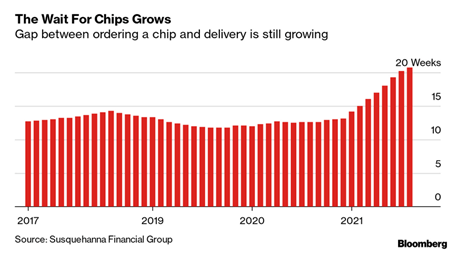
Governments have lifted restrictions only to repeatedly put them back again as the virus returned in second, third, and even fourth waves.  Ocean-going vessels ran short of shipping containers for clients and the clients scrambled to build inventories as their customers rushed orders.  Factories stopped and started due to uneven deliveries of critical materials ranging from semiconductor chips, coffee beans, cotton, and chemicals. 

Some politicians trumpeted recovery but realities on the ground were that supply chains have buckled under the stress of whipped up demand and limited supply and capacities. 

Supply chains aren’t in a crisis because of the pandemic.  The pandemic just aggravated what has been holding back supply chains. 

Silos. 

Many businesses had built walls and had focused only on what’s happening within; they ended up at the mercy of outside forces.  They faltered from disruptions that became more frequent this past decade, culminating with the global coronavirus pandemic. 

The concept of the supply chain, since its introduction in the 1970’s, requires managers and executives to not only interact with each other’s functions but also relate with parties along the supply chains they link to.

A butcher must take into account the origin of the meat he procures. 

Chemical companies must assure the lasting efficacies of its products from deliveries to customer to succeeding tiers of trade to the final consumer. 

We cannot not care.  We need to realise we are participants in a supply chain that runs through enterprises, not just within enterprises.  The bottlenecks our vendors face whether it be in material shortages or traffic gridlocks are our business as well as theirs.  The effects of how our deliveries cascade down from buyers to consumers are for our best interests to know and even be involved.    

We should mind the business of others, as we no longer can mind our own alone. 

This is what supply chain management teaches us.  A supply chain’s greatest strength lies in its links, in the connections we make with others. 

It’s a hell of a change in mindset. 

The good news is that many if not most enterprises we compete with are still stuck in the mindset of silos. 

The bad news is that they’re getting the picture too and they will soon be change to become better themselves. 

About Overtimers Anonymous