The First Step is Always the Hardest

The journey of a thousand miles begins with a single step.”  In building a supply chain, that single first step can be a doozy. 

When we construct a home or facility, the first thing we think we of doing is plan.  Seek a site.  Draft a layout.  Determine our budget. Schedule the construction. 

But that is not really the first step.  We consult real estate agents to find the best place to build.  We engage architects to draft the designs.  We talk to accountants to budget funds.  And we hire contractors for construction.  In short, we establish relationships before we build. 

The same very much applies for building supply chains. 

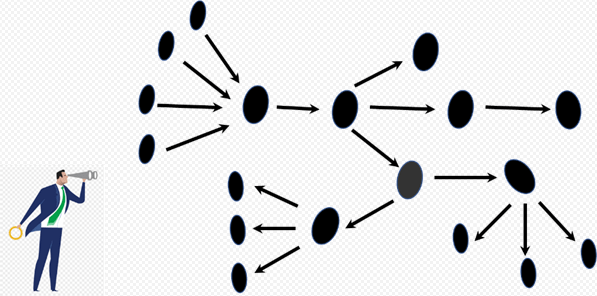
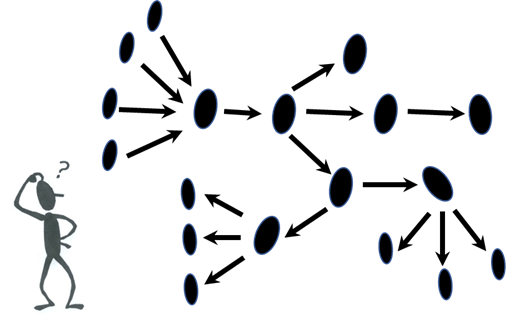
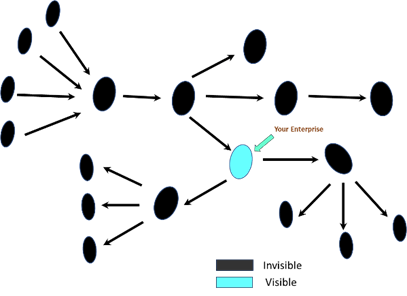
Before we build supply chains, let alone improve them, we’d need to first acknowledge the relationships that underlie them.   These include whom we buy from (vendors, service providers), whom we sell to (customers, clients, consumers), and the functions & departments within our own enterprises (e.g., manufacturing, logistics, purchasing, planning, sales, finance, marketing engineering, quality assurance, human resources). 

The contracts we sign with our vendors, the orders we accept from our customers, and the standards & policies we conform together with our enterprise counterparts form the bases of the operating structures & systems of our supply chains. 

Because supply chains are multi-tiered, our relationships include not only whom we buy from or sell to directly but also those who our vendors buy from and who our customers trade with.  We connect with all individuals & enterprises from where merchandise & services originate, to where they are converted or transformed, to who conveys or transports them, and to who are the final end-users or consumers.  Ideally, this includes all parties all along the supply chain, whether big or small, near or far, and within or beyond the borders of our enterprises.

Connecting with our relationships is the first step in building supply chains.  We assess our links, recognise the strong & weak ones, and renew our ties, if not make new ones. 

It’s not going to be easy.  It’s going to be a doozy.   But how we connect with our relationships will define our supply chain’s fate. 

Find Ellery

The Changing & Un-Changing Supply Chain

Since Keith Oliver and a Mr. Van ’t Hoff coined the phrase in the 1980s, supply chain management has evolved from an obscure middle-management responsibility to a high-echelon business priority. Supply chains had become hot topics in executive suites and business school lecture halls.  At the same time, operations managers face endless enigmatic problems as external factors from natural disasters to geopolitical events rock global trade. 

Supply chains are far more different from what they were in the 1980s but at the same time, they’re not, in some respects. 

What did change? 

Supply chains have advanced technologically. 

Thanks largely to pioneers like Amazon, consumers order many products via e-commerce portals. Warehouse management systems (WMS), artificially intelligent (AI) algorithms & robots assist logistics workers in allocating, picking, loading, and dispatching deliveries. 

Supersize containerships, self-driving vehicles, drones, and longer-range energy-efficient aircraft are propelling the transportation of merchandise not only faster and farther but also at greater volumes.   

Artificial intelligence (AI) is also enabling enterprises to upgrade not only the automation of their factories but also of their offices.  Executives had been aspiring to apply AI in the planning and execution of all supply chain operations. 

What didn’t change? 

Supply chains are global, but they always have been since civilisations began buying and selling from one another.  The ancient Silk Road connected Asian merchants with Europe.  Europeans, in turn from the medieval ages, shipped goods by sea to and from the American New World and the Far East.  American railroads, at the onset of the 19th century Industrial Revolution, transported products & people from the Atlantic coast to the Pacific.  In the 20th century, nations trade globally via the Internet and elaborate transportation networks. 

Supply chains had been predominantly dependent on contracts which organisations haggle and hammer out with vendors & customers.  At the same time, nation-state governments had taxed & regulated supply chain operations, such as manufacturing and export & import activities. 

Executives also had tended to limit supply chain management to operations which they have direct influence over.  Even before supply chain management became a buzz-phrase, enterprises already were forecasting demand, processing orders, controlling inventories, planning production & capacities, inspecting & assuring quality, reducing expenses, spending for fixed assets, supporting new product initiatives, and measuring performances. 

A good number of business owners, however, continue to treat supply chains as nothing more than logistics or transportation.  Manufacturing and purchasing functions have remained outside of supply chain managers’ scopes in many firms. 

Worse, some managers have blamed supply chain management for undelivered pending sales orders, product stock shortfalls, customer complaints, runaway costs, and high working capital. 

What also hasn’t changed was the perception that computerisation and automation are the best solutions for supply chains.  Much of what have been talked about in supply chain social media sites and business articles are how much hope executives, academics, bloggers, and consultants have been putting in on state-of-the-art artificially intelligent (AI) driven information technologies (IT) to drive supply chains to the next level, whatever that would be. 

And finally, what has also not changed since Keith Oliver’s time is that supply chains could only be improved via management.  Supply chain management is operations management, one of four basic branches of business administration which included sales & marketing, finance, and people. Supply chains are components of the business of operations. 

Executives had thought they could improve supply chains via management, they saw themselves as ready experts as per their business acumens.  They saw themselves as more than qualified what with their education from business schools and/or from their hands-on experience in their respective industries.  Executives had been confident they could manage supply chains via the basic management principles of planning, organising, directing, and controlling. 

Managers have gauged supply chains based on assessed capabilities. Hence, to improve supply chains, executives simply needed to hike capabilities.  The obvious options would be in tactics such as increasing production capacities, adding more logistics assets such as storage space & handling equipment, and hiring more people. 

Managers also leaned toward information technologies to drive supply chain improvements.  Executives just needed to invest in IT hardware & software to automate processes and streamline the flow of data & merchandise.  Never mind that almost one out of two enterprises have not succeeded in implementing new IT into their business. 

Also hardly changed was the bias of executives towards the other branches of business administration, namely sales & marketing, finance, & people (organisational development).  Many executives tended to delegate supply chain management to subordinates because they either had no professional experience, or they just didn’t see it as an avenue for personal career development.  Supply chain management was a slow-growth career path.  Much attention to supply chains in many firms stemmed from crises, such as when materials don’t arrive or customers complained about unserved orders, late deliveries, or off-quality goods. Many executives did not see supply chain management as an equal to strategic planning. 

Supply chains had, therefore, gotten stuck.  Executives stubbornly held on to the belief that supply chains were no more than internal operations which they by themselves could handle. New attractive technologies like AI & robotics, were the easy answers for improvements; all that was required was capital investment. 

If we want to improve supply chains, we’d need to change how we perceive them: 

  1. Supply chains are not limited to the internal operations of an enterprise; they encompass activities that add value to merchandise & services from the point of their creation to their final usage or consumption.
  2. Supply chains consist of relationships in which their effectiveness & efficiencies rest on the maturities of the partnerships forged between parties. 
  3. Structures & systems underlie the operations of supply chains, and they are where we should focus any improvement, not only in their capabilities, but also in their achievements to meet the strategic priorities of organisations. 

It would be quite a tall order for executives to veer from the mindset of meeting their enterprises’ individual priorities to that of nurturing supply chain win-win relationships and building structures & systems beyond the boundaries of their internal operations. 

This is not something entirely new.  Past civilisations had recognised the need to work with partners such as vendors & customers.  Merchants, craftsmen, and shipping owners had always been active in improving methods and workplaces. 

What’s different is that we should take in a more holistic approach in dealing with our supply chains.  As much as we may continue focusing on minute tasks, we should also be approach supply chains as relationships working together in unison.  We should define how every link should perform and how every connection should work together. 

It is from there, we can build the supply chains we want, regardless of how different they may be from the ones of today. 

Find Ellery

Aiming for Acceptance By Choosing Who Will Like You

Acceptance had become an economic necessity; a social media ‘like’ is a precious commodity, a metric that is a stepping stone to endorsements, to fame & fortune. 

Social acceptance is at the third (3rd) tier of Maslow’s Hierarchy of Needs.  The first tier is physiological needs (e.g., food, water), the second is security (shelter, employment).  After social acceptance is the fourth tier:  esteem (recognition, respect).  The fifth and final tier is self-actualisation, in which Abraham Maslow described as the point individuals could realise the best of who they can be. 

You, however, determine how much satisfaction is enough. 

You can eat and drink without excess. 

You don’t need a big place to live in. 

And you don’t need that many likes, if you could relate well with family & friends.

You choose who will like you as much as whom you will like. 

Find Ellery

What’s the Big Deal About 300?

People celebrate milestones; I’m no exception.

Birthdays, anniversaries, victories.  We celebrate sentimental times and achievements.

Sometimes, we play down some these things because whatever we’re celebrating doesn’t stand up to what others had done or had been awarded with.  We compare notes; we look small; we decide not to make a big deal. 

I once did a barbell squat of 197 lbs, but so what?  Others had squatted way more. 

The business I manage just churned an after-tax profit of USD$ 80,000, but what is that compared to the millions of dollars many other firms make?   

This is my 300th essay.  Many other writers had done more.  There are more famous authors who wrote scores of books.  So, what’s the big deal?

Essays are passé to most people, especially in the 21st century age of overly abundant information and short attention spans.  Essays compete but are essentially no match to streaming videos, blog posts, and artificially-intelligent-enabled data-bots. Who would want to read an essay for five (5) minutes when an AI program can provide the same insightful information in five seconds? 

Still, I’m amazed I wrote 300 essays. 

Fine, some were quite short as in less than a hundred words.  I will not apologise for it.  I learned that essays need not require so many words to make a point.  My late high school professor, Rev. Fr. Daniel Clifford, SJ (†) would disagree, as well as other traditional academic writing instructors who believe that essays need to be content-rich to be worthy.  But I couldn’t agree more with the less-than-a-hundred words philosophy of Grant Faulkner & Lynn Mundell

In our fast-paced world, making a point matters, especially one that will influence readers. 

That remains my goal, never mind it remains elusive.  (I don’t get many hits or likes ☹).

It can be quite heartbreaking to see other bloggers become viral, receive accolades, and multiply their followers as soon as they debut on social media. 

Obvious advice would be for me to give up.  Or change my strategy such as shifting to more attractive topics or seeking artificially intelligent (AI) assistance. Or find a famous sponsor who would plug me in with positive reviews. 

But I’m not giving up. 

Worse, I’m even going to try* to write a book.

For the meantime, I bask in the humble achievement of writing 300 essays and hope it brings some wind on my back as I begin an ambitious undertaking.  

*Given the seemingly insurmountable difficulties to book-writing, I emphasise the word “try.” 

Find Ellery

Why the Yellow Line?

The yellow median on the street means traffic is two-way.  When it’s white, traffic is one-way.  It’s one of many standards written in land transportation manuals and taught in driving schools.

In Philippine roads, however, white or yellow lines divide two-way highways. Motorists just know the lines divide the roads; it’s up to you to figure out if traffic is one-way or two-way. 

Many drivers don’t know or don’t care about medians, signs, or traffic lights.  “STOP” is a suggestion.  “YIELD” is whatever.  A red light may mean green; green means no need to brake.   

No wonder driving is dangerous in the Philippines.

About Ellery’s Essays

Beware the Fine Print

My sisters and I ate lunch at our favourite Japanese restaurant.

When we got the bill, I presented my credit card and mentioned to the server we like to avail of the 50% discount the card-issuing-bank and the restaurant were advertising. 

“Sorry, sir, but you do not qualify for the discount,” the server replied.  “Only customers who reserved in advance qualify for the 50% off.” 

The ad did say so…in the fine print. 

I paid the bill but presented my and sister’s senior citizen cards which qualified us for a 20% discount. 

It’s a lesson I always forget:  read the fine print

About Ellery’s Essays

A Reason to be Grateful

A 77-year-old family friend was angry with God.

He was born with only one (1) kidney, has congenital heart disease, and was hospitalised due to trouble breathing.  He was angry at God for the sufferings his illnesses caused.  

We told our friend:

“Should you not be grateful that you have lived 77 years despite your illnesses? That you have done well in business and have a happy marriage with successful children?”

Our friend didn’t respond but we think he got the message.

Do you, too? 

About Ellery’s Essays

No Such Thing as an Undignified Job

A well-dressed middle-aged Filipino man sat at the compartment of the train heading for Paris.  A passenger, an American woman, sitting across, asked what he did for a living.

Man: “I clean people’s houses.”

Woman: “You’re a maid?”

Man: “Yes.”

Woman: “Why are you on this train?”

Man: “I’m on vacation. I’m meeting my wife and children who are visiting from the Philippines.”

Woman: “How nice. I never would have thought a maid could earn so much money.” 

The man just smiled. 

There’s no such thing as an undignified profession.  So long as one earns well and is happy with the work, who cares what other people may say or think. 

About Ellery’s Essays

Demand Fulfilment Means Keeping One’s Promises

The airport lounge no longer granted access via my platinum credit card.  The credit card’s fine print did warn that perks may be withdrawn without notice. 

The bank dangled the lounge perk on top of other benefits.  I took it and the bank succeeded in selling me the card. 

But I’m unhappy because I no longer enjoy the perks the bank sold me for. 

Firms create demand by making promises.

Firms fulfil demand when they make good on their promises. 

About Ellery’s Essays

Knowing Your Inventory ABC’s

A business owner asked me:  how can I manage my company’s inventories more efficiently?

The business owner imported soap, luggage, and cell phones, in short: assorted merchandise.  He shipped in and kept hundreds of items in inventory, in which he had trouble keeping track.  Sometimes he had too many items in storage or had too few which quickly ran out of stock. 

I advised the businessman to try an ABC inventory system. 

An ABC inventory system classifies items under three (3) categories founded on Pareto’s Law.  (Pareto’s Law otherwise known as the 80-20 principle states that 80% of outcomes stem from 20% of inputs). 

In the ABC inventory system, I recommended to the businessman the following classification: 

Another way of putting it:

Sales is the product of price times quantity sold (P x Q) so items in a Group could either be selling at high volumes at low prices or at low volumes at high prices: 

An enterprise realises higher total sales as prices & quantities increase, and vice-versa if prices & quantities decrease. 

Operations managers would treat each group (A, B or C) differently. 

Group A inventories should be accurate and real-time.  Operations teams should count Group A items at least once a day and reconciled with book balances or with reports derived from the company’s database.  Procurement quantities & inbound logistics schedules should be based on what’s on stock, in-transit, and demand outlooks.  There should also be policies for safety stocks and customer orders management. 

Group B item inventories should also be accurate but need not be reviewed as often as that for Group A.  Managers may schedule counting & reconciling of items less frequently such as once a month.  Replenishment may be based entirely on reorder points.  Purchasing managers have more leeway to order bigger bulk quantities to avail of offered volume discounts. 

Group C items are items which require the least frequent inventory monitoring though this does not exempt storage facility staff to keep an eye on them.  Group C items include items which are at the sunsets of their product cycles and hence headed for discontinuance and eventually, the scrap heap. 

Group C items, however, may be significant in that they usually constitute half or a lion’s share of stock-keeping units (SKUs) and may take up significant, if not sometimes the most, storage space.  Operations managers should ideally buy Group C items only to match any confirmed customer orders and at the same time, keep stock levels low, if not wind down inventories. 

The business owner took my advice and tried the ABC system. 

After a few months, he reported that challenges remain but at least he was able to bring some formal control to his company’s inventories.  Staff had more clarity on which items to count more frequently (Group A) versus those which they didn’t have to as often (Groups B & C).  Staff also had a better idea which items needed more marketing (Group C).  And the owner had a better handle of planning how much to buy & stock such that he could control his working capital. 

Enterprise owners can vary the ABC to suit whatever needs they deem fit.  There can be more than three (3) categories [e.g., ABCD] or even just two [AB].  Managers may use other criteria such as turnover (inbound & outbound quantities), total delivered cost of goods, or value of purchases, rather than the standard value of sales.    

The point is to use what works best for one’s business. 

About Ellery’s Essays