Beware the Fine Print

My sisters and I ate lunch at our favourite Japanese restaurant.

When we got the bill, I presented my credit card and mentioned to the server we like to avail of the 50% discount the card-issuing-bank and the restaurant were advertising. 

“Sorry, sir, but you do not qualify for the discount,” the server replied.  “Only customers who reserved in advance qualify for the 50% off.” 

The ad did say so…in the fine print. 

I paid the bill but presented my and sister’s senior citizen cards which qualified us for a 20% discount. 

It’s a lesson I always forget:  read the fine print

About Ellery’s Essays

A Reason to be Grateful

A 77-year-old family friend was angry with God.

He was born with only one (1) kidney, has congenital heart disease, and was hospitalised due to trouble breathing.  He was angry at God for the sufferings his illnesses caused.  

We told our friend:

“Should you not be grateful that you have lived 77 years despite your illnesses? That you have done well in business and have a happy marriage with successful children?”

Our friend didn’t respond but we think he got the message.

Do you, too? 

About Ellery’s Essays

No Such Thing as an Undignified Job

A well-dressed middle-aged Filipino man sat at the compartment of the train heading for Paris.  A passenger, an American woman, sitting across, asked what he did for a living.

Man: “I clean people’s houses.”

Woman: “You’re a maid?”

Man: “Yes.”

Woman: “Why are you on this train?”

Man: “I’m on vacation. I’m meeting my wife and children who are visiting from the Philippines.”

Woman: “How nice. I never would have thought a maid could earn so much money.” 

The man just smiled. 

There’s no such thing as an undignified profession.  So long as one earns well and is happy with the work, who cares what other people may say or think. 

About Ellery’s Essays

Demand Fulfilment Means Keeping One’s Promises

The airport lounge no longer granted access via my platinum credit card.  The credit card’s fine print did warn that perks may be withdrawn without notice. 

The bank dangled the lounge perk on top of other benefits.  I took it and the bank succeeded in selling me the card. 

But I’m unhappy because I no longer enjoy the perks the bank sold me for. 

Firms create demand by making promises.

Firms fulfil demand when they make good on their promises. 

About Ellery’s Essays

Knowing Your Inventory ABC’s

A business owner asked me:  how can I manage my company’s inventories more efficiently?

The business owner imported soap, luggage, and cell phones, in short: assorted merchandise.  He shipped in and kept hundreds of items in inventory, in which he had trouble keeping track.  Sometimes he had too many items in storage or had too few which quickly ran out of stock. 

I advised the businessman to try an ABC inventory system. 

An ABC inventory system classifies items under three (3) categories founded on Pareto’s Law.  (Pareto’s Law otherwise known as the 80-20 principle states that 80% of outcomes stem from 20% of inputs). 

In the ABC inventory system, I recommended to the businessman the following classification: 

Another way of putting it:

Sales is the product of price times quantity sold (P x Q) so items in a Group could either be selling at high volumes at low prices or at low volumes at high prices: 

An enterprise realises higher total sales as prices & quantities increase, and vice-versa if prices & quantities decrease. 

Operations managers would treat each group (A, B or C) differently. 

Group A inventories should be accurate and real-time.  Operations teams should count Group A items at least once a day and reconciled with book balances or with reports derived from the company’s database.  Procurement quantities & inbound logistics schedules should be based on what’s on stock, in-transit, and demand outlooks.  There should also be policies for safety stocks and customer orders management. 

Group B item inventories should also be accurate but need not be reviewed as often as that for Group A.  Managers may schedule counting & reconciling of items less frequently such as once a month.  Replenishment may be based entirely on reorder points.  Purchasing managers have more leeway to order bigger bulk quantities to avail of offered volume discounts. 

Group C items are items which require the least frequent inventory monitoring though this does not exempt storage facility staff to keep an eye on them.  Group C items include items which are at the sunsets of their product cycles and hence headed for discontinuance and eventually, the scrap heap. 

Group C items, however, may be significant in that they usually constitute half or a lion’s share of stock-keeping units (SKUs) and may take up significant, if not sometimes the most, storage space.  Operations managers should ideally buy Group C items only to match any confirmed customer orders and at the same time, keep stock levels low, if not wind down inventories. 

The business owner took my advice and tried the ABC system. 

After a few months, he reported that challenges remain but at least he was able to bring some formal control to his company’s inventories.  Staff had more clarity on which items to count more frequently (Group A) versus those which they didn’t have to as often (Groups B & C).  Staff also had a better idea which items needed more marketing (Group C).  And the owner had a better handle of planning how much to buy & stock such that he could control his working capital. 

Enterprise owners can vary the ABC to suit whatever needs they deem fit.  There can be more than three (3) categories [e.g., ABCD] or even just two [AB].  Managers may use other criteria such as turnover (inbound & outbound quantities), total delivered cost of goods, or value of purchases, rather than the standard value of sales.    

The point is to use what works best for one’s business. 

About Ellery’s Essays

Problems vs. Situations

Problems have solutions. Situations are simply things we need to live with, Seth Godin writes. 

He goes on to say:

Once we realize that a problem we have isn’t a problem at all, but actually a situation, it’s easier to do our best to move on and thrive. Focusing on a situation is usually a source of stress, not a way forward.

I disagree.

There may be problems where there are no available solutions; it doesn’t mean there aren’t. 

A mediocre person says: “I’ll do my best.”

A great person says: “I don’t believe in no-win scenarios.” 

About Ellery’s Essays

Productivity: They Still Don’t Get It

Leading global consultancy McKinsey defines productivity as Gross Value Added (GVA) per work-person and reports that the world needs productivity growth on top of balance sheet profitability.

McKinsey still doesn’t get it.  The world doesn’t need labour productivity, it needs supply chain productivity, which is how fast and how much organisations sell merchandise and collect revenue vis-à-vis utilisation of resources & assets. 

Limiting productivity to labour alone is narrow-minded.  It propels bias towards reducing headcount and adding workloads to employees. 

Focus should be on performance of operations, not just people. 

About Ellery’s Essays

The Marimba Player

Maybe you should try the marimba.”

It was a statement, not a question. 

My music teacher was exasperated with my piano lessons.  The teacher believed the piano was not for me. 

The marimba, which is unfairly labelled as an oversized xylophone, utilises only one scale versus the piano’s two, which made it easier to teach.

I got the hang of the mallets in no time, and my music improved. 

Like most students, I played in a recital before I graduated high school.  My music teacher gifted me a cheap plastic bust of Mozart, which I treasure to this day. 

I never saw my music teacher again. 

How I very much regret for not ever thanking her.

About Ellery’s Essays

The Good Problem

The repairman sighed.  No one called; there was nothing to do. 

The ad said it best:  we make dependable appliances

That meant that the repairmen, even though employed and salaried, had no jobs pending.  They were there just in case, nothing else. 

It was a lonely life, and the repairmen complained about the loneliness. 

For the company’s executives, having lonely repairmen was a good problem.  They would rather have that than the alternative, which wouldn’t be good. 

The brand, however, was long gone.  They don’t build them like they used to. 

About Ellery’s Essays

The Need to Change the Supply Chain

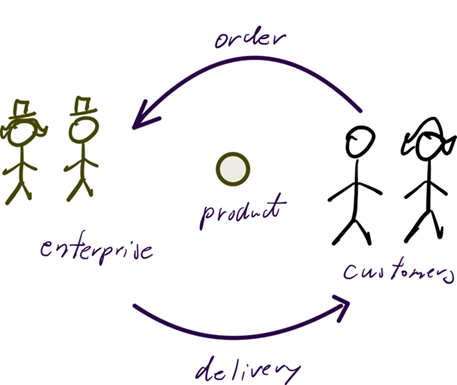
When a parcel arrives at my doorstep, I see myself at the end of a supply chain process—a process which involved multiple operations from procurement, manufacturing, to logistics.

But I could care less.  What mattered is I got my parcel and the items I ordered.

The individuals in the respective supply chain processes which enabled the delivery of my items could care less too.  What mattered to them was that they did their jobs, got paid for it, and were moving on to delivering their next order. 

Many a mission of supply chain managers is to deliver products & services at the right time, at the right quantity, at the right quality, and at the least cost.  Supply chain professionals deemed their jobs done as soon as they finish delivering the orders of their respective enterprises’ customers.   

Unfortunately, the adverse events of the 2020s taught me that this mission was flawed.  The mission was too limited in scope in that it did not consider the many processes which laid outside the boundaries of individual enterprises.   

A first reaction would be that supply chain managers should work with their partners, i.e., vendors, service providers, & customers.  It, however, went deeper than that.  Supply chain managers had look at not only those who were next door to them but also at those who were further before or after the vendors & customers of their enterprises.  Supply chain managers needed to work with partners to improve the productivities of all the connections of the supply chain from the sources to the end-users. 

That was a tall order to ask, as a lot of work would be required just to establish the relationships between all the members of the supply chain. 

But it was becoming necessary because of the adversities. 

Adversities are unfavourable situations which arrive in untimely fashion.  They not only disrupt the operations of enterprises but also entire supply chains as well.  They can be natural or man-made such as earthquakes, weather disturbances, epidemics, wars, trade barriers, or a groundbreaking app invented by an entrepreneur.  They can originate from outside or inside enterprises and the disruptions they cause could be far from predictable. 

Adversities had become fiercer as supply chains went global and became more complicated.  Selling to global markets and sourcing from locations halfway around the world came with compounded risks.  Enterprises had not adapted or anticipated these risks.  

Unprecedented adversities, thus, buffeted supply chains at the onset of the 2020s.  Executives found themselves at a loss as they had no influence or upper hand over the adversities.  They did not know what to do as disruptions made demand & supply more uncertain.   

Executives complained to government leaders which was futile since many politicians were just as much as the reason for many adversities in the first place.    

Executives preached resilience but what did that even mean, other than hunkering down and weathering through storms? 

Some hoped that benefits of new breakthrough technologies like Artificial Intelligence (AI) would outweigh the impacts of adversities setback.  But then again, many executives could not comprehend what AI was or how it could be applied.  AI wasn’t a know-it-all computerised oracle which could solve any problem. 

Supply chain managers resorted to traditional playbooks to seek ways out of adversities. 

They looked for alternative suppliers, preferably nearer to their manufacturing & logistics locales, and thereby closer to customers. 

They attempted to re-negotiate contracts with existing vendors & service providers, especially those their enterprises could not quickly switch away from.

They asked for help.  They argued with legal teams to lobby for government relief (like Apple asking the American administration to defer tariffs on smartphones & other computer equipment).  They requested chief finance officers (CFOs) to allocate more working capital to build inventories.  They worked with human resource managers & labour union leaders in seeking concessions to optimise head counts & payroll expenses. 

But the playbooks could go only so far (if they didn’t fail outright). 

Supply chain managers had to face reality.  The traditional playbooks were no longer useful in overcoming adversities especially those which affected entire supply chains.   Managers needed new methods to solve problems pertaining to the overall supply chain than to operations within the walls of their respective enterprises.   They needed to change the systems & structures that underlie the supply chain. 

Supply chain managers had to first embrace productivity as their aim.  It was no longer about respective enterprises delivering the goods at the right quantities, right qualities, right times, at lowest cost to the next direct link on the supply chain.  It was more about adding value to the merchandise & services which flowed through the supply chain.   Productivity was the aspiration to bringing about more value or worth to every linked enterprise in the supply chain.      

Supply chain management by itself won’t be enough in bringing about productivity improvement.  Supply chain managers needed supply chain engineers.  

Engineers build systems & structures that enable supply chain operations.  Managers oversee operations.  Engineers build or change them. 

Managers plan, organise, direct, & control resources & people.  Engineers design, experiment, test, and commission systems, structures, & equipment. 

If enterprises were to work together to boost the productivities of the supply chain they belong in, they’d had to adopt engineering principles and methodologies. 

Industries had become global in the 2020s and in the territories where enterprises set up shop, adversities became more severe.  So much so that enterprise executives were dumbfounded on how to mitigate the risks and tackle the disruptions.  Supply chains needed to change and supply chain management wasn’t the means to do so.  Organisations needed supply chain engineering.     

The good news is that supply chain engineering (SCE) stems from industrial engineering (IE), a field that has been around since the end of the 19th century, right before the height of the Industrial Revolution. 

The bad news is that many executives and engineers themselves are not familiar with SCE and some have very little recognition of IE itself. 

Nevertheless, executives are slowly recognising the need to communicate & collaborate with their partners & linked enterprises along the supply chain.  Many businesspeople had experienced the disruptions of entire supply chains but don’t know what to do afterward. 

The answer is to boost productivity and to do this via supply chain engineering. 

About Ellery’s Essays