People Aren’t Changing, We Are

The late reverend Fr. Rafael Cortina(†), S.J., the counsellor for my senior high school class in 1980, said it a few times: people aren’t changing; you are

Fr. Cortina’s context was as we young people grow up, we encounter changes in our environment.  We think it’s the people around us who are changing but in reality it is us.

We complain that customer services of businesses have gotten worse when really, we had raised our own expectations.  What was satisfactory to us several years before is no longer the case and so we complain about services that we were happy with before. 

We complain our Internet receptions for our smartphones are super slow but we forget that not many smartphone models several years before had the capability to surf the web.

We complain about how an hour would be so long to wait in line at the bank but we forget that we were waiting for two (2) hours at the same bank a year ago.  Thanks to an automated queuing system installed six (6) months ago, wait times at the bank had been cut but we complain anyway because we now have higher expectations. 

Other people aren’t changing; we are changing. 

The world changes as fast as we do.  As we adapt to changing times, we change too.  As we physically age and gain more experience, we change too.  As we learn and accept new ideas, our mindsets change and we do too. 

When we say people are changing, we react defensively.  When we say we are changing, we act proactively.  For the former, we look at ourselves on the receiving end of what are being thrown at us.  For the latter, we see ourselves as changing and the ones who will decide what to do with our changing selves. 

It’s a not an ‘us against them’ issue but as a ‘what am I going to do with what’s new with me’ question. 

We don’t stay the same.  We change every day as we undergo new experiences, learn new things, and gain insights.  What we are today will be different tomorrow, even if only slightly.

In our fast-moving world where we are fed information and ideas at overwhelming quantities, we are changing much faster than we think. 

Acting proactively has never been so essential as today.

About Ellery’s Essays

Sometimes It’s the Smallest of Things that Cause Big Problems

It can take three (3) hours to travel to the hot spring pools of Los Baños, Laguna in the Philippines. Authorities have invested millions of dollars in improving the highway’s infrastructure but motorists still complain about the long travel time.  At one intersection of the highway leading into the town, a lone traffic cop stops traffic twenty (20) minutes at a time for each side.  The queue of vehicles builds up and it can take up to an hour just waiting to cross the intersection. The Los Baños local government finally installed a traffic light to improve vehicular flow.    

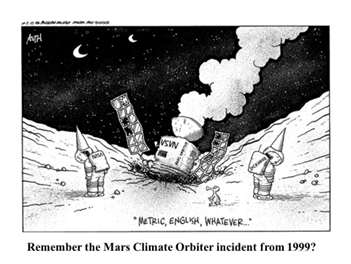
In 1999, the United States’ National Aeronautics & Space Administration (NASA) lost a USD$ 125 million probe to the planet Mars because ‘because a Lockheed Martin engineering team used English units of measurement while the agency’s team used the more conventional metric system for a key spacecraft operation.’  The probe, the Mars Climate Orbiter, was at the end of its 286-day journey and was in the process of putting itself into orbit around the red planet.  The wrong calculations inputted to the probe forced it into the wrong position, causing malfunctions in its propulsion system.  NASA lost contact with the probe which probably bounced from the Mars atmosphere and headed towards the Sun. 

Many times, it’s the small things that cause the big problems.  Address the small things and chances are the problems will be solved outright. 

Yet, many corporations and organisations miss the small things. They hire highly paid engineers and consultants who recommend expensively sweeping solutions such as replacing old machines with new ones, installing an integrated information system, or re-structuring the enterprise’s organisation. 

Small causes often require easy solutions.  There will of course be some work to set up any solution, such as purchase & installation of needed equipment, education & training, and testing.  But it’s likely that the solution involved won’t be major in expenditure in terms of cost and time. 

At an energy company I was a consultant for, supervisors at the company’s geothermal power control room complained that executives were slow in approving new automated valves needed to control the flow of steam from underground wells & pipes to the power plant’s turbines.  Supervisors were forced to drive to the wells to manually turn valves on or off to regulate steam output.  Executives didn’t see the importance of new automated valves but they’d complain how come steam-to-power energy yields were not meeting targets and why expenses for overtime and diesel fuel were over budget.

And that’s why many small causes aren’t addressed and problems solved immediately.  We don’t see.  We don’t walk around.  We don’t ask.  We don’t delve into the causes.

Many small causes can also be fixed, if not prevented, if managers have sufficient autonomy and authority to fix them.  Some of us who are executives place too many limits on managers such as needing approval to buy critical parts, to proceed in the repair of an equipment, or to give assignments to workers. 

Enterprises encounter problems all the time.  Few are crises; many are rooted in small causes, such as a not-well-trained traffic cop or an error in calculations for a space probe.  Problems with small causes are more often than not easily and quickly solvable, albeit some investment in time and resources may sometimes be needed.

For various reasons, we pursue complicated strategies to solve problems caused by small things.  We fail to see the real reasons behind many problems.  We in turn become more the cause to the festering of problems and crises in organisations. 

We would do well to go back to basics when it comes to management.  We should walk around, see things for ourselves, and delegate many issues to the staff we hired to trust in the first place. 

About Ellery’s Essays

Scarcity and Abundance Depend on What We Need and Where We Are

My bedroom gets sunlight for only a few minutes every morning.  Because my room faces the north-east and because there are trees nearby, the morning sun’s rays shine through my window for only a moment, passing through a break between the tree branches. 

Then it’s gone, for the rest of the day. 

The sun’s rays hardly come in at all later in the year as the sun angles southward, away from shining directly onto my bedroom window. 

The availability of sunshine is relative to the place where it is received.  Extreme northern and southern regions of Earth get almost no sunlight in their respective winter seasons but receive almost 24 hours of sunlight during their summers.  We folks near the tropical equator get sunlight up to almost 12 hours every day.

Sunlight is free but how much we receive is beyond our control.  It is therefore abundant for some and scarce for others at different times of the year at different places of the Earth. 

The same applies for resources like water, agriculture, and fish.  Some places have plenty of these while others have to make do with much less.  For fossil fuels and minerals, there are times during the year when the stuff can easily be mined and drilled and when it’s difficult to do so (like in winters when the ground is icy hard).    

Technology offers some answers to maximise what we can get from resources but there’s only so much we can avail depending on the place and time of year. 

How we procure what we need when we need them boils down to how well we manage our inventories and schedule our operations.  We harvest, fish, or mine when seasonal stocks are abundant and accumulate enough to supply us through the lean months.  We carefully plan how much we will store to meet anticipated demand and invest in storage & logistics facilities so that we have enough to keep and sufficient resources to deliver. 

Both demand and supply are, however, fickle.  Consumers, for whatever reason, may want more or much less than forecasted.  What we harvest, fish, or mine may be more or much less than we expected.  In any case, we always need to adjust.  Whether items are perishable or not, it’s never really a good idea to have too much of anything and always downright unacceptable to have no more stock available to use or sell. 

We’d like to supply as much as we can to all buyers and exact tidy profits from doing so.  We are after all taught to be greedy; we want to sell as much as we can and obtain as much as we can get. 

Reality, for many of us, however, doesn’t work that way.  There will often be limits to how much we can get and how much we can sell.  We therefore choose whom to sell to and work with whatever supply would be realistically available.  In short, we budget and allocate. 

Management is a lot about setting targets and meeting them realistically.  As much as resources can be plentiful, there will only be so much we can avail at a given time.  And whether or not we have enough to meet demand, we can only make available finite quantities. 

There is no such thing as unlimited. 

About Ellery’s Essays

The Pros & Cons of Trigger-Dependent Systems

I complained to the Philippines’ Department of Trade & Industry (DTI) that a mobile phone seller didn’t honour the terms of a promotion in which I was entitled to a PhP 3,000 allowance to buy smartphone accessories.  The DTI responded that I have to fill out a form before the department would respond.  No form, no action.

Many systems are trigger-dependent, that is, they don’t work until a prerequisite is satisfied. 

A pizza parlour, for example, won’t deliver until there’s an order from a customer. 

An usher won’t let patrons into a movie theatre until they show their paid ticket stubs. 

A contractor won’t start building a house until the architect and the homeowner approve the plans. 

A warehouse won’t let a truck out without a signed gate pass.   

A vendor won’t deliver without a purchase requisition.

For many enterprises, system triggers are important if not essential.  Operations won’t proceed unless there’s authorisation or an order.  Manufacturing operations won’t run until the accomplishment of needed activities beforehand such as the refining of raw materials prior to the manufacture of finished products.  System triggers ensure control and clarity in the running of processes.   

Auditors target the absence of triggers when they check operational deviations.  Was there a signed customer order before an invoice was printed?  Was there authorisation to release cash for payment to a supplier?  By pointing out the absence of triggers, auditors can check for possible malfeasance as well as point out where managers can improve process controls. 

Managers and their subordinates, however, can become dependent on the triggers.  Managers like control and some won’t permit subordinates to start something without permission, authorisation, or order.  But as both managers and subordinates become so dependent on triggers, they may lose their sense of initiative.  They both become people who wait for things to happen rather than making things happen. 

In a factory that was fabricating various metal products, for instance, a supervisor instructed workers not to start work until she gave out their written job orders.  The factory opens early at 7am but the supervisor gives out the job orders at 9am at the earliest.  Asked why it took two (2) hours to prepare the job orders, the supervisor said she had to wait for a planner at the main office to tell what products to make for the day.  The main office opens at 8am and the planner in charge of sending the day’s production schedule had to wait for the managing director to approve it.  The managing director arrives daily at the main office at 8:30am. 

An answer to improving productivity for the factory is for the main office and managing director to approve the production schedule the day before so that the supervisor can already have job orders ready first thing in the morning. 

But a better answer is to give the planner the authority to prepare and forward the daily schedule to the supervisor without having to wait for the managing director to approve it.  The planner instead could make out an earlier weekly production plan which the director can approve.  The planner would notify the managing director when there are changes in the plan during the week in question. 

In this scenario, the planner and supervisor are given the power of initiative; both get autonomy to schedule the manufacturing of metal products more productively.  They both gain some leeway to flex production timetables as long as they don’t end up delaying targeted delivery lead times to customers. 

Trigger-dependent systems assure control and efficiency.  But they don’t help productivity if the systems encourage people to wait rather than act. 

Enterprise executives invoke trigger-dependent systems because they want to control operations such that they comply with standard procedures and policies.  The trouble with trigger-dependent systems is that people may end up too dependent on triggers that they end up waiting for them instead of acting with initiative.  People aren’t machines; we have the ability to learn and improve and to decide what would be best for our employers as long as we understand policies and we agree with our superiors’ standards and strategies. 

It’s nice to have triggers but it’s better if we can trust the people we hire to pull them.

About Ellery’s Essays

Many People Don’t Use Toilet Paper

Many people don’t use toilet paper.  For some, it’s a cultural thing.  For others, it’s economics.  As a matter of fact, more than four billion people don’t use toilet paper. 

Many people in Asia, Africa, and even in Europe don’t particularly like toilet paper.  For some of them using toilet paper is downright disgusting. 

In Japan, people prefer to use the bidets in their toilets as the means to cleanse themselves.  In other countries, they wash themselves with water after they finish.  Using toilet paper to many people is not sanitary. 

Some people, however, just can’t afford toilet paper or it isn’t simply available.  Aside from being poor, some live in rural isolated areas not readily reachable by toilet paper marketers.  Some also make do with very rustic restroom facilities that don’t make it really feasible to use toilet paper. 

The earliest use of paper for cleaning after oneself at a toilet traces back to China in 589 AD.  Widespread use in succeeding Chinese dynasties followed, notably among wealthier people.  Many people, however, also preferred alternatives such as water, cloth, or leaves to cleanse themselves.  Paper was just one of many popular means after toilet use. 

It was in the 19th century that Joseph Gayetty invented and introduced the commercial toilet paper which many of us are familiar with today.  Today, more than seven (7) billion rolls of toilet paper are sold yearly in the United States alone.   For those of us who have grown accustomed to it, toilet paper has become an item we can’t imagine living without. 

When we face facts that don’t agree with our mindsets, we either respond or withdraw.  We all have our beliefs and when we face facts that go against them, we feel forced to respond.  Many times we’d rather not confront those facts, choosing instead to remain in our comfort zones.

We all have comfort zones.  Comfort zones are situations where we feel in control and secure with whatever beliefs and values we have.  

Comfort zones can manifest themselves physically such as in the dens or bedrooms of our residences where family members find privacy or in associations such as church communities where individual members feel belonged and faithful to a common deity. 

Comfort zones are more of states of mind than something physical; the physical being more of a reinforcement of what we want to think and believe.  They are where we find realities in alignment with our beliefs.  They are our heavens on earth. 

When we are in our comfort zones, the last thing we want is something challenging its justification to exist.  We call such things disruptions, which can range from the mere annoyance to a tidal wave of opposing views. 

A fact that more than half the world’s population does not use toilet paper disrupts the comfort zones of those who do.  Many toilet paper users may laugh at the fact and forget about it, but for some who have travelled to places where toilet paper is not readily visible, it can be a jolt. 

People who have used toilet paper all their lives wouldn’t readily welcome the idea of not using it wherever they may be.  Never mind what other people say that it isn’t sanitary or that it is getting more expensive or unavailable to buy, the toilet paper advocates have always used it and they can’t do without it. 

How we respond to disruptions to our comfort zones determines how we lead our lives and what we can expect in return. 

We either elude or fight for our comfort zones.  For instance, if we travelled to a country where toilet paper isn’t popular (and where the toilets may be nothing more than a hole in the ground), we either surrender to the situation and do what the local people are doing or we push back and insist that the item be made available no matter what the cost.  Either option can be stressful which is what happens when we experience disruption to our comfort zones. 

As much as possible, we rather not like to leave our comfort zones.  But for those who do, there are advantages, one of which is the thrill of discovery of and insight into new ideas. 

The cleansing habits of the Japanese, for example, have provided many visitors to their country a perspective into their sanitary routines.  Most Japanese practice cleanliness and organisation at a very high standard.  Many have learned the benefits of Japanese housekeeping.

For the courageous among us who immerse themselves in the rural corners of the world where toilet paper is unavailable and unaffordable, we can come to appreciate the challenges of logistics in bringing basic commodities productively to far-flung places and the untapped markets of consumers willing to avail of them. 

We don’t have to abandon our comfort zones to become successful people; we just have to at least understand what it’s like from another one’s point of view.  It does require stepping out of our comfort zones but in return we may learn something new that we could cultivate for own benefit.

There will always be disruptions; it’s just a matter of how we respond to them. 

About Ellery’s Essays

Tools are Just as Important as Talent

A mechanic once advised a trucking owner that his job is only as good as the tools he has.  The trucking owner agreed and bought all the tools & supplies the mechanic needed.  The owner was rewarded with trucks that hardly had breakdowns.  If there were, the mechanic would immediately have the broken-down truck repaired within a few hours.  The result was increased revenue and the appreciation of good delivery service by the truck owner’s clientele. 

A lot has been said about talent but not much about the tools and instruments the people we hire use.  Many enterprises insist on hiring talented people but would scrimp on tools and instruments.  The results then speak for themselves. The jobs we give to talented people end up done short of our expectations because the talented people didn’t have the right tools or instruments that they needed.

When managers at an energy corporation complained that the quality control department took a long time in clearing materials for use, the QC laboratory staff retorted that the managers hadn’t acted on their repeated requests to buy new testing equipment.  The managers said that the equipment, which included specialised ovens, were too expensive.  The laboratory staff said that their ovens were already old and were difficult to start up every morning; hence, the QC laboratory couldn’t test materials fast enough.  Executives, thus, asked the purchasing department to rush the order for new ovens.  The QC laboratory was fully staffed but they didn’t have capable equipment such that they couldn’t do their jobs and meet the enterprise’s expectations. 

We see the same situations in offices where administrative assistants end up working overtime because their desktop computers are slow and outdated.  We see this also in cafeterias where servers complain there are not enough plates, utensils, and trays to serve customers.  And we see this in banks where there are enough tellers but poor internet connections force long transaction times for waiting clients.   

Talent is only one factor when it comes to pursuing productivity in the workplace.  The other is having adequate tools, instruments, and supplies for the talented people to work effectively. 

About Ellery’s Essays

I Hate It When People Rush Me

I don’t play golf.

It’s not only because I’m a lousy player (although that has a lot to do with it).  It’s also because I hate it when people rush me at the golf course.

When I used to play golf, the caddies would tell me to hurry up because there were other players who were following one hole behind me.  The caddies would rush me even more if some VIP general or rich person was playing just behind me and the caddies wanted that person to pass. (In the Philippines, VIPs—so-called very important people—are usually high-ranking military officers, politicians, business executives, and large landowners who assert themselves as such. Caddies also get big tips from these VIPs, hence why they get so much priority on the golf courses). 

Golf is a sport that requires pacing, not rushing.  Caddies, however, would still rush me and even get mad if I don’t hurry up.  I gave up golf as soon as I could.

Rushing to get something done or to go anywhere spoils the pace of productivity. Haste makes waste, as the adage goes, and when we rush things, quality and efficiency suffer.

It’s already bad enough when clients don’t pay vendors and contractors what are owed the latter by a certain date.  Executives would rush subordinates to get something done even if they themselves are slow in settling past dues with the people they owe. 

Haste makes waste.  Rushing has no benefit.

It’s not a good idea to rush.  It’s better to pace; it’s more productive.

About Ellery’s Essays

Quality is Free; Value is Not

Is quality free? Philip Crosby in his book, Quality is Free, believes it is when we adopt a Zero Defects policy.  An enterprise can achieve quality in its products and services without having to pay more. 

Quality may be free but value is not.  At least to consumers searching for the best products and services.  We have to pay more for better value. 

Consumers may perceive a Mercedes car as better value than a Toyota, for example.  This may be because a Mercedes Benz car runs faster than a Toyota on an autobahn or expressway.  If the consumer’s criteria are a car that can go fast and at the same time has a luxurious interior, the Mercedes would win over a Toyota.  The consumer would need to pay more for the Mercedes, however. 

There’s no cost to getting products to conform 100% to specifications.  Enterprises just need to ensure systems are following instructions to meet the standards that lead to zero-defects quality.

But there is a cost if we want a product to be superior than another in a particular performance category. 

Quality is free for the managers who oversee their operations to reduce defects.

It isn’t free for the customers who expect better value. 

About Ellery’s Essays

Why There are No Patron Saints for Modern Business

The Jesuit priest in his homily for the Catholic mass service I was attending with fellow high school students many years ago declared there were no Catholic patron saints for business people.  At least there weren’t any who could be a model for those who led corporations and enterprises. 

In the Roman Catholic Church, patron saints are canonised saints who a person or a community considers as ‘a special intercessor with God and the proper advocate of a particular locality, occupation, etc., and merits a special form of religious observance.”  A patron saint is a “heavenly advocate of a nation, place, craft, activity, class, clan, family, or person.’

Communities, like the barrios in my hometown country of the Philippines, would have a patron saint, a person to pray to for whatever intentions, be it for good fortune or for assistance in a crisis.  The barrios would hold fiestas, or celebrations complete with parades and group parties, on the feast days of their respective patron saints. 

Hospitals, courts of law, retail stores, and schools also would have patron saints as their divine sponsors.  Many would name themselves after their respective patron saints. 

A saint can be patron for more than one group or place. Many churches, for example, schedule the blessing of animal pets on the feast of St. Francis of Assisi, even though a tour guide at Assisi scolded me once that St. Francis is first and foremost the patron saint of Italy.

There is a patron saint for just about every profession.  For academics, there’s St. Thomas Aquinas; for accountants: St. Matthew, evangelist and former tax collector; for doctors of medicine: St. Luke, evangelist; for lawyers: St. Mark, evangelist; for fisherfolk: St. Peter the Apostle; and for athletic sports: St. John Paul II.

For business people, there is supposedly one patron saint:  St. Homobonus. 

Saint Homobonus was ‘a merchant from Cremona, northern Italy. Born Omobono Tucenghi, he was a married layman who believed that God had allowed him to work in order that he would be able to support people living in a state of poverty. His name is derived from the Latin homo bonus (“good man”).’  

St. Homobonus was no multi-millionaire but he apparently succeeded as a merchant in his town.  He was honest and helped people by donating some of his profits.  St. Homobonus was a devout Catholic and Pope Innocent III was impressed enough to canonise him in 1199, two (2) years after St. Homobonus’ passing.

St. Homobonus, to this day, is the one and only patron saint for business enterprises.  Except for a church in Rome and a commune in Bergamo, Italy, he is a virtual unknown.  The Jesuit priest erred in overlooking St. Homobonus as the patron saint for business people but we can forgive him for his mistake given that many business enterprise executives haven’t even heard of him.   

The Jesuit priest’s point of his homily is that being saintly contrasts with the practice of the business profession.  Business people pursue profit and the accumulation of wealth on top of gaining competitive advantage, power, and esteem.  The saintly priorities of sharing possessions with the less fortunate, helping communities, and working for a Divine intangible God are not in the to-do lists of typical business executives. 

Many business people are good people who lead morally upright lives.  Many raise families who are faithful in Christian teachings.  Many successful business leaders have very respectable reputations for sharing much of their wealth with less fortunate communities.  Microsoft founder’s Bill Gates and Berkshire Hathaway’s Warren Buffet are citable examples of business magnates who have given much of what they have to charities. 

Despite how good business people may be or how much they donate, most, if not all, enterprise executives wouldn’t make the cut for sainthood. 

The Roman Catholic Church calls all faithful followers to live to be saints, or to be those who lead heroically virtuous lives, offer their life for others, or were martyred for the faith, and who are worthy of imitation.  To become a canonised saint in modern times, however. requires any candidate to undergo a stringent series of examinations, more so than what it took for St. Homobonus to go through.

A ‘good person’ who worked hard, lived a pious life, and shared profits with poor people probably won’t qualify for canonisation in the 21st century’s Catholic Church.  By modern canonisation rules, candidate saints would need to pass three (3) levels before being considered recognised as such:

  1. Venerable: The Pope would need to notice a deceased saint’s heroically virtuous life or offering of such a life;
  2. Beatified & Blessed: There must be a miracle attributed to the candidate saint;
  3. Canonisation: A second (2nd) miracle after the attainment of beatification. 

I doubt very much St. Homobonus would have been able to pass these standards, and thus more so we could doubt business people would even be in the running even if they aspired to it.     

Are business people evil?  They definitely don’t share the same priorities with the leaders of the Church.  And because they don’t, we probably won’t see business people being model saints in the near future. 

But aspiring to be saintly can be good for business.  Accumulating wealth to generate positive cash-flow and sharing a lot of the profits with communities would boost an enterprise executive’s place in the community.  Lowering prices for poorer people to afford buying needed products and services may also help an enterprise gain greater market share.  And investing in sustainability by mitigating pollution and tapping renewable sources may lead to accolades of popularity and fame for the enterprise and its stakeholders. 

The two-edged benefits from being saintly and capitalistic may not bring canonisation to an enterprise’s executives in the long run but it might be a viable strategy nonetheless in getting desired results. 

And isn’t that what business is for?  To make money, grow in influence, gain esteem, and become the market leader?

About Ellery’s Essays

What Is Stupidity?

We don’t like being called stupid.  It’s insulting and the one who says it obviously has bad intentions against the person he’s labelling as stupid.    

But what does stupid mean, anyway? 

It is not the opposite of smart.  Smart describes cleverness, ingenuity, intelligence, and innovation.  Ignorant would be the best antonym of smart as ignorance implies lacking education or awareness.  Ignorance is not necessarily insulting as it points to a deficiency in learning or skills, although many of us don’t like to be called ignorant nonetheless.  Stupid, however, rudely puts down a person’s character.  Calling someone stupid is abusive and disrespectful.

As much as stupidity is an insult, however, it is a trait that realistically and frequently occurs in our society.  Stupidity happens when one decides and acts against common sense without any logical basis and it results in more harm than benefit.  Martin Lindstrom, author of the best-selling book, The Ministry of Common Sense, defines common sense as:

Common sense refers to the judgment and instinct that has been shaped and refined by experience, observation, intelligence, and intuition. … Common sense is the sum total of our ability to separate right from wrong, efficient from inefficient, useful from pointless, valuable from worthless, orderly from sloppy, clean from dirty, dry from soaked, secure from hazardous, mature from childish, beneficial from harmful, and prudent from ill-advised. Common sense is practical.  It’s reasonable. It’s iterative. It’s dynamic. It’s obvious, or rather, it’s supposed to be obvious. When it’s working, common sense often leads to a sense of happiness, productivity, and an improved quality of life.’

-Lindstrom, Martin. The Ministry of Common Sense. New York, Houghton Mifflin Harcourt Publishing Company, 2021. Page 26

We can add that common sense is grounded on personal values and principles shared with the community we live and work in.  Going consciously and willingly against common sense is what we would call stupidity

Examples of stupidity are: 

  • Getting married to someone one is not in love with, not compatible with, or just surely will not get along with;
  • Littering streets or sidewalks in front of one’s own residence or place of business;
  • Running a red traffic light despite opposing & oncoming traffic;
  • Investing in a company that is showing and forecasting certain decline in income & cash;
  • Voting for a person who has a criminal record and is not qualified for the position not only from what people say but also explicitly based on a sovereign nation’s constitution that one agrees with wholeheartedly;
  • Hurting people we love;
  • Biting the hand that feeds us.    

What we hold for ourselves as the right things to do are what we would express as consistent with our values and principles, what we wholly accept from our education and experience.  When we go against these values and principles, that’s stupidity. 

If some of us say that we don’t have clear values and principles, then we have a bigger problem: it means we’re rudderless, meandering, and have no idea what to do or where to go. We would still have common sense and it probably would tell us to get a handle of what are important to us before making any further decisions.  Deciding and moving without knowing what we want and what we hold dear is just plain stupid. 

Stupidity does not mean jumping on a bandwagon like going with friends to buy the same clothes to look groovy with the current fashion or buying the same new gadget everyone else is showing off.  As much as it may look illogical to spend impulsively on stuff just for the sake of prestige, we do it because we decided there and then based on what we see as important, in which in these examples is how we look to other people.  It becomes stupidity when we spend impulsively even though we place more importance to saving money and being humble.  In short, we become stupid when we go against our own beliefs and standards. 

Stupidity offers no justifiable or logical explanation for actions.  It’s putting away reason in favour of none.

Why then do we do stupid things?

Stupidity often is the result of self-deception that often exploits our emotions. We do stupid things because we lead ourselves to believe that doing so would somehow make us feel good.  We go all-in at an eat-all-you-can buffet of desserts even though we are diabetic.  We buy crypto-currency from a friend that promises high interest returns even though we know that the friend’s crypto money is fraught with risk that already has caused bankruptcy with a number of investors.  When we act stupidly, we turn off our consciences which warn us that the stupid thing we are about to do goes against everything we stand for.  

Stupidity is an obstacle to productivity.  Stupidity deserves no place in business as enterprises exist from the values, principles, and visions of their owners.  Productivity comes about from enterprise stakeholders defining what they want and thereby steering performance to fulfilment of those wants. 

Yet, despite the clarity of values, principles, and policies, some enterprises still allow stupidity to seep into their organisations. 

Some examples of stupidity in enterprises:

  • A large financial institution that offers 24/7 online banking convenience to clients and then declare that said services are not available after 5pm weekdays and all day on weekends;
  • An airline that has a mission statement that puts utmost importance to its passengers but has a policy where staff can bump off and forcibly pull a person off a plane even if the said person has a confirmed paid ticket who was already seated by the very same staff;
  • A beverage corporation demands that its No. 1 retail customer pay full price for deliveries received by the latter even though the corporation agreed in a written contract to a 10% discount;
  • An insurance company launches a customer service portal that always crashes and when it does work, is difficult to navigate, while at the same time charges penalties for unpaid billings which the insurance company doesn’t post on the portal or is just not accessible to by its clients;
  • A milk supplier that mixes cheap but poisonous ingredients into its finished product that ends up sickening consumers who drink it. 

The results of stupidity are added cost, other than setbacks in reputation and even possibly, punishment from regulatory agencies.  Productivity suffers and so do the enterprises in which the executives allowed stupidity in the first place. 

No one likes to be called stupid.  But stupidity happens; it is a fixture among us humans which we can all prevent via our common sense.  Stupidity represents our intentional proactive decision to deviate from standards and beliefs we ourselves had set.  We are stupid when we purposefully act against not only our common senses but also from our own values & principles. 

Stupidity happens among enterprises when it shouldn’t as per collective standards and beliefs that underlie their existence and purpose of being.  As much as we may blame human nature and resent being called stupid, we have no one to blame but ourselves when we decisively act against what we firmly believe in. 

Being stupid is just plain dumb. 

About Ellery’s Essays