We Need Librarians More Than Ever

How relevant are librarians in the 21st century?

In the 1970’s, when I was much younger, a library was that room of stand-alone shelves filled with books, spaced by a few tables and chairs.  The librarian was the one minding that room, making sure we who visited kept quiet while we browsed through the titles for one that maybe we’d borrow using our then library card. 

We don’t hear much about libraries and librarians in the 21st century.  If we do, a library would perhaps be that data collection on our desktop computer.  Or someone may describe a “library” as that dark section of the old family house where old books and documents of great-grandparents are kept. 

Libraries and librarians have changed in the mindsets of many people.  But contrary to what many may think, we actually need them more than ever. 

In a USA Today article written in November 2017, Careers: 8 jobs that won’t exist in 2030, Michael Hoon of the Job Network wrote that “you’ll have a tough time finding a job if you decide to become a librarian.”  Mr. Hoon cites “many schools and universities are already moving their libraries off the shelves and onto the Internet,” arguing that “as books fall out of favour, libraries are not as popular as they once were.”

Steve Barker in his opinion piece on the Wall Street Journal dated January 10, 2016, was blunt in that he called librarians “a dying breed.” 

Library and Information Science students Samantha Mairson (LIS) and Allison Keough of the School of Information Studies at Syracuse University, immediately responded to Michael Hoon with their article of rebuttal, Are Librarians Truly a Dying Breed?

In their response, Mmes. Mairson & Keough write:

“Librarianship is far from a ‘dead-end field’ or a ‘dying profession.’ The field is transforming rapidly. Librarians and library students are leading this transformation. Library professionals are careful to consider the needs of their communities. The ‘Information Age’ needs more professionals responsibly curating information, and hiring managers agree that there’s demand.”

Sari Feldman, then President of the American Library Association (ALA), responded meanwhile to Steve Barker’s article by arguing that “nothing could be further from the truth.”  She writes:

“At a time of information overload and growing gaps between digital ‘haves’ and ‘have-nots,’ the roles for dynamic and engaged librarians are growing. Though their skills and the technologies they use may be changing, they have never been more valuable to people of all ages, socioeconomic, and educational backgrounds.”

In the Philippines where I live and work, people identify libraries as that repository of books at a school or university.  Many don’t associate a library as an emerging essential function for enterprises, which we should. 

Many enterprises the world over have adopted standards from ISO, the International Organization for Standardization, an independent non-governmental organisation with headquarters in Switzerland.  

A popular one is ISO 9000, a family of standards for quality management systems that helps enterprises assure their products and services meet customer requirements. 

Whereas ISO 9000 sets principles in how quality management systems are established, the organisation’s trained consultants and auditors place much emphasis on documentation and records management.  Many enterprises around the world have gone to the extent of hiring librarians to oversee documents and records, not only in how they are filed, but also how they are created, edited, approved, and shared.  

In short, libraries are important for managing enterprise records thoroughly. 

As a treasurer for three (3) buildings, I have always advised respective administrative managers to organise records and documents.  These consist not only of accounting transaction records but also files of board resolutions, certificates, other important legal documents, and engineering & maintenance records. 

Building managers, however, don’t put too much priority on records management.  Whenever I inquire about a past record, for instance, I always get answers that they can’t find the documents because they’re buried in an archive in a basement closet.  It would take the administrative staff a week to dig and find something from the past, if they ever find it at all. 

Whenever I do insist that records be scanned and filed properly, building staff would go on overtime to catch up.  The building always needs to spend extra just to file and scan records and, in most cases, the records still wouldn’t be organised. 

Records management is a very much neglected function.  A good many enterprises just don’t manage records very well.  Memos, invoices, reports, and purchase requisitions that are often scattered, dirty, and torn have become common sights in many firms. 

We underestimate the value of library science when it comes to records management.  Thanks to technology, librarians have the means to scan and classify records quickly such that we can search and retrieve them much faster than ever before.

Librarians are the experts of organisation.  With reasonable support such as investing in desktop computers, scanners, and software, a librarian can turn that mess of papers and files into a systematic virtual storehouse of archives in which we can easily seek that particular document no matter how long ago it originated. 

In this age of information and the perpetual need to simplify complex transactions, we need librarians more than ever. 

About Overtimers Anonymous

Finding the Right Management Style

Different Strokes for Different Folks” are what we apply when we as managers deal with subordinates.  “Different strokes” imply that we should behave differently toward different people.  But behaviour just by itself might not be enough. 

A household of two (2) married relatives of mine has two (2) female domestic helpers and a male family driver.  The domestic helpers get along very well with my relatives and do their jobs very well.

The family driver is newly hired.  The driver does his job satisfactorily.  He is careful while at the wheel and is quick when summoned.  He follows instructions and has even helped with the gardening at the home. 

The domestic helpers, however, don’t get along well with the new driver.  He has no sense of humour and doesn’t have a rapport with the helpers.  The new driver also is often grouchy and sometimes rude. 

My senior relatives sought my advice on what to do with the driver.  I say there is nothing to point to that the driver is doing wrong.  The driver is doing his job as asked and even goes the extra mile by helping with the garden.  He may not get along well with other people but he is doing his job.

Different strokes for different folks” seems to be good advice on how my relatives should manage the driver and the helpers.  Treat each person with a different behaviour.  My relatives can have light conversation with the helpers but be more serious with the driver. 

Different strokes for different folks” implies we take on a different personality mask whenever we talk to a subordinate.  Do we try to be funny with some but serious with others?  Do we put on a smile or do we look emotionless? 

But it goes beyond that.  This is because how we manage people should not only entail how we behave but how we influence them to do their jobs well.  

Paul Hershey and Ken Blanchard introduced a situational leadership model in 1969 that argued that there are different “leadership styles” when it comes to managing people.  Hershey and Blanchard essentially said there were four styles: 

Through the years since the 1970’s, managers have built on these “styles” and as in my case, I’ve adopted the following depending on whom I’m overseeing: 

  1. Dictator: I dictate in detail to the subordinates what I want, what they must do and I supervise them to make sure they does what I tell them to do;
  2. Coach: I provide instructions, tell subordinates to demonstrate, and then I correct them for any mistakes.  I monitor their performance from a distance but continue to make corrections as needed;
  3. Facilitator: I set standards and goals and leave the subordinates alone to perform.  I check their performance and ask them what they can do better.  I provide continuous advice to improve their performance;
  4. Delegator:  I allow the subordinates to set performance standards and targets and leave them to perform although I occasionally provide feedback.  Essentially, I trust them to do their job and just check that their results are aligned to what I want. 

To get to know which style is best, I assess first the subordinate.  And that requires listening, and not just analysing performance based on my own point of view.  It seems logical that to know someone, I’d have to seek what his or her thoughts and feelings are. 

When I tried these approaches with different people, managers felt I was being too nice sometimes.  That I should apply a firm hand, that is, punish poor performance right away even before asking the person how or why he or she didn’t do the job as expected. 

This “shoot first, ask questions later” policy did work for veteran managers who already knew their people well, especially the ones they knew were hard-headed and who would short-cut work at any given opportunity.  It didn’t seem to work for me when I was just new to a managerial position as I wouldn’t be outright familiar with the people reporting to me. 

In other words, as a manager I needed to learn fast and apply the styles unique to every individual subordinate as soon as possible.  I could be listening too long and people would abuse that courtesy.  Getting to know people does not give me a luxury of time; I needed to assess every subordinate quickly. 

A lesson I learned when it comes to managing people is it would be ideal if I were the one who hired them or got to know them before I became their manager.  It was an advantage that I was there when my relatives interviewed and hired the family driver so I sort of had a head-start in knowing his personality.  It also helped that I’ve known the domestic helpers for a long time especially whenever I visited my relatives. 

I advised my relatives to talk to the driver professionally, that is, just tell him what the next day’s schedule is so he can prepare the car and be immediately ready.  It would also allow the driver to plan his work schedule for the garden.  The driver had that personality in which he’d speak up when he was in the mood, so I told my relatives to not prod the driver with too many questions or small talk.  Instead, just tune in when he does start talking.

And over time, the driver did start talking.  He’d once in a while give small talk and some opinions about his work.  He would answer quickly when I and relatives asked about the garden.  He suggested improvements which I and the relatives approved.  It isn’t the perfect employer-employee relationship the relatives envisioned as the domestic helpers still find the driver’s stoic behaviour annoying, but the driver does his job well so there are no complaints. 

We count on continuing improvements with the management styles we use which hopefully will be effective in the long run. 

About Overtimers Anonymous

Problems are Doorways to Opportunities

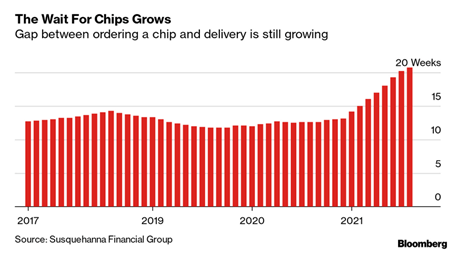
Since the start of 2021, semiconductor chips, which are used in cars, trucks, computers, and smart-phones, have been in short supply.  Supply has been so short that automotive companies have shut down assembly lines and consumer electronics corporations have delayed roll-outs of new products. 

Bloomberg reported in its September 22, 2021 Supply Lines newsletter that the gap between “ordering a semiconductor chip and delivery is still growing.” 

But four years before in 2017 (see chart above), it was already taking at least 10 weeks to deliver a semiconductor chip from time of order.  So, while businesses in 2021 anxiously wait up to 20 weeks for their chips to arrive, why were industries tolerating long order-to-delivery times of up to 10 weeks in the first place?

The dictionary defines a problem as an “unsatisfactory situation.”  It is a “state of difficulty that needs to be resolved.” 

Many of us equate problems with crises and disruptions, that is, we see a problem only when it hurts us such that it becomes urgent to address it. 

Hence, we tend to avoid them or try to resolve them as quickly as possible.  The fewer problems we have, the better, we usually say. 

The dictionary, however, also says it is a “a question proposed for solution or discussion.” 

Problems can be doorways to opportunities, in which if we think of them that way, we should seek them out and solve them for the ideas that would benefit us. 

Enterprises and even governments are scrambling hard in 2021 to fix the semiconductor chip shortage that has crippled factories and caused supply shortfalls of many products, from cell-phones to computers.  Most saw the problem when order-to-delivery lead times extended from 10 to 20 weeks.

If enterprises in 2017, however, proposed the “question” of shortening the supply lead time of 10 weeks, and found a solution, would industries be undergoing a crisis in 2021?  Wasn’t there a way to bring the number of weeks of lead time down to 4 weeks or even less? 

It was obvious that since 2017, company executives had accepted the 10-week order-to-delivery cycle and adjusted their inventories and production schedules to cover for the waiting time.  Executives managed the 10-week lead time into their financial forecasts.  The 10-week lead time was not considered a problem. 

If one enterprise in 2017 had seen the 10-week lead time as a problem rather than as an acceptable fate, and in the process of “discussion” found a “solution,” one wonders how much of a competitive advantage that enterprise would have in 2021. 

It’s never really worthwhile to ask “what-if” questions especially after the fact of a crisis.  But in the process of problem solving, as a question becomes clearer, it would have been likely that a solution would have addressed future adverse situations. 

As companies see their businesses compromised by the semiconductor shortage of 2021, it becomes more sensible to seek out the problems and pose the questions for “discussion” and “solution.”

For the pain many had been experiencing in 2021, it would have been worth it if they had only sought and solve problems then. 

It’s never really good to dwell in the past unless we learn something from it. 

About Overtimers Anonymous

Blaming Doesn’t Solve the Problem

Frustrated by their violations of rules and disorderly conduct that led to disturbances, a homeowners association banned mainland Chinese people from leasing residential houses within a posh village in the southern suburbs of Manila. 

Majority of the homeowners cheered the resolution released by the board of governors of the village.  A very few who raised concern about racial profiling were told to shut up or “get some balls.”  Most homeowners hoped that the resolution once and for all would rid the village of undesirable groups of people from mainland China who don’t follow traffic rules, cause unrelenting noise, and get into fights with neighbours. 

But will singling out an ethnicity or a national identity of people really solve the problem?

On one hand, yes. 

The village’s tally of violations showed most, if not all, incidents involved mainland Chinese nationals who were leasing homes as dormitories for online gambling businesses, otherwise known as POGOs (Philippine Offshore Gaming Operators).  Tenants would number by the dozens in one house.  They would throw litter everywhere, make noise throughout the day and night, and disobey traffic rules which led to numerous mishaps and automobile collisions. 

The mainland Chinese tenants continuously ignored the village’s notices to desist their disruptive practices until finally after several years, the village’s board had enough.  The board released the resolution banning people of mainland Chinese citizenship from leasing homes within the village. 

The resolution is logical in the sense that it bans outright most of the violating culprits from the village.  There is no doubt that violations will drop as soon as the offending Chinese residents end their leases and get out. 

But on the other hand, it won’t solve the real problem. 

Getting rid of the mainland Chinese may finally bring back the peace and order the village wants.  It doesn’t, however, answer the question:  why was the village’s authorities unable to enforce rules and regulations in the first place?

Laying blame on an entire race of people (especially from a country that makes up at least a fifth of the global population) is a sweeping solution to the village’s frustrations.  But it doesn’t address how in the first place the village’s association wasn’t able to enforce its rules.  Why couldn’t it? 

When a village, a community, or even a country makes laws, we’d expect that the laws will have provisions for enforcement.  Otherwise, the laws would be useless.  Why make laws that can’t be enforced? 

The village will no doubt dodge criticisms about racism.  Homeowners who cherish their village’s peace and order will be relieved the mainland Chinese culprits would be begone and rid of. 

But when a violation happens again, albeit maybe not as frequently or as seriously, maybe by another defiant resident who is not Chinese, will the village’s authorities be able to enforce their rules? 

Blame is a game politicians and executives have used when they don’t bother to solve a problem.  Adolf Hitler blamed the Jews for Germany’s woes in the 1930’s.  Some Americans in the United States blame minority ethnic groups such as African-Americans, Asians, and Hispanics for high crime rates.  Mainland Chinese officials single out ethnic Uyghurs and Tibetans in drives against cultural differences which are deemed a threat.  There are executives in Manila who blame Indians and Koreans for promoting bad business practices. 

It’s easy to blame other people for problems and we can even claim there’ll be outright improvement when we do so. 

But even if as it may alleviate the effects of a crisis, it does not really solve whatever problem that brought the blame in the first place.  Blame is more a mechanism to deflect problems than it is to solve them. 

We don’t realise that solutions to problems are hard to come by not because there are not many options to choose from but because we didn’t define it right the first time.  We therefore become frustrated and we resort to the blaming, just as what the homeowners’ village did towards mainland Chinese people. 

The homeowners of the village did not really address the root issue:  its inability to enforce the rules effectively

And there are the trade-offs which blame brings.  The posh village now adopts a reputation that it will profile ethnic Chinese people. When a Chinese-looking person enters the village, homeowners will be prejudging his or her appearance against that stereotype of what they experienced as undesirable.  Prejudice on the basis of race will be a norm. It sows the seed of racism that will linger and grow malignantly. 

And that would emerge as a much bigger problem in the future even as the village’s residents probably won’t care for now.

About Overtimers Anonymous

Finding Fault in Who versus in What

There seems to be a lot of finger-pointing going around. 

People pointing to other people as causes of problems:

  • One country points to another for the coronavirus pandemic. 
  • One politician points to another for failure in stopping the spread of the virus;
  • A restaurant owner blames a vendor’s delay in deliveries as reason for the lack of items on a menu;
  • A manager blames an office worker for poor sales performance;
  • Fans ask “Who’s at fault for why our team didn’t make the playoffs?” and the next thing we see is the head coach getting fired.

We tend to find fault in people.  And we do that a lot.  Just read the newspapers and we see people blaming other people.  Anything from crime, accidents, or plain gossip, someone is hitting somebody else for the issue.   

Rather than say: “Who’s at fault?”  maybe we should first ask: “What’s at fault?” 

Right there and then, the paradigm shifts from outright blame to a study of the circumstances behind any incident. 

  • “What, instead of who, started the pandemic?”
  • “What, instead of who, brought about the spread of the virus?”
  • “What, instead of who, caused the delay in deliveries of needed supplies for the restaurant?”
  • “What, instead of who, led to the enterprise’s poor sales performance?”
  • “What, instead of who, did we do wrong that our team didn’t make the playoffs?”

Just by substituting “Who” with “What,” our frame of mind, even our attitude and feelings, change.  Our ill feelings toward a suspect diminish. We switch from witch-hunters to problem-solvers.

When a problem strikes, it may be good to take a deep breath, get our thoughts together, and remind ourselves to start asking questions with “What” before “Who.”

One word can really make a difference. 

About Overtimers Anonymous

No Pain, No Gain

I’ve been lifting weights for a long time.  It’s been an on and off activity but I’ve been doing it since I was a teenager. 

Have I become a stronger person?  No.

Do I have a bigger, more good-looking physique?  No. 

I am fat and diabetic.  I’m have a body that is nowhere close to any athlete or one that would resemble Arnold Schwarzenegger’s.

Was all the weightlifting then worth it?  To many people who don’t exercise, probably not.  But for me personally, yes it was.  This is because I feel good about myself after every time I do it. 

I may not have met the vision I originally had in terms of a well-built body but I have to come like doing the exercises for the pump it gives me to get through the day. 

I lift weights as an exercise, not as a mission to become a Mister Universe or a superhero with superior strength.  As an exercise, it’s part of a lifestyle to promote my health.  It keeps my mind and body in shape, even if it doesn’t bring me any nearer to what people may call the ideal type.  

Weight-lifting is a no-pain no-gain sport.  Routine after routine, I add a little more weight to make the exercise more challenging than the first.  It is not a leisure activity or just something I do to fool myself into thinking I’m working out to look fit.   

It is not without some risks and setbacks.  I have incurred injuries and I’ve had to suspend lifting weights sometimes for weeks due to strained muscles. 

But I have achieved milestones I never thought I’d reach.  For example, I never realised that at 58 years old, I could squat with a barbell weighing close to 200 lbs. 

I didn’t gain without pain, never mind what some experts say otherwise. 

The pain is part of the investment.  The benefits may not turn out what I’d thought they’d be but I’m glad for the gains. 

About Overtimers Anonymous

When Increasing Capacity Becomes a Priority

One Sunday morning, a homeless woman at a traffic intersection was approaching cars and begging for alms.  Some drivers give but most don’t.  But the woman persists anyway; she shows a sign saying she’s homeless and asks for money for food. 

I thought as I observed the homeless woman:  if the government could spend so much setting up facilities to quarantine patients infected with the CoVID-19 virus, couldn’t it also spend a little more to house the homeless who roam the streets?  At least the government could provide a place to sleep and some food and water to homeless people even for a brief time so they’d be able to find work or resolve whatever issue that brought them there in the first place? 

The frequent answer to such a suggestion is a lack of resources.  The government would say they don’t have the budget to provide such for homeless people. 

How then were they able to provide for CoVID-19 infected people?  That’s different, a government person may say.  It was a national emergency and the virus is dangerous and life-threatening. 

But isn’t being homeless and without food dangerous and life-threatening too? And at this point, the government would not pursue the argument.  With a wave of a hand, they’d just say there is no justification to provide the resources. 

Not only governments but also enterprises hesitate to provide resources even when the demand would be there.  Executives would cite limitations in budgets or capital.  They would prefer that the operations spearheading supply reach their points of maximum capacities before asking for any investment in additional capacities. 

And even if they are at that point of maximum utilisation, executives would require proof that operations are also at their highest efficiencies.  Executives by common practice, will want an organisation to exhaust all of its means before considering any investment in additional capacities. 

If executives can avoid investing in new capacities, they will.     

This is why factories run flat-out to supply products before companies realise they need to build new production lines.  This is why airlines wait until flights are overbooked or ticket counters turn away passengers before they add new planes to their fleets.  This is why some restaurants don’t expand their dining areas or hire new staff until they see patrons waiting for tables or walking away because they couldn’t get a waiter to serve them.    And this is why internet companies don’t install new equipment until they see slowdowns in downloading speed or backlogs of subscribers. 

It doesn’t occur to many enterprises that investments in additional resources should ideally happen before operating limits are reached. 

At the height of the CoVID-19 pandemic in New York City, USA, in late March of 2020, the US Navy dispatched the USNS hospital ship, Comfort, to assist the city’s medical services. 

New York was low on available beds and staff to treat a surge of CoVID-19 patients.  New York City welcomed the Comfort, with its 1,000 beds and trained medical staff.   

But instead of helping, the Comfort would only take non-CoVID-19 patients.  The US Navy thought that by taking in patients not infected by the virus, New York could free up space in their hospitals for the CoVID-19 patients.  The Comfort’s beds were also spaced closely side by side so in the first place, the ship could not enforce social distancing for CoVID-19 patients.

The Comfort ended up treating 20 patients at its first week as New York’s hospitals continued to struggle with crowded wards and weary staff.  After so many weeks of sitting idly by hardly utilised, the Comfort departed New York City. 

The story of the Comfort was a lesson for leaders, if not an eye-opener for executives.  One should not wait till an issue becomes extremely urgent before acting.  

But nobody did learn.  Nobody did realise.  Many executives of governments and enterprises have forgotten the story of the Comfort. It has been relegated as one more passing tale of the pandemic era.  Meanwhile, wave after wave of virus infections months after the story of the Comfort have led to overcrowded hospitals and more deaths due to patients unable to be admitted for treatment.   

We shouldn’t wait till the last minute before deciding we need more capacity.  It isn’t complicated to calculate how much more we need if we can see the rate of  growing demand and anticipate when our resources will no longer be enough. 

I gave money to the homeless woman that day but I saw more homeless people begging on the street corners the weeks afterward. 

We still haven’t learned. 

About Overtimers Anonymous

Weighing the Benefits of Quantities, Streaks, and Trends

People put a lot of weight on numbers, especially those that show significance in terms of accomplishment:

  1. 100 days in political office;
  2. 10,000 followers for a social media influencer;
  3. 100,000 likes for a viral post on the worldwide web;
  4. 1,000,000 units sold;
  5. 1 billion customers served by a fast-food chain.

But as much as we pay a lot of attention to quantity, we seem to pay less notice to quality.

  1. What percentage of constituents were satisfied with the politician’s performance during his 100 days in office?
  2. How frequent did followers visit the social media influencer’s website?
  3. How many likes did the viral post author get for his other posts? 
  4. How many of the 1,000,000 units sold were defect-free or without complaints from buyers?
  5. How many of the billion customers served were satisfied with the fast-food’s service? 

We seem to have it in our human nature to celebrate quantity over quality.   

Maybe it’s because quantity is easier to grasp and recognise. 

It gets complicated if we say we sold 1,000 good quality items out of 1,050 produced.  People will ask what happened with the 50 that didn’t make the cut?  We’d end up explaining what we did wrong with 50 items rather than what we did right with 1,000 items. 

It’s our nature to see the bad more than the good.  Hence, just being one-dimensional, just by citing one simple number in quantity makes our achievements more tangible and easier to brag about. 

We also like to celebrate streaks and trends.  In sports, we take pride in winning so many games in a row.  During the CoVID-19 pandemic, nations would tally how many days they had without a single infection and cite it as a reason to loosen restrictions, at least until one comes along and causes another lockdown. 

We take what we can from quantities, streaks, and trends.  But we will hesitate to appreciate ratios and quality statistics. 

We’d prefer a manufacturing plant manager report employees worked 1,000,000 hours cumulatively without an injury rather than say there was one injury out of 2,000,000 man-hours registered.  People would ask what was the injury and how and why it happened. 

Still, we should ask ourselves:  what are the benefits of reporting quantities, streaks, and trends?  Is it to boast, make us look good, and build our reputations?  Will it increase our influence resulting in something positive and tangible in return?

We sometimes focus a little too much on what’s it about for us when maybe we should be asking what good will it also be for them—the customers, the likers, the readers, and stakeholders. 

This is my 100th blog post.  Though I rather prefer the few readers who visit my site like what I wrote than how many I posted.    

About Overtimers Anonymous

When Idle is Not Necessarily Bad

A chief executive officer (CEO) of a large corporation was touring a manufacturing facility.  As with all CEO’s touring a factory, he had an entourage of executives accompanying him as he walked and shook hands with workers on the production line.

As he strolled through the facility’s main line where the most important manufacturing processes took place, he noticed a uniformed operator sitting idly on a chair with his hardhat over his eyes. 

The CEO asked the plant manager accompanying him what the operator’s job was.

The plant manager answered: “That man, sir, is our annealing oven operator.  He watches the oven’s gauges and adjusts the temperatures when needed.”

“I’m sorry for you having to see this man just sitting there doing nothing,” the plant manager said apologetically.  “I’ll go tell him that he should be working.”     

“No, you don’t need to do that,” the CEO replied.  “The operator is doing precisely what we want him to do. Just by the fact that man is sitting there doing nothing, it means that the annealing line is operating smoothly.”

The CEO then approached the operator who quickly got up when he saw him coming.  The CEO shook the worker’s hand and said, “You’re doing a good job, keep up the good work.” 

What do we do when we see a subordinate worker doing nothing at his work-station or desk? 

Some bosses scold their employees for just sitting around.  Some bosses would chide supervisors for not assigning more tasks to employees.  A worker who’s not working is not productive, a boss may say.

On one hand that may be true especially if the idle worker in question had deadlines to meet.  But in most of my experiences, it would be the opposite.  The idle worker would actually be the most productive.   

Like the operator the CEO noticed, idle workers may have no problems to fix.  The operator had already set his equipment and did all the adjustments needed.  He had done his job making sure the annealing line wouldn’t fail and there would be no issues in the quality of items being processed.  He would of course check the gauges now and then to make sure everything is all right. 

We sometimes think that idle workers should be doing something more.  If we see an office worker taking longer coffee breaks than usual, we’d somehow try to think of giving more work to that person to make him more productive.  If we see other workers sweating away while another is just sitting around, we sometimes get the first impression that the idle worker doesn’t have enough work. 

Some bosses believe workers are just too lazy to find other better things to do or problems to solve.  We sometimes conclude that workers in general lack initiative or a sense of ownership. 

So, we try to push workers to be creative problem-solvers.  We command them or offer them incentives to take the initiative to find improvements for the workplace.  Creative ideas are starting points for higher productivity, after all. 

But we have to beware that there are pitfalls to forcing workers to find and solve problems.  Workers might end up finding and solving problems for the sake of it; they’d just identify stuff that seem like problems but aren’t.  Trivial issues that don’t offer any benefits would just be reported.  We would end up back to square one:  just finding work so an idle worker won’t be idle.    

In my experience, many idle workers are veteran workers who have by experience learned how to do their jobs so well they end up with extra time on their hands.  Because these veteran workers have accumulated much wisdom about their jobs, it has often become a good idea to assign them as mentors to younger, less experienced workers.  Veteran workers can be the best mentors. 

And more often than not, we don’t have to ask.  Veteran workers who have stayed long at their jobs usually volunteer to train their peers.  We managers just have to reinforce this by recognition and praise, by showing genuine appreciation. 

Veteran workers also have many ideas for improvement.  Rather than forcing upon them assignments to find and solve problems, it usually is a good idea to just ask them first, informally.  Questions like, “what do you think this factory needs to get better?” or “what’s your opinion about laying out the office differently?”  usually generate some interesting eye-opener responses from veteran workers.

True, some veteran workers wouldn’t offer much at the start.  And most of the time, that’s because there was some bad history involved.  A manager before you didn’t appreciate the veteran worker for a previous suggestion or a manager simply ignored an idea a veteran worker offered. 

This is where investing in listening comes in.  When one can make a veteran worker open up, one may be pleasantly surprised by the treasure trove of ideas and knowledge that come out. 

At that point, the veteran worker is no longer idle. 

About Overtimers Anonymous

Cultivating Passing Thoughts into Aha! Moments

The late Isaac Asimov was a famous author who wrote science fiction stories (e.g. the Foundation series) and essays.  

In one such essay, The Eureka Phenomenon, Dr. Asimov writes how some scientists made great discoveries out of the blue.  He cites:

  • Archimedes who, while taking a bath, solved the problem of determining the volume of a king’s crown by simply dipping it into a tub of water and measuring how much of the liquid was displaced;
  • Friedrich August Kekule von Stradonitz, who solved the ring formula of benzene by dreaming about it;
  • James Watt who overcame a design problem with his steam engine after he took a walk in the park;
  • Otto Loewi who won the 1936 Nobel prize in medicine for his findings about the human body’s nervous system in which he wrote down key formulations after waking up in the middle of the night with ideas that suddenly entered his mind. 

Asimov doesn’t know “how often does this ‘Eureka phenomenon’ happen.”  But he suspects it “happens often,” that many of what people discover come about from “real inspiration,” a result of “thinking under involuntary control.”  We get “revelation” and “insight” but leaves it to the “mystic” how it comes about. 

“Eureka” is Greek for “I’ve got it!” which is what Archimedes says the instant he solves his problem with the volume of the king’s crown via the displacement of water. 

It’s also known as the Aha! moment and I believe it happens much more often than even Dr. Asimov realised.

I tested that idea for one day.  Whenever I had a thought that seemed to be an Aha!, an insight that just came to mind for no reason, I wrote it down.  On that day, I tallied three Aha! moments. 

I tried it again the next day.  I only had one.

The day after, I had none. 

Aha! moments, they seem, don’t come in consistent numbers and frequencies.  But I found to getting three in one day as already a lot.  On that second day I had only one Aha! but I was in a bad mood, so I surmise emotions may have a bearing on why I hardly had any that day. 

We all have our Aha! moments.  They are those insights that light us up at any time.  They more often than not are seemingly small and inconsequential. 

One Aha! moment I had was I felt people I know from a job a long time ago have forgotten who I am when I meet them at a reunion.  If I let the thought prosper, the Aha!  becomes an insight in how we as individuals choose whom we remember and whom we forget.  It becomes a basis of how we judge others and how we feel about ourselves.  The Aha!  became a discovery about how I think and maybe how others think as well. 

I and many, if not most of us, probably discard many of the passing thoughts that cross our minds every day.  We perhaps see many passing thoughts as worthless stuff that enter our minds out of nowhere while we’re focused on something else or just doing something out of routine (like riding a bus or playing games on our smartphones). 

Too bad.  As Isaac Asimov wrote in his Eureka Phenomenon essay, many of what we think as worthless passing thoughts may actually be potential Aha! moments that can lead to big ideas and discoveries. 

Some people would disagree with me.  A search for “passing thoughts” on the web suggested a similarity to “intrusive thoughts,” which Psychology Today warns as possibly negative and harmful.  Nevertheless, I’d like to think there’s a positive side to having passing thoughts and their potential to become Aha! moments. 

Many creative problem-solving consultants teach structured approaches to seizing those Aha! moments.  Messrs. David Rock and Josh Davis, Ph.D., for instance, preach having time alone, thinking positively, and looking inward as means to maximising the Aha! moment.   

Yet, many organisations I’ve engaged with don’t really apply much in the way of structured approaches to finding ideas or solutions, no matter how many workshops and seminars on creative problem-solving these organisations may invest in.    

In many cases I’ve witnessed, executives rely on on-the-spot solutions during meetings.  Or they hand off the especially complicated problems to task forces made up of department representatives and technical people. 

The task forces often then delegate the complicated part of a problem to one or two low-level engineers or managers, who then crunch numbers, experiment, or do surveys.  Sometimes the task forces hire contractors or consultants to study further whatever the problem is.   

When all the number-crunching and multi-thousand report writing are done, the contractors, consultants, or low-level engineers submit findings to the task force who then present their conclusions and recommendations to their executive superiors.  The chief executive officer (CEO) would then supposedly decide on the proposals. 

Usually, insight into a problem and the Aha! moments that come with them happen during a task force meeting or among consultants and engineers discussing the issue.   

But as much as it may happen with the task-force, consultant, or engineer, I’ve noticed quite often that such insights don’t really reach the executives, especially the CEO. 

Many of the presentations to executives I’ve participated or witnessed have resulted in a chief executive officer (CEO) making a decision that he had already made up his mind to make, sometimes even before the executive had engaged a task force, consultant, or engineer.

The executive in charge had his own Aha! moment and many times from personal experience, task forces and consultants’ recommendations came out as nothing more than confirmations or formalities adapted to what a CEO had already made up his mind on.  

Nevertheless, I believe we should not discount the passing thoughts that enter our minds.  I believe there’s value in those nuggets of thoughts that flicker once in a while in our brains.  I also believe many entrepreneurs and scientists had found success from cultivating passing thoughts into Aha! moments, and had thought further through to formulate breakthrough ideas and discoveries. 

I’ve been making it a habit to jot down as many Aha! moments that come my way of mind.  So far, I’ve gathered four in the last two days.  I’m looking forward to getting more in the immediate future. 

I just have to avoid being in a bad mood.  

About Overtimers Anonymous