DRP, Deployment and the Role of the Supply Chain Engineer

Distribution Resource Planning (DRP) was my first assignment as supply chain planner for a large consumer goods firm.              

It was the late 1980’s and Manufacturing Resource Planning (MRP 2) was at the height of popularity in the corporate world.  The company I was working for was embarking on integrating MRP 2 in an information technology upgrade of its operations and DRP was one module offered. 

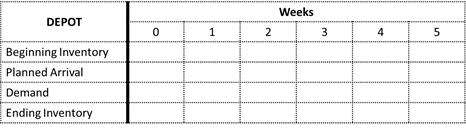
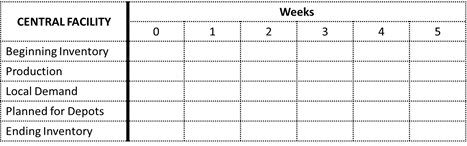
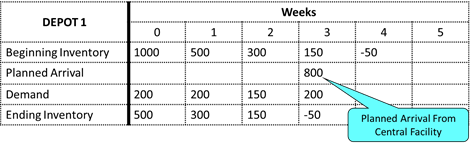
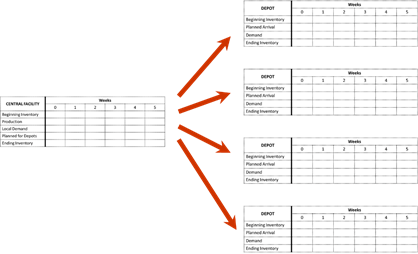
DRP is a planning tool in which one schedules the deployment of items, usually finished products, to distribution centres or depots at different geographical locations.  It manifests itself in matrices such as the following for a depot and a central storage facility:

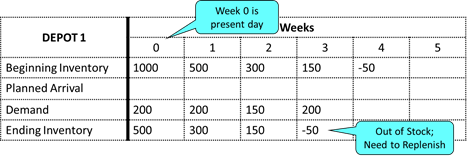
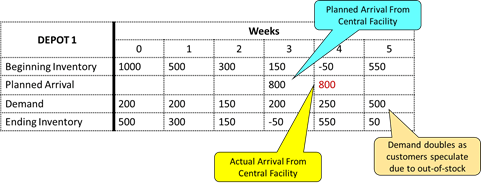
The matrices serve as templates in which the planner can see how much a depot needs at a point in time in the future.  In the following example, it’s week three (3) in the future:

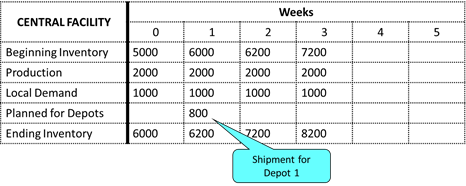
To anticipate the out-of-stock on Week 3, the planner simply schedules the shipment of product to the depot.  Assuming a lot size of 800 and a two-week transit time, the planner schedules a shipment from the central facility at Week 1:

It’s simple enough for one item and for one depot.  The work adds up when it includes several depots:

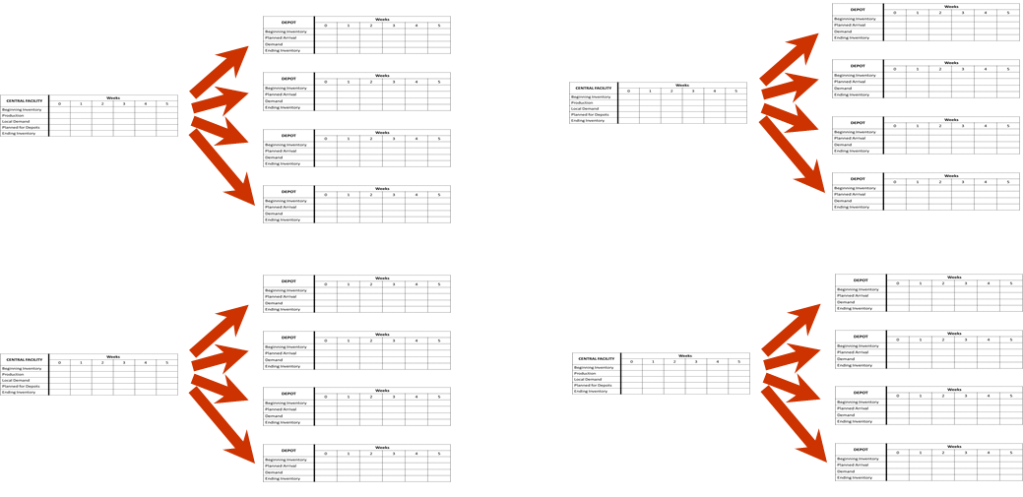
For multiple items and multiple depots, the work adds up even more:

As much as the planning is simple per item per depot, the work becomes more cumbersome and complicated with multiple depots and multiple items.  Hence, DRP works best with the help of MRP 2 software that would automatically compute the schedules for all items for all depots. 

It’s no wonder then that organizations look forward to artificial intelligence (AI) in planning the deployment of products.  It’s just a lot of simple work that a machine can do instead. 

If only it was that easy. 

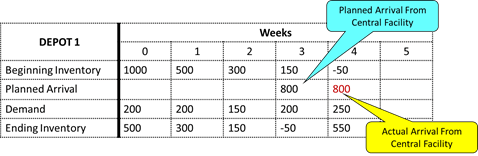
DRP deployments don’t take into account uncertainty and sudden disruptions.  It assumes things will go as planned when in reality, they do not.  Such as when a planned arrival is delayed: 

Customer orders as a result are not served.  And the disruption may even cause customers to speculate: 

In such scenarios, automated planning is no longer useful.  Human intervention is needed as the central facility would either rush stocks to the depot or the sales force served by the depot negotiate with customers to smoothen demand. 

When it comes to uncertainties, planners tend to build up inventories to avoid situations like in the aforementioned example.  It defeats what DRP is trying to do which is to keep inventories manageable and at the same time serve customers only when they would be needing their items. 

Information technology (IT) software does not provide a fool-proof automated solution for planning inventories and deployment.  Yet, many managers make the mistake expecting that computer programs will do so.  DRP is no exception.

Deployment is a critical step in the supply chain, especially for enterprises that have markets in far-off places.  It isn’t something that can easily be automated.  It requires a framework founded on an overall strategy. 

An overall strategy answers how the enterprise shall distribute its products: 

  • Do we set up depots or distribution centers at different geographical regions?
  • Do we deliver directly to markets from a single central distribution facility?
  • Do we build manufacturing and distribution facilities at different locations?
  • Do we just rely on a 3rd party logistics (3PL) provider to do all the sales and distribution of products? 

The distribution strategy will need to align with how the enterprise wants to sell and deliver its products. 

  • Will selling be via retail channels?
  • Do we negotiate contracts with distributors, wholesalers, and/or licensed dealers to sell at different markets?
  • Does the enterprise utilize e-commerce for customers to order and couriers to deliver? 

The framework for deployment consists of both policy and structure derived from a distribution strategy.   

Policy would cover such areas as:

  • Inventory: how much to keep, when to replenish, how items are handled (e.g. first-in first-out);
  • Service:  how items are dispatched (e.g. minimum quantities, lot sizes, less-than-truckload [LTL] limits);
  • Quality:  how merchandise is inspected, how damages are prevented;
  • Risk: how products are secured and accounted for. 

Structure would involve the assets and people directly involved with deployment.  These would consist of:

  • Facilities such as depots, warehouses, storage equipment (e.g. racks, tanks, vessels), & materials handling (e.g. forklifts, conveyors);
  • Transportation assets from trucks, vans, to shipping containers and air-freight;
  • Organizational structure and management set-up.    

The effectiveness of a deployment framework depends on how well the enterprise develops its policies and structures.  This is where supply chain engineers (SCE’s) can help. 

SCE’s can assist executives in studying various scenarios for an enterprise’s deployment framework.  These range from assessing the capacities and financial effects of product flows via different network options to determining optimal inventory levels taking into account the risks of stock-outs and overstocks. 

SCE’s can also fine-tune options on how an enterprise can deploy its products efficiently and effectively.  For example, SCE’s can help executives decide whether cross-docks would be a better option to rapidly move products from centralized locations to customers. 

DRP is a good tool for supply chain planners.  But like all good tools, it is most effective when it fits in with a framework founded on a well-developed distribution strategy. 

Supply chain engineers have the expertise to help enterprises optimally spread their inventories to the markets they want to sell to, with the tools and software they are familiar with and can muster. 

About Overtimers Anonymous

The Feasibility Study Ends with a Plan, Not A Solution

The feasibility study consists of the following steps:

  • Defining the Problem
  • Brainstorming Possible Solutions
  • Developing Criteria for the Solution
  • Evaluation and Selection of the Solution
  • Assessing the Solution’s Practicality and Benefits
  • Making a Plan

It starts with defining the problem.  It ends with a plan.

A lot of people make the mistake of ending a feasibility study with a solution. 

After they have the answer, many of them neglect to ask “what’s next?” 

They rely on the stakeholders to figure that last step out.  That’s a big mistake because most of the time, the stakeholders have no clue as to how to do so. 

The process of finding a solution begins with brainstorming.  This is already controversial as some would argue that one should first set criteria for whatever idea or answer is presented.

What inventory and procurement policy should we establish? 

Brainstormed ideas:

  • Buy only when customer orders?
  • Eliminate all items except ten (10) fast-selling products?
  • Keep no stock of top 20 most expensive items to make?
  • Have a single exclusive vendor for each material item and make vendor accountable for inventory?
  • Have at least three (3) suppliers per material item purchased and keep at least one (1) month’s equivalent worth of sales per item? 
  • Put all inventory on a huge container vessel that would constantly be at sea and move from one port to the next to load and unload merchandise?

Brainstorming comes first because it is a no-holds barred free-thinking exercise that allows minds to capture all the thoughts possible to address the problem.  Nothing is filtered or evaluated.  Every thought is acceptable and listed.

Criteria comes afterward but they should relate to values, principles, and strategic objectives. 

Examples of Criteria:

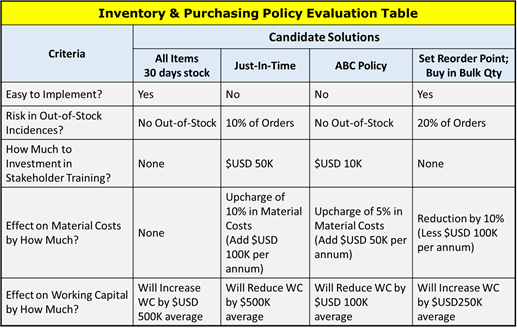
  1. Solution has to be easy to implement;
  2. There should be minimal risk in running out-of-stock;
  3. There should be minimal investment in training and education:
  4. Material costs should not increase;
  5. Working capital should decrease.    

Brainstormed ideas are then filtered based on the criteria.  Those that obviously wouldn’t fit are thrown out outright.  The ideas that qualify would remain.

The remaining ideas then pass through an evaluation process. 

The evaluation process is mostly an intuitive one.  Whereas defining a problem depends a great deal on data gathering, analyses, and presentation of evidence, evaluating candidates in search for the best idea or answer to a problem is mostly done via perception and insight. 

We weigh candidates against the criteria we developed earlier.  The weighing is an attempt at rational calculation but most of how we do it is based on opinion.  We predict benefits on what we think will happen, not really with any rationale. 

A feasibility study is a contrast between the rational definition of a problem and the intuitive search for a solution.  That’s why as soon as a solution is selected, we need to refine it and move forward to developing it into a plan on how to make it into a reality. 

Refining the selected solution or idea is simply clarification of what we think needs to be done.  Whereas a problem is best described in the form of a question, a solution should come out in the form of an action plan.

As an action plan, a solution or selected idea should follow a SMAC format.  It should be Specific, Measurable, Attainable, but Challenging. 

We will develop an ABC Inventory & Purchasing Policy. 

A feasibility study ends with a plan, not a recommended solution. Solutions are intuitive but a plan brings it into reality. 

With a plan, an organisation will know what to do next. 

About Overtimers Anonymous

A Feasibility Study Starts with Defining the Problem

An employee has an idea and brings it to her boss.  The boss says “good idea!” and forms a team to do a feasibility study.  The team determines the idea feasible for a new product. 

The boss authorises the introduction of the new product.  The product, however, does not sell.  Customers think it’s too expensive.  The boss kills the product.  The employee who suggested the idea is fired.  He gets rich when he sells the product on his own. 

There is a fine line between an idea and a solution.  Both are not the same.  An idea is a thought that develops into a concept.  A solution is an answer to a problem or it’s a process or method to deal with a problem. 

More often than not, we mix up the two and we do a feasibility study without really thinking through whether what we’re studying the feasibility of is an idea or a solution. 

Why is it important to know if we’re studying an idea or a solution?  Because the best approach to doing a feasibility study is knowing the purpose of what we’re studying in the first place. 

If we’re studying the solution, we’d need to make sure what the problem the solution is answering. 

If we’re studying an idea, we’d need to know what we’re developing from the idea.  What is the idea’s purpose?

Feasibility studies typically consist of the following steps:

  1. Defining the Problem
  2. Brainstorming Possible Solutions
  3. Developing Criteria for the Solution
  4. Evaluation and Selection of the Solution
  5. Assessing the Solution’s Practicality and Benefits
  6. Making a Plan

If somebody is going to say I just laid out a problem-solving approach, I will say yes, I did. 

A problem-solving approach is the core of a feasibility study.  If it isn’t, it would make no sense to do a feasibility study.  How can one judge the feasibility of something if one doesn’t know the purpose of that something or what problem it is solving? 

In starting a feasibility study, it pays to know what the purpose is.  Hence, the first step is problem definition

A problem is not necessarily a disruption, a roadblock, or a painful symptom.  A problem in the context of a feasibility study is what we’re trying to achieve.  It typically comes in the form of a question that starts with “what” or “how.”  And it should be as specific as possible.

What can we do to lower the cost of electricity in our factory?

How can we reduce our pending orders faster? 

Please note that defining the problem is not as straightforward as it looks.  Just asking a question does not mean we have defined the problem. 

Defining the problem requires diagnosis.  Diagnosis requires data and analysis. 

A doctor does not simply define a patient’s problem just by the patient’s symptoms.  The doctor would diagnose, that is, do tests, study the results, establish the cause, and prescribe a procedure to cure. 

Likewise, with problem definition.  We need to gather data, analyse the data, organise the evidence, identify root causes, and conclude what the problem is. 

Inventories are high but we run out of stock every end of the quarter.  We import in large lot sizes.  Our stocks spike when the imports arrive.  Arrivals of imported merchandise come in at the same time.  Demand depletes our stock but some items run out faster than others.  We order when we notice items nearing out-of-stock.  It takes six (6) weeks for merchandise to arrive from the time we order and prepare the import documents. 

What inventory policy should we develop for our imported merchandise? 

We would also need to listen to what stakeholders are saying, especially what their ideas are.  It may sharpen the problem definition further. 

Our purchasing staff suggests we break up the imports into smaller quantities but that would mean foregoing bulk discounts from vendors.  They suggest negotiating with vendors such that we can order in bulk but have the order shipped in staggered smaller quantities. 

What inventory and purchasing policy should we develop for our imported merchandise? 

Defining the problem is a significant step in the feasibility study.  Once we know the problem clearly and specifically, it can be downhill from there in finding the solution or developing an idea. 

About Overtimers Anonymous

Balancing Unstoppable Production and Benefiting from It

I used to work in a flat glass factory. 

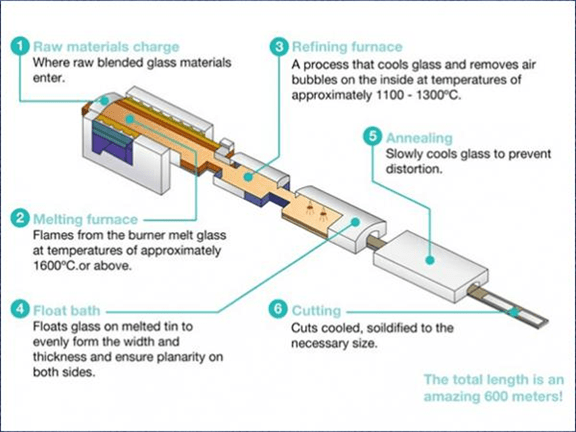
The flat glass factory I worked at used float technology.  It starts with a furnace that melts raw materials such as silica (sand), soda ash, dolomite, and limestone.  Molten glass flows from the furnace to a tin bath, a chamber of molten tin, in which the liquid glass from the furnace floats on the molten tin to produce an almost flawless sheet of flat glass. 

Float glass factories run continuously.  Shutting down is out of the question because it risks damaging the furnace and tin bath which would result in lengthy cleaning and expensive rebuilding. 

Re-starting a float glass facility is likewise very expensive.  Restoring the flow of float glass requires tedious re-calibration operations and the difficult pulling of the liquid glass from furnace to tin bath.  

I know because I participated in one such operational re-start.  It was hot, time-consuming, and it cost the company I worked for a lot of money. 

The economics of keeping a float glass hot and running outweighs any temporary shutdown regardless of whatever the demand for glass is.  Unless it’s a permanent shutdown, flat glass companies will keep their float glass plants running no matter what. 

Float glass plants typically produce a minimum of 450 tons of sheet glass a day.  Glass companies, however, believe there is enough demand to absorb the daily unstoppable production.  Never mind that glass demand fluctuates with the highs and lows of the construction and automotive industries.

Unstoppable production is a reality in several industries.  Steel manufacturers have blast furnaces that cannot be shut down.  Petroleum corporations cannot outright stop the output of oil wells.  Farmers cannot reschedule harvests. 

We are taught that the purpose of supply chain management is to fulfil demand.  How does one then balance the management of unstoppable production with the swings of customer demand? 

Unstoppable manufacturing dictates the need for efficiency.  Ongoing production operations means ongoing supply of materials, supplies, and labour.  There has to be enough storage space, materials handling, and transport to handle the continuous manufacture of products.  At the same time, enterprise executives need to ensure that there is demand for what is continually produced.  Sales and marketing managers would strive to find buyers or markets to sell whatever is made.

Continuous production, however, should not be the centre of attention.  Selling products to keep manufacturing operations efficiently running should not be the sole purpose of supply chain professionals.

Customers and what they want should always be the focus.  There should be a balance between supply and demand in which the supply chain operations aim to meet customer expectations at the same time reap the benefits of such for the enterprise’s stakeholders.   

Flat glass companies market a variety of products.  They sell custom-cut window glass for buildings.  They produce coated glass window panes that insulate homes from the heat of the sun and thick glass sheets for furniture tables.  They sell glass for car and truck windshields.  They also sell glass that are used for solar panels and photoelectric cells.  The variety of products sums up to a high demand which justifies the continuous production of flat glass. 

Agricultural enterprises also allocate harvests in a variety of ways.  Fruit companies sell outright to wholesalers and supermarkets and at the same time export to other countries.  They also sell to fruit processing enterprises which manufacture canned and preserved items. 

Supply chain engineers (SCE’s) can help unstoppable producing enterprises by focusing attention on distribution and inventories.  They can help managers determine how much of what product to make, how and where to spread the items, and how much raw and packaging materials to buy and store. 

Oil companies, for instance, invest in storage tanks and lease super-tanker vessels to temporarily store production when demand is low.  The companies would dispatch the super-tankers to position their stock near to buyers who would be ready to purchase them when demand recovers. 

SCE’s can also help find out what kind of product to make and keep.  For example, SCE’s can determine how much work-in-process inventories to make instead of finished items.  Steel and metals manufacturers produce heavy rolled-up coils and ingots which they later convert to items such as bars, parts, sheets, plates, and pipes.  With the help of SCE’s, manufacturers can set inventory policies for work-in-process products and devise customised make-only-when-needed systems for finished items. 

Manufacturing is not a quick on-and-off kind of operation.  There is a cost when production facilities halt and re-start.  As much as possible, production lines should operate continuously, for efficiency’s sake. 

Efficient production, however, is not the end-goal of supply chain professionals.  Fulfilling customer demand is.  An unstoppable production process exists because of the confidence an enterprise has in selling all of what it would make.  Balancing the flow of product from vendors to manufacturing to logistics to customers should always focus on delivering to customer expectations and in terms of what enterprise stakeholders seek in terms of their organisation’s strategic mission and goals. 

An enterprise can make plenty, deliver plenty, and profit from plenty, with the help of supply chain engineering expertise. 

About Overtimers Anonymous

Why Enterprises Need A Chief Supply Chain Officer

“Behind every great leader there was an even greater logistician.” -M. Cox

On a trip to Saudi Arabia in 1990 at the start of preparations preceding Desert Storm, the American-led military operation to take back Kuwait from invading Iraqi forces, United States Air Force General Chuck Horner was granted only one companion to accompany him.  Some thought General Horner would bring his executive officer (XO). 

General Horner chose to bring his logistician: 

If you’re going to a war, and you can only take one person, who would you take? ”

The answer was obvious—his logistician.  There are three kinds of staff people who are never heroes, but without whom a commander is dead in wartime:  his intelligence, communications, and logistics chiefs.  He can limp along in peacetime with less than capable people in those slots, but he’s dead if there’s any weakness there when the shooting starts. There is great truth in that old adage that amateur warriors study tactics, and that professionals study logistics.”  -Tom Clancy with Gen. Chuck Horner (Ret.), Every Man A Tiger (New York: G. P. Putnam’s Sons, 1999), p. 173

American military leaders have embraced supply chain logistics as a key component to victory in any conflict.  Desert Storm was no exception and was an eye opener for future war plans.  Logistics, notably the management of military supply chains, is still part and parcel of any country’s military doctrine in the present day. 

Every American field commander has a logistics leader on his/her staff to run the day-to-day and long-term needs of their operations.  Business leaders of private organizations, particularly those who market products and merchandise, would do well to do the same via a chief supply chain officer (CSCO).

Most of us know the supply chain is typically a pretty big and complicated operation made up of several sub-departments.  It’s important there’s someone who should be in charge of it.  Not many; not a few; just one person to rule it all.  

The supply chain covers the flow of goods, services, and information through various operations and industries.  In a typical organization that markets products, the supply chain’s scope covers purchasing to manufacturing to shipping.  Included in that scope are support groups such as planning, engineering, maintenance, and quality control. 

The supply chain encompasses a variety of activities such as but not limited to materials sourcing, inventory management, quality inspection & testing, production scheduling, demand management, storage & materials handling, orders management, transportation, maintenance, and after-sales services.  Cost management from budgeting to operating expense (OPEX) and capital expenditures (CAPEX) is often within the bounds of supply chain management.  Projects especially investments in facilities involve supply chain managers.  And when it comes to discussion on topics such as product life-cycles, working capital, customer services, and organizational development, the supply chain manager would be a major participant.

Given the wide scope and the number of activities a supply chain executive’s job would entail, it comes to no surprise that some executives don’t entertain the idea of having one person managing all of an organization’s supply chain operations.  Aside from seeing it as too big for one person to handle, it would be downright difficult to find a person who would qualify with the experience and skill-set. The CSCO would have vast authority over practically most, if not all, of an organization’s core operations.  This is perceived as power that business leaders fear could be abused.

But even in very large organizations, such as the military branches of the United States armed forces, it makes sense to have one person running an organization’s entire supply chain.

The supply chain works best with a focused purpose and strategy.  Whereas departments such as Finance, Sales, Marketing, Research & Development (R&D), and Human Resources have their specific supporting missions, so does the supply chain. 

The supply chain’s role is to fulfil demand at the best value and best returns in investment for the organization’s stakeholders.  In whatever way this purpose may be framed, the supply chain’s operations have a single end: fulfil demand.  And one person should be on top of it, in leading it, and making sure it gets done. 

Having one leader also gives recognition to the uniqueness of functions and the importance of contributions from each of those functions.  With a united department under one executive, what each function does rises in importance in the overall organization.  The function of a warehouse, for instance, would receive more recognition in how long items are stored and the costs that handle those items as a CSCO examines the total delivered cost of a product. 

Just as functions would receive more recognition, so too would performance measures.  A CSCO would rationalize all the key performance areas in all respective operations towards demand fulfilment consistent with corporate objectives.  Quality measures, for example, would be focused towards the final outcome of a finished product.  The Purchasing function would focus on materials quality in relation to Manufacturing’s consistency to produce within specifications.  The Planning department would take into account inventory lead times in how they may affect product shelf lives.  Logistics would consult Purchasing and Manufacturing on supply and production lot sizes to avoid overstocking and to mitigate risk of damages. 

Having one supply chain leader means one decision-maker, one person to rally all of the supply chain functions in its day-to-day performance and long-term strategies.  In unity come strength, and having a variety of unique functions working together requires a single leader who not only can make timely decisions but also provide guidance in consideration for all concerned. 

The arguments against a single supply chain executive are more about finding the right person for the job than about the politics of one person having a lot of power.  There really is no argument against the logic of having a single leader for the supply chain. 

Fear prevents change in any organization.  Fear in having one person running the supply chain is understandable considering the qualifications needed and the power that comes with it.  But it should not be a deterrent but a means to understand and solve the issues that are causing such fear.  Fear should be a motivation for change, not an obstacle. 

High-ranking United States military field commanders have logistics experts as members of their staffs.  Just one individual who runs the whole supply chain of any military operation.  Private organizations should likewise have chief supply chain officers to singularly manage the supply chains that procure materials, manufacture products, and deliver them to customers.  The unity of supply chain functions under one CSCO allows for more focus in strategy and performance.  The fear that a CSCO would be unqualified or would have too much power does not argue against the need for a single leader.  On the other hand, it should motivate business leaders to address the issues such that the benefits of having one supply chain leadership can be gained. 

Originally released in LinkedIn: https://www.linkedin.com/pulse/why-organizations-need-chief-supply-chain-officer-ellery-samuel-lim

About Overtimers Anonymous

Four (4) Supply Chain Scenarios and What to Do When They Change

We don’t know when it’s going to rain.  So, we build dams.  Dams are reservoirs, inventories of fresh water.  Having a reservoir assures an adequate supply of water to meet the continuous demand of communities. 

Magat Dam, Luzon Island, Philippines http://bagong.pagasa.dost.gov.ph/flood

Supply chain managers face a myriad of challenges in their operations.  But one can categorise some of these challenges when it comes to inbound materials and outbound finished goods.  The following are four (4) such categories or scenarios:

  1. Unsure Supply, Sure Demand

Demand is known but supply is not.  As in the example of the dam as water reservoir, demand (i.e. water consumption) is certain but supply (rainfall) is not.  Supply chain professionals would put much time and resources in predicting supply or finding alternative means to maximise it (e.g. cloud seeding, drilling wells).  They would also be investing in enough capacities for inventories (in this case, the reservoir) to assure demand is always met. 

2. Sure Supply, Unsure Demand

Supply is assured but demand is unknown.  People who have new products talk about this scenario a lot.  But this also applies to products with not-so-long life-cycles such as attire and accessories from the fashion industry.  In such cases, supply chain managers tend to stock up on finished products to ensure availability.  But because finished products are the most expensive type of inventory, supply chain managers spend a great deal of time and money in policies and systems to make sure they only have enough—not too much and definitely not too few. 

3. Sure Supply, Sure Demand

Supply and demand are certain and predictable.  This can sound like an enterprise’s idea of a business dream come true but there would still be work to do for the supply chain manager.  In such a scenario, the focus would be on reliability, that is, making sure that the enterprise’s processes are operating efficiently and delivering to the satisfaction of customers.  This can be easier said than done especially for enterprises that have complicated manufacturing operations (e.g. chemical refineries). 

4. Unsure Supply, Unsure Demand

The nightmare opposite of number 3?  It’s a reality for many enterprises who market products such as consumer goods, machinery & parts, and household appliances.   Enterprise sales managers would constantly be guessing demand (what they would call forecasting), while supply chain executives would be unendingly negotiating long-term contracts with vendors, at the same time managing inventories of materials and merchandise. There would be pressure not only to minimise working capital but also to ensure availability of items to customers.   One key take-away strategy for this scenario is collaboration—working with vendors and customers.  

These four (4) scenarios may sound over-simplified given the reality of issues that surround supply chains (how expensive materials are, where they originate, the shelf lives of materials and products, number of products the enterprise sells, etc.).    

But they provide a starting point for Supply Chain Engineers (SCE’s) to devise systems that synchronise the flow of merchandise through supply chains to generate productivity and competitive advantage. 

SCE’s can help managers calculate capacities and set inventory policies for unsure supply and/or unsure demand scenarios.  SCE’s can also work out manufacturing reliability improvements, labour work-place settings, and equipment maintenance methodologies that would cover sure-supply / sure-demand scenarios. 

As 21st century business becomes more dynamic, SCE’s can help enterprises anticipate changing scenarios.  SCE’s, for instance, can study the feasibilities of outsourcing production versus building in-house capacity given any of the different supply and demand scenarios.  SCE’s can also plan contingencies for logistics such as determining how many trucks an enterprise should buy for itself versus how many should be outsourced to 3rd party providers.  SCE’s can also offer ideas for flexible production systems such as cellular manufacturing and fast-changeover assembly lines. 

Enterprises face different scenarios depending on their business environment.  Supply and demand of what they buy and sell may be certain or they may not.  Whereas enterprise managers resort to inventories and capacities to make up for any uncertainty, supply chain engineers offer help not only in optimising for whatever scenario but also in anticipating to whatever changes that may come.

Supply chains can be complicated; supply chain engineers make it less so. 

About Overtimers Anonymous

What Is the Right Supply Chain Model for New Products?

A lot has to get done when it comes to launching a new product.  Aside from marketing and selling, enterprise executives need to know how much to make, how much to stock, and how they’ll spread that stock. 

If the new product is replacing an older one, the enterprise would need to figure out what to do with the older product’s inventories and its raw and packaging materials.  If the new product will involve purchase of new specialized manufacturing equipment, what will happen to the machines used for the older one? 

New products also would have new characteristics.  They may have more limited shelf lives.  They may use materials that require special handling. 

Many enterprise executives often plan very well the manufacturing and distribution of new products.  Many, however, don’t have immediate plans how to respond to the actual demand as soon as the new product is launched.  Higher than expected demand would wipe out inventories quickly and strain production and transportation capabilities.  Lower than expected demand would result in inventories occupying precious floor space and idle machines and workers costing the enterprise money. 

Every product has a life cycle.  A new product may start slow or move fast but would eventually reach a plateau and decline.  Some enterprises try to prolong the lives of their products especially if the products have profitable margins.  Enterprise executives, on the other hand, won’t hesitate replacing maturing products in exchange for potentially more beneficial ones. 


Joffrey Colignon & Joannes Vermorel, Product Life-Cyle (Supply Chain), April 2012, https://www.lokad.com/product-life-cycle-(inventory-planning)

Supply chain managers and engineers play a key role in the management of product life cycles.  And it starts not when a product is launched but before.  Many enterprise executives have the habit of telling supply chain managers to plan only when the product is just about to be introduced.  And when the demand becomes reality, more often than not it comes out much different than expected; the supply chain manager ends up scrambling for more materials, more storage space, more production capacity, or the opposite. 

Supply chain managers and engineers can contribute a great deal in the conception of a new product.  The supply chain engineer (SCE) in particular can compute estimated needed capacities for production, transportation and storage.  SCE’s can devise deployment plans and simulate various demand scenarios.  They can also work out the quality assurance protocols not only for manufacturing but also for procurement and logistics. 

In other words, SCE’s can develop a supply chain model for a new product.  It wouldn’t just be a production plan or a distribution plan.  It would be a comprehensive supply chain road-map that would synchronise the procurement of materials, production of goods, and inbound & outbound logistics.  Such a road-map would even cover after-sales services such as warranty responses and retrieval of damaged or rejected items. 

An enterprise would stand to benefit a great deal from a supply chain model for a new product.  It would offer the enterprise’s finance team a better forecast of cost and working capital and give enterprise executives a clear crystal ball of how a product would do once it is in the market. 

Making a supply chain model for a new product is not easy but it wouldn’t require re-invention. 

Hernán David Perez, supply chain professional and teacher, developed a “Supply Chain Roadmap” that would answer the question: “which supply chain strategy best fits my business?” (Hernán David Perez, “Supply Chain strategies: Which One Hits the Mark?”, CSSCMP’s Supply Chain Quarterly, https://www.supplychainquarterly.com/articles/720-supply-chain-strategies-which-one-hits-the-mark, 2013 March 06).

Mr. Perez outlined six (6) generic supply chain models enterprises can adopt depending on their industries and strategies.  The six (6) models consist of continuous-flow, efficient, fast, custom-configured, agile, and flexible.   Each has a different focus, from low-cost (efficient) to agile (responsive to uncertain demand).  An enterprise may adopt more than one model, i.e., it may use different models catering to different products or to specific areas of operations. 

The role of the SCE would be to find and propose the right model that would best fit an enterprise’s new product.  Mr. Perez’s six (6) models can be a reference for the SCE to tailor a model for the new product. 

Developing a supply chain model for a new product is similar to managing a project, such as construction of a building.  It starts with the design or what one wants the model to look like and function.  Next would be the detailed plans of the supporting structures such as materials requirements, transportation, storage & handling methods, work crews, procedures & standards, quality assurance methods, and equipment. 

Design and detailed plans are the end objectives, what we want the supply chain model to look like and how it will operate when the new product is launched.  To achieve the end objectives, the supply chain professionals would need to draft the road map, the series of activities to build the structures that make up the supply chain model.  It’s again similar to what project managers do:  a critical path schedule that includes a timeline and the timing of investments in resources.

Implementing a supply chain model involves a lot of uncertainty.  Demand, for starters, would be based on forecast and would no doubt come out much different than expected.  The model should take into account various scenarios.  To put it another way, the supply chain model should be ready to adapt.  It should be quick to react to fluctuating demand such as preparing a customer order & shipping system that quickly notifies supply chain planners to position inventories immediately where they’re needed. 

Costs, quality, and other issues would also likely crop up when a new product goes on line.  Some people would blame it on the “learning curve,” that period of getting accustomed to a new set of activities.  The longer the learning curve, however, the greater the expense and enterprises don’t want to spend too much time and capital for it.  The supply chain model, hence, should also be prepared for changing situations on the ground.  For example, the model should include training of machine operators and warehouse material handlers in regard to a new product’s characteristics and storage requirements.  The model may also include facility designs that allow swift change-overs between product variants (e.g. sizes, colours).

The ideal supply chain model is one that does not only cover for the introduction of a product but it’s future life cycle stages as well.  The supply chain model should incorporate monitoring systems that watch out for trends not only in demand but also in external factors such as commodity prices, freight rates, exchange rates, labour wages, taxes, and trade tariffs.  It should also watch out for disruptions and opportunities which it should be ready to respectively mitigate or take advantage of. 

It isn’t easy to launch a new product.  It’s not simply just having stock ready when it’s time to sell the product.  There are many things to consider if one wants to attain long-term success. 

Every product has its life-cycle.  One has to understand it and make a supply chain model for it in order to ensure its marketing success. 

The best kind of supply chain model is one that is ready to meet the challenges of inevitable change. 

About Overtimers Anonymous

How Control Charts Can Help Get Things Done Correctly and Consistently

How can enterprises better control their supply chains?  How does one know if the supply chain is under control in the first place?

A soy sauce manufacturer bragged about its wonderful customer service numbers.  The manufacturer showed charts that it was delivering 98% of orders on-time and complete.  There was no problem with quality as there was barely any rejections from customers.  

Customers, however, were telling a different story.  The manufacturer’s largest buyer, a supermarket chain, complained that orders were arriving at merely 65% of the time.  Fill-rates or order completeness was averaging 50%, i.e., the corporation was delivering only half of the supermarket’s orders.

It was even worse with product quality.  Soy sauce sachets were leaking at the supermarket’s shelves.  The supermarket chain was pulling out damaged sachets every day.

This is a true-to-life story and one that is repeated countless times not only at supermarkets but across industries.  An enterprise boasts outstanding sales numbers, excellent customer service, and second-to-none product quality.  Customers in the meantime grumble about poor service and unsatisfactory quality and frequent out-of-stock.  Who’s right and who’s wrong? Clearly there’s conflict and something should be done. 

Supply chains are product and service streams in which materials flow, transform, and advance in value from their origins (sources) to their final stage as finished goods.   A supply chain’s aim is to deliver products and services correctly and consistently.  Correctly means delivering the right products and services that match customer demand and expectations.  Consistently means delivering products and services correctly all the time

To do things correctly and consistently, there has to be control.  Control is the influencing and regulating of activities, the critical ones especially, to attain discipline in desired results. 

Many firms, particular those that do manufacturing, utilise statistical methods to keep operations under control.  One prominent method is the control chart. 

Control charts makes visible the actual behaviour of operations versus what we would normally expect of them.  The theory behind control charts is that results of most operations would follow a standard normal pattern, what statisticians call a normal distribution.  Products as they are made would have characteristics that tend toward an average result.  The variations between individual products would also follow an expected range, which statisticians measure as the standard deviation. 

The Normal Distribution

If items exhibit results that stray far from the average, that is, beyond the normal distribution curve, then chances are the operations making available the items have become erratic, or in other words, they are going out of control. 

In the case of the supermarket chain and the issue of leaking soy sauce sachets, control charts can track the number of leaky sachets: 

x̅ chart
R Chart

The control charts above are examples of what the leaky sachets can be like at the supermarket’s shelves every day of the week for sixteen (16) weeks.  The control charts track the weekly average percentage of damaged sachets as well as the range or widest difference between daily samples. 

The x̅ (average percentage) control chart shows close to an average 7.4% in leaking sachets while the R (range) chart shows an average variation of 0.4% between daily samples from each week. 

Right away, management of both the supermarket chain and the manufacturing enterprise can see that at least 7 out of every 100 sachets are leaking on the shelves every week.  For the soy sauce manufacturer’s executives, who pride themselves on their company’s reputation for zero defects, this is unacceptable. 

But the point of the control charts wasn’t just to indicate how many sachets are leaking.  The control charts showed that the percentage of leaking sachets was averaging 7.4% to 7.8%.  The range (R) chart illustrates this variation, as differences between items varied at an average of 0.4%.  This meant daily damaged sachets kept to a steady range between 7% to 8% of total.  

There was an instance where one week’s average dropped to 7.2% and fell outside the control chart’s limits.  Even as a drop in damaged sachets was a welcome sight, it was more of an exception.  It wasn’t normal and the damaged average was not in normal control. 

There were two (2) weeks in the R chart where variations spiked or narrowed outside the statistically set limits.  This indicates samples on those two (2) weeks may have been gathered and computed differently or that operations in each of those two weeks were being done differently. 

To put it as simply as possible, sachets are leaking daily at more than 7% average.  From the consistency of the damages, one may speculate that the source of the damaged sachets is an operation at the soy sauce manufacturer’s facility. 

It was later found that the manufacturer’s sachet packing machines weren’t sealing the soy sauce sachets 100% effectively.  The sachets’ seals were deteriorating and opening as soon as the products left the soy sauce manufacturer’s premises.  It was recommended the manufacturer refer the problem to their product research department to review packaging specifications and sachet production protocols.  It was also suggested that the manufacturer and supermarket chain come up with common quality and service measures. 

Control charts can be intimidating given the requirements to compute statistical numbers.  But as much as one needs familiarity and initiative to set up control charts, they are not that difficult to make.  The hard part usually is in identifying what specification or performance measure to chart.

But once they are established, control charts can be very useful as they provide instant feedback on how consistent and correct operational results are. 

The whole point of supply chains is to deliver products and services correctly (matching customer expectations) and consistently (all the time).  Being consistent and correct begins with being in control of the supply chain. 

About Overtimers Anonymous

How Do We Define Quality?

Quality is a strange subject.  It’s strange because people talk about it a lot especially when they have a complaint or an admiration about a product or service.  At the same time, people don’t seem to take it seriously especially when they settle for a cheaper product or service because they don’t have the budget to spend more for a better one. 

Over the years there has been so much said and written about quality.  A very long time ago, it seemed to mean something done well for a very reasonable price.

But as time passed and people produced a lot of all sorts of stuff, quality has seemed to become doing things just right.  The price might go up but that’s because stuff became scarcer and not because it was made better.

Things of luxury would equate themselves as things of quality.  Brands that price themselves higher than others would market themselves as brands of higher quality.  Things that were made via a precisely painstaking process would consider themselves better quality than those made on a cheap assembly line.  A Swiss hand-made timepiece would market itself as superior to a Japanese mass-produced watch, for example. 

Quality lately seems to be influenced by the level of technology involved.  A state-of-the-art mobile phone with a bigger, high-pixelated screen and a camera that can take breath-taking photos would be touted as the best in the market. 

What should quality be, therefore?  Some would say it should be about what customers want.  It should be what customers specified.  It should be what customers value.  It should be in how it performs versus what it’s supposed to do. 

The problem with these definitions is it would mean quality is about satisfying everything for every customer.  As in everyone who buys the product.  But can a product satisfy everyone?

In the first place, not all products are for everyone.  All customers do not necessarily mean everybody.  Products cater to a group.  It can be a big group or a select group, but a group nonetheless. 

Quality then means meeting specifications for that group.  It means tailoring a product to a target market group.

I bought a bag of instant coffee sachets from the supermarket a few weeks ago.  One morning, when I picked out a sachet from the bag to prepare a cup of coffee, I noticed that the notch where it says “Tear Here,” wasn’t there.  There was no notch.  I had to get a pair of scissors to make a notch of my own in order to tear the sachet open to pour the instant coffee to my cup.

Did the sachet fail in product quality?  The coffee tasted fine.  Would I still buy the coffee sachets next time?  Yes, I would.  The lack of a notch was a minor inconvenience.  But it won’t prevent me from picking out the sachets again from the supermarket shelf.  The price was within my budget and the coffee tastes better than the other coffee brands I tried before. 

Other customers may do mind, however.  They may find the experience of seeing no notch to tear as a major annoyance.  What if a customer bought the sachet at a roadside cafe and as he looked forward to having a nice cup of coffee, he couldn’t tear the sachet because the notch wasn’t there?  And because there wouldn’t be an available pair of scissors, he’d be stressed trying to tear the sachet open.  The annoyed customer may swear he’ll never buy that coffee brand again.  He’ll buy a competitor’s sachets next time to avoid a repeat of that stressful experience.  He’d tell his friends and family members that he thinks the multinational corporation that marketed the coffee isn’t worth the trouble of buying products from.  All because a tiny notch was missing where it should have been. 

The perfect quality product is perhaps one that satisfies all of the customers’ needs and wants.  But nothing is perfect.  And how does one define specifications based on wants and needs of many customers?  And how does an enterprise balance the attainment of the ideals of customers’ wants and needs with whatever capabilities it has at the moment?

The answers to these questions would be never-ending.  But if there are to be working answers, they’d may be:

  1. A product’s specifications are manifestations of the enterprise’s perceptions of what customers want.  Therefore, enterprises should always be listening to customers for what they value from the products the enterprises sell.  This is where market research is important.  How a product sells over time would indicate how it’s meeting what customers want and need;
  2. An enterprise should always maintain consistency of its product’s quality by keeping control of the operations that make and deliver the product.  Consistency not only indicates control but also capability.  How a product consistently meets its specs would naturally tell the enterprise what it’s capable of. 

For the enterprise, quality is about meeting specifications.  Specifications are the features that an enterprise translates from what it believes customers want.  How well an enterprise bridges that belief with what customers really want determines its products’ quality reputations.  The specifications should match customers’ values, the product should consistently meet the specs, and the customers prove both when they choose what to buy. 

About Overtimers Anonymous

What is the Right Way to Serve Customers?

A manufacturer of metal parts hires a management consultant to help stimulate sales.  The consultant at once suggests the manufacturer prioritise production of its top twenty (20) best-selling items. 

The manufacturer thus makes one month’s worth of stock of each of the twenty (20) top-selling items.  Three (3) months later, the stock is hardly selling.  Meanwhile, customers complain that they haven’t received their shipments of items that are not on the top twenty (20) best-seller list.  Pending orders is equivalent to one (1) month’s average sales and the manufacturer simply has no stock to serve the orders. 

What happened? 

The management consultant had analysed the manufacturer’s sales history and listed the manufacturer’s top selling items based on their average sales value over the previous year.  The top twenty (20) items constituted 80% of the manufacturer’s sales that year.  It therefore seemed logical to have on stock those twenty (20) items.  It was easy to see that the top twenty (20) items have a high demand history. 

The manufacturer hired a supply chain engineer (SCE) to do something about the pending orders and out-of-stock problems.  The SCE analysed the manufacturer’s operations and observed that the manufacturer produced 1,800 individual items or stock-keeping units (SKU’s) in that same period of twelve (12) months.  Most of the customer orders the manufacturer received, however, were delivered late and many others were cancelled due to out-of-stock. 

The SCE noticed that the management consultant based his recommendation to produce the top twenty (20) selling items on the following analysis:

The SCE broke down the daily histories of the top selling 20 items and saw that each item had an erratic demand behaviour, in which for one (1) item, it looked like this:

Not one of the top twenty (20) items was selling at close to the overall average quantity at any day or even any week throughout the twelve (12) months surveyed.  Each item would experience very high demand in one or few orders but hardly would any item be selling close to average every day or every week.  The variance between average demand and each day’s demand over a year was very large. 

The manufacturer sold more than 1,800 unique items over a one (1) year period and most of each item’s sales were limited to one or two orders sometime during that same period.  Some items did have frequent daily sales but they were in small quantities.  The management consultant’s list of top twenty (20) did sell up to 80% of annual revenue but the manufacturer was losing potential sales from unserved orders of other items.   

The management consultant thought that producing and having stock of the top twenty (20) best-selling items would bring higher sales as based on historical numbers.  The consultant, however, didn’t see that customers didn’t need the said items every day.  A few customers with big projects bought large quantities of the top twenty (20) items in one or few orders. Other smaller scale customers ordered much fewer pieces of metal products at any one time and for certain items, more frequently.  The consultant didn’t realize that the manufacturer’s items were not needed every day, or even every year. Customers only bought for projects or for maintenance needs; items were only needed periodically.

Further studies by the SCE showed that some customers ordered each of the top twenty (20) items only once.  It would be a different customer ordering for a large quantity.  There was no uniform demand pattern.   Customers buying plenty of an item were probably buying for one-time projects.  Customers buying smaller quantities were buying for fewer requirements. 

And because they were for projects, customers would have unique specifications for the items they needed.  A customer’s order of an item was often different from that of another.  Some customers would want better finish on an item; other customers would deem the item’s finish as is as all right.  Even if basic specifications were consistent, it was commonplace for the manufacturer to do additional work on an item as per a customer’s request. 

The manufacturer therefore was really customising items more than making the same items over and over.  Sales orders very often had instructions for how products would be finished, cut, and packed.  Some customers required very tight specs, others did not.  Some customers wanted their items cut to certain sizes.  Some customers wanted more stringent packaging; some were satisfied without any packaging at all. 

The manufacturer’s order fulfilment system did not take into account these frequent instructions.  The information system had on file more than 10,000 items and it was found that many of the items were similar to each other.  In other words, every time a customer order was received, it asked for an item that was made before but with slightly different specifications.  The accounting and IT groups were constantly entering “new” items into the information system. 

The SCE therefore suggested that the manufacturer re-develop its customer service strategy.  The SCE suggested the manufacturer refocus the order fulfilment system from one that sells based on a fixed inventory of items to one that is based on customisation.  Instead of having a system like a grocery store, the system should be like a machine shop—i.e., only make an item when there’s an order.  The SCE also recommended that the manufacturer only keep stock of needed raw materials, not finished items. 

A large metal manufacturer a few kilometres away was actually doing that kind of thing.  His inventories of finished goods were limited to stocks that are about to be shipped.  He only kept at most a month’s worth of raw materials (he thought that already was too much) and he had no backlog of pending orders.  Every item that was made had its own unique identity unless it was a repeat order to the same customer. 

The SCE proposed a system in which the manufacturer’s sales representative would prepare quotations for customer inquiries.  When a customer is interested in an item, the sales representative would quote not only price and quantity but also confirm specifications and schedule of deliveries.  The sales representative would coordinate with a joint sales and supply chain support team that would translate customer inquiries into a quoted proposal for the customer.  The quoted proposal becomes a sales order upon negotiation and agreement between customer and sales rep. 

The supply chain team would keep stock of raw materials which happen to only number to less than twenty-five (25) items or stock-keeping units (SKU’s).  The stocking strategy would be independent of actual demand but would take into account large spikes as in when a customer conveys interest for a very large order.  Again, the sales and supply chain support team would ask the sales representative to negotiate delivery schedules to take into account the manufacturer’s capabilities to buy raw materials and produce the needed item. 

How demand is fulfilled varies from industry to industry, enterprise to enterprise.  One should study demand based on customer behaviour, not on overall totals or averages. 

One should also tailor the supply and fulfilment of demand to the needs of customers.  At the same time, one should always be aware of the system’s capabilities.  Customers may be always right but the enterprise is not one with unlimited power.  There has to be communication and collaboration via negotiation and mutually beneficial agreements that would address price, terms, and supply. 

There has to be a right way to serve an order.  Not for management, not for consultants.  But for customers. 

About Overtimers Anonymous