Do We Really Need New Capacity?

Do we really need a new highway?

Metropolitan Manila, Philippines, has one of the worst urban traffic congestions on Earth (at least before the pandemic of 2020 forced people to stop travelling).  This has led to a number of corporations and wealthy individuals to propose new roads, bridges, and tunnels. 

The proposals cite the obvious problem of traffic gridlock and the resulting negative effect on productivity.  The city’s leading agency, the Metro-Manila Development Authority (MMDA) believes the country’s economy loses an estimated PhP 3.5 billion ($USD 70 million) daily due to traffic congestion.

For so many years, the Philippine government has extended expressways north and south of Manila, built or refurbished new bridges, and even initiated river ferries to reduce travel times within the city.  At the end of 2019, however, people were still complaining about being stuck in traffic for hours.  This has led the government, investors, and private corporations to propose and initiate new projects.  These include elevated expressways, more bridges, and a subterranean commuter train that will traverse underneath the city. 

Government and some so-called experts believe these new projects when completed will ease traffic and alleviate the woes of commuters and automobile drivers. 

But will it, really? 

Los Angeles County, California, USA, has lots of highways.  Over many years, the city has seen more freeways built, expanded, and improved.  It takes only minutes to travel from one place to another, even if the distance is 30 to 40 miles (48 to 64 kilometres) across the county.  LA’s freeways is just a subset of the United States’ Interstate expressway system which allows people to drive across the country seamlessly. 

In recent years, however, traffic along the Los Angeles freeways have gotten worse.  Gridlocks are common not only during morning and evening rush hours but also even during weekends.  And even as the state of California adds more to its freeways, the traffic has grown longer year after year. 

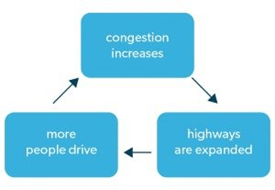
Expanding road capacity doesn’t necessarily reduce traffic; it actually may increase it.  It’s called Induced Travel Demand (ITD).  As more roads are built, more drivers together with their automobiles emerge and eat up the added capacity. 

ITD has been proven in urban centres not only at Los Angeles but in cities around the world such as Beijing and London.  It puts truth to the adage: “if you build it, they will come.”

The phenomenon of ITD, however, doesn’t apply to all places.  The Louisville-Southern Indiana Ohio River Bridges Project in the USA, for example, saw travel demand reducing instead of increasing despite forecasts to the contrary.  

In brief, increasing capacity can cause a corresponding increase in demand.  In contrast, increasing capacity can result in decreasing demand.  In both scenarios, engineers don’t get what they expected in terms of beneficial results. 

Adding capacity always seemed to be an obvious solution to increasing demand.  In reality, however, it’s not. 

Enterprises often invest in additional capacity when supply chains fall short in deliveries due to reasons such as production not being able to keep up with orders or because there were not enough trucks to load items. 

It’s obvious, the executives would say.  Manufacturing is running flat-out and we need more trucks. 

It goes further.  Logistics managers would say they need more storage space and more forklifts, on top of more trucks.  Purchasing managers ask to hire more staff to find more vendors.  Manufacturing would want their facilities expanded to accommodate more equipment. 

Justification is supposedly straightforward.  Engineers extrapolate present-day numbers with trends into the future.  Space will run out.  Production capacity will continue to run behind.  There will be more truckloads. 

The extrapolations that engineers use to justify added capacities aren’t even based on simplified mathematics but on elaborate algorithms certified by experts and established as valid for years. 

So, why then do projects fail to reap benefits?  Why does demand suddenly increase and traffic get worse?  Or why does demand fall off after new capacity is installed?

Because the forecasts, simply put and for what they were worth, are wrong.  Or to put it more concisely:  the forecasting is wrong. 

Urban planners often don’t take into account Induced Travel Demand because their forecasting only considers historic trends in demand.  They fail to see that sociological factors come into play when new roads and bridges are built.  Simply put, when people see a new road, they want to drive on it.   And the more a city boasts about the added capacity of a new road, the more the people are encouraged to change their habits of commute to use it.  More people drive and more cars are bought.  Congestion on the new road increases. 

In the Louisville-Southern Indiana Ohio River Bridges Project, the forecasting model engineers used assumed traffic would increase because there would be more commuters and motorists.  The forecasting model was based on surveys and mathematical algorithms. 

What the forecasting model didn’t take into account was that people’s behaviours change.  They don’t remain necessarily constant.  Hence, as the Louisville economy and demographics evolved, the patterns of commuters and motorists also changed.  Demand actually fell.  The forecast was wrong.

Engineers in the United States now realise that justifying new capacities whether it be for new highway infrastructure or for new machinery for manufacturing should not be based on forecasting alone.

It should be based on what the problem is. 

Capacity is not the problem when it comes to traffic.

Capacity is not the problem when supply is not meeting customer demand. 

For urban planners, it should start from questions like:

  • Where do we want people to reside and work?
  • How much public transportation do we want?
  • How many high-rise buildings should we allow to be built and where?
  • Where do we locate our airports and seaports?
  • Do we really need a new highways and airports?

For supply chains, questions arising about capacity shortfalls should focus toward:

  • Do we need more or less customers to deliver to? 
  • Who do we want to sell and deliver to in the future?
  • Who are the customers that are buying more or less of our products? 
  • Do we need to sell more new products or do we need to sell fewer?
  • Are our manufacturing facilities too big and too far from customers?
  • Should we centralise or put up satellite depots and service centres?
  • Are we satisfied with our transportation set-up? 

Forecasts are the bases of justification for new capacity projects.  Unfortunately, forecasts cannot be depended on to be precisely accurate.  In the first place, forecasting by itself, despite the modern-day algorithms, can never be counted on to provide a clear picture of the future. 

The error in justifying new capacity is in using the shortfall of capacity alone as a reason.  Engineers have realised that they should look at the causes behind the capacity shortfall and not by its symptoms.

We won’t ease traffic if we just build more roads. 

We won’t benefit by just adding more machines or trucks. 

We need to address the causes that underlie the effects. 

We build not only to accommodate.  We build to solve. 

About Overtimers Anonymous

Reducing Losses, Whatever the Type, Whatever the Scale

Material losses happen in every industry.  From the time a raw material is mined, extracted, or harvested, to the point where it finally is transformed and delivered as a finished product, there will be some loss along the way.  Not all merchandise that comes into an operation comes out 100% intact in the finished product. 

There are two (2) ways of looking at losses:

  • Loss in Quantity:  materials or items are destroyed, discarded or removed.  Examples include:
    1. machine scraps from milling, drilling, & cutting;
    2. discarded material left from painting & coatings;
    3. evaporation;
    4. spills;
    5. gas leaks;
    6. items that are thrown away such as soiled paper;
    7. over-usage of materials;
    8. pilferages.
  • Loss in Value:  otherwise known as degraded, these are materials that have deteriorated or have lost their primary utility.  Examples include:
    1. residues from chemical reactions such as refining;
    2. expired product;
    3. under-cooked or over-cooked ingredients;
    4. contaminated material;
    5. damaged goods during transport or from handling.

Enterprise managers use measures such as variances and yields to monitor losses. 

Variance is the difference between what is actually used versus what is supposed to be used.  It’s what some managers would call actual usage versus standard usage. 

Yield is the percentage ratio of output versus input in an operation or process.  Output is the quantity of quality-accepted product.  Input is amount of all of the material put into the process.   Operations managers always strive for the ideal of 100% but in most cases, they’d settle for 95% or greater. 

Variance and yield provide managers the yardsticks to how well their operations utilise the materials and product that pass through them.  The lower the variance or the higher the yield, the more efficient the operation is said to be. 

Manufacturing managers apply variance and yield in their operations but both can be useful to measure losses throughout the supply chain, at least from when an enterprise receives its materials to when the final finished product arrives at the customer’s doorstep. 

Manufacturing managers work to reduce variances and increase yields through improvements in production operating parameters.  Purchasing managers help improve yield and reduce variant losses via collaborations with vendors to improve materials’ conformities to desired specifications. 

Logistics managers work with their quality control counterparts together with vendors, logistics providers, and freight contractors in setting standards and methods that would improve merchandise shelf lives and at the same time mitigate risks in materials handling & transport. 

From another viewpoint, losses are either anticipated or un-anticipated.

In manufacturing, losses are generally anticipated, that is, they are expected to occur given the nature of an operation.  Losses usually happen during the transformation of materials into finished product.

Unanticipated losses are those that occur infrequently, unpredictably, and at scales much wider than that of anticipated losses.  Unanticipated losses tend to happen more often in logistics operations, as in materials handling and transportation, where there is an absence of direct monitoring. 

Amid the coronavirus pandemic of 2020, Philippine farmers threw away vegetables because they suddenly couldn’t find buyers for their produce.  Buyers didn’t show up at the trading post where they typically transact with farmers as people could not leave their homes due to mandated quarantine lockdowns.  Meanwhile, locked down Filipino households were complaining that they couldn’t buy food. 

Unanticipated losses can be catastrophic especially when it comes to the global supply chain trade. 

In early September 2020, a ship carrying 6,000 cattle and 43 crew sank amid bad weather as it approached the coast of Japan.  Only two crew members of the ship, the Gulf Livestock, were rescued. 

A crew member believed to be from Gulf Livestock 1 is rescued by Japan’s coastguard. Photograph: Japan coastguard/Reuters https://www.theguardian.com/world/2020/sep/03/typhoon-maysak-ship-with-43-crew-and-nearly-6000-cattle-missing-off-japan

An investigative article by the Guardian published on January 2020 speculated  significant losses of live animal livestock on sea transport.  The article’s writers observed that a number of ships have less than adequate facilities in transporting live animals but there was little in the way of data on the scale and frequency of losses.  Unanticipated losses can not only be disastrous but also could be happening more often than one thinks.

Whereas managers might find variance and yield applicable in reducing anticipated losses, they are quite less effective when it comes to unanticipated losses.  Enterprises fall back on insurance to offset unanticipated losses but they don’t solve the problem.  Losses would still hurt especially if lives are lost other than the loss in resources. 

This is where supply chain engineering can be helpful. 

Supply chain engineers can assess the storage facilities, material handling equipment, and transportation assets and seek improvements in how merchandise are worked through them. 

Supply chain engineers can be instrumental when enterprises accredit the 3rd party providers who take custody of products for deliveries to customers, especially those that require meticulous handling and long-distance travel.  Supply chain engineers can devise operating standards for the proper storage, handling, and transport of products.   SCE’s can reconcile manufacturing, procurement, and logistics protocols in the management of merchandise that would minimise variance, increase yields, and mitigate the risk of catastrophic losses.

Losses happen throughout the supply chain.  Some get lost in quantity and some lose in value during a process.  Managers use variance and yield measurements to mitigate anticipated losses but unanticipated losses represent a blind spot especially as they occur more often in the logistics realm where there is less visibility. 

Supply chain engineers have the skills and knowledge to combat unanticipated losses by auditing the assets and systems that store and deliver the goods of enterprises.  SCE’s can propose standards that would encompass the entire supply chain and put more productivity in the transformation and handling of merchandise. 

Losses can be heart-breaking especially when they are catastrophic such as when a vessel sinks in the high seas.  Executives might try to cover their losses via insurance or by simply taking a blind eye but it would still be worth the effort to ensure not only most of what is procured, produced, and shipped reach their final destinations in one piece but also that human lives are not wasted for nothing.   

About Overtimers Anonymous

Hoarding and How to Discourage It

When people buy a little more than what they usually need, we call it speculation.  When they buy much, much more, we call it hoarding.

What happens when people hoard?  Do the enterprises that supply the goods gain in sales and profits?  Do hoarders make money?

Hoarding happens when people perceive they might not be able to buy the items they essentially will need in the very near future.   They end up buying a lot, to the extent consumers empty grocery shelves or businessmen use up all of their storage and look for more. 

Hoarding is not the same as building up buffer stocks or safety stocks.  Buffer and safety stocks take into account estimated variations in demand and supply.  These would be based on statistical formulae, as in like standard deviations if one recalls his or her education in statistics. 

Hoarding doesn’t have any statistical basis.  It is pure over-speculation borne by exaggerated perceptions of a current reality.  It often is a reaction to an adverse situation. 

A typhoon threatens to hit town.  Residents panic and buy based on what they believe they would need when the storm hits and afterwards.  How much they buy is based on fear and perceptions.  Perceptions are based more on emotion than it is speculation.  Hence, people buy as an emotional response and they tend to buy a lot more than they really need. 

Hoarding doesn’t benefit anyone.  Having too much of anything either eventually results in wastage or in having cash tied up for too long in the stuff bought.  Hoarders believe they would profit a great deal from selling the excess stuff that would become scarce but even then, the money earned is just a one-time bonus and the windfall doesn’t necessarily come at once.  Hoarders pay for the additional cost of storing the stuff and the opportunity cost for the cash they expended would be sunk into the goods they probably would be keeping for some time. 

Hoarding regularly also isn’t really a good idea.  On top of the added cost of storage and lost cash liquidity, having a lot of inventory drives up expenses.  Costs for security and upkeep creep in and eat away profits. 

Successful wholesalers especially of consumer goods and food items should not be classed as hoarders.  One wholesaler I know stocks up on canned goods and liquor starting July of every year.  He stocks up enough quantities that would meet likely demand for the year-end holiday season.  He bases his projected sales on the demand histories of the products he stocks.  And he’s often right.  The goods he bought and stocked up end up practically sold out before Christmas. 

Hoarders on the other hand don’t base their purchases on demand forecasts.  More often than not they end up with inventories that last for months and even years.  Hoarders buy based on irrational reasoning.  Wholesalers buy based on rational estimates. 

Hoarders likely won’t listen to advice to not stock too much.  Some enterprises, therefore, control how much inventory they make available to their customers, especially if the products they sell are fast-selling essential commodities.  Suppliers will ration and allocate to discourage hoarding.  Or they’ll ask for cash up front as hoarders, just like everyone else, would have limits in their financial capacities to pay. 

Hoarders can be very persistent in procuring the stuff they want to keep for themselves and satisfy their irrational urges.  Enterprises should distinguish who their customers are from the hoarders that put away products and refuse to share with others who may need them just as much, if not more.    

Customers may be always right.  Hoarders never are. 

Improving the Customer Experience and Gaining Higher Productivity

This Photo by Unknown Author is licensed under CC BY-SA

An automotive service centre in Manila, Philippines advertises that it opens at 8:00am. The doors actually open, however, around 8:15am.  Employees time in before and after 8am but pass through the washroom before heading to their desks.  A waiting client who would have arrived at 8:00am would probably be served earliest at 8:30am. 

The automotive service centre is part of a dealership that sells Japanese cars, vans, and motorcycles.  The dealer represents the final point of a Japanese automotive company’s global supply chain.  The Japanese company is heralded as a market leader but that view is far from the mind of the customer waiting for a half hour for one of its dealers to open the doors of its service centre. 

The Japanese owners of the automotive company wouldn’t likely be aware of the experiences of their Manila dealer’s customers. 

They probably wouldn’t know how customers felt for having to wait for 30 minutes.  And they probably wouldn’t know some customers would have to wait even longer because the supervisor who would decide on specific service requests hasn’t arrived yet. 

Many executives don’t know first-hand what their customers are experiencing with their enterprise’s front-liners.  They would rely on feedback, surveys, and statistics but they would hardly see the actual experiences of customers. 

Improving the customer experience can catapult an enterprise’s competitive advantage.  But it’s not only because customers will flock for the better service but also because when one improves the structure and processes that improve that experience, it uplifts not only customer satisfaction but the enterprise’s productivity. 

The automotive service centre has a competitor down the street.  The competitor advertises that its service centre opens at 8:00am but at 7:30am, the service representatives are already checking in customers and inspecting cars.  At 8:00am sharp, the service representatives are already interviewing the customers for their specific complaints and requests.  Service representatives provide the first group of waiting customers diagnoses and estimates within a few minutes.  The service centre would immediately begin work on cars as soon as the customers sign on their approvals.  Customers who were at the service centre at 7:30am for routine service checks would be checking out as early as 9:30am. 

The automotive competitor serves more cars than the one who keeps customers waiting.  It’s not because the competitor has more poor-quality automobiles that need fixing, but it’s because the competitor sells more cars than its neighbour.  The competitor does not keep its customers waiting and makes sure all the cars that come in the morning are served as soon as possible. 

Customers at either service centre may not be very loyal to the automotive brand they buy but they will remember their experiences.  This would have an impact on what automobile they will decide to buy in the future.

But more than that, the competitor has a higher productivity than the neighbour who opens late.  The higher productivity assures no backlogs in service jobs that would not only drive up expenses but also make it difficult to keep the customer experience consistent.

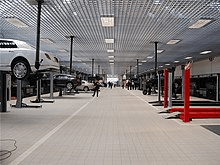
The competitor didn’t just add staff to engage waiting customers right away.  The competitor also invested in multiple maintenance bays to service more cars simultaneously.  The competitor also laid out the facility to have two types of bays: one for quick routine service and the other for longer, more complicated jobs. 

The routine service bays were closest to the facility’s doors so service attendants can move cars quickly to customers who can leave immediately.  The other bays were located deeper which made them closer to parts storage and special equipment. 

The competitor has seen the challenge for consistent customer experience and productivity grow.  Sales has gone up and down in recent months.  But because the competitor has made sure he has enough staff and bays, customers haven’t been complaining. 

The automotive service centre that kept customers waiting for 30 minutes, however, had obviously not paid attention to how promptly its staff reports in the morning.  And one could see there was no system of assigned bays or facility plan when it comes to maintaining customers’ cars. 

Companies are fickle when it comes to customer experiences.  Every so often they harp on it, but when times get tough, they sometimes forget about it. 

When one connects a consistently good customer experience with higher productivity, one can see the immediate benefits.  The intangible advantages of satisfied customers result in the tangible paybacks of having a productive work-place. 

About Overtimers Anonymous

Why and How Banks Should Improve their Services

In the late 1990’s, Asiatrust Development Bank, a relatively newcomer to the Philippine banking industry, expanded its banking hours from 8:30am to 6:00pm.  It was a break from the traditional 10:00am to 3:00pm schedule that was the mainstay of other Philippine banks.   Many small businesses and individuals particularly those who worked until evenings, flocked and opened accounts with Asiatrust. 

Asiatrust also offered pick-ups of deposits from customers and post-dated check warehousing, in which post-dated checks can be safe with banks until their deposit dates.  These added conveniences helped the bank snare more clients, notably small & medium-sized businesses

Some banks took notice of Asiatrust’s meteoric capture of market share and also expanded their hours and services.  Asia United Bank (AUB) absorbed Asiatrust in 2012 but its legacy of services for small businesses and entrepreneurs lived on in the Philippine banking industry.

Almost thirty (30) years later, amid the pandemic of 2020, Philippine banks have reversed these services.  Citing the risks to public health, banks have shortened hours; some have even closed branches.  Banks have reduced staff, resulting in long queues of clients at branches and long waits when calling customer service hotlines. Bank internet services have slowed thanks to surges in online transactions. 

Banks serve an important function in ensuring enterprises and their supply chains keep running well.  Cash-flow transactions between vendors and customers transpire mostly via banks.  Foreign exchange dealings, such as letters of credit (LC’s) and wire transfers, happen in most cases through banks.  Philippine bank executives repeatedly extol their commitment to customer service but they balance that priority with that of managing present-day risks in order to maintain the health of their finances. 

When banks downgrade services, enterprises’ supply chain activities may suffer. When a bank is closed or the waiting line leading into it is too long, for instance, clients may find themselves unable to consistently do routine financial transactions.  This can result in delays in payments to vendors and depositing collections from customers.  Receipts of materials and deliveries of merchandise would be negatively affected. 

Cutting back services, especially those dealing with foreign exchange transactions, can hamper the timelines of enterprises to import materials or export products.  

Banks have a golden opportunity to grow if they would just focus on service. 

In the Philippines, more than 65% of adult Filipino households don’t have bank accounts.  That’s 65% in potential market growth for banks.  Many Filipinos don’t deal with banks because either it’s a hassle for them (branches are inconveniently far from their homes or places of work) or because it’s simply discouraging to open accounts (e.g. too many forms to fill, minimum deposits, low interest rates, restrictions on loans). 

Small businesses make up 99% of commerce in the Philippines.  Which means they also likely make up 99% of supply chain transactions in the Philippines.  Even if the remaining 1% of enterprises that comprise big businesses may hold a large share of the commerce, the revenue and investment potential of small enterprises cannot be discounted. 

Banks aren’t just important to supply chains, they are much like them and can even be managed as such.

Banks purchase and deliver cash to and from branches and require the logistics of armoured cars.  They not only tap the talent of managers and staff to serve clients but also have work systems that can be optimised (e.g. tellers and customer services). 

The science of determining how many branches to have and where to locate them are not much different from that for storage depots for manufacturing firms.  And finding out how much capacity a branch should have (number of staff and how many operating hours) isn’t far from the capacity computations for assembly lines and logistics operations. 

The risk management for banking operations which encompass safety and occupational health aren’t really unlike that for the standards and practices for supply chain operations. 

Organisations with supply chains have been continually adapting to risk and improving customer service, pre-pandemic and amid the pandemic.  If they can do it, banks can too. 

The science of supply chain management and engineering can work for banks as much as it has in many industries.  It just perhaps needs the insight to get it started.  

About Overtimers Anonymous
Competitive & Non-Competitive Priorities and How to Deal with Them

In several firms I’ve worked with, I couldn’t help but notice that supply chain managers would sometimes be engrossed with priorities regarding compliance to government-mandated occupational safety & health standards.  They would have long meetings and spend much time on the nitty-gritties of reports to be filed and procedures to follow.

But in the following week, the same managers would switch to issues regarding costs that were going over budget.  The general manager of their company was concerned about expenses and wanted a meeting so the supply chain managers would be rushing to prepare their presentations to explain their respective functions’ spending. 

Priorities would shift week after week, month after month.  One day it would be safety, the next day it would be quality.  When managers would ask which priority is more important, their boss would reply: “all of them.” 

There are two (2) types of priorities enterprise executives deal with.  These are competitive priorities[i] and non-competitive priorities. 

Competitive priorities are those when addressed add value to the enterprise.  Examples are sales, cost, quality, delivery reliability, and after-sales service excellence.  As the term suggests, these priorities directly contribute to an enterprise’s competitive advantage. 

Non-competitive priorities are those that executives do not recognise as adding value to the organisation but are too important to ignore.  Examples are safety, security, industrial labour relations, community relations, government regulation compliance, environmental safeguards, and employee health.  These priorities may not contribute to an enterprise’s competitive advantage but are imperative to its ongoing operations. 

Enterprise executives see competitive priorities as vital to the organisation’s growth.  Consumer goods executives, for example, would develop marketing and product initiatives to bring about higher sales. 

Enterprise executives, on the other hand, see non-competitive priorities as crucial to the organisation’s survival.  Executives, for example, would stress industrial safety as a program to prevent injuries.  They would expect their organisations to adopt safety practices so that people don’t get hurt, and not lead to disruption in operations. 

To put it in another way:

  • Competitive priorities address opportunities.
  • Non-competitive priorities address adversities.

Classifying priorities in either category may help enterprise executives not only what to tackle first but also determine who should be leading the respective priorities. 

Quality and safety are everyone’s jobs but if there are no quality control or safety managers to lead priorities in either one, then it would probably be chaotic for the executives trying to handle them on top of the other important things they have to do. 

It also pays to have awareness of the two types of priorities to know how they would affect the enterprise.  Classifying community relations as a non-competitive priority, for instance, may prove worthwhile for an enterprise who has a factory situated within a largely populated city.  It would encourage executives to invest in a manager who would engage with the factory’s neighbours and handle issues that might result in mutual benefits. 

Being mindful of competitive and non-competitive priorities also gives the organisation a constant big picture of the work it’s doing.  Engineers building a new storage facility, for example, would best have an understanding of what they want to accomplish.  It wouldn’t just be about building for more capacity; it would also be about the impact on working capital, better distribution of products, reduction in damages, and safer working conditions.

Executives can sharpen their enterprise strategies with their awareness of both competitive and non-competitive priorities.  The trick is to have balance and brevity.  Some company mission statements tend to stress too much on quality and leave out the rest.  Other corporate philosophies overdo it with numerous paragraphs that overwhelm the organisation. 

We all have priorities.  We just need to understand which ones are competitive and non-competitive in which the former addresses opportunities while the other takes on adversities.  Both are too important to ignore so it would help if we classify the things we do as either competitive or non-competitive. 

If we can’t do things all at once, we may need to check our structure and resources.  We also should try to make sure our overall strategies aren’t complicated or overwhelming for our own organisations. 


[i] Davis, Mark M., Aquilano, Nicholas J., and Chase, Richard B., Fundamentals of Operations Management, 1999, Chapter 2, p. 25

About Overtimers Anonymous

What Collaboration Is and Is Not

Collaboration denotes a cooperative working relationship between parties which leads to mutual benefits.  It’s not commonly observed in industries and supply chains despite the potential benefits it can bring.  This is because it’s not easy to do and in the first place, many business executives don’t think it’s worth the trouble. 

Many enterprises, small businesses especially, don’t have the leverage to collaborate.  Big companies look down at small ones, for one thing, and see no worth in pursuing collaborative relationships with enterprises that contribute little to their revenue or cost. 

Even if a small business grows larger, it would still have trouble earning trust from suppliers and customers.  It’s just natural to be suspicious and wary when dealing with others outside of our own organisation, if we aren’t already to those within our own workplace.  Our parents did tell us not to talk to strangers when we were children.  We were taught not to trust just anyone.  

Collaboration has to start between individuals within an organisation before it can expand to those outside it.  An organisation has to establish internal collaboration before it can externally collaborate with other enterprises such as vendors and customers.[1]

Internal collaboration is when “sales, marketing, and operations find a way to align and focus on serving the customer in a way that maximises internal profit.”[2]

When internal collaboration is achieved, then an organisation can move to external collaboration.  External collaboration “consists of a supplier and a customer working together to achieve mutual improvement.”[3] 

We should know what collaboration is and what it is not. 

  1. It isn’t a meeting.  It’s not several representatives of one company meeting with those from another.  It’s not enough also that representatives draw up agreed action plans or sign a contract after a series of meetings.  Agreements and contracts aren’t collaborations; they’re just formalities to existing business arrangements that don’t outright lead to mutual improvement; 
  2. Collaboration isn’t an internet link.  When an enterprise can order materials from suppliers via email or customers can order merchandise via a dedicated electronic data processing (EDP) network, that is not collaboration.  That’s a connection.  Such a network that eliminates time-consuming documentation may be a manifestation of enterprises working together but it’s really nothing more than a wired conduit between information systems; 
  3. Collaboration is about multi-function cooperation, not just one department with another.   It’s about representatives from every relevant function of an organisation cooperating with counterparts from another.  Suppliers and clients in collaboration wouldn’t be limited to price and order issues; they’d be discussing inventories, payables, quality, and operations reliability;
  1. Collaboration is working together.  It is about enterprises huddling as one in developing common mutually beneficial objectives and strategies;
  2. It isn’t a merger.  Collaboration doesn’t mean becoming one enterprise.  There’s still a distance to maintain because there would still be diverging interests.  A customer who’s into retail may not want to really involve herself too much with a supplier who’s into manufacturing, for instance; 
  3. Collaboration is dedication via leadership.  Enterprise executives must lead by showing initiative, investing time, and developing trust with their counterparts.  When executives dedicate, they show how serious they are to the organisation.  Naturally, the organisation would follow the leaders; 
  4. But it’s dedication not commitment.   Collaboration is more like a friendship, in which individuals come together as a team to explore opportunities and come up with common goals.  But it’s not a marriage where an enterprise wholly commits itself to another.  We don’t sell our souls when we collaborate; 
  5. Collaboration is not for everyone.  Small businesses may not have much leverage to collaborate but who cares?  Some firms may be perfectly fine without collaboration, for now or for the meantime.  A hardware store dealing with thousands of items wouldn’t spare the time to collaborate with a vendor of very few items, even if the items make up a significant bulk of sales;
  6. Collaboration is an activity that requires preparation and structure.  Dealing with counterparts, whether internally or externally, with other functions or with vendors or customers, requires planning, policies, and a framework of assignment, accountability, and performance measurement.  There must be a front-line team who will work with another from the other side.  That team must know what it wants, what its limits are, and what it must answer for; 
  7. Collaboration is a system.  At least it should evolve into one.  Collaborating is not just a meeting of minds and just getting things done together.  For it to be worth it, it has to result in a continuous mutually beneficial relationship.  Each side should establish a shared routine of communications, negotiations, and transactions that point toward higher levels of performance that give rise to ever increasing benefits. 

Collaboration is not only about getting two parties together, ironing out differences, and coming out with an agreement.  It’s not a meeting.  It’s not something that leads to a contract or even a merger.  It’s an activity where counterparts work together toward a common purpose for mutual benefit.  But it’s not a marriage; counterparts should respect each other’s individual personality and path.  It requires a team with a set agenda and that’s dedicated to perform.  It eventually becomes a system where the parties perform and grow together in a shared environment. 

It’s not easy to start, not easy to sustain.  But it might be worth the effort.  Because two heads are always better than one.  Working together is better than working alone. 

About Overtimers Anonymous


[1] Reuben E. Slone, J. Paul Dittman, and John T. Mentzer, The New Supply Chain Agenda: The 5 Steps that Drive Real Value (Boston, Massachusetts: Harvard Business Press, 2010), chapters 5, Kindle.

[2] Ibid, chapter 5, Kindle.

[3] Ibid, chapter 6, Kindle.

How Maintenance Can Make the Difference Towards Victory or Defeat

On October 6, 1973, Egyptian and Syrian military forces launched attacks on Israel.  It was Yom Kippur, Israel’s holiest religious holiday and despite defensive contingencies, the Jewish state’s citizens were taken by surprise as thousands of tanks, artillery pieces, and soldiers invaded the Golan Heights at the north and at the Sinai Peninsula at the south. 

While media attention focused on the Egyptian invasion at the Sinai, Israel’s survival hung on a balance from the Syrian offensive at the Golan Heights.  The Syrians had brought 1,200 Soviet-made tanks backed by 1,000 artillery pieces and another 1,000 armoured personnel carriers (APCs).  Israel had only up to 250 tanks going into battle.  Syria’s Soviet-made surface-to-air (SAM) missile batteries shot down responding Israeli Air Force (IAF) jet fighters, effectively neutralising air support.  It was a duel to be determined by two ground armies in which the odds were stacked in favour for the Syrians.  It was a life-or-death struggle for Israel. [1]

Within 100 hours from start of the attack, however, Israel had beaten back the Syrians.  Israeli professionalism, gallantry, coupled with advantages in terrain, had prevailed.  Some would say it was a miracle. 

The Syrians had hit all engaging Israeli tanks during the battle of the Golan Heights.  Of the 250 Israeli tanks that Syria had knocked out, 150 of those tanks returned to battle after they were repaired within 24 hours.  Some of the 150 Israeli tanks were even hit more than once but still returned to battle within hours.

At the height of the fighting, Israeli tank crews brought their damaged vehicles to repair centres behind front-lines.  Soldiers would rescue tank crews and towed the tanks back.  Logistics personnel made sure there were ample stocks of spare parts as mechanics and engineers quickly fixed the tanks and made them ready for service within hours.  Tank crews meanwhile used the respite to rest and eat. [2]

The Syrians had no such system.  Tank crews would simply abandon their damaged tanks.  There was no replacement or repair for any Syrian tank that was hit.  The Israeli tanks, meanwhile, returned to the field again and again to engage their enemies.  Even at overwhelming odds of up to 10 Syrian tanks for each one from Israel, the Syrians could not keep up.  After four (4) days of fighting, the Syrians withdrew.  Israel emerged victorious. 

The Yom Kippur war was a testament how the Israeli military valued its soldiers and equipment.  While its Arab opponents relied on the Soviet military doctrine of unleashing large numbers of tanks and soldiers, Israel opted on the ability to rotate its weaponry on the battlefield.  The Israel military’s system of maintaining their equipment and rotating them back to service undoubtedly contributed to its victory in the battle for the Golan Heights.  

Maintenance of fixed assets is a commonly neglected area in enterprises.  Buildings, trucks, material handling equipment, production machinery, and office hardware are part and parcel of most, if not all, enteprise operations.  Yet, some enterprise executives don’t see the value of maintenance of such assets in good running working condition.

We hear the complaints all the time: 

  • A purchasing assistant has to share her laptop with a colleague whose desktop personal computer is waiting to be fixed;
  • A quality control laboratory technician delays the release of a finished product because a replacement part for her broken-down testing machine hasn’t arrived yet;
  • Employees on a shipping dock can’t finish loading trucks because their forklifts constantly stall;
  • A building roof leaks when it rains and disrupts production on an assembly line. 

Enterprise executives should not view maintenance as a burden.  They should see it as an opportunity for competitive advantage. 

Setting up a maintenance program does not require management re-invention.  As with any management process, it involves setting goals, formulating strategies, and establishing policies. 

Supply chain engineers (SCE’s) can help enterprises assess the system of managing the procurement and inventories of spare parts and marry it with the performance measurement of operations. 

Maintenance may be daunting especially for supply chains that employ complicated processes and equipment.  All the more reason for enterprises to engage the engineering prowess of SCE’s who can assess and untangle the myriad complexities of equipment set-ups and recommend solutions to optimise the balance between operational uptimes and maintenance downtimes. 

The Israeli military in 1973 made sure their soldiers had the support of a superior maintenance system to defend their country.  The repair centres behind the front-lines those fateful days at the Golan Heights had enough tools, well-trained crews, and a well-stocked inventory of parts to fix damaged tanks and equipment and bring them back to battle. 

Maintenance made a difference to a country’s miraculous victory.  What more can it do for enterprises in highly competitive arenas.  

About Overtimers Anonymous


[1] Jerry Asher with Eric Hammel, Duel for the Golan, (New York, New York: William Morrow & Company, Inc., 1987) book jacket.

[2] Ibid, page 192.

The Three Capacity Types

How much can we make?

How much can we buy?

How much can we deliver?

These are typical questions executives ask their managers all the time.  Executives often want straightforward answers; they’d rather be spared the complicated assumptions behind any of them. 

Calculating capacities can be a headache.  It’s never really as straightforward as a machine’s rate of production or how many items a person makes in a day.  Operators sometimes slow machines down or speed them up.  A shorter person may not make as much as a taller person.  Raw materials from one vendor may lead to higher output than that from another supplier. 

How executives view an enterprise’s supply chain capacity is also often different from that of employees.  Executives usually prefer what’s the most that can be produced and delivered.  Employees typically equate capacity with how much they have delivered in reality. 

Answering the questions of capacity therefore requires knowing what assumptions to base on and what data and formulae to use. 

I usually propose three types of capacities for enterprises:

  1. Maximum Capacity
  2. Operating Capacity
  3. Demonstrated Capacity

Maximum capacity is how much an operation can make or deliver assuming it runs at its highest designed rate all the time, that is, 24 hours a day, seven days a week, 365 days a year (366 if it’s a leap year).  No breaks, no shutdowns. 

maximum capacity = design rate x 24 hours/day x 365 days/year

Note that it involves the highest designed rate, that is, what the operation is engineered to do.  The design rate isn’t what it can actually do but what it’s supposed to be capable of. 

Operating Capacity is how much an operation can make or deliver assuming it runs at its highest designed rate based on a schedule.  Operating capacity computations are based on planned timetables but regardless of downtimes.

operating capacity = design rate x scheduled operating time

Note that operating capacity uses the highest design rate and 100% of the scheduled time.  Operating capacity does not take into account planned or un-planned downtimes, such as break-times or time lost during an operation for whatever reason.  For example, in a production process that has a design rate of 100 pcs per minute and is scheduled to run eight hours a day but with allowed breaks totalling 1-1/2 hours, the operating capacity would be:

operating capacity = 100 pcs/minute x 8 hours/day x 60 minutes/hour = 48,000 pcs/ day

Operating capacity does not factor in the break-time.  It does not consider any slow-down from the design rate. 

Demonstrated Capacity is based on the actual output of an operation.  It is determined by multiplying the actual operating time with the actual operating rate

demonstrated capacity = actual operating time x actual operating rate

The actual operating rate is the regular rate of output or what an operator or supervisor establishes as the equipment’s or workplace’s attainable output of items.  The actual operating time is the total amount of time the operation was running after deducting planned and un-planned downtimes.  For a production process that has a design rate of 100 pcs per minute, but an actual output of 5,000 pcs per hour that has a schedule of one eight-hour shift a day with 1-1/2 hour breaks, the demonstrated capacity would be: 

demonstrated capacity = (8 – 1.5 hours) x 5,000 pcs/hr = 32,500 /day

Demonstrated capacity does not take into account the design rate or the total eight (8) hour scheduled shift.  It only considers the actual operating time and actual rate of output.  It does not, however, deduct any unacceptable output (e.g. scrap, rejects). 

The Three Types of Capacity

Executives, especially financial managers, prefer maximum capacity when it comes to assessing how well an enterprise is utilising its assets.  If an enterprise’s supply chain schedules an operation at one (1) shift a day, it would be utilising at most one-third of an operations assets’ capability, which reduces the potential return on investment for the assets.  For an enterprise’s owners, that would be tantamount as wasted opportunity. 

Supply chain managers favour operating capacities in measuring efficiencies.  Operating capacities would be the baselines to determine how reliable operations are. 

Many operators and supervisors like demonstrated capacities for performance measurement.  Some would see operating and maximum capacities as unreachable parameters.  They’d instead measure their output against what they can attain, which would be demonstrated capacities.    

When it comes to determining what the capacity of an operation is, one has to be aware of who’s asking and what is being looked for.  Is it how much an operation is capable of? (Maximum Capacity).  Is it how much can be achieved at full efficiency over a planned time frame?  (Operating Capacity).  Or is it how much can one realistically count on to attain? (Demonstrated Capacity).

Enterprise executives, managers, and engineers may have their own versions on capacities.  It should be based on what one is after.  An executive seeking the best return on investment would have a different perspective from an operator who wants to know how much can really be done. 

Capacities apply to every operation.  Variables such as design rates can be tricky to determine, especially if the design rate is to be determined from labourers or logistics.  Supply chain engineers can help provide the data. 

That’s what they’re there for. 

About Overtimers Anonymous

The Nimble Supply Chain: Is It Even Possible?

Managers like things to turn out elegant.  A well-laid out factory that produces flawlessly.  A warehouse with more than enough storage space and material-handling equipment.  A complete fleet of trucks that delivers all the orders without delay.  A smoothly running purchasing system in which supplies and materials are bought at the best price and arrive on time. 

Nice to dream about but hardly the reality.  All it takes is one disruption to mess everything up. 

The COVID-19 pandemic of 2020 is the popular example.  Many enterprises have closed thanks to sudden drops in demand and supply.  What many executives thought would be a good year turned out the opposite. 

But as much as the pandemic was the biggest whammy to business in recent memory, it is not the last and it certainly wasn’t the first.  Disruptions happen all the time in different degrees and forms.  There will always be uncertainties and resulting variabilities in supply and demand.  Consumers will overstock or switch to other brands.  Business customers will be fickle about buying new equipment.  Vendors will speculate and change prices, terms, and the availabilities of items.  Third-party providers will abruptly ask to renegotiate contracts.

Many consultants cite the need for supply chain flexibility and resilience in order to re-grow and survive.   But that’s not the answer. 

What we need are nimble supply chains.  Nimble means having the prowess to adapt and respond quickly to changing circumstances without having to invest or spend too much in resources.  It’s more than being synonymous to agile.  It involves the ability and tendency to adapt rapidly to changing circumstances.  Enterprises not only need to run fast but run fast and dodge unpredictable obstacles while aiming toward moving targets.     

Hence, the challenge for supply chains:  with all its differing functions and all the uncertainties, how does one become nimble from start to finish?  Can it even be done? 

The answer is yes but it would need changes in mindsets. 

First, nimble is not a buzzword.  Consultants and so-called experts have promoted buzzwords like agile, just-in-time (JIT), Six Sigma, ERP, Lean, and responsive.  Many projects have ended up dead-on-arrival while consultants and so-called experts made money out of them.  When we say we want to be nimble, it doesn’t mean uttering it in every meeting.  (“we need to be nimble!”, why aren’t we nimble?”). We need to define it and make a strategy out of it. 

Second, nimble does not mean a total change in how we operate.  It’s more of finding and focusing what to improve and where.  How fast can we switch to a different item?  How do we shorten the set-up times between products? How do we adapt our order-to-delivery systems?  How do we quickly source new materials?    

Large consumer goods firms such as Unilever and P&G have bragged about their introduction of hand sanitizers and face masks in the wake of the COVID-19 pandemic but it took them several weeks to develop the items.  Toyota has made it a routine to retool their assembly lines and make available a new vehicle model in a matter of hours, if not minutes. 

Third, it is relevant to all functions in the supply chain.  Nimble isn’t limited to manufacturing (where a lot of people think it does).  And even if an enterprise thinks it can be nimble just on the production line, it is doubtful its supply chain will be if its logistics and purchasing functions aren’t geared up for it. 

A large wholesaler excelled in the procurement and inventory management of merchandise but had room for improvement when it came to deliveries.  The wholesaler hired a freight trucking company to deliver products to customers.  The wholesaler insisted that the trucking company supply large 6-wheeler trucks to maximise loads and minimise freight costs.  Trucks, however, often had to wait for hours till they were fully loaded and the wholesaler usually loaded the trucks with up to 10-15 customer orders each.  Either way, deliveries were frequently delayed or trucks weren’t able to deliver all of the orders in a single day.  Customers complained.  The wholesaler finally relented to the trucker’s call to use smaller four (4) wheel vans which delivered to customers faster, sometimes within the same day orders were received.  It turned out freight costs didn’t significantly increase as four (4) wheel vans could do several trips in a day.  

Fourth, nimble applies in every industry.  Whether it be consumer goods, industrial, or energy, going nimble can help enterprises of every sort. 

For many years, a large cement company sold to a captured market.  It had steady revenues and all it had to worry about was cost.  Its factory was designed to mass produce cement bags by the hundreds in a day.  One day, however, the government allowed foreign cement producers to enter the market.  Suddenly, the cement company found itself at a pricing disadvantage.  The cement company eventually closed down its factory.  Imported cement was cheap and had better quality.   The cement factory never bothered to improve its products or its operations.  It thought it never had to. 

Fifth, nimble isn’t limited to enterprises that sell tangible products; it works for service-oriented organisations too.  Hospitals in Taiwan have long realised that fast turnaround of patients is crucial in keeping costs down and reducing wait times for sick people seeking treatment.  Taiwan hospitals were well-prepared for the COVID-19 pandemic.  They had an inventory management system that assured enough medicines, supplies and personal protective equipment (PPEs).  They also set up a structure in which assigned medical teams, consisting of doctors, nurses, and staff, would be dedicated exclusively to the contagion.  These teams would work separately from other medical practitioners dealing with patients with other ailments.  The strategy worked and Taiwan was nimble enough to dodge the virus bullet. 

Sixth, and finally, it needs an engineering approach.  Leaders set directions, managers plan and implement, but engineers do the nitty-gritty design and development of structures and systems essential to the improvement of operations. 

Enterprises don’t construct factories on their own.  Enterprises hire engineers to do that.  In the same way, they should engage supply chain engineers to build systems and structures that would enable an enterprise to become nimble. 

Enterprises don’t have to start from scratch.  And it would not need super large investments.   Engineers can identify workplaces along the supply chains that would significantly contribute towards becoming nimble. 

It can consist of re-designing production lines to quickly change over to different items, such as what Toyota did.  Or it can involve having smaller trucks to deliver rapidly to customers, as what the wholesaler did.  It can also just entail identifying areas to reduce costs and improve quality which the cement company failed to do. 

Supply chains operate in a normally disruptive world.  Enterprises need to be nimble; flexibility and resilience aren’t enough.  Buzzwords are useless.  For an enterprise to be nimble, it needs to define its strategy, focus on where to improve, and involve all functions.  Enterprises have to believe that nimble applies to all industries, even service-oriented ones. 

The best approach to nimble is via supply chain engineering.  Supply chain engineers have the best qualifications to build the nimble enterprise. 

About Overtimers Anonymous