The Key to Managing the Future is to Anticipate It

We do a lot to foretell the future.

Organizations and individuals invest heavily in analytics and software to know what tomorrow will bring.  Some offer great potential as in the case of Google’s investment in artificial intelligence for wind energy.

But just as much as it may be worth it to foretell the future, it may be just as better to anticipate it. 

A large multinational company longed for a system that would ensure continuous supply of pineapple products to customers. 

The multinational company served customers in its home country as well as from overseas.  Demand varied throughout the year and peaked near religious holidays.  Customers from abroad would buy in large quantities and would send large-capacity cargo vessels to pick up their orders at the multinational’s processing plant. 

The multinational’s planners not only contended with up-and-down demand but also with uncertain supply.  Supply depended on the daily harvests of the company’s nearby sprawling plantation.  Although the plantation’s employees harvested from fixed areas of farmland each day, the quantity and quality of pineapples received at the processing plant differed one day to the next.  Sometimes the harvest was plentiful; sometimes it was not. 

The company invested a great deal in research and development (R&D) to ensure harvests were consistent, if not predictable or manageable.  The plantation managers, for example, used chemicals to accelerate ripening to increase harvests when demand was outstripping supply.  But no matter what, harvests remained unpredictable.  A nice sunny day would result in unexpected high yields of pineapple but a truck stuck in mud would cause a shortfall. 

The company’s planners relied on finished product inventories to buffer the uncertainty of demand and supply.  But their problem didn’t go away.  Some products still went out-of-stock on store shelves and the company at times turned down orders from overseas customers. 

The company’s executives overhauled their inventory system.  The company’s executives previously had set a single sweeping target inventory level for all of their products.  Planners scheduled production against that one inventory level.  The results were shortfalls and excesses from item to item.  The executives learned that each item had its own identity and behaviour.  There was no such thing as an average item. 

The company’s executives reset the inventory policies that determined the stock levels for individual items.  Canned pineapple juices, for example, would be set at low inventory levels because the processing plant produced them daily.  Planners on the other hand would build inventories for exported products to synchronize with the timing of arriving vessels. 

Right after new policies were in place, the company registered record sales as supermarket shelves were well-stocked during holidays and orders were completely filled for overseas customers. 

Developing inventory policies is a method in anticipation for the future.   It’s not expensive though it does require a significant amount of work.  But as in the case of the example of the company and its pineapples, it would be well worth the effort.

As much as foretelling the future via investment in cutting-edge technology may offer profitable windfall, anticipating the future through methodical policies may just be as beneficial.

It isn’t sexy but it works. 

About Ellery’s Essays

previously written February 2019

Making the Most of Ishikawa’s Fishbone Diagram

Kaoru Ishikawa was a Japanese professor who championed quality improvement.  He is credited with the formation of quality circles, groups of workers & supervisors who work together to improve their operations.

We remember Kaoru Ishikawa for his namesake Ishikawa Diagram, more popularly known as the fishbone diagram, a tool quality circles would use to identify root causes of problems.

Via the fishbone diagram, the quality circle spells out a problem which at the onset is more of a symptom, issue, or disruption.  The problem takes up the position as head of the fishbone in which a facilitator asks quality circle participants to share what they think what’s causing it.  For example, if the problem is not meeting a production target, the group may cite possible causes like:

  • Frequent changes in schedules
  • Poorly maintained machines
  • Not enough people
  • Late deliveries of raw & packaging materials
  • Lack of pallets

The facilitator draws a fishbone showing these causes:

Not meeting the production target’ makes up the ‘spine & head’ of the fishbone diagram.  The causes a quality circle would bring up comprise the fishbone’s ‘primary ribs’ which connect to the problem’s spine. 

The facilitator would then ask quality circle participants what they think are the causes leading to each of the primary ribs.  These causes would make up the ‘secondary’ ribs of the fishbone diagram:

The secondary ribs would not only be causes for the primary ones but also would be factors for the main problem: not meeting the production target

We don’t stop there.  The facilitator would ask quality circle participants what they think are the causes for the secondary ribs.  Thus, our fishbone diagram with 3rd-tier causes may look like this: 

Once again, these 3rd-tier causes are not only factors behind the secondary & primary branches but also are suspect as reasons for the problem of not meeting the production target. 

Note that, in this example, there are several causes that resemble supply chain issues:

  • unavailable spare parts
  • delayed arrival of imports
  • rush customer orders
  • vendors asking for payments of unpaid purchases
  • many empty pallets not returned from warehouse

And we note causes that seem to involve departments or disciplines the quality circle may not belong to or have any direct scope in:

  • no formal training program (human resources)
  • few qualified applicants to hire (human resources)
  • not enough skilled mechanics (human resources)
  • poor sales & operations (S&OP) planning (sales, finance, marketing)
  • limited cash flow (finance)

Quality circles had been the stereotypes for manufacturing work teams, consisting typically of rank & file workers, operators, & supervisors.  Hence, a downside of quality circles is that the root causes participants may identify could lie beyond their workplace borders.  Cynical observers may get the impression that quality circles are finger-pointing their failures to other functions of the enterprise.

Quality circles have faded in popularity and some of us may even label them as a bygone symbol from the 1980s quality movement.  This does not mean we should chuck Ishikawa’s fishbone diagram because quality circles are no longer hip.  Instead, we should recognise that there is potential in using it as an effective means to solving problems, especially supply chain ones. 

As we’ve become familiar with the interconnections of supply chain operations, we’ve been realising that some problems we encounter have root causes linked either to other functions or to our relationships with vendors and customers. 

Ishikawa’s fishbone diagram encourages us to identify causes to symptomatic problems, whether or not those causes originate from where we work or from shortcomings in our operating relationships with other functions or links in the supply chain. 

Many enterprise quality improvement training sessions include exercises in drawing Ishikawa’s fishbone diagrams.  But hardly do we see executives, managers, and rank & file staff using the fishbone diagram in meetings or crisis management sessions.  Many of us have relegated the fishbone diagram more as an organisational development or teambuilding training exercise than as a real tool for solving problems or improving productivity. 

We can exploit Ishikawa’s fishbone diagram if we realise it is a useful tool which any group or individual of any discipline can use.  And please note the following six (6) insights we can glean from using Ishikawa’s fishbone methodology. 

First, we don’t need to be in a group to use the fishbone diagram.  Individual problem-solvers can use the fishbone diagram by themselves.  We can make our own fishbone diagrams in seeking causes for problems we opted to study and solve.  If we need help, we can research or interview people of different backgrounds to help build the fishbone and validate the ‘branches.’

Second, if we do work as a group, the members don’t necessarily need to be from a single department or function.  Especially for supply chains, we should enrol people from as many disciplines as possible or at least from those areas that are upfront relevant to the problem.  If we identify causes which our group would have no members to provide details on, then we should invite them. 

And if or when we do form problem-solving teams, we should make sure that all members do participate.  A team leader is at least a facilitator and as much as possible should not be seen as a superior (even if they may be our bosses).  When it comes to team rapport in drawing the fishbone diagram, team leaders best serve as moderators or facilitators, and nothing more. 

We also should not categorise anyone we invite as a resource person instead of as a participant.  Doing so makes it look like we treat invitees as inferior non-members, meant to only contribute when we ask them to. By experience, resource people won’t volunteer more information than what we ask. 

Third, in workplace settings, it would be nice if higher-level executives show support to inter-disciplinary problem-solving teams drawing fishbone diagrams, but if they don’t (and more often they really don’t), we should not stop ourselves from forming problem-solving teams anyway.  The beauty of Ishikawa’s fishbone diagram is that it relies on the experiences and expertise of participants contributing to it, not on executives who are typically distant and not as empathetic. 

Fourth, Ishikawa’s fishbone diagram is a tool to identify root causes.  It is a means toward solving problems. It is not meant to bring about outright solutions.  Any individual or team should be aware that solving problems is a methodical process in which Ishikawa’s fishbone diagram is just one of several innovative tools we use to look for causes. 

Fishbone diagrams don’t solve problems; we do. 

Fifth, as the fishbone diagram lays out all the possible causes to our problem, selecting which one we prioritise to address is an exercise in data gathering, analysis, and evaluation.  We should not just outright choose a cause to solve.  We should do our homework and study the root causes laid out on the fishbone before we determine which one we address as the problem to solve. 

Sixth, fishbone diagrams aren’t fads.  Just like wrenches & screwdrivers, it is a tool that does not become obsolete.  Tools are useful and beneficial only when we use them (and know how to use them). 

The aim of the fishbone diagram is to make known all possible (if not probable) causes to a problem, which at the start is more of a symptom, issue, or disruption.  From the fishbone branches, we narrow down and decide which one or few root causes shall deserve our wholehearted attention. 

We can use Ishikawa’s fishbone diagram either by ourselves as individuals or via groups we form.  Some top management support would be helpful, but we can still form teams and use the fishbone informally by ourselves.  Everyone in a group should participate in drawing the fishbone diagram and we should treat co-members of our problem-solving group as equals by welcoming whatever they contribute. 

Kaoru Ishikawa advocated for quality improvement in our operations.  He taught us the importance of quality circles and gave us the fishbone diagram.  Thanks to him, we have a useful and effective tool from which we not only can identify root causes to problems but in the long run, continuously improve our operations and our businesses.    

About Ellery’s Essays

Productivity is the Priority, Not Customer Service

My office air-conditioner broke down.  I therefore ordered a new air-conditioner from a reputable dealer.  It took two (2) weeks for the dealer to deliver and install the new air-conditioner. 

Then the new air-conditioner stopped working three (3) weeks later.  It took the dealer another three (3) weeks to schedule an inspection and finally have the unit repaired. 

How would one evaluate the service of the dealer? 

Unsatisfactory?  Downright lousy? 

Whenever I followed up the dealer, her customer service representatives would politely mention they were swamped with service requests.  There were many customers waiting.  All the dealer’s technicians were fully booked for several days. 

In other words, if I wanted better service, the dealer would not give it.  The dealer had more than enough customers as it is.  Accommodating my requests for faster service was out of the question.  If I dropped her, she could care less. 

Would it help if the dealer did improve her customer service?  The dealer would probably say no. The dealer has no incentive to improve her service level because she was getting enough sales from the customer demand.  Many of her customers do complain about the slow service but they come back anyway. The dealer wasn’t about to prioritize service improvements as she continued to reap revenues.   

If she did hire more technicians, she could perhaps cut her service lead time and accommodate more customers which would increase her sales.  But that would mean investing money to hire and train technicians, not to mention buy additional equipment and tools.  With revenues already growing from continuous sales in air-conditioners and corresponding services, the dealer would maybe hire new technicians to just match the demand.  She would rather not spend more to reduce the customers’ waiting time and providing better service.  The extra cost of improving service would not be worth the extra work and there’s the risk that better service may not necessarily translate to more sales.

The dealer’s air-conditioning business is supply-driven, that is, whatever the dealer supplies will be sold.  For whatever capacity she has in terms of services, it will translate to sales.  Her preoccupation would be to make sure her staff continuously works to deliver orders and do their service calls. 

The dealer’s motivation to improve would be in productivity, not service.  She would for sure welcome ideas that would enable her staff to install and service more air-conditioners in a day. 

It’s a mistake to think that customer service is a number one priority for all businesses.  In the real world, it’s not.  Any business owner would not put in extra effort for her customers if it does not translate to higher sales or lower costs.  In other words, any improvement for customers should be mutually beneficial to the business. 

About Ellery’s Essays

previously published June 2019

Engineering Supply Chain Productivity

We are only as productive as that of our vendors and customers. 

If vendors don’t deliver the materials we need when we need it, we wouldn’t be able to make available products no matter how efficient our manufacturing & logistics operations are. 

And if customers habitually cancel or change their orders which they booked with us, then we would be stuck reworking delivery schedules, or be burdened with excess inventories of merchandise which likely will end up obsolete or destined for the scrap heap. 

Boeing announced in June 2024 that it would buy Spirit Aerosystems, a company that the aircraft manufacturer spun off some of its operations to in 2005.  Spirit made fuselages for Boeing but due to issues from in both companies’ operations, Boeing executives decided to re-integrate Spirit’s production line with its own.  Boeing would regain, if not improve, its control of the supply chain of key components for its aircraft production lines. 

Boeing prides itself with its efficient aircraft assembly lines but had unfortunately gotten entangled with high-profile quality & safety issues which resulted in damages to its reputation.  Returning the operations it once outsourced to Spirit Aerosystems was part of Boeing’s effort to fix those issues and prevent them from happening again. 

But it isn’t only vendors or outsourced service providers which observers blamed for problems with Boeing.  Some of the company’s customers had requested for delays in deliveries of aircraft they ordered.  Some even cancelled their orders, even though Boeing was close to finishing the planes.  The changes in customers’ orders meant not only delays in deliveries but also Boeing getting stuck with unsold airplanes that, as an undesirable addition to its inventory, would tie up its cashflow. 

The irony was Boeing had invested for years in establishing collaborative relationships with suppliers and customers.  Boeing was once a model of customer-vendor harmony which could be cited as key to its competitive advantage versus its arch-rival, Airbus.

We manage our operations to make them as productive as possible and to ensure they perform to stakeholders’ strategic expectations.  We can have automated manufacturing lines that can change over in seconds, state-of-the-art warehouse management systems which could store & retrieve items in minutes, and top-of-the-line artificially intelligent information technology (IT) planning networks which could provide real-time accurate reports and production, purchase, & distribution schedules.

But if our vendors don’t deliver critical materials or customers constantly change their minds about what they ordered, our operations would suffer significantly productivity-wise. 

We can set the most optimal lot sizes for manufacturing to ensure fewer changeovers and minimise scrapping.  But if batch quantities exceed what customers order, the extra production becomes inventory, and we as operations managers end up hoping customers will buy the remaining stock via new orders.  In most cases, they don’t.

We can speedily arrange for the shipping of our products for export to other countries.  But if shipping lines encounter delays due to unforeseen circumstances or suddenly upcharge freight rates, we lose not only the timeliness of deliveries to our customers but also find our profit margins getting hit as well.  Just imagine if we were delivering Christmas trees that end up arriving at our customers’ doorsteps in January!

Shortcomings in vendor reliabilities and fickle customer demands had been common in industries.  Despite the unproductivity it brings to our operations, many such challenges remain unresolved.  We try to ‘manage’ them, that is, we try to adapt our operations, negotiate with (if not threaten) suppliers, streamline our responsiveness, invest in new technologies, or just work harder to plan better.  We even hope that buzzwords like ‘resilience’ and ‘agility’ would spur instant transformation in our supply chains!

We don’t hire scientists or managers to solve problems although many executives for some reason do.  Scientists aim to explain how our world and our universe work via drawing conclusions from them via observation and experimentation.  Managers plan, organise, direct, and control people and resources to accumulate wealth, gain competitive advantage, build their enterprises’ esteem, and grow the business. 

Scientists don’t solve problems.  They try to figure out why they happen.  Managers don’t solve problems; they instead work with they have to sustain and develop the businesses they have stewardship over. 

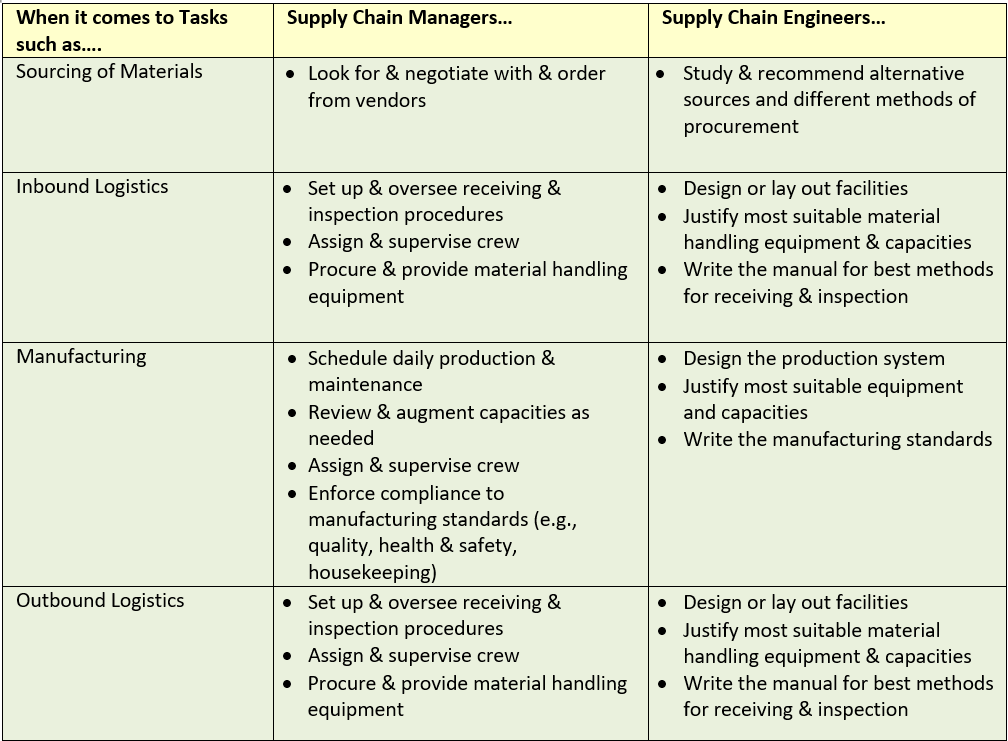
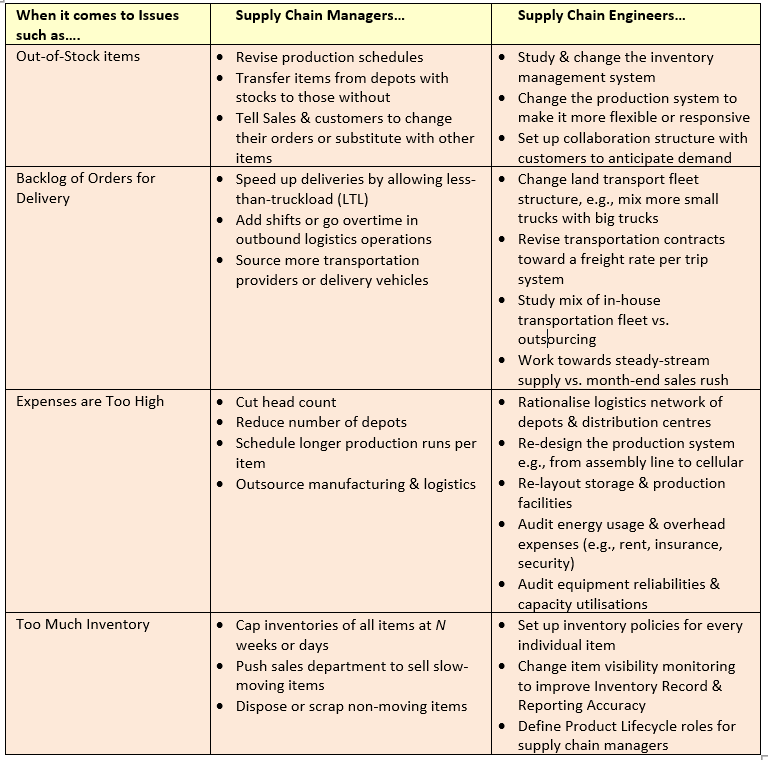
Solving problems is the primary scope of engineers.  To up the productivity of enterprises, we’d need to solve the problems which are in the way of accomplishing it.  And that’s what engineers do.

Solving problems, however, is too simplistic a purpose for engineers.  Engineers should not see themselves as passive professionals who obsequiously wait for people to give them problems to solve.  Engineers should proactively seek problems on top of defining them, studying them, and solving them. 

Barriers to better supply chain productivity remain because the problems underlying them remain unidentified and unsolved.  Supply chain managers limit themselves to the boundaries of the enterprises which employ them, and they deal with vendors & customers only to further the interests of their employers. 

Supply chain engineers don’t confine themselves to issues within the walls of individual enterprises.  Doing so would defeat their aim to identify and solve supply chain problems.  Supply chains represent operational links within and between enterprises and these links comprise the scope of supply chain engineers.  As much as an individual enterprise may engage a supply chain engineer to solve issues within itself, supply chain engineers do not hesitate to work on problems that go beyond enterprises’ borders.   

If vendors aren’t delivering on time, supply chain engineers will study the vendors’ and enterprise’s operations. 

If customers are cancelling or changing their orders causing disruptions to an enterprise’s outbound logistics, supply chain engineers will examine both the enterprise’s systems and customers’ rationales for such issues. 

Collaborations between vendors, enterprises, and customers result from all three solving supply chain problems together.  And supply chain engineering offers the best help in solving those problems which would make such collaborations realities.

It is hoped that Boeing just doesn’t “manage” the operations of Spirit Aerosystems as it reintegrates the latter.  Adapting wouldn’t be enough.  Uniting systems or procedures wouldn’t necessarily be the ideal approach.  It would be best if Boeing and Spirit lay bare their issues, define problems, fix them, and re-apply the process with Boeing’s vendors and customers as well.

About Ellery’s Essays

Why We Need Policies and Why They Can Make or Break A Business

A young businessman had set up a wholesale business selling consumer goods in downtown Manila.  His competitors, however, told him he won’t succeed. 

Competition was indeed fierce.  There were several wholesalers already established and they sold at cut-throat prices at razor-thin profit margins.  To get market share, the new wholesaler would have to offer better prices without sacrificing profit.  It seemed impossible. 

But the young businessman was unfazed.  Instead of fighting competition head-on through pricing, he offered better service. 

He set up a store which looked more like a call centre.  In the store sat sales people on tables with phones.   From opening to closing of the “store,” the sales people would call customers and offer a wide range of consumer products. 

The businessman via his sales people offered complete delivery of orders in two (2) days but customers could pick up their items at the store or at the nearby bodega or warehouse within the same day of the order.  The sales people also offered discounts for cash payments. 

The young businessman also hired talented managers to run his sales and operations.  He set up an information system in which his sales people would know the inventory of items in real time and the status of pending orders.  Sales personnel could therefore know what items were available and what were not.  The businessman’s purchasers would know when items were close to out-of-stock and thereby order from suppliers. 

The young businessman had clear policies for his sales and operations. 

His sales policy focused on selling to paying customers, not selling to any customer.  The businessman was strict when it came to giving credit.  He insisted on cash on delivery and did not allow customers to pay later.  

Many customers at first balked at buying from the businessman.  Many customers were small groceries or family-run shops that were not cash-rich to begin with.  They preferred terms of credit that would allow them to purchase as much as a month’s worth of stock and then pay for it as they collected from consumers buying from their stores.   

But the businessman also had a service policy.  He assured complete delivery of a customer’s order in two (2) days.  A customer can also opt to pick up ordered items on the same day at an additional discount. 

Customers gradually started buying from the young businessman.  The young businessman convinced customers that having complete deliveries arrive fast was better for their business.  With the assurance of having available items to stock in their grocery shelves, the customers realized they could sell more even if they had to pay cash in advance.

And so, the young businessman’s enterprise flourished.  It flourished not only because he had a clear vision and strategy.  It flourished not just because he invested in a talented organization and a real-time inventory management system.  It flourished because he had a set of policies that governed how his strategy was executed and how his business would be run.

Whereas a vision and strategy define an organization’s direction, policies define the principles of the management of the organization.

Policies are not targets

The young businessman mentioned above did not simply commit to deliver to customers in two (2) days. He set a customer service policy to which his business will deliver in two (2) days or else his sales people will apologize to the customer and ask him or her to either cancel or rebook. 

Policies provide for clear paths of action

The young businessman had an inventory policy.  He set re-order points for his items that when reached, would trigger purchasers to order from suppliers.  He also had a policy in which his executive manager would buy more fast-moving items when suppliers notify of upcoming price increases. 

Policies are focused toward functions or to specific areas of the business. 

The young businessman had policies for each of his departments.  He had policies for hiring and retaining his managers.  He had policies for managing his information technology (IT) hardware and software.  And he had policies for purchasing, warehousing, and transportation. 

Policies form the bridge between overall strategy and the execution of business procedures.  

The young businessman had a vision and strategy for success.  His policies connected the businessman’s lofty ideas to realities. 

For example, one of his strategies was to have a real-time inventory management system that was ahead of its time (the businessman founded his enterprise in the 1970’s).  To do this, he hired a skilled programmer to install a customized inventory information system.  He set policies on the entry of transactional data and instilled daily cycle counting of items.   He achieved the ideal of an inventory management system that accurately showed how much were on stock for hundreds of products at any time.   

Many companies I’ve worked with have clear visions, objectives, and strategies.  Some are doing very well.  But when they come to me about problems in their business, almost always there was a policy that’s missing or just needs to be cleared up. 

Policies not only have to be consistent with an organization’s objectives.  They also have to be clear as guides to how an organization would act.  They are no way the same as targets.  They are specific to functions and they are the bridge between executive strategy and procedures at the grass-roots level. 

Policies determine how an organization is managed and how it will behave with customers, suppliers, and stakeholders.  It can make or break a business. 

About Ellery’s Essays

Embracing Supply Chain Productivity in Strategic Planning

No, we will not change our sales policy,” the general manager of the consumer goods wholesale trading company tersely said. 

As I was formerly a logistics manager and land transportation service provider (trucker for short), the wholesaler GM was asking me for advice on how to bring down transportation costs, which had been rising sharply.  And when I did give her my advice, she didn’t like it and replied with the answer above.   

Transportation costs were one of the wholesaler’s largest expenses and before my conversation with the general manager, the wholesaler’s truckers had been demanding higher freight rates.  Despite coordinated efforts & negotiations between the wholesaler’s logistics staff and their truckers, the truckers remained adamant for rate increases.  The general manager was reluctant tp grant the increases but knew the risk if she didn’t; she couldn’t afford losing delivery capabilities as her wholesale business was growing. 

I told the GM that one best and quick option to bring down freight expenses was to stop the month-end surges in sales orders. 

The wholesaler had been offering incentives in which customers can avail of additional discounts when they bought more than PhP 1 million (approximately $USD 17,000) of merchandise within a calendar month.  Sales employees also had monthly quotas tied in with customer orders.  The more customers bought, the more bonuses the salespeople would be entitled to. 

Because the wholesaler measured sales based on actual deliveries received, customers and sales raced to submit their orders to the wholesaler’s logistics department before the month-end deadline.  Logistics staff, in turn, would work overtime to load & dispatch deliveries to reach customers’ doorsteps before the close of business of the month’s last day.  

The number of delivery trips dispatched on the last week of a month was typically four times (4x) the number of trips dispatched on the first week of that same month.  That meant truckers had to make available four times more trucking capacities on the last week versus the first week. 

Truckers procured new trucks and subcontracted vehicles from third parties to augment their fleets such that the number of available trucks would be in lockstep with the wholesaler’s month-end order swings.

This led, however, to many of the truckers’ vehicles being idle on the first week of the month before they would be needed for the last week’s surge of orders.  Truckers had to shoulder not only depreciation but also overhead expenses to maintain their vehicles on top of the thin profit margins they eked out from their subcontracting arrangements, even though their own vehicles weren’t being fully utilised. 

Truckers, thus, factored in these expenses in their petitions for higher freight rates.  The wholesaler’s general manager would argue in vain against the petitions but the truckers wouldn’t budge; the truckers weren’t making money. 

When the general manager, therefore, sat down with me to ask what can be done to reduce her freight costs, I told her that she should study smoothening her month-end order surges.  It was one thing to deliver versus orders triggered from incentives, it was another to fulfil demand based on actual consumption.   It was obvious that the wholesaler was doing more of the former than the latter. 

It had been proven that consumers buy based on what they need, and don’t wait till the end of the month to do so.  Consumer demand does not skew toward the end of every month, even though they may speculate every now and then.  Without incentives, the wholesaler’s customers would buy products closer to consumers’ buying patterns which would likely be steadier and more consistent week to week.  Exceptions would be introduction of new products or whenever there were price changes. 

If the wholesaler’s customer orders arrived in steady quantities than in swings, truckers would be able to utilise more of their existing fleet capacities as their trucks would be delivering more or less the same number of trips per week rather than a skewed few-to-many trips from the month’s first week to the last.  Trucks wouldn’t be standing by idly at the start of the month and they would have less need to subcontract from third parties.  The wholesaler would have more leverage to maintain, if not reduce, freight rates as truckers would reap more productivity from their operations. 

But the wholesaler general manager didn’t want a solution that would disrupt her company’s current sales scheme.  She feared that letting go of incentives would mean lower sales volumes as well as risk losing competitive advantage from rivals (who also did sales incentives). 

She abruptly ended discussion on the matter after she tersely replied in the negative to my advice.  With that, I just said “okay.”  I packed up, bid farewell, and left. 

The wholesaler continued to be successful financially and as a market leader.  It continued to grow as prospects for its future remained bright.

But would the wholesaler’s business have been more better off had the general manager at least considered the idea of ending month-end surges?  Maybe yes, maybe no.  One thing we can be sure of is that productivity of the wholesaler’s operations could have improved.  But apparently, the wholesaler’s general manager didn’t really put much importance to her operations’ productivity. 

The lack of putting importance into supply chain productivity is common in many enterprises.    

The president of an exclusive distributor of an information technology corporation’s product line of desktop printers, components, and supplies also had a similarly blunt reply when I advised he should re-examine his sales strategy which were causing sales order surges every month.  “There’s nothing we can do about it,” he responded, as tersely as the wholesaler’s GM said a few years earlier. 

“How many people buy printers only at the last week of the month?”  I asked.  But the president would hear no more. 

Sacrificing supply chain productivity to spur sales every calendar month is a symptom of a mindset in which sales & marketing schemes reign supreme in many enterprises’ strategic plans. 

My stories of the wholesaler GM and the IT distributor’s president echo with others I was asked for similar advice.  From a snack foods corporation, a roof tile manufacturer, a metals importer, a food condiments producer, to multinational consumer goods conglomerates and even an energy utility company, many enterprises adopted strategies centred on short-term sales growths.  Supply chain managers were expected to deliver versus revenue and financial goals rather than improve the productivities of their operations. 

What exactly do I advise enterprises?  Plan not only for demand creation but also for demand fulfilment.  A business is basically about doing both.  Maybe a business can still grow by creating demand exponentially and fulfilling demand unproductively, especially if competitors are also doing the same.  But we can only imagine what potential breakthrough opportunities could be had if enterprises focused on both the creation and fulfilment of demand in their strategic plans. 

The following is an example of how a company benefits when it embraces supply chain productivity into its strategic planning: 

A supply-chain overhaul turned into more than a cost-cutting efficiency plan for one of the largest home-appliances makers in the U.S. GE Appliances says it has managed to double revenue over the last seven years thanks in part to a multiyear effort to reset its manufacturing, tighten control of its inventory and rethink how it manages its production cycle. Marcia Brey, the company’s vice president of logistics, tells the WSJ Logistics Report’s Liz Young GE Appliances began restructuring its supply chain in 2017, years before the pandemic, to better balance production and demand. That effort accelerated as Covid disruptions took hold, and pressed companies around the world to rethink their supply chains. Brey says GE Appliances turned its process on its head, prioritizing real orders to pull goods forward rather than production schedules. The company’s inventory turns have improved some 50% as a result, and sales are up.

–Paul Page, Resetting Supply Chains, The Logistics Report, 03 July 2024, The Dow Jones & Company, Inc.

It can be done. 

About Ellery’s Essays

Building the Entrepreneur’s Business via Supply Chains

All businesses begin from entrepreneurship, in which creative individuals turn ideas into profitable realities. There had been many who tried their luck as entrepreneurs.  Many failed; some succeeded. 

It didn’t matter if the products or services entrepreneurs introduced seemed mundane or looked grandiose.  What mattered was that entrepreneurs worked hard to develop their ideas into items which they could sell & prosper from.    

Entrepreneurs need supply chains to ensure their products will be available to their targeted customers.  It’s one thing to create demand with attractive products; it was another thing if entrepreneurs couldn’t fulfil demand with items absent from their markets. 

Supply chains consist of the relationships which entrepreneurs establish between their operations front-liners and their vendors, customers, and service providers.  Activities respective to each supply chain link drive the flow of goods from sources to customers.

Many entrepreneurs, unfortunately, ignore the importance of supply chains in their strategic planning.  Whether it be because many entrepreneurs don’t want to bother with their supply chains’ step-by-step operations or because they’d rather focus on what they believe are more ‘important’ stuff, entrepreneurs tend to delegate supply chain management to other individuals or groups.

When entrepreneurs don’t recognise the importance of their supply chains, they unsurprisingly run into trouble immediately.  Troubles include out-of-stock, runaway costs, shoddy quality, merchandise losses, and too much inventory.  Entrepreneurs should focus on supply chains as much as they do the development of their products.  This is because a product isn’t only what it’s made of and its features (i.e., its core) but also includes what surrounds it (e.g., delivery reliability, after-sales service): 

Ref: The Handbook of Logistics and Distribution Management, 3rd Edition, Rushton, Croucher, & Baker, Kogan Page, 2006, page 35

Whereas delivery and service may only take up 20% of a product’s total cost, 80& of its impact is in how it is made available to the enterprise’s customers.  Supply chains are therefore crucial to the entrepreneur’s business. 

Supply chains surpass the boundaries of enterprises.  Enterprises are subsets of supply chains and not the other way around.  Supply chains offer the awesome opportunity to build an enterprise’s business, even if entrepreneurs may get the impression they don’t have much clout, especially if they are small start-ups.   

We who want to be entrepreneurs can utilise supply chains by starting with how we set up systems & structures in procurement, manufacturing, & logistics.

Our systems & structures, however, shouldn’t be focused inward but outward.  We could invest in data & communication systems which allow for quick two-way sharing of information with vendors & customers.  Our planning systems should begin not from the receipt of orders or from vague forecasts but from when we first anticipate customers’ interest in our products.  We should define the processes of our manufacturing and inbound & outbound logistics operations.  And we should have organisational structures which allow department heads to autonomously manage processes and at the same time invoke ownership of the end quality and total cost of our products. 

It’s a bad idea to exclude supply chains when we as entrepreneurs plan and introduce our products.  How we make available our products matters just as much, if not more than what they are, how much they cost, and what we can use them for.  At the onset of beginning our businesses, we need to plan our supply chains as much as we develop our products. 

Our starting points are the systems & structures we set up.  We should always consider how they will relate with their total supply chains in which enterprises are the connections. 

We shouldn’t downplay supply chains as mere operations internal to our enterprises. 

About Ellery’s Essays

Who’s Responsible for Collections?

It’s a question that bothers many organizations.  Who should be responsible for collecting debts from customers? 

Some people say it should be Sales, because a sale to a customer ends not with an order that is delivered but with an order that is collected. 

Others say it should be the Supply Chain, particularly Logistics, or the people who deliver to the customers.  The one who delivers the goods should be the one who collects. 

Other people say it should be the Finance department, specifically those in Treasury or the ones who manage the organization’s cash resources.  Finance managers track unpaid collectibles from customers and Treasury accounts for the cash.  They’re the ones who should collect.

Sales executives would say their job is to develop and increase business.  Collecting from customers distracts them from this focus so collecting from customers should belong to another department.

Supply chain managers would say their job is to make available products, deliver the goods, and satisfy after-sales requests such as warranty fixes—activities that meet customer needs.  Collecting doesn’t fall under this scope. 

Finance executives would say their job is to record transactions and manage financial assets.  As much as they report how much debt there is to collect, that doesn’t mean they’re supposed to do the collecting. 

Some chief executives tend to try to answer the question of collection as quickly as possible, thinking it’s just a matter of finding out who’s accountable.  Other executives would simply pass it on to a third-party like a debt collector or via creating a stand-alone department devoted to debt collections. 

Debt collection efficiency doesn’t necessarily get better even when there’s a third-party or even if the enterprise has assigned the accountability to either Sales, Supply Chain, or Finance.  In several corporations I’ve observed, it sometimes gets worse, with debts not only soaring but also with conflicts becoming more frequent between departments.

This is because when whoever starts to collect more intensely, issues start to arise between enterprise and customer.  For example, in one manufacturing corporation, customers refused to pay debts because their orders weren’t delivered complete.  Another customer protested that they weren’t credited for a return of rejected products to the corporation.  While another customer said she shouldn’t be paying because she had a pre-arranged agreement with her sales representative. 

In other words, the problem of collection accountability is in many cases not the real problem.  The real problem is the policy of collection and how it is being implemented. 

Many corporations do have collection policies, which are usually built into their billing policies.  The policies dictate allowable terms of payments and qualifications for credit for customers.  It is the topmost echelon of an enterprise’s management who formulates the collection policy and oversees its enforcement. 

Collecting from customers is therefore a process founded on policy.  It starts with the terms of payment agreed with the customer upon sale.  It continues with the enterprise checking the status of customer debt before delivery, then with the customer receiving and confirming the delivery, and it ends with the customer making the payment in conformance with the terms. 

Sales, Supply Chain, and Finance have their roles to play in the collection process.  The policy guides the conduct of the process and each function’s role. 

To answer who should collect would be to ask who is the one who would pick up the customer’s payment.  But as one can see from the bigger picture, that’s the one final step that depends on how well the other ones did before it. 

This post originally published on August 2019

About Ellery’s Essays

What Are We Responsible For?

An old shop proprietor was lying sick on his bed.  His wife and children, fearing the worst, were at his bedside. 

“My dearest wife, are you here?” the proprietor asked weakly. 

“Yes, I’m here, my husband,” the wife replied.

“My dear eldest son, are you here?” the proprietor asked. 

“Yes, father, I’m right here,” answered the eldest son. 

“My dear second son, are you here?” the proprietor asked feebly. 

“Yes, father, I’m here,” the second son responded.

“And my dearest youngest child, my daughter, are you here?”  the proprietor asked in a strained voice.

“Yes, papa, I’m here, and I won’t leave your side,” said the daughter.

The proprietor suddenly stood up and shouted, “Who, then, is watching the store???” 

We hear it every day from people who we see as successful.

‘We should do what we love.’

‘We should pursue our passions.’

We make bucket lists to see places or go to events we want to experience.    

We travel to see the world.  We emigrate to other countries to start new careers.

Meanwhile, who takes care of our parents & grandparents? What happens to the relationships we had with relatives, friends, co-workers, and neighbours? How do we turn over the projects and routines when we leave our current jobs? How loyal do we remain to our countries or communities we move away from? 

We can imagine the variety of answers to these questions.  I’m sure they would differ from individual to individual, given each of us would have our own opinions. 

We should not be restrained to do what we wish whether it be working for a cause or chasing a dream. 

We, however, have duties to our families, our countries, and our heritages, which we should not shirk from.  

Are we irresponsible when we uproot ourselves from the routines we have been doing for countless years, from the positions given to us by our employers or by the heads of our families?  Aren’t we fulfilling our talents and ambitions when we chase after our visions and goals? 

What does it mean to be responsible?

The dictionary has several meanings.

 re•spon•si•ble

adjective

  1. accountable, as for something within one’s power.
  2. involving responsibility: a responsible position.
  3. chargeable with being the source or occasion of something (usually followed by for).
  4. having a capacity for moral decisions and therefore accountable: a defendant not responsible for his actions.
  5. able to discharge obligations or pay debts.
  6. reliable or dependable, as in conducting one’s affairs.


The words associated with responsible are accountable, chargeable, reliable, and dependable.  On top of that, the dictionary states that being responsible means being “able to discharge obligations or pay debts.” 

But who determines what we are responsible for?  And who judges how responsible we should be and are?

In the free societies we live in, we opt for the responsibilities we adopt. Acceptance of responsibility is a choice.  We decide whether to stick with our responsibilities or give them up when we believe it is time to. 

Consequences arise when we don’t live up to our responsibilities and in the free societies we live in, we only have ourselves to blame.

In not-so-free societies, other people or parties impose responsibilities on us.  Autocratic governments enact laws which they expect and enforce their citizens to follow, no questions asked, no avenue to deny. Groups with strict traditions such as families or churches with strong religious beliefs dictate detailed rules which they command members to obey to the letter. History is replete with charismatic leaders who lay down strict obligations on their followers.  Authorities or elders determine the consequences of non-compliance, which in some instances, can be severe. 

The rewards of routinely doing our responsibilities consist of harmony in our relationships, peace with our community, and even benefits of the financial sort.  We get paid better for being responsible employees, for example. 

Responsibilities do tie us down when we commit to routines and causes.  There are trade-offs when we take on responsibilities and after some time, we are tempted to give them up. 

When we observe we’re going nowhere with some of them, when we sense we are not climbing our career ladders, or when we’re losing touch with whom we want to be close to, we feel the urge to chuck our responsibilities, to escape.  Our responsibilities become chains that tie us down rather than catalysts for growth.

When we become unwilling to continue with our responsibilities, the first thing that comes to mind is to get away from them.  We rationalise that we have our own interests to pursue, that our lives are passing us by, and we need to do more for ourselves.  We do need to love ourselves as much as others, after all. 

So-called self-help experts (e.g., online coaches, self-certified gurus) would tell us that we need to examine our values & principles and reconcile them with our responsibilities.  In more ways than one, these so-called experts would tell us to chase our dreams and leave everything behind.  Most of the advice from these people would be likely consist of them abandoning previous lifestyles which led to their own success stories, never mind if they leave out the costs of doing so.    

Sometimes, however, the difficulties we encounter with responsibilities stem from challenges, obstacles or issues.  We don’t live in a perfect world after all, where everything falls neatly into place for us every day.  We do run into roadblocks.  This is more so frequent for those of us who live and work rife with unforeseeable events.  

Traffic today can be smooth but in gridlock tomorrow.  Power and water supply may be consistent for many years but a cutoff could happen anytime.  There are governments that put out laws that change business conditions more than once a year.  A storm may cancel that annual trip we always take.  A new technology (e.g. artificial intelligence) may come along to threaten the jobs we held for decades. 

Disruptions have become more common (at least we perceive them to be more common) as our lives move faster from the pressures of competition and advances in  information & communication technologies.    

Rather than simply escape or abruptly cede our responsibilities, it may be proper to first consider trying to find out and solve the problems that may be hindering the carrying out of our responsibilities. 

If we can’t take care of our aging parents because we ourselves are getting older or busier, perhaps we should seek assistance from caregivers.  (I personally think sending aging parents to a nursing home more as a cop-out than a solution, unless the nursing home offers special skills or medical care which our parents may require). 

If we are becoming frustrated with our careers, we should maybe evaluate not only our job descriptions but also our performances.  Have we been slacking without realising it?  If we don’t like the assignments given to us, maybe we should find out what it is we don’t like and discuss options with our superiors?  Are our jobs lacking challenges or meaning?  Have our jobs become no-win scenarios?  Are we harbouring ill feelings for that promotion we didn’t get? 

It may be nice to figure out what really is bothering us about our responsibilities than to outright quit them. 

A problem-solving approach may help:

  1. Enumerate the issues
  2. Define the problem
  3. Lay down criteria a solution must fulfil
  4. Study & test options
  5. Decide on the solution
  6. Invest in the solution

We decide whether to accept or avoid responsibilities.  Consequences await those who don’t perform. We feel the temptation to escape our responsibilities and some of us do, to the detriment of those who had been counting on us to carry them out routinely. 

The progress of our modern times has been accompanied by frequent disruptions and pressures such that it has been getting harder to execute our responsibilities.

Many of these disruptions and pressures have root causes which we can identify as problems.  Problems can be solved and with a patient approach, we can find solutions that can be win-win for both our personal aspirations and for those who rely on us to do the right things. 

About Ellery’s Essays

Why Does It Take So Long?

I looked at the bottom of a dog food can at the pet shop to check its expiration date.  It said “10/26/2026,” but the production date said “10/27/2023.”  I concluded the dog food was safe as I bought the can of dog food on May 25, 2024. 

I thought, however: why was the production date more than six (6) months ago?  Why did it take so long for the product to be purchased by me, the consumer, from the time it was canned at its factory?

We see the same discrepancy in dates not only in canned pet food but in other products as well.  Pharmaceutical prescription tablets I bought on May 02, 2024, show an expiry date on August 2026 but a manufacturing date of August 2023.  Why did it take nine (9) months from the time the tablets were packaged to when I bought it from the pharmacy? 

Time study after time study has shown it doesn’t take more than a week to make most products from scratch.  Items like my prescription medicine and dog food don’t take more than a day to pack or can.  Why then does it take so long for merchandise to move along supply chains?

Process flow charts have revealed that merchandise spend a lot of time in inventory, either in storage or in transit, i.e., inside vehicles like container vans on ships. 

Is it worth the time and effort to shorten the period from when a product is created to when a customer buys it?  

For products like newspapers and perishable food, the first thing that comes to mind is yes.  Newspapers published more than a day ago or fruits harvested more than weeks ago don’t sell; hardly anyone buys to read yesterday’s news or eat over-ripe fruits. 

It also makes sense to not have products languish in inventory when customers clamour for them.  Aircraft manufacturers and shipbuilders, for example, don’t hesitate to deliver their finished planes & ships to impatient customers who usually wait for years for their orders.  

Enterprises that customise items logically avoid keeping products in stock.  Tailors tell their clients to pick up and pay for their bespoke suits when they’re done.  Some bake shops penalise customers who order but are late in picking up their cakes.

For those of us who sell mass-market items like consumer goods, we opt to keep inventory equivalent to several days of sales, which can be either based on historical or forecasted demand.  The stock levels we keep depend on how expensive the product is and how regular customers buy them.  The more expensive the product (e.g., luxury wristwatches), the more reluctant we are to tie up our cash in inventory for long periods of time.  The more predictable our products sell (e.g,, multivitamins), however, motivates us to keep more stock of them.

We do not stock items which experience erratic demand.  We make-to-stock items that move frequently or steadily.  We make-to-order items which customers don’t purchase often, or which differ in specifications or requirements from one buyer to the next. 

The risk of keeping low stock levels is we may not have enough items immediately available to sell.  Customers don’t go to supermarkets to wait for groceries to arrive.  Customers want their items now, otherwise they’ll go somewhere else or buy other items. 

This hasn’t stopped us from counting on customers to wait anyway.  Customers who like our products may prefer to wait rather than buy items from rivals.  They’ll also wait if they have no other choice (we can’t easily find alternatives to supply our electricity & water, for example).

We keep inventories to buffer against demand variations which we don’t expect or can’t forecast accurately.  We try to keep enough items to serve customers as soon as they want them as much as we try to not to keep stock that would end up idle for months or worse, unsaleable due to obsolescence, degradation, or damage. 

Managing inventories is as much an active endeavour as it is for managing purchasing, manufacturing, and logistics activities.  We plan, organise, direct, and control inventories as much as we do the operations of procurement, inbound & outbound logistics, and production.  We minimise the time it takes to make items as much as we strive to reduce the quantities of items that sit in our warehouses. 

So, why then does it take so long for items to flow from production to customers if we are already working hard to optimise our operations & inventories? 

Many of us would have different answers to that question and we would rationalise them depending on the industries our products are in.  Here are some of them:

Answer #1:  Time adds up from one inventory location to the next

As items move from one location to another, they accumulate time waiting in one storage facility to the next.  The total time adds to the length of time from production to when the customer buys the item.  

Some items also undergo quality inspections & sampling testing at different locations and are therefore intentionally put on hold until they are cleared or certified.  This adds more time to a product flowing through the supply chain.

Answer #2:  Items wait for orders before they’re served

Many manufacturers wait for middlemen like dealers or distributors to order products before they are shipped.  If dealers or distributors don’t order, items sit in inventory and wait. 

Answer #3:  The time to transport can be long 

If products are coming from far off places, the time to transport them would add to an item’s production-to-customer journey.  If products are passing through international gateways, there would be additional time spent for customs inspections & clearances and perhaps for other government requirements.

Given the answers mentioned above, a product would take some significant time from when a factory makes it to when it reaches buying customers. 

But as much as supply chain managers may offer answers such as these, should we just accept that it takes as long as six (6) months for products like canned god food and prescription medicines to reach customers from the manufacturing lines? 

Some executives would just say ‘yes,’ and that would be that. 

Many supply chain managers focus a great deal on activities within the enterprises which employ us.  We don’t manage entire supply chains but those that lie within the borders of the businesses we work in. 

Hence, we optimise the operations of our employers, but we don’t optimise the supply chain flows upstream or downstream from where we’re at.  Whatever productivity improvements we implement are mainly for the interests of our organisations.   

We, therefore, would not concern ourselves about products taking too long to flow from production to customers, at least unless it becomes relevant to our business or jobs. 

At the height of the coronavirus pandemic from 2020 to 2022, many customers took to social media to complain about orders taking so long to be delivered.  Orders for computer chips, exercise gym equipment, medical personal protection gear, frozen meat, and groceries were taking so long to deliver. 

Answers from supply chain managers, like those enumerated above, did not placate irate & impatient customers. 

The outcries from many customers were loud enough for not only enterprise executives but also government leaders to seek action.  Meetings were held.  Quick-fix measures were applied. 

Supply chain managers pushed vendors, manufacturers, and transport providers to speed things up.  Demand shifted as some customers gave up or found alternatives.  The problem faded but it wasn’t solved, if not even defined in the first place. 

Asking questions like ‘why does it take so long for a product to reach customers after it’s manufactured?’ leads us to see how our enterprise’s operations relate with others in a supply chain we are participants in.  It gives us an opening to know what our relationships are like with vendors & customers who are upstream and downstream from where our enterprises are. 

It also forces us to evaluate the productivity of the entire supply chain.  We may be productive in our operations but is the supply chain outside our enterprises’ scopes benefiting from our productivity? 

Customers don’t care about what cause delays in deliveries; what they care about is getting the items they ordered and paid for.  Hence, the onus is on us, the supply chain managers, to fix the flow of goods from procurement, production, logistics, to delivery to fulfil the demands of our customers. 

We need to recognise that our jobs aren’t limited to within the boundaries of our operations but also includes our relationships at least with our vendors, service providers, and customers.  What we do productively for our enterprises, we should ensure it contributes to the productivity of the supply chain; otherwise, our products, for what it may have been worth when we shipped it, would lose value to the final end-users. 

Solving supply chain problems begins by asking questions and then getting stakeholders to enrol into identifying, defining, and working on solving the problems together

About Ellery’s Essays