The Importance of Education in a World of Word-of-Mouth

Many graduating high school students apply to colleges and universities.  Many turn to rankings to find out what college or university would be best to apply to, given whatever interests the graduating high school students may have.  US News and World Report’s Best Colleges list, for instance, relies on ranking factors that are based on statistics and data surveyed from many schools.  US News even offers subscribers to make their own rankings based on the data. 

Students would tend to apply to the schools they see on the top of the rankings.  They then would visit the schools to check out the facilities and assess the costs. Some colleges would hold orientations for applicants to promote their schools as an attractive place to study. 

Applicants also ask people they know who had graduated from colleges and universities. What do they think about the alma maters they graduated from; would they recommend the schools?  Applicants would sometimes put a lot of weight on the word-of-mouth testimonies of people they know than with the rankings of schools, never mind how thorough the statistical computations that led to the rankings. 

It can be kind of ironic that applicants would decide based on word-of-mouth testimonies than the statistics of surveys and rankings.  Colleges and universities, being institutions of higher education, are where we supposedly would find the best methodologies for research and instruction.  Decisions based on word-of-mouth would seem to go against the rationale of scientific studies which underlie much of what college students learn especially if they are enrolling in majors that require a lot of math. 

Word-of-mouth is indeed subjective but it becomes the deciding factor because, for whatever their worth, rankings don’t satisfy all applicants’ expectations.    

When it comes down to appraising how good a college education is, it is the student who decides.  It is the student who evaluates based on criteria the student defines and sets. Rankings can’t cover all the criteria of all students.  Students have varying expectations which no survey can fully satisfy.    

The same applies for the everyday decisions we make.  We as individuals have our own sets of criteria and expectations. Statistical surveys such as polls, lists, and market research may be available and comprehensive but they can never sway everybody towards whom to vote for, what to say is best in style, and what products to buy.  We don’t rely solely on data and ratings; we also consider the opinions of other people, especially from those we trust.   

People more than ever rely on what others say, especially as social media technologies dominate inter-personal communications in just about everywhere.  Opinions and unsolicited advice abound, together with accusations of fake news and prejudicial news reporting.  We live in a world where we have so much data such that we don’t know what’s accurate or not, or what’s right or wrong.  Everything can be questioned and we are left on our own to decide what to accept.  (Sometimes, we are even forced to accept information from the pressures of so-called authorities). 

Education is not only about learning how the world works but it’s also about training ourselves how to adapt to it, if not change it.  We need education to learn how to assess what information to accept, analyse, and draw conclusions from.  We educate ourselves to form our own values, principles, and expectations.  We educate ourselves in learning to experiment and formulate our own pathways in line with society’s standards while at the same time, introducing changes which we feel would benefit ourselves and others. 

Rankings and the science behind them help us in the decisions we make, such as for what colleges to apply to.  But there’s a lot more in the form of word-of-mouth and testimonies that also matter, never mind how subjective they may be.  To make sense of science, word-of-mouth, and the avalanche of social media information, we need to be educated in not only knowing how things work but also in building our own expectations and criteria. 

About Ellery’s Essays

Do-It-Yourself Hands-On Experience versus Delegating

A Roman Catholic church at San Mateo, California had one parish priest who not only said the Masses but also cleaned the premises, drove the car to buy groceries & supplies, and pay the bills.  Volunteers would come to help on Sundays but the parish priest was practically on his own on weekdays.

Contrast this with a similarly sized parish in San Juan City, the Philippines.  The church has at least three (3) priests on site at any one time.  It has an office staff of three (3) employees as well as three (3) “contractors” (workers from an agency) who cleaned and maintained the church premises, and three (3) security guards who rotated on duty 24 hours a day.  Ask any of the three (3) parish priests if any of them can handle the church alone and they would probably say no. 

Head counts are quite low in organisations and small businesses in First World places like the United States, Canada, Japan, Australia, and Europe, where the costs of wages and benefits are high in relation to total operating expenses. 

In less-developed countries in Asia, Latin America, and Africa, where the cost of labour is predominantly much lower, head counts in organisations are higher.  Organisations could afford to have more people on their payrolls. 

Factories in low-wage-cost countries tend to be more labour-intensive, that is, they employ more people rather than invest in automation.  The opposite is true in high-wage-cost nations where enterprises prefer to put in machines to minimise manual labour. 

From the late 1990’s to today, enterprises in the developed countries have outsourced much of their materials and services to those located where wage rates were low.  Apparel firms had their products made in Bangladesh, for example, where the low cost of labour more than offsets the cost to make the same items in America and Europe.  Service industries likewise locate their call centres and backroom operations in low-wage countries in Asia rather than in their home countries in Australia or America.  American automotive companies have invested in assembly plants in Mexico where wages are much lower than in the United States.  Head counts in any of these aforementioned operations can number up to the thousands. 

In nations with low-wage rates, high head counts are the norm.  Such as the parish church in the above example, organisations don’t hesitate to add people to their payrolls. Households hire domestic helpers to clean homes, cook meals, and take care of children and the elderly.  Enterprises employ workers not only to staff operations but also to do menial work like cleaning, guarding, and running errands. 

The opposite is true in high-wage nations.  Like the parish church in San Mateo, enterprises and households hesitate to hire workers, especially for menial jobs or regular maintenance.  Families would do the cooking, cleaning, and any home fixing by themselves.  One would hardly find security guards or more than one custodial worker working in an office.  Factories would opt to automate rather than employ workers for production. 

Even as some wealthier households or businesses engage contractors like part-time gardeners, housekeepers, and maintenance personnel, most people in homes and enterprises in high-wage places would opt to do things they can do themselves than hire and pay a worker full-time.

In low-wage societies, however, some families and organisations would not even consider a do-it-yourself option.  They would refuse to do the laundry, clean bathrooms, or do simple repair jobs.  For some, it would be beneath them to do so.  For many, it would just be more convenient for someone else to do the job.  This kind of thinking not only applies to the wealthier people but even also to low-income groups where it would be not surprising to find domestic servants working for families in poor neighbourhoods. 

People in both low-wage and high-wage countries would agree that productivity improvement comes with lower head counts.  Each, however, would have a different notion on how many people would be the ideal for their respective organisations. Enterprises would base their productivity performance by comparing themselves with the competition.  Households would look at their budgets or just see what their neighbours are doing.    

Lost in the discussion would be the impact of having people do work for us versus doing it ourselves. 

When we do things by ourselves, we become familiar with the tasks and details of the job.  We gain hands-on experience and this can be helpful for our careers, if not for future projects. 

On the other hand, when we engage other people to do work for us, we become more productive or have more time to do other things. 

There’s value in doing things by ourselves and there’s value in having other people do work for us.  It’s a matter of balance and what goals we are working on to achieve. 

For example, there are engineers I know who made ideas into realities via drafting their own drawings by hand, fabricating prototypes in machine shops, pouring the concrete together with construction workers into building foundations, putting together the circuits and testing them, and they themselves fixing the plumbing.  These engineers have become very well-versed in their professions.  As these engineers became older, they left more of the hands-on jobs to younger apprentices but their experience and familiarity made sure that the novices did their jobs right. 

And there are also engineers I know who have never touched or would even know one drafting pencil from the next.  Or who has never operated a lathe.  Or who doesn’t know how the cement should be mixed before it would be poured.  Or who has no idea how to seal a pipe leak.  They, from the instant they graduated from college, wholly relied on technicians and contractors do the work for them.  They may have been productive in getting projects done but there was insecurity whether the projects were accomplished rightly.   

Different cultures, places, and individuals have divergent views on how to do jobs.  Some people do things by themselves and gain valuable expertise, while others pay and delegate tasks to other people so they can be free to do other things. 

The price of hiring and employing people plays a big part in whether we do things by ourselves or we delegate someone to do it for us.  But we also should consider how much we want to gain in experience and how much we want to achieve before we really decide which path to take.  As much as we have limited budgets, how much we want to do in a given time will drive our decisions whether to go on our own or find people to do the work for us. 

There is always an advantage in hands-on experience and there will always be benefits in being more productive. 

About Ellery’s Essays

Don’t Forget Productivity in Promoting Resilience

When the coronavirus pandemic in 2020 catastrophically caused a sudden global economic recession, enterprises went on the defensive to keep their businesses afloat; executives promised stakeholders they would transform their organisations to become more resilient

Risk management was the popular precursor to resilience.  In risk management, managers laid out possible threats and prepared for them.  A factory would invest in fire-fighting equipment, for example, and trained personnel in fire safety & prevention.  An office would install state-of-the-art cyber-security software to protect itself against computer viruses and malware.  But as much as a factory prevented fires and an office stopped cyber-threats, an enterprise couldn’t anticipate all risks, much more so when it came to supply chains.  

Supply chains cross through enterprises and thus make it difficult for executives to anticipate and mitigate risks for operations and links not within their spheres of influence.  Executives, thus, turned their focus from identifying threats to gearing their organisations to coping with disruptions.  Executives may not know what disruptions are coming but they believed they could improve systems to bear with them, much like a ship battening down its hatches to go through any storm or a house-owner laying down a strong foundation to endure any strong earthquake.  

The enterprise had to be supply chain resilient, that is, it had to somehow be able to cope with whatever disruption will happen.  Whereas supply chain risk management is about identifying and preparing for threats, supply chain resilience is about improving systems to cope with all sorts of changes

Resilience, therefore, became a popular buzzword for businesses especially those reliant on supply chains.   Not wanting to be hit hard by the next coronavirus surge, natural disaster, or transportation disruption, enterprise executives executed resiliency strategies such as building up inventories, increasing manufacturing capacities, and sourcing materials from multiple vendors.    

Enterprise executives learned, however, that strategies for resiliency can and do lead to trade-offs with profitability and growth.  When North American retailers such as Target and Walmart built up inventories in the wake of supply chain transportation delays from 2021 to 2022, they found themselves ending up with more stocks of items that didn’t sell as fast as they thought they would.  The retailers didn’t anticipate changing demand patterns as they prioritised having stock in the wake of the coronavirus pandemic and global transportation disruptions.  They ended up paying more in wasted effort and resources. 

From risk management to resiliency, enterprise executives have forgotten about productivityProductivity is about how much we achieve versus how much we put in

Michael Mankins seems to describe productivity best when he compares productivity against efficiency in his Harvard Business Review article.  He defines efficiency as ‘doing the same with less’ resources, while he defines productivity as ‘doing more with the same’ resources.  Mr. Mankins promotes the ‘productivity mindset’ which he believes if adopted by business leaders, will lead to top-line growth

Productivity, however, is not a popular buzzword in the business community, more so among supply chain managers.  One does not see productivity often in mission statements, even among industrial engineers, who used to champion the term in the 1980’s. 

Instead, many people equate productivity with labour performance or how well we manage our time.  Not many people see the view such as that of Michael Mankins in which productivity is about getting more from a fixed input of resources. 

Productivity is like velocity, which is not speed or about how fast we are going with what we have or with less but how fast we get to our destinations with what we have.  It’s about setting challenging objectives and doing better than expected with the resources we allocated. 

Resilience’s worth is in the productivity that results from it.  An enterprise that has resilience but has no productivity will not go anywhere; it won’t be profitable and it won’t grow. 

What both resilience and productivity have in common are that there is no single performance measure for either of them.  As much as executives extol resilience, there is no universal metric for it.  When executives say they want resilience, they usually actually mean they want their businesses to be stable & steady profitably. 

Productivity also is more of a concept than a goal.  Its measure, like resilience, is in the results, as in profit & growth and also in areas such as delivery timeliness & completeness, customer satisfaction, low costs, and market share dominance. 

Resilience and productivity are buzz-words but the former has become more popular while the other has been relegated largely to worker performance and individual time management.  Resilience, however, works only if there is productivity.  Both are not measured by universal metrics but by the results desired by enterprise stakeholders. 

Executives may want their supply chains to be resilient in the wake of frequent and damaging disruptions but they can’t go anywhere unless they link resilience with productivity.  They already do ask for productivity and resilience in the results they want; the idea is to find good solutions to achieve them. 

About Ellery’s Essays

What to Keep in Mind When We’d Rather Be Somewhere Else Doing Something Else

There are times when we wish we were somewhere else doing something else. We may think this while we are running around in the middle of a busy day doing so many tasks which we wonder if they’re worth doing in the first place. 

Many of us started out our careers aspiring to be artists, scientists, and entrepreneurs.  We wanted to enjoy life and change the world.  But as we grew older, our eagerness faded as realities took hold.  We got into repetitive routines that didn’t bring us any closer to our dreams.  We find ourselves doing stuff we’re not sure are important or relevant.  We became bored, tired, and resigned. 

As much as possible we should only be doing things that are important to getting to our goals.  The trouble is we find ourselves with tasks that are not relevant to our personal roadmaps.  Many of these tasks somehow would be classified as urgent but not really important to us. 

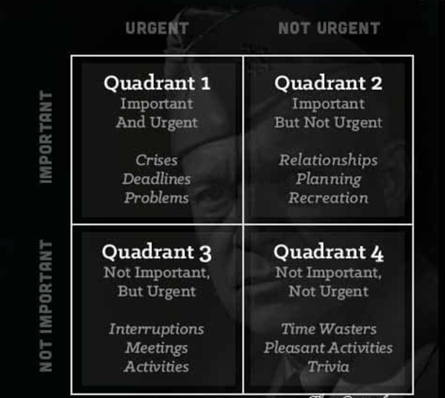
Stephen Covey, via his 7 Habits of Highly Effective People, cites the Eisenhower Decision Matrix in his 3rd habit, First Things First

In his teachings about time management, Stephen Covey says we face tasks that are either urgent, important, both, or neither.  To manage time effectively towards our goals, we should be doing tasks that are in Quadrants 1 and 2, in which both are important.  We should not be doing stuff in Quadrants 3 and 4, which are tasks that are not important.

The trouble is we usually are pressured to do tasks that are urgent, which are classified under Quadrants 1 or 3.  Any task deemed urgent is classified as important if not to us but to someone else. Urgency originates from someone’s insistence to do something immediately.  It may not be important to you but it’s important to them.

Urgent tasks often come from people who are important to us.  If we are employees, it’s likely our bosses who’d tell us to do things urgent & important for them.  Likewise, for those of us who are married; our spouses and children would demand that we do things urgent & important for them.  Even friends would come to us to plead to do favours they deem urgent.

The urgent things that land in our laps test our priorities and because we receive them practically every day, we’re forced to evaluate the importance with not much time to spare.  And because most of the people who give us these urgent things are those who are important to us, we end up doing them much to the detriment to our personal priorities. 

When we get stuck doing mostly urgent but not important stuff, the stuff in the ‘Quadrant 3,’ we get caught in a cycle that gets us to nowhere nearer to our goals.  Even when we hustle to do urgent but important stuff, the stuff in Quadrant 1, we would often find ourselves exhausted at the end of the day and likely not making much progress as most of what we did were likely fixes or disruption mitigation. 

When we feel stuck doing urgent things for a long time, we become discouraged and that’s when we start to wish we’d rather be doing something else somewhere else.   

What then can we do if we want to do more of the important but not urgent stuff, the Quadrant 2 activities, or simply the stuff we want to do? 

There are outright some seemingly logical, if not radical, options:

  1. Reboot. Quit our jobs, move out to another country or town, start a new business or finding an occupation we very much rather like to do;
  2. Adapt:  Look from a new mindset.  See the positive side of the present routine. Change what you can and negotiate compromises with superiors & family members.  In other words, live with what we got;
  3. Escape: Do hobbies and join groups we like on our spare times.  Travel.  Don’t work after office hours.  Allocate a “me” time to do the stuff we like and make sure not to read email, answer calls, or scan social media during these personal times;   
  4. Just Say “NO.”  Refuse to do favours.  Disagree with bosses on assignments.  Argue.  Stand our ground.  Push back.  Fight.

Unfortunately, there are repercussions as well as benefits to these aforementioned options.  Saying ‘No’ and arguing can lead to harmful conflict, for instance.

To avoid repercussions, Stephen Covey says we should grow our circle of influence in which we become capable of convincing others to see our positions.  This requires being proactive in doing things we have power over, or to put it another way, changing what we can change while acknowledging what we can’t.  When we change what we can, our accomplishments help expand our influence and we get more things done consistent with our goals.  It’s easier said than done, however, especially if we have small circles of influence to start with versus goals that are ambitious.

The Eisenhower Decision Matrix is a tool for how we manage and plan our schedules.  The idea is to categorise whatever tasks are on our plates and see how many of each would go into each of the quadrants.  It’s a way of knowing how we are choosing to spend our time. 

If we’re doing a lot of urgent and important tasks lately, we should review our goals.  Maybe they are too ambitious and deadlines are too tight? 

If we’re involving ourselves with more urgent and un-important activities, we should ask why we are choosing to do them.  Maybe we lack clear goals?  Or maybe we really don’t like the goals we had set for ourselves in the first place?

When we wish we were somewhere else doing something else, it’s probably high time we review our schedules.    The Eisenhower Decision Matrix that Stephen Covey champions is a good tool to see what we’ve been doing.  It may show we may be doing more urgent tasks important for other people than for ourselves and that we may need to reboot, adapt, escape, or just say ‘no.’  We may also need to review our goals; maybe they are too ambitious or we are not really enrolled in them in the first place. 

We classify what is urgent based on the insistence and demands of others and we categorise what is important based on our goals.  We choose what we do with our time.  If we bow more to urgencies, we do so because of choice not force.  Whatever the urgency, it always come down to us to choose what our response is.  That’s how Stephen Covey defines proactivity.  That’s what we should always keep in mind.

About Ellery’s Essays

‘Who Cares’ Were the Best Words I Ever Used

Those two words, ‘Who Cares?’, ended my mid-life crisis and I never looked back. 

But wait, is there such thing as a mid-life crisis?

Some experts say it’s not real:

Occurrence of the midlife crisis has turned out to be myth; research shows 10–20% of people actually experience it.’

Research suggests the mid-life crisis is largely a myth…Very few people report having some definable crisis that’s due to their age.’

So, what was that experience I went through in the late 1990’s which finally ended a few years later? 

It was a time when I felt there was no meaning in life.  I had low self-esteem.  I felt there was nothing to look forward to. 

It was a time in which I found myself asking or saying the following:

“Is this it?”

“There is no more?”

“Nobody cares.” 

“What is there to look forward to?”

But was I only just one of the 10% to 20% of the population who was experiencing this?  Were other people not going through this?

Even as it may be that most people don’t suffer a mid-life crisis, many do testify that they are at their unhappiest in mid-life.   Happiness is a ‘U’ for many in which many individuals feel joy least in the middle of their lives.  

Mid-life crisis is a matter of definition.  It may not be a stage which every adult passes through at a certain age but it at least represents a time of unhappiness likely occurring sometime between the age of 30 to 60.   

Experts can only guess why we feel unhappiest in our middle ages but we can guess that it is because we probably experienced loss of our loved ones like relatives and parents which are most likely to happen when we are in mid-life. 

Many of us also plateau in our careers in our 40s and 50s, no longer seeing the prospect of promotion but rather the looming of retirement.

It is also when married adults in their later years see their children grow up and leave home.  Empty nests become more the rule than the exception as parents get older. 

Mid-life ‘crises’, which we can perhaps define as a time of unhappiness, can last quite long.  For some, it can lead to clinical depression and mental health issues. 

But I found for myself a cure.  It came in a question with two words: ‘Who Cares?

Much of my unhappiness was due to comparing where I was in my career and status with other people.  Seeing other people get rich, have nice places to live, look like athletes, and have happy families made me want to be like them.  The wealth, health, and looks of other people became yardsticks for me to follow and aspire for. 

It didn’t help that relatives and friends would tell me how much they admire the rich and famous and then ask about my career and my social status.  Friends and relatives would constantly be sending the message that ‘we should be like the rich and successful.’

I snapped out of my sadness when I asked myself, ‘Who Cares?’  Why indeed, should I and we care about what other people think?  Why should we be striving to meet other people’s standards? 

We as individuals decide our fates and whatever we decide is ours alone.  Whatever other people may think is immaterial and irrelevant. 

And as it turns out, few really do care.  We live in a world where we have so much complicated problems to deal with.  Of course, we do make the effort to help our relatives, loved ones, team-mates at work and sports, even strangers, when they are in need.

But all in all, most of the time anyway, we as adults are really on our own in this world.  Some of us may work with large groups of people every day; some of us may be leaders or executives; and some of us may just be ordinary low-in-the-organisation-ladder workers who do the same routine day after day.  We may deal with people or we do not.  At the end of the day, however, we are always left to fend for ourselves. 

It is a gift when someone does care, like when our parents used to take care of us as children, when one finds the sweetheart who falls madly in love with any of us and when the devoted spouse waits and serves us when we go home after a hard day’s work. 

But most of the other 5 to 6 billion people in this planet could care less about any of us.  Not that they don’t want to, but because many have so much on their plates to really give time to do so.  We ourselves know this; many of us have enough already as it is to really think about other people all the time. 

When we find ourselves not happy because we are wallowing in that low part of the ‘U’ of life, we should ask that question: ‘Who Cares?’  Does it matter that much about what’s making us unhappy?  Is it worth it to wallow around for?  Much as there may even be good reason to be unhappy (e.g., loss of a loved one, losing a job), what value would it be to sulk and ponder about it for long periods? 

No matter the traumas we experience, the setbacks we go through, life goes on and most people don’t really care.  The best in the end is to look at what we ourselves believe in and go from there.

We set our own pace, decide our own directions.  People may tell us what to do but it’s us who finally determines whether we follow them or go our own ways. 

About Ellery’s Essays

The Power of Building on Ideas

We get ideas all the time.  Many we quickly forget or shelve and most don’t prosper beyond the fleeting thoughts they had been. 

Many ideas are originally not ours.  Many ideas we notice while interacting with other people.  We see some that seems worth the trouble to invest time and resources in such that we tell the people that we want to build from their ideas.

This is how teamwork starts.  When we build from someone else’s ideas, we say to that someone that their ideas have value. We send a message that the person we’re interacting with has value. 

It’s definitely much better than killing an idea outright, which tragically happens more often than not.  Rather than say an idea isn’t good, we ask instead “how can we build something from that idea?”  The potential answers can become endless in number as we welcome more thoughts, more ideas.

People have ideas just like we do.  And theirs can just be much better than ours.  Another way of putting it is that other people have already thought about our ideas before we came up with them. 

Many inventors build based on the ideas of others.  Many inventions are far from what they were originally thought.  Chances are, however, they developed from the tinkering and cultivating of other people’s ideas. 

The late Steve Jobs of Apple took a class on calligraphy and it is said that the class inspired him to promote the very many fonts we see on Apple’s and other manufacturers’ computers today:

“When we were designing the first Macintosh computer, it all came back to me. And we designed it all into the Mac. It was the first computer with beautiful typography. If I had never dropped in on that single course in college, the Mac would have never had multiple typefaces or proportionally spaced fonts. And since Windows just copied the Mac, it’s likely that no personal computer would have them.”

-Steve Jobs

Note that Jobs said “we designed it all into the Mac;” he and his design team members built on each other’s thoughts to bring the breakthrough of fonts into personal computers. 

We all have our ideas and some of us would like to get sole credit for the ones that develop into beneficial inventions.  But in more ways than one, inventions are likely the products of teamwork, in which individuals cooperate to share ideas and make them realities.  And the device that makes that happen is the building from each other’s thoughts. 

Invention is not a one-person job. 

About Ellery’s Essays

One-Way Conversations Are Never Good

A salesman boasted that his meeting with customers went well.  He did all the talking and pushed his customers to agree to whatever he suggested.  “Dominating the meeting is important,” the salesman said, “it avoids the meeting turning into a gripe session and at the same time, focuses on getting what we want.” 

Many executives assert their agenda by dominating the conversations they have with their peers and employees.  It’s a practice for some chief executives to summon subordinates, tell them what they want, and dismiss them, at the same time reminding the subordinates to get their assigned task done by a certain date and time.  Sometimes the executives would ask if there are any questions, and if one or two subordinates ask, the executives would show some annoyance especially if the questions seem to contradict the executives’ wishes. 

It doesn’t just happen in the professional world. 

I have friends who’d call me in the middle of the day and want to get into a conversation.  The conversation would turn out to be one-way in which the friends talk and talk about themselves and I listen and listen all throughout.  They hardly ask about my situation and if they do, they’d ask, ‘how are you?’  and instantly after I say, ‘fine,’ they go back to talking about themselves.

Some friends thank me for listening although whatever advice offered would not seriously be considered.  Most discussions usually end up as one-way conversations; it’s always all about them. 

As much as we read about the importance of listening and empathy, most of us would just prefer to tell others what our views are and what we want.  We’d just prefer people listen and follow what we say without argument.  Listening and empathy offer opportunities for others to argue and most of us in this fast-paced world we live in just don’t have time for that. 

We believe listening just adds to the time of a conversation or meeting.  We don’t have time, we’d say, so we end up dominating the meeting and cutting the conversations short.  We’d call it keeping the meeting in line with the agenda or sticking to topic; we really just want to send our messages without further ado.      

Listening is an investment.  It is an investment in which we spend some of that valuable time to hear and empathise what the people whom we talk to are trying to tell us.  The trouble with this investment is that when we do it the first time, we have no inkling what the rewards or benefits will be. 

In many first-time attempts to listen, we don’t experience any benefits, at least none that would have made the time we invested seem worth it for ourselves. 

It is misleading to say empathy is a means to put ourselves in another one’s shoes for the sake of the other.  Empathy is not meant as a charitable exercise.  It is meant as a way to communicate for mutual benefit, i.e., for the benefit of the other person and you.  It is a process not meant to get personally in-touch but for both or more parties to have a discussion steered towards mutually beneficial outcomes.  We don’t listen to be nice; we listen so we can understand and cooperate. 

Any conversation we get into or any meeting we attend is an investment of our time.  When we try to dominate and steer the discussions, we should ask ourselves:  will it lead to mutually beneficial outcomes?  Or will it just result in marching orders to other people who may not really be enrolled to any ideas that are put on the table? 

Domination of a conversation is attractive as it espouses power over others.  Domination, however, implies a one-way form of communication and doesn’t really bring about mutually beneficial outcomes.  It may lead to benefits for the one who is domineering but it likely won’t to the ones who were dominated, at least the latter will likely feel they didn’t feel any good from it.     

Any conversation where all parties feel they got something good out of it is already a benefit.  It makes any investment in listening that leads to two-way mutually beneficial results worth it. 

About Ellery’s Essays

Ergonomics Can Be Helpful, Really Helpful

When it comes to productivity improvement, the first thing many executives think of is head count, how many people are needed for the job.  The last thing many managers think of is the human factor, how to better improve the working conditions for the individual person. 

Ergonomics (or human factors) is the scientific discipline concerned with the understanding of interactions among humans and other elements of a system, and the profession that applies theory, principles, data and methods to design in order to optimize human well-being and overall system performance.

Ergonomics, strictly speaking, is a subset of Human Factors Engineering (HFE).  Ergonomics refers more to the individual’s physical make-up and how it interfaces with the individual’s workplace.  Human Factors Engineering is broader as it considers the environment and involves even how facilities are designed and built.  Both Ergonomics and Human Factors Engineering have become interchangeable, however, and many people nowadays see both as one and the same. 

Whether we call it ergonomics or human factors engineering, the study of how to improve the human individual’s interface can be very helpful to an organisation or an enterprise.  

Despite its growth in popularity since the 1980’s, Ergonomics remains a field where applications have been spotty.  Certainly, Ergonomics has been a key influence in the development of workplace standards and has been instrumental in the design of products such as automobiles, furniture, tools, and appliances.  Yet, there is plenty of potential for Ergonomics and we can see this in our daily experiences. 

We notice ergonomic applications in the vehicles we drive.  Seats are fitted to the contours of our human physiques.  Temperature and humidity inside the vehicles are ‘climate-controlled.’  Front- and rear-cameras supplement the wide windshields, mirrors, and rear-windows that maximise our fields of view.  And engineers have invested a great deal into passenger safety, such as airbags and seat-belts. 

But for many us who do drive, we still have to contend with blind spots, where we would be unable to see cars or trucks at certain corners of our visual field.  We have difficulties reading road signs, especially those with lettering that are too small or insufficiently illuminated.  We can’t be expected to anticipate the vehicle that stops suddenly in front of us.  And we can’t still see too well during heavy downpours of rain or when there is heavy fog or smoke.  There is indeed still much to improve in the ergonomics of automobiles. 

The popular coffee shop where I frequently dine in has very comfortable furniture where one can relax while having conversation.  But its chairs and tables aren’t that friendly when I want to type on a laptop or just write with paper & pen; the chairs are too low & the round tables don’t provide enough space.  As much as furniture may have come a long way in being more comfortable, there is still much room for improvement when it comes to being more ergonomic. 

The challenges for ergonomics aren’t limited to driving cars or sitting on coffee shop furniture.  We can see the need for better ergonomics in just about every profession, from the cockpits of airplanes to call centre work stations, from restaurant kitchens to factories.  Despite whatever progress or awareness we have gained in making workplaces friendlier for workers, we can do better. 

Traditional industrial engineering has focused on making the worker more efficient by instituting methods and quotas; the focus is on the workers making more by telling them to comply with standard operating procedures.   Industrial engineers would set up workplaces from the point of the view of the job.  IEs would instruct workers on how to do their jobs and they would set up reward & penalty systems to motivate them to optimise output. 

Ergonomics sees it the other way around.  The focus is on the well-being of the worker.  The workplace should be illuminated, not noisy, and not burdensome to the physical & mental health of the individual worker.  Hence, ergonomic experts establish standards for illumination, sound, environment, and for anthropometry, in which the latter deals with the measurements & movements of the human body vis-à-vis the workplace. 

The point of ergonomics is productivity via human occupational safety & health.  Just as IEs promote productivity via the design of the job, ergonomics seeks the same purpose but via adapting the workplace to the worker.  Hence, ergonomics doesn’t adapt the worker to the job, but instead, the job adapts to the worker. 

The major challenge of ergonomics is to find the right conditions, the optimal human factors so to speak, that would accommodate all individual workers and assure the best productivity performance possible.  With each person being different, it has been a huge challenge for ergonomic scientists.  How can ergonomics tweak a workplace to fit anyone, big or small, petite or tall, young or senior, without discrimination to gender, ethnicity, and other physical limitations?

The obvious answer is:  we can’t.  We can’t adapt everything at work to everyone.  But what we can do is adapt conditions flexibly to accommodate just about everyone.  

Furniture companies already supply adjustable office chairs and desks.   Automotive firms already build in seats that can be programmed to the anthropometry of the driver.  Not everyone (like seven-foot basketball players, for instance) may fit comfortably on a chair, but at least it would to a lot of people, if not most. 

One good example towards an ergonomic-for-all-approach is in office space design.  Enterprises recently have learned that the fad of open-plan office spaces in which, instead of cubicles, workers share tables in large open spaces, doesn’t lead to better performance; on the other hand, it has brought forth negative feedback as workers complain of distractions, not to mention endless meetings.

Designers, as a response, have put in small private rooms to offices and workers have welcomed not only the privacy the rooms bring but also the exclusivity of environmental control (e.g. the setting of the room thermostat).  Offices have more than accommodated most, if not all, their personnel in improving their working environment. 

As the coronavirus pandemic from 2020 to 2021 (hopefully) subsides, offices and factories that invest in better ventilation, cleaner surroundings, and exclusive private spaces will have an advantage to attract back their much-valued workers.  It’s not only about productivity, nor just safety, but the well-being and health of the individual person.  The pandemic may have made offices a pariah but enterprises by their initiatives to improve the office environment can make that negative idea temporary. 

Ergonomics is a science that focuses on the well-being of individuals for the sake of they doing better productively for those they are engaged with.  As ergonomics and its broader partner, human factors, become more synonymous, enterprises should continue to promote the science of adapting the job to the person and seek its benefits.  Ergonomics’ challenge is to accommodate for all types of individuals and this can be achieved through innovation, if not via simple common sense. 

Ergonomics can be helpful, really helpful. 

About Ellery’s Essays

Basic Needs Come First

A parish church conducted a field census of an impoverished neighbourhood.  The purpose of the census was to gather demographics, that is, how much households were earning, how many family members, if parents were married in a church, etc. 

When the census takers asked about what were their most important priorities, every household replied:  money.  It wasn’t employment, food, or security.  Just:  money. 

Money was the single focus of families who lived in shanties in the impoverished neighbourhood.  Nothing else was of higher importance.  Families and their breadwinners woke up every morning and worked throughout the day to get money that would at least tide them through the day. 

Money to the neighbourhood’s families was their number one singular basic need.  It wasn’t because of greed but need that drove them to pursue getting money.  Many families didn’t have members with steady jobs.  Heads of households went out every day looking and working to get cash to buy just enough to meet the basic needs for that day. 

Some religious groups label money as the root of evils.  They preach against focusing on money and tell people to pay attention to prayer and attending services.  The people hear the preachers, nod their heads, but go back home to return to their routine of earning money to survive. 

It’s always best to know what the priorities are of those we’re solving the problems for.  Famed American psychologist Abraham Maslow placed physiological needs like food, water, and sleep on the bottom of his pyramid model of the Hierarchy of Needs.  The bottom represented the most basic needs of humans—the ones we prioritise to satisfy first before we would move on the “higher” needs of safety, belonging, esteem, and self-actualisation. 

People have different priorities based on the needs they have at the moment.  Poorer people need money more importantly than rich people.  Rich people might be more obsessed with the security of their assets than poor people.  Established enterprise executives may contemplate more on becoming more influential than a start-up entrepreneur who is insecure about his finances.  Teenagers may search for belonging while retired people look for meaning. 

Needs vary.  And whatever they are for whomever at the moment will determine how problems are defined and solved. 

A final example about basic needs coming first:

A psychiatrist shows a little girl a series of inkblots as part of a routine psychological evaluation.  For every inkblot, the little girl sees hamburgers, fries, and eggs.  When the psychiatrist asks the little girl why she keeps seeing food in every inkblot, the little girl says because it’s close to lunchtime and she’s hungry.  We don’t seek meaning in our lives when we’re hungry.

About Ellery’s Essays

About The Supply Chain Engineer

Supply chain management has figured prominently in organisational priorities since Keith Oliver in a reported conversation with a Philips manager, Mr. Van t’Hof, coined the term in the 1970’s, and it has become even more so at the onset of the 2020 coronavirus pandemic. 

Supply chains are operational relationships made up of activities that transform and carry merchandise from their sources to their final point of use.  Supply chain operations cross borders and through enterprises, making it a requisite for managers to deal with counterparts from other places and firms as they strive to productively fulfil the demand of products and services. 

Despite just about everyone’s familiarity with supply chains, it has become a challenge managing them.  This is because supply chains are very comprehensive in scope and as such, it covers all functions that have anything to do with the procurement, manufacture, and logistics of products & services. From the mining of materials, the harvest of fruits, grains, & vegetables, to the manufacture of metals, consumer goods, & appliances, to the purchase of merchandise plus the logistics of storage, handling, transport, and delivery, supply chains intertwine through industries. 

Management is about the exercise of stewardship of activities and operations in a facility, department, and an organisation for the purpose of meeting strategic visions, missions, and objectives of stakeholders.  Managers work with systems and structures as they bring forth value for the enterprises they work for. 

The design and construction of said systems and structures, however, are not the jobs of managers.  Much as they may be charged to initiate and oversee their set-ups, they’re not the ones who build and fix them. 

That job goes to the engineer. 

Both supply chain managers and engineers have one common purpose:  deliver productivity

Productivity is how much is accomplished versus of how much is put in.  It’s output over input where the higher the ratio, the more ‘productive’ one is. 

Supply chain managers plan, organise, control, and direct the operations they oversee towards higher productivity in the delivery of merchandise and services for the enterprises they work for.  Supply chain managers have the added task of establishing interdependency between their employers and the vendors, service-providers, & customers that are the links in the supply chain.

Supply chain engineers plan and build the systems and structures the supply chain managers work in and with.  Supply chain engineers study, design, plan, build, set up, buy, install, and fix facilities, networks, methods, equipment, vehicles, workplaces, and flow patterns of activities, resources, services, and merchandise that underlie supply chain operations.

Whereas supply chain management has become a high-profile profession given the growing challenges of scope, complexity, and disruption in the global, regional, and local exchange of goods and services, supply chain engineering remains as an unrecognised, if not ignored, field. 

It is my aim to promote Supply Chain Engineering as a very much needed discipline that goes hand-in-hand with Supply Chain Management.  This is in line with my vocation to boost the productivity of the operations of organisations. 

One cannot achieve optimal productivity if supply chain managers have shoddy systems and structures to work with.  It’s hard enough that supply chain managers have to negotiate with other organisations given the over-reaching scopes of operations.  They could use the help of engineers in ensuring they have the optimal systems and structures that support the strategic productivity goals of enterprises. 

About Ellery’s Essays