Supply Chains are All About Flow

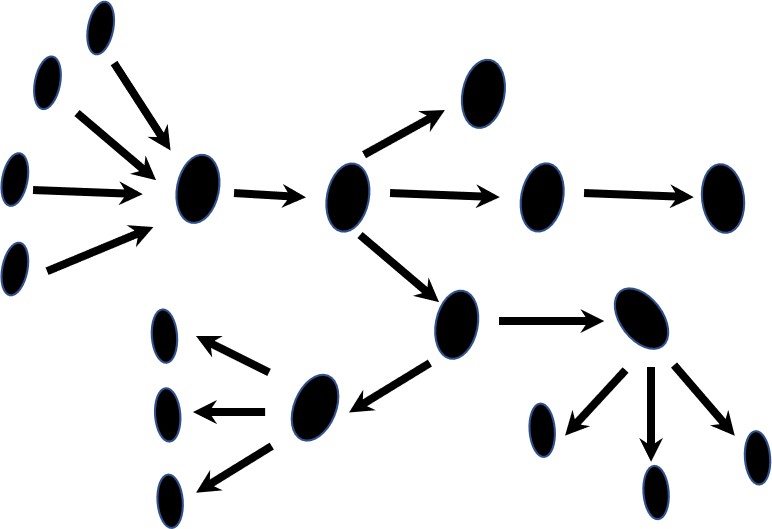
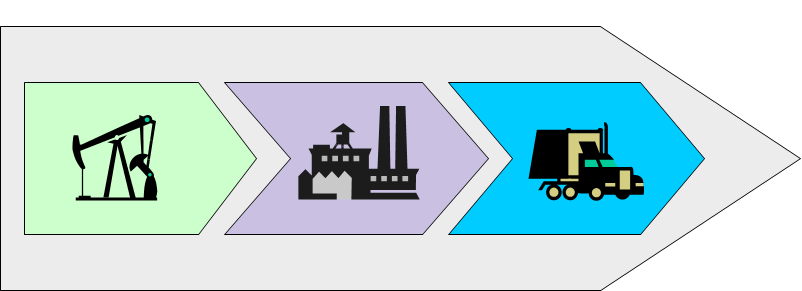
Supply chains are about flow:  the movement of product from one stage to the next, from a starting point—a source—to an endpoint—a user. 

          We call them product streams, demand flows, pipelines.  But supply chains are hardly these as streams and pipelines imply a single fluid in motion.  What flows in a supply chain is not the one same item but a multitude of merchandise: parts, materials, components, and products. 

          Items also never remain the same as they weave through supply chains.  It is a basic point of supply chains that items change and never stay the same.  And not change for the sake of change but for the purpose of transforming to something that becomes more valuable from that where it came.  Solid ores become metals.  Metals become jewellery, spare parts, and the support beams for high-rise buildings.  Crude oil becomes petroleum which in turn becomes gasoline, motor oil, and plastics. 

          Supply chains converge and diverge.  They rarely follow a straight line.  Many see their items originate from other chains and disperse to others.  For instance, bauxite joins with caustic soda and other materials coming from other supply chains and are transformed together in a manufacturing facility into aluminium.  The aluminium in turn becomes material for other supply chains such as for cans for beverages, foil for kitchen wraps, and wire mesh for window screens.   

          Enterprises comprise most supply chains.  A fruit farm ships to wholesalers who ships to supermarkets and grocery stores.  In-between are transport providers and storage facilities. 

          Capacities limit how much can flow through supply chains.  The limits are also known as constraints and bottlenecks. 

          Policies, procedures, and controls govern the flow of merchandise through supply chains.  These vary from one supply chain stage to the next and to whomsoever has ownership of the territory the merchandise is moving through. 

          It should come to no wonder that flows are not steady or uniform.  Merchandise flows in fits and starts and in different mixes of product composition.  Flows are never identical from one instant to the next.  In a sense, flows may not even be the right word to describe what happens through supply chains as more often than not, merchandise moves in batches, surges, and waves. 

          Boosting productivity in supply chains is therefore a monumental challenge given the complexities and underlying uncertainties. 

          It would be easier to design a plumbing system and electrical schematic than it is to plan a supply chain.  At least with plumbing and electricals, the product stream is far more predictable and homogeneous.  It definitely is not like that with supply chains. 

The nature of supply chain flow by itself justifies the need for engineering prowess.  It is a daunting challenge but one that supply chain engineers are in the best position to undertake. 

About Overtimers Anonymous:

https://overtimersanonymous.home.blog/2020/04/30/about-overtimers-anonymous/

Admitting Not Knowing What to Do Is The First Step to Problem-Solving

At the height of the Second World War, Great Britain was on the brink of defeat.  The Nazis had conquered the European mainland.  German U-boat submarines were sinking merchant ships from America, constricting critical supplies to the United Kingdom.  The German Air Force, the Luftwaffe, was bombing London and other British cities at will, inflicting heavy casualties.  The British leadership didn’t know what to do. 

          The British government engaged the help of its most brilliant scientists to find technological breakthroughs that would perhaps give the English armed forces some advantage in weaponry.  The scientists, consisting of physicists, mathematicians, and even biologists, found out that technology wasn’t the problem, but rather in the manner the military managed its operations. 

          For example, the scientists led by physicist Patrick Blackett1, found that anti-aircraft (AA) batteries defending London were shooting pointlessly against German Luftwaffe bombers because only 30 out of 120 of the guns had access to radar data to track incoming targets.  Blackett’s science group recommended re-deployment of the anti-aircraft batteries so all of the guns would have access to the radar data.  Whereas before it took 20,000 AA rounds to shoot down a German bomber, the number was reduced to 4,000 rounds per shoot-down after the re-deployment.  Anti-aircraft accuracy improved by 80%. 

          Blackett also introduced operational solutions to defeat the German U-boats.  His colleague, E. J. Williams2, also a physicist, suggested changes in how British bombers searched and targeted U-boats.  By changing the timing and placing of depth charges, and by simply repainting planes from black to white to make them less likely to be spotted in the daytime sky, the British was able to increase the kill rate of U-boats from 1 to 2 per cent to 10 percent, a 1000% improvement. 

          British leaders at their darkest hour of the war admitted they didn’t know what to do.  They went to their scientists for answers.  When they did, they found out that the issue wasn’t about searching for the right answers but defining the problems rightly.   By just knowing what problems to solve and solving them, the British and their Allies were able to defeat the Nazis and win the Second World War. 

          Eighty (80) years later, the world again is in a crisis.  The COVID-19 pandemic has sickened more than a million people and brought businesses to a halt.  More than three (3) billion people worldwide are in lockdowns. 

          Despite the efforts, government and business leaders do not have a unified front versus the pandemic.  They have engaged medical experts who have urged quarantines, personal hygiene, and social distancing.  There is no prospect for an early cure or a vaccine.  No one has a firm idea how long this crisis will last.  No one leader, it seems, knows what to do. 

          Admitting not knowing what to do should not be seen as shameful.  Rather, it should be seen as a first step to solving a problem.   

          We have gotten used to finding solutions quickly for most of our problems.   In our fast-paced world, we like to get obstacles out of our way as fast as we can. 

          But not all problems can be solved outright.  Sometimes, and it’s getting more often, we have to admit that we just don’t know what to do.  We need to realize it may be better to engage other resources or talents to define our problems rightly before finding the right answers.

1Stephen Budiansky, Blackett’s War, (New York: Alfred A. Knopf, 2013) Kindle Edition, Chapter 6, Loc 2846

2Ibid, Kindle Edition, Chapter 7, Loc 2982 to 3047

A Letter to All Industrial Engineers: Time to Rise Up

Dear Industrial Engineer:

          I come to you as a fellow Industrial Engineer (IE) with a message.

          It’s time for us to rise up.

          For years, or should I say decades, Industrial Engineering (IE) has been an un-recognized engineering discipline. 

          Many engineers—e.g. civil, mechanical, chemical, electrical—look at us as fakes. 

          Industrial Engineers (IEs) aren’t recognized as technically proficient builders or problem solvers at par with other engineering disciplines.  Even if many of us have professional licenses issued from places like the United States and Europe, we are not respected in many parts of the world.

          Most enterprises and organisations see us as more of management professionals than engineers.  They perceive the specialized courses we take, such as time & motion studies, operations research (OR), facilities planning and inventory systems modelling, as management subjects than technical specializations.  This is despite the fact that we are educated in advanced mathematics and sciences such as calculus, chemistry, and physics, and in engineering courses such as statics & dynamics, materials science, and electrical systems. 

          We are competent in reading and drafting engineering drawings and many of us know how to operate equipment like lathes, drills, presses, and milling machines.  We specialize in advanced statistical models such as linear/non-linear programming, queuing theory, and transportation algorithms. 

          Despite our engineering prowess, very few understand what IEs do.  We ourselves don’t have a clear picture of what Industrial Engineering is.  We’re always finding ourselves struggling to explain what IE is to our peers, co-workers, friends, and fellow family members. 

          The problem is with the title itself.  What does the “Industrial” in Industrial Engineer mean anyway? 

          People know what a civil, chemical, mechanical, or electrical engineer is just by the titles.  But with Industrial Engineer, we have to explain it and most, if not we, still wouldn’t get it. 

          True, many of us IEs, thanks to our training and experience, have successful careers.  Many of us have become top-notch executives and well-off entrepreneurs. 

          It would be nice, however, if we could just have a little more recognition and apply what we know as IEs.  And this is exactly what this letter is all about. 

          We are in the midst of the worst crisis to hit the globe since World War II.  The COVID-19 disease has ravaged communities and brought economies to a standstill.  Enterprises and individuals have lost earnings and incomes as people get sick or are forced to stay home.  Many products are in short supply as manufacturing and logistics facilities have become undermanned or short of materials.  Border closings have delayed or stopped deliveries altogether. 

COVID-19 is the latest and the worst in a series of adversities that has befallen supply chains.  It isn’t the first and it will not be the last.

          Year after year, adversities ranging from natural disasters, cyber-data malware, and trade tariffs have made life difficult for supply chains.  From the September 11, 2001 terror attacks to the climate change crisis, adversities have been buffeting businesses and societies.  They come small but frequently (as in daily traffic jams) or big and infrequently (such as typhoons).   They can come in the form of interruptions (e.g. power failure) or as a man-made business trend (e.g. a new mobile app that makes obsolete traditional package deliveries). 

          As supply chains have become global and more sophisticated, they have become more and more sensitive to adversities.  The challenge to supply chain productivity, and to enterprise survival, is very real. 

          We as IEs are in the best position to deal with adversities.  We have the expertise, the talent, and the tools. 

          For example, amid the crisis of COVID-19, we as IEs can help hospitals reduce wait times for patients via our knowledge of Operations Research (OR).  We can set up forecasting and inventory models to assist hospitals to avoid out-of-stock incidences for medical equipment and supplies.  We can help in improving schedules and reducing wastage in medicines and supplies. 

          When it comes to supply chains, we have the capabilities to analyse and improve the flow processes of materials and merchandise.  We are the experts in optimizing methods and in boosting the productivity of supply chain operations. 

          Before anything else, however, we need to upgrade our identity.  We should stop calling ourselves Industrial Engineers.  It’s too vague. 

          We should instead start calling ourselves Supply Chain Engineers.  Just as with other engineering titles, we need to be recognized quickly for what we do by what we call ourselves.   

          Because supply chains are at the core of global business, it’s time we see ourselves as Supply Chain Engineers.  We can build them, we can improve on them, and we can make them risk-averse and world class. 

          We have evolved and we should continue to do so.  Industrial Engineer as a title belongs to a time when manufacturing was prominent.  Today in the 21st century, supply chains are prominent.  Whether it be in products or services, there will be supply chains.  And we have the means, the skills, and the talent that earns us the title as Supply Chain Engineers. 

          The COVID-19 pandemic has demonstrated the vulnerability of supply chains.  It also has demonstrated the potential value of our vocation as Supply Chain Engineers. 

          We have the ability to change the world for the better.   We are Supply Chain Engineers.   We can make supply chains resistant to present and future adversities and deliver world-class productivity to the enterprise. 

          We have the power and we have the responsibility to demonstrate that power.

          Let’s show them what we got.    

About Overtimers Anonymous

The World Needs Supply Chain Engineers

Not leaders.  Not managers.  Not business executives.  We have plenty of leaders, both real and wannabes.  Managers and executives too; we have enough. 

We need supply chain engineers. 

The global supply chain is a present-day 21st-century reality.  We get much of our goods from all over the world.  We buy shoes from Europe to sell in America.  We ship rice to Australia and import minerals in return.  We travel to trade and we negotiate with our tablets and mobile phones. 

E-commerce has expanded the reach of supply chains.  We order and pay via the Internet.  More and more enterprises deliver door-to-door, business-to-business, person-to-person.  Transportation’s new normal is multi-modal: airplane-to-van, van-to-vessel, vessel-to-truck, truck-to-motorcycle.  Ordinary people ferry food and merchandise to homes as much as courier companies deliver packages to businesses. 

There is so much room for improvement that supply chain management has become a high-profile career choice.  But this is not a promotional message for supply chain management; this is a call for action.  Supply chains are facing challenging adversities and supply chain management, as is, is no longer capable to deal with them. 

Supply chain engineering is the “application of scientific and mathematical principles” for the design and synchronization of highly complex supply chain operations.  It is a field the world needs to synchronize supply chain operations and networks.    

It’s not only because supply chains have so much room for improvement.  It’s also because adversities have become too significant to ignore.  The adversities, which some may classify as supply chain risks, are real. 

Adversities in recent years have caused plenty of pain to supply chains.  They’ve disrupted transport, caused shortages of critical raw materials, and brought widespread inefficiencies.  As much as they’ve been manageable, the adversities are not getting any fewer.  In fact, they’re getting more disruptive and threatening.  To an extent, they can shut down supply chains and cause not only economic failure but also society chaos.  The most prominent example of this is the COVID19 virus pandemic. 

Just as we need doctors to deal with disease, we need engineers to deal with supply chain disruption.  Management as a profession and talent is no longer enough because management is only about planning, organising, directing, and controlling.  We need engineering, that is, we need to have people with skills to design and install systems, networks, and methods to synchronize and integrate the various supply chain operations and make them adversity-resistant. 

We need problem solvers that can define problems before they happen.  Anticipating adversity and mitigating it, if not overcoming it, are the key tasks of the supply chain engineer. 

Where can we find supply chain engineers? 

They’re closer than you think

Where are the Supply Chain Experts?

Supply chain managers are noticeably invisible amid the COVID-19 crisis.

There have been no supply chain executives standing beside national leaders as they made speeches and announcements.

There have been rarely any interviews with supply chain experts about how to deal with shortages of food and difficulties in transportation.  If there were, much of whatever was said had been largely ignored.  

A lot of people have viewed the coronavirus disease, COVID-19, as a medical problem requiring a medical solution, i.e., hospitalization, quarantine, finding a cure.  As much as it is a medical issue, it is more of a problem that needs a social solution. Such a solution needs four (4) things:

  1. convincing everyone to re-align their lifestyles to that of good hygiene, sanitation, avoidance of unnecessary travel & physical contact, and healthy living;
  2. rapid segregation and isolation of suspected infected individuals;
  3. boosting capacities of facilities and mobilization of medical personnel;
  4. synchronising supply chains to stockpile and deliver inventories of essential items such as medical equipment, parts, supplies, food, water, fuel, and other essential goods.

Many countries did the first two, (a) & (b), many are scrambling with difficulty to do (c), and as for (d), it has been a nightmare of shortages and desperation. 

Supply chains are overwhelmed amid the COVID-19 pandemic.  Business firms and organisations are fending for themselves.  There is no united front, no coalitions formed.  There is no high-profile leadership to rally the logistics and manufacturing industries.  Countries aren’t cooperating with each other; how could one therefore expect enterprises to do the same? 

Despite the strides in bringing supply chain talent to corporate board rooms, many executives both in business and government have not engaged the supply chain professionals in the fight versus COVID-19.  Instead, the supply chain experts are relegated to the side-lines, sweating away somewhere untying bottlenecks and moving merchandise as fast as they can to where they are needed the most.   

Many enterprises only see supply chains as networks working within the boundaries of their respective businesses and not as continuous lines of flow of materials and merchandise that cross from one enterprise to another as they accumulate in value from one point to the next: from mines & farms, to factories & warehouses, to stores & e-commerce cross-docks, and finally to users & consumers. 

As much as executives may justify confining supply chain management within imaginary boundaries as a means to foster their respective enterprises’ competitive advantages, there is great potential in designing supply chain systems and networks that synchronise the streams of products, information, and capital from the sources to customer’s shelves. 

This is made more apparent with supply chains becoming more vulnerable to adversities such as COVID-19. 

Adversities are those that disrupt the routines and flows of operations, particularly supply chains.  Adversities come in different forms, degrees, shapes, and sizes.  They are never the same from one to the next (similar, maybe, like with typhoons but different in that typhoons never follow the exact same path with the exact same intensity of wind & rain).

Because supply chains have stretched themselves to the four corners of the world, they have become more susceptible to varying adversities.  Global supply chains are spread thin; their links ever more sensitive to disruption and change.

As supply chains have become global, supply chain management, however, has remained local.  As mentioned, enterprise owners are reluctant to collaborate and link with vendors and customers for fear of compromising their competitive positions.  Hence, there’s no overall organized effort to synchronize because there’s no strategy or structure for such in the first place. 

The COVID-19 pandemic has shown that supply chains can’t function productively without synchronisation.  And it has also shown that societies suffer when supply chains become adversely unproductive. 

How do we synchronise supply chains to make them if not keep them productive? 

The answer is not in management.  It’s in engineering

We Need a Playbook and It’s the Last Thing We Need

Many enterprises and countries around the world have playbooks to deal with pandemics such as COVID-19.  These range from ISO standards and those based on the United States’ Occupational Safety & Health Administration (OSHA), Center of Disease Control & Prevention, and even the US Army Medical Research Institute of Infectious Diseases (USARMIID).   

But as much as present-day playbooks may have protocols for pandemics, they don’t have any for supply chains.  Enterprises and governments may have response plans such as quarantines and allocations of resources for medical facilities & personnel; there wouldn’t be any, however, for cross-border supply chains.

Why is that?  Because global supply chains have become prominent only in recent years.  Governments and many enterprises still manage supply chains as if they exist only within their borders and factories. 

Global supply chain relationships are mostly in the form of contracts with vendors and 3rd party providers.  Most of the links, from the sources, to the transportation, to the storage & deliveries are siloed, that is, they’re autonomous and overseen separately.  Collaborations and interactions are mostly done between individual representatives such as between sales agents and purchasing personnel. 

With no real connection, there is no protocol, and therefore no synchronisation that can overcome widespread disruptions from adversities such as what has happened from COVID-19.  Every link on the supply chain is actually vulnerable to whatever form of adversity, more so a global pandemic.

If enterprises can synchronise (some people call it integrate) their supply chains, then there would be a united front versus any adversities.  Enterprises would be able to adapt together.  Goods would keep moving.  People will get their products.  Economies would remain stable.    

Playbook protocols and procedures, however, are the last thing supply chains need.  Synchronising supply chains requires several things first: 

  1. Management commitment;
  2. Establishing comprehensive policies and strategies;
  3. Setting objectives and performance measures;
  4. Designing structures and systems to support the strategy;

Many enterprises have embraced (1), (2), and (3).  Many have not been fully successful with (4).  This is because many enterprises have trouble finding the talent to do (4). 

Doing (4) is an engineering effort.  It requires talent that will be sought for because before enterprises can sync their supply chains, they’ll need to engineer their networks to establish the links. 

Only then can enterprises rewrite their playbooks and prepare for the next pandemic and whatever adversity that comes their way. 

Why Weren’t We Ready for COVID-19 and How Should We Have Been?

The COVID-19 disease is the latest adversity to hit our world and it’s the worst yet.  It also should be the last in how we deal with adversity because how we’ve been dealing with adversity has just been outright awful.   

COVID-19 started late December 2019 in China and had spread around the world three (3) months later.  People got sick, nations closed borders, supply chains stopped moving, and businesses slowed if not closed shut. 

Many organisations had no playbook, protocol. or contingency plan, to deal with COVID-19.  Many measures taken were akin to knee-jerk reactions.  We just weren’t ready.  And we should have been. 

Adversities are part and parcel of enterprises and society.  We encounter them all the time.  From natural disasters to daily traffic, adversities come in all scales, shapes and sizes.  And they always differ one day to the next. 

Organisations develop risk management strategies to combat adversities.  Risk management just has not been effective, however, as many organisations don’t treat risks as high-profile priorities, that is, risks are considered important only when they turn into threats or problems. 

For instance, a company would invest in fire safety equipment and delegate a safety officer to monitor compliance to prevent fires.  But executives would prioritize reports and presentations on issues such as sales, costs, and customer service.  Managers wouldn’t ask about fire safety reports unless there was a fire. 

Risk management also has traditionally been limited in scope such as to security, safety, and secrecy.  It wouldn’t include adversities such as unexpected price increases in commodities, sudden imposition of tariffs, the surprise inability to collect from a customer, and diseases—these would be the responsibilities of respectively different departments and they wouldn’t even be called risks. 

The COVID-19 pandemic offers us the lesson that what we’ve been doing in terms of adversity mitigation has simply just not been enough.  We need to change how we anticipate and mitigate adversity.  We should start by saying that it is not risk management but adversity management, that is, we treat adversity with wider ranging scope and priority. 

It requires a change in mindset.  Adversity is not risk.  It’s a whole different category that encompasses risk.  We need to realize we have become more vulnerable to it.  How we’ve dealt with it in the past and with COVID-19 hasn’t been the right way; we need to formulate a new right way. 

If we didn’t get sick from COVID-19, we should at least be sick and tired of how we responded to it and to all the adversities beforehand.  We need a new approach, because not only can we will be able to save lives, we will be able to save our livelihoods. 

Regular Customers Are Our Geese That Lay Our Golden Eggs

My tenant asked that I don’t increase his rent this year and at the same time requested a month’s delay in paying it.  He’s been having problems with his business so if I would please consider. 

At first, I didn’t like to agree.  Finally, I did.  My tenant had been a regular on-time payor and had agreed to rent escalations in the past.  I decided to concede.

There is that famous Aesop’s fable about the Goose & the Golden Egg (http://read.gov/aesop/091.html). A man owned a goose that laid a golden egg every day.  One day the man killed the goose and cut it open in the hope he’d get all the eggs.  There was none.  The man ended up with no more golden eggs. 

Regular customers are like the geese that lay golden eggs.  They buy regularly and pay regularly.  The money we earn from them often makes up the majority of our revenues. 

Our customers experience good and bad times, just like everyone else.  There would be days they’d buy more and there would be days they’d buy less.  We would be happy if they buy more and we would be concerned if they buy less. 

Enterprises sometimes offer discounts, promotions, or product upgrades to get regular customers to buy more and contribute to sales growth. 

But sometimes, when times may be not that good, for some adverse reason or another, regular customers just won’t be buying.  And there’s not much enterprises can do about it. 

Some enterprises seek new customers to make up for any revenue shortfall.  They invest in new store branches at new locations or expand product lines to different markets.  But if resources are limited because times are bad, some enterprises would resort to cost cutting. 

Cutting costs, however, doesn’t mean cutting our regular customers off.  Unfortunately, some enterprises inadvertently do when they cut costs.  Some enterprises cut staff that communicate with regular customers or cut logistics budgets that result in poorer delivery services.  Enterprises end up losing the regular customers who already have it hard and are getting it harder because the service has become worse. 

When enterprises lose regular customers, they lose their geese that lay their golden eggs.  It’s one thing to have fewer eggs; it’s another when there are no more eggs. 

We may have the best of intentions to begin with but as the saying goes:  the road to hell (in this case business failure) is paved with good intentions. 

Dealing With Peer Pressure

A former high school classmate invited me to a Sunday get-together with other alumni.  When I replied I may have other plans with my family, he begged me to cancel them.  He urged I attend for the sake of our high school class.  My family would understand.

This is peer pressure.  It’s what happens when friends, acquaintances, co-workers, or who we call “peers” insist on one’s participation or agreement for a group event or activity.

Never mind what you feel.  The peers seek simply your attendance and compliance.  No is not an acceptable answer. Debate is out of the question.  One just has to say yes, for the good of the peers. 

Peer pressure disables individual proactivity or the person’s freedom to choose.  It favours the peers’ priorities over your own. And in my case, it would stifle my Sunday plans. 

How we respond to peer pressure reveals how strong we endear to our values.  Sunday is a day I value with family.  What I reply to my classmate would test that value. 

Challenging peer pressure is challenging the peer, not the pressure.  Clarify the peer’s purpose.  Listen and empathize but don’t sympathize—peers pursue sympathy as a strategy.  Insist to discuss even if the peer prefers not to and seek a win-win arrangement if possible. 

Unfortunately, it often doesn’t get any further than clarifying.  The peers would just assert.  No flexibility.  No negotiation.  It leads to one making a decision.  Yes or No.  And if it’s a No, to sticking to it, despite the pressure.  Despite even veiled threats or the warning of irreparable damage due to your intransigence. 

I ended up saying No because I was sick. 

How NOT to Manage a Crisis

https://www.google.com/url?sa=i&url=https%3A%2F%2Fwww.philstar.com%2Fnation%2F2020%2F02%2F03%2F1990083%2Fanonas-katipunan-and-santolan-lrt-2-stations-be-repaired-end-june-2020&psig=AOvVaw2TLf-WxdyNO0dgxbRbfR-9&ust=1583878713388000&source=images&cd=vfe&ved=0CAIQjRxqFwoTCPjr2ce2jugCFQAAAAAdAAAAABAD

My manager apologized for coming in late for the meeting.  She came from her home at Marikina but got stuck in traffic because she couldn’t use the LRT-2 commuter train.  The LRT-2 station nearest to her home has been closed since October when two (2) rectifier transformers tripped and caused a fire.  (https://www.linkedin.com/pulse/four-4-starting-points-getting-reliability-you-want-ellery-samuel-lim/)

The Light Rail Transit Authority (LRTA) proudly testified in a congressional hearing that the Marikina station and two others would reopen in June 2020, about a week ahead of schedule (https://newsinfo.inquirer.net/1233945/shuttered-lrt-2-stations-to-reopen-by-june).  They assured the Philippine Congress that the bidding to purchase the replacement transformers has finished and they just needed to hire a full-time consultant specialist.  The LRTA notified Congress, however, that trains may run below par at the onset. 

The closing of three (3) LRT train stations constituted a crisis for commuters. But after more than four (4) months, there is yet no purchase order for the transformers.  Worse, the LRTA warned that trains may run at limited speed and schedule when the stations reopen. 

This is a good example of how NOT to manage a crisis. 

No sense of urgency.  The LRTA proudly declares they’re done with the bidding after FOUR months.  How long does it take to find the best vendor to buy the transformers from especially in a time of crisis?  Maybe four (4) weeks, but not four (4) months!

No competent person to handle the technical ramifications.  Saying that a full-time consultant specialist is needed for the installation of new transformers implies that the LRT-2 has no qualified technical people to begin with. How can a commuter railway system survive without technically competent people to oversee operations?  How does one select a vendor without technically competent people evaluating the bids?

And how does one assure operational reliability for the long-term? 

With no permanently assigned and qualified technical people and with a management approach that shows no rush to restore service, the LRT-2 commuter train is destined to be unreliable, unproductive, and expensive, all of which commuters and taxpayers would end up shouldering the burdens.