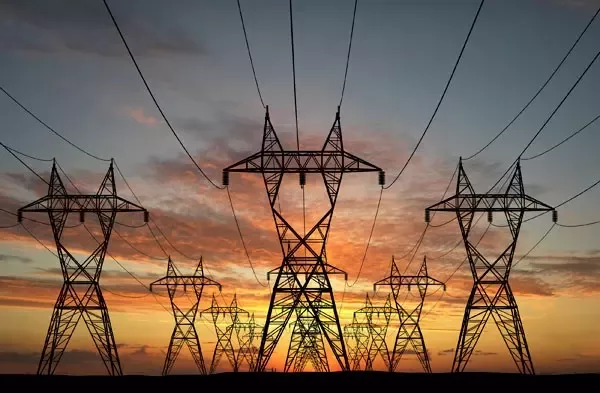
Why Redundant Systems are Out-of-the-Question Necessary

I live in Mandaluyong City, Manila, Philippines and on June 2, 2021, there were three (3) announcements:

  1. The Luzon electrical grid was on “red alert,” meaning power failures of up to two (2) hours were imminent due to shortfalls in supply from power plants;
  2. The water utility company, Manila Water, warned that there would be no water supply later in the evening, as the company was planning to fix a water main which could take up to ten (10) hours;
  3. The government’s weather bureau forecasted that a tropical storm was bearing down on Manila, which could bring heavy rains and strong winds.

None of the above happened. 

There was no power interruption.  Water slowed to only a trickle for up to at most a half hour in the middle of the night.  And the storm brought light rain but no strong winds. 

Though it was good news that none of the above happened, the three (3) announcements were disturbing for the following reasons:

  1. They all came as surprises.  The government was assuring ample electrical supply from April to June 2021.  Manila Water had just fixed the water main a few weeks before so we residents didn’t expect there’d be another job that would entail one more whole night of no water.  The weather bureau was predicting the tropical storm wouldn’t reach Luzon but we suddenly saw the new forecast on social media before the storm would hit;
  2. There was no sense of urgencyPoliticians bickered about the power shortages.  Agencies weren’t advising people about the risks in regard to the storm.  And no one was asking communities to prepare for the scheduled water interruption.
  3. These announcements wouldn’t have been necessary if the systems behind each of them were reliable in the first place

All of us rely on electricity and water for our basic needs.  It’s therefore a given that supply should be reliable, as in 100% reliable.  We don’t and shouldn’t accept anything marginally lower. 

If someone tells us we should be happy with 99% reliability in electricity and water, we would ask that person if he’d be happy having no water or power one day out of every 100 days.  We wouldn’t and no one else would. 

Hence, we expect the people who supply us the power and water to be utterly and perfectly dependable.  It’s what we pay for via the bills the utility companies send us and expect us to pay by deadlines with the threat of disconnection if we don’t. 

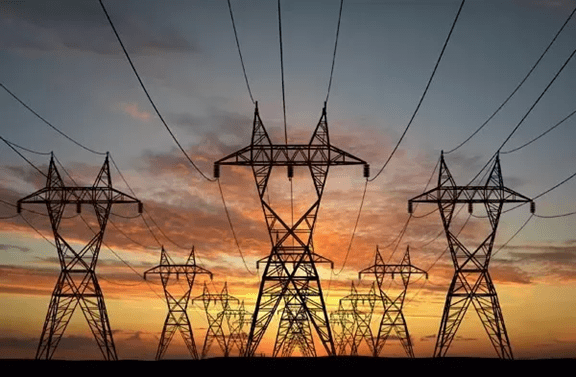
Electricity and water, like products, easily follow the supply chain model.  Power plants procure raw materials (e.g., coal, oil, gas, wind, solar, geothermal steam) and convert them to electricity which they deliver via transmission lines and distribution grids.  Water companies likewise procure raw water from reservoirs, treat it, and distribute it via their plumbing networks to household and commercial consumers. 

The procurement, transformation, and logistics that comprise every supply chain are present as well in electricity and water utilities.

What makes the power and water supply chains unique is that the products of both are instantly available.  We get power at the flick of a switch and water at the turn of a valve. 

We consumers expect three (3) things from utility companies that supply electricity and water: 

  1. Reliability all the time.  When we consumers need it, the supply should be there. 
  2. Reliability to all.  Supply should be available all the time to all in a utility company’s coverage area.  It is not acceptable if one community has water and power while another has none. 
  3. Reliability in quality.  Utility companies must supply electricity and water at the quality needed.  If our appliances need 220 Volts, it should be 220 Volts, not 250 or 190.  Water should be clean, not dirty. 

Some executives and politicians mistake capacity for reliability.  Some believe if there are more power plants, the more reliable power supply will be.  Likewise, for water, some believe the greater the reservoir capacities, the more reliable water supply would be. 

Capacity is about the capability of assets, such as machines that can produce more and such as storage facilities that can keep more.  But having the ability to make or store more doesn’t make a system more reliable. 

Manila relies on one large reservoir to supply the bulk of its water.  Some people urge that another should be built so that there would be more water available for a growing population.  It’s an issue of capacity, these people say. 

Manila, however, relies on treatment plants to clean and filter the water.  It also relies on a network of pipes to bring the water to consumers. 

What would happen if Manila had lots more water than needed via two (2) reservoirs but had only one treatment plant and one main pipe supplying several of its cities?  The system may have more than enough capacity but wouldn’t exactly be reliable especially if the treatment plant shuts down or a pipe springs a leak.

This is what exactly was the issue for that announcement of no water on June 2, 2021.  A main water pipe needed repair and it was the only one that supplied to a large swath of the city.  One pipe determined the reliable supply of water to hundreds of thousands of people. 

Similarly, it would be nice to have more power plants to have more generating capacity. But if there’s only a single transmission line from each power plant and single substations to process that power before reaching respective consumers, then the power supply may not be as reliable.

Luzon had a shortfall of power supply on June 2, 2021 not because there weren’t enough power plants.  It was because Luzon’s power plants weren’t being managed reliably.  A power plant for instance didn’t have a backup for its boiler facilities that ran its turbine.  Other power plants were down simultaneously for preventive maintenance, which reflected poor scheduling. 

Redundancy is key to dependable reliability in utility companies.  Redundancy is the operation of multiple identical assets for the same process.  Instead of one asset, there’d be two or more even if just one is enough to do on its own.  That means either there’d be at least one idle asset backing up other assets in an operation or several assets running at the same time but at lower capacities as they share serving the total demand. 

For electricity supply, that would mean multiple facilities, not only in the form of multiple power plants but also in multiple transmission grids and substations running parallel to each other. 

For water, that would mean not only multiple reservoirs but also multiple treatment plants and plumbing networks either running parallel or taking turns to be on standby. 

If a transmission line has a fault, the power company can switch to another grid to deliver the electricity.  If a pipe bursts, the water company can switch to an alternate pipeline. 

Some executives, however, see redundancy as a bad thing.  Since it requires extra investment and added operating costs, they would rather not have redundant systems and instead insist that their management teams simply make sure that the systems are always running all the time and perfectly.

Unfortunately, no system is perfect.  Eventually, there will be failure.  It is just not humanly possible to prevent a power line from snapping due to wear and tear or a water treatment plant from shutting down due to an unexpected clog in its filter systems.                                                                                  

Redundancy therefore not only becomes justifiable but also necessary especially when the consumers the utility companies serve, which is practically everyone, demand 100% reliable electricity and water.

Redundancy applies to other supply chains in other industries as well where customers are very sensitive to failure in the delivery of goods and services. 

Enterprises that sell finished products rely on multiple vendors for the same raw materials to avoid run-outs.  They also set contracts with multiple transport providers to ensure there’d be available trucks to deliver the goods. 

Again, some executives mistake capacity for reliability.  They ration procurements from vendors based on percentage of their manufacturing capacities and they ask only so much trucks per transport provider to total only what’s needed to ship in a day.  When a vendor fails to deliver or a trucker doesn’t show up, the enterprise ends up not making what’s needed or delivering to schedule. 

Redundancy means having assets that provide multiples of needed capacity, not just the capacity itself.  It means having multiple sources, multiple facilities, and multiple systems such that when one fails, another picks up the slack. 

And as much as it applies to electricity and water, it is very much applicable to other industries that have very demanding customers.

And it also applies to weather forecasting too.  Weather forecasters rely on multiple monitoring stations and multiple providers for satellite and analytical data.  The data and analyses are redundant but it allows weather forecasters to compare information and come up with more accurate and reliable forecasts.  Which makes it puzzling as to why the forecast was so much wrong before June 2, 2021. 

For critical services like electricity and water, we demand perfect reliability.  Redundancy in systems help assure that reliability.  We expect nothing less from those who provide what we feel we deserve. 

About Overtimers Anonymous

Three Questions Every New Manager Should Ask

Every new manager should always ask three (3) questions about an operation he or she will be in charge of:

  1. What does the book say should be happening?
  2. What do the people say should be happening?
  3. What is really happening? 

Chances are each answer would be totally different from the others. 

What does the book say?

The “book” in this case is the manual, memo, policy, or rule.  What does the book say how an operation should be run? 

What do the people say?

The “people” are the workers running the operation, your boss, and your peers whom you work with.  They’re the men and women on the ground who know their jobs as well as those co-managers who think they know more than you. 

You could also pose the same question to support staff like the inspectors & maintenance technicians, or to foremen and supervisors who oversee the workers.  But I’d put more weight to what the people who are on the front-line say since they’re the ones who are right there doing the job itself.   

What is really happening?

This is what is actually happening which comes from witnessing the operation itself. 

Most of the time the answers to each question differ greatly.  What the book says would differ from what the people you work with say and either would differ from what is happening in real life.

When a new manager notes the different answers, it provides a starting point on how best to manage the people and operations she will be in charge of.  It will lead to more questions like:

  • Why isn’t the operation doing what it’s supposed to as per the manual?
  • Why are people saying differently from what is actually happening?

The idea isn’t to catch people and find fault.  It’s to know what real problems underlie the jobs people are doing and the systems that run them. 

The three (3) questions provide an opening into understanding what those challenges and difficulties are. 

Case in Point:  Production at a Refrigerated Margarine Packing Line

As a new manager of a refrigerated margarine packing line of a multinational consumer goods corporation, it was my job to make sure production would always be maximised.  There was high demand for the corporation’s refrigerated margarine brand at the time and I had to make sure production was in full swing.

I noticed, however, that production per eight-hour shift never was more than 700 packed cases a day. 

I went to check the work styles of the margarine’s operators.  I had the three (3) questions in mind:

What did the book, the company’s manufacturing manual, say? 

The manual said employees must be on the production line at the very start of their shift and can only leave their work-place during breaks and only at the end of their shift.  During their work-time, they must be working and packing to meet output as dictated by the production schedule.

In other words, employees should be working throughout their shift except during breaks. 

But if they are working throughout their shift, then based on time & motion studies, they should easily exceed 700 cases a day.  So why weren’t they?

What did the operators say?

When I asked the operators how come they weren’t exceeding the 700 cases a shift, they said that is the maximum they can humanly do.  Each case is heavy and packing them isn’t as easy as what the manual says. 

When they pack a refrigerated margarine case, they said they have one person scooping up the margarine bars and putting them into a corrugated container.  A second packer tapes the case and stacks it with others on a pallet.  A third person who is also the operator of the production equipment moves the pallet to cold storage adjacent to the packing line and then provides a new pallet for the packets to stack new cases. 

What was really happening?

When I went to discreetly observe the packing operation (I would observe from a spot where they wouldn’t see me), I noticed that there’d only be one operator on the packing line.  The other two wouldn’t be there.  In fact, whenever I observed the operation, there will always be only person doing everything:  packing, stacking, and moving the pallets. 

On the swing shift (afternoon to evening) and graveyard shift (evening to early morning), there would be no production operation for the last two to three hours of each shift.  As in no one present on the production line. 

When I confronted the crews about this, their first answer was that the other operators were on break when I was observing only one person on the line.  When I countered that it wasn’t the designated company break time, they then said they took turns on breaks so that they could run the machine straight without having to turn it off and on again. 

When I asked how come there was no operation for the last two to three hours of a shift, they said they were making up for the break-times they didn’t use up from going straight during the shift.

Finally, when the employees realised they weren’t making sense, they finally said:

Some years ago we were paid on incentive.  We were given a quota of 700 cases a shift.  If we exceed quota, then we will be paid extra.  But the company decided two (2) years before you the manager came to scrap the system and raised every worker’s salaries to make up for the lost incentive.  We at the refrigerated margarine line, however, felt no longer motivated to produce more than 700 cases per shift.  And rather work throughout a shift, each of us operators took turns packing the items on the line.  Each of us would really be working only two (2) hours a shift.  After six (6) hours, when we reached the “quota” of 700 cases, we would all go upstairs to our locker room and rest until quitting time. 

For the succeeding months afterwards, I worked with the refrigerated margarine crew in this regard.  I didn’t outright succeed in getting more production per shift but I did change how production schedules were done and did organise the crews into teams that worked on reducing downtimes.  Productivity actually improved despite the ongoing practice of producing only a fixed quantity per shift. 

Asking those three (3) questions:

  1. What does the book say?
  2. What do the people say?
  3. What is really happening? 

helps managers see what’s happening from three (3) different angles. 

Neither answer may necessarily be the right one.  The idea is to reconcile them all and identify the problems that underlie each one of them. 

About Overtimers Anonymous

Just About Every Enterprise is a Supply Chain Enterprise

I and ten million people in Manila have the same problem every day.  Mobile phone reception—it’s lousy. 

It would take several tries to call someone on my mobile phone and when I do, chances are the conversation would stop in the middle. 

Poor cellular reception is a norm in the Philippines.  It’s just so hard to get a decent signal to have a continuous conversation or get a text out. 

I’m sure telecom companies are doing all they could to improve their services.  I see it with their unrelenting investment in the set-up and maintenance of cell-phone towers as they continue to expand coverage and upgrade reception. 

If we think about it, the operations of telecom companies have similarities to those enterprises who manufacture and deliver finished products.  The good quality mobile phone reception we yearn for is not much unlike the supermarket products in how both are made available to consumers.  In short, both have supply chains. 

The supply chain is a model for enterprises that buy raw materials and produce & deliver merchandise for their customers.  Supply chain management has become a standard when it comes to managing the inventories and logistics of items, from chemicals to consumer goods.

Supply chains, however, aren’t limited to just physically tangible products.  They’re very much applicable to intangible items, such as electricity, health care, and business process outsourcing (BPO) services. 

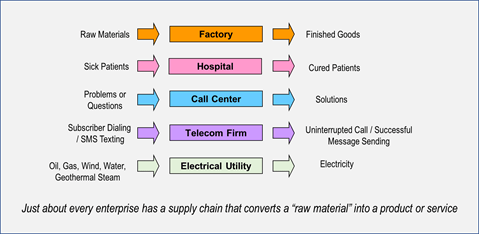
Supply chains follow the flow of products from their start as raw materials to their conversion to merchandise and subsequent delivery to users.  Service and utility enterprises also follow a path of conversion and delivery not altogether different from product supply chains. 

In manufacturing industries, factories convert raw materials into products. 

In non-manufacturing industries, enterprises convert specific problems and issues into finished services.   Hospitals treat sick patients.  Call centres handle problems and questions.  Telecom companies provide mobile phone receptions resulting in uninterrupted conversations and successful sent messages.  Power utility companies make available electricity from energy sources. 

But It’s not just relating manufacturing and services.  It’s also the logistics behind both.  Whereas manufacturers rely on procurement of materials and logistics for transport and delivery, service enterprises depend on infrastructure and systems to ensure the flow of their operations.

A hospital needs not only ambulances but also the system of managing the dispatch of the ambulances for the assurance of fast turnaround for the benefit to patients needing immediate transport. 

One mistake I observe with service companies is that they limit supply chain management to stuff like spare parts and supplies. 

A large energy corporation for instance has a supply chain executive whose job is to buy equipment and components.  The energy corporation had no structure or strategy when it comes to power conversion and delivery.  The energy corporation, hence, had big issues in unreliable power delivery due to poor planning in energy generation and power plant capacities. 

The success of a supply chain model starts with its scope.  Does the supply chain manager of the enterprise handle the total flow from start (procurement/purchasing), to its conversion (production/service operation), and the logistics operations (transport/delivery/orders processing)?  If it misses on any of the aforementioned, chances are the enterprise’s business has a lot of room for improvement.

We consumers want good quality from the things we buy.  Not only the merchandise from the store but also from services such as mobile phone reception, electricity at the flick of a switch, and the best health care. 

The supply chain model is just as much applicable for intangible services as much as it is for tangible items.  Most if not all enterprises have supply chains for what they offer and deliver.  We just need to recognise that managing the operations with supply chains in mind can go a long way to bringing excellence and win-win results. 

If only the telecom companies can think like this, then maybe we’d get better service with our cell-phones. 

About Overtimers Anonymous

The Heroes Among Us

It’s easy to criticise.  It’s simple to call someone stupid. 

Social media in the Philippines has been abuzz since the pandemic began in 2020.  Not that it hasn’t been abuzz before; it was more so after as people stayed home and expressed their frustrations.

As vaccine supply remained scarce, the COVID-19 virus continued to wreak havoc in 2021.  Hospitals were full; people died.  Critics blamed government; government blamed critics. 

People finger-pointed at politicians; politicians grand-standed or pushed back.  It was a show we watched and participated in every day.  We texted, we posted, and we hurled invectives.  While people absorbed themselves in the viral discussions on the Internet, many chose not to join the fray and decided to do their work―work that mattered. 

There was the barangay (village) health officer who was in charge of scheduling vaccinations for the village residents.  He would call the residents up and tell them when their vaccines were ready.  He also scheduled the village’s ambulance to pick up and bring patients to the hospital. He also secured medical clearances for recovered patients.  The health official did many things at once and when asked, he did it as a “service” and for no more.

There were the many others like the barangay health officer who did their part beyond the call of duty:

There were the doctors who did house calls to diagnose and treat CoVID patients, despite the risk of infection to themselves. 

There were the swab test nurses who went house to house to get samples from suspected infected patients.  And those who worked at the laboratories to analyse and deliver the results. 

There were the crews of mobile X-ray trucks who went place to place to cater to patients who couldn’t leave their homes because they were in quarantine.  

There were the funeral home employees who did the sad and thankless job of picking up and cremating the remains of patients who didn’t survive.

And on the fringes, there were the security guards who reported to duty every day.  The custodians who cleaned the buildings.  The maintenance technicians who watched and made sure critical equipment kept running.  Not only at the hospitals but at facilities such as office buildings and factories. 

There were the drugstore clerks and pharmacists who worked the whole day to dispense medicines.  The supermarket merchandisers and workers who helped shoppers find the food and household supplies they needed.  And the many motorcycle riders and delivery truck crews who left early in the morning and went home late at night. 

It is true all of the above work for an income; an income that agencies and enterprises bill us and we frequently complain about. 

But despite whatever flak we may give them, these ladies and gentlemen did their jobs without fail and contributed life-saving work for many stricken from the pandemic. 

Hats off to them.  Perhaps we can’t do any better in giving them tribute but we can at least make sure we pay our bills and get inspired to give a little more extra in the work we ourselves do. 

About Overtimers Anonymous

Supply Chains Must Have These Five (5) Traits

What’s all the fuss about supply chains?

An Evergreen container ship, the Ever Given, got stuck at the Suez Canal in late March 2021.  The solution was simple:  dig out the sand it’s grounded on and tow the ship to a nearby lake.  Unfortunately, because it’s a big heavy ship and the Suez Canal is a narrow shipping lane between Asia and Europe, a traffic jam of vessels ensued at both ends of the canal. 

The media jumped on the Ever Given’s predicament and soon enough, it became a global talk-of-the-town.  Supply chains became a hot topic as media analysts speculated on shortages of merchandise as container cargo ship arrivals were delayed due to the logjam. 

The Ever Given’s saga at the Suez Canal riveted the world.  It created so much buzz that weeks after the ship finally was freed, people were still talking about it and more so about supply chains. 

One stuck ship had created so much fuss.

Supply chains have been the focus of media attention since countries started locking down their cities and territories at the onset of the COVID-19 pandemic in early 2020. 

At first, media reported shortages in food, personal protective equipment (PPE), and supplies.  Then there were the reports about transportation bottlenecks in air and sea freight due to restrictions at borders and ports. 

More than a year later, by March 2021, the news shifted toward cargo congestions at North American ports, spiking consumer demand, shortfalls in semiconductor chips leading to automotive factory shutdowns, and the lack of available shipping containers as international trade picked up

And as vaccines became available, just about every so-called expert raised the spectre of not enough injections for everyone due to weaknesses in global supply chains.

But is all the fuss pointing to real problems in supply chains?  Or are they just exaggerations exacerbated by media and analysts seeking attention?

The COVID-19 pandemic disrupted just about every enterprise on Earth.

  • Many saw the emptied grocery shelves and many more waited in long lines to buy medicines and toiletries. 
  • Farmers threw away vegetables and poultry business owners cut production as inventories grew and demand fell.  There was plenty of food available in 2020 and then there were the shortages, particularly meat, in 2021; 
  • It wasn’t easy for some of us to find spare parts for fixing our cars, trucks, or motorcycles.  This was especially true as some car dealers and shops closed due to lockdown restrictions. 

We realised how fragile product supply chains can be in the era of the pandemic.  And as a result, we have seen the supply chain landscape changing before our very eyes.

So, yes, there are real problems in supply chains and no, the media weren’t exaggerating about those problems. 

The Ever Given wasn’t a wake-up call but the media attention is.  Supply chains need to be managed in a different light after all the disruptions enterprises have experienced. 

Where do we start? 

I recommend identifying what traits a supply chain should have:

  • They need to be proactive especially when it comes to demand.  Demand is a primary driver of supply chain flow and if it was already hard to predict what customers will buy, it was even more so during the pandemic and likely stay that way in the post-pandemic eras.  Supply chain professionals need to be at least one step ahead in anticipating, capturing, and cultivating demand in the planning and execution of customer fulfilment services. 
  • Many executives believe supply chains need to build in resilience.  Resilience is the ability to recover from difficulties—to spring back into shape after a shock.  I don’t fully agree.  Resilience implies that enterprises roll with the punches of disruptions, taking in hits and then healing afterward.  In my opinion, enterprise supply chains should learn to parry; they should build in resistance to whatever a bad disruption may bring.   Supply chains therefore should be versatile.  Enterprises shouldn’t just be ready to adapt or resist disruption; they should also be ready to initiate disruption.  And what does an enterprise need to manifest that?  Versatility
  • Supply chains must be productive.  Productive not as in efficient but as in performing effectively towards meeting and exceeding enterprise goals and strategies.  Supply chains are not generic.  Though they may share common standards such as service, cost, and quality, the extent of how each individual supply chain performs depends on the mission of the enterprise each works with. 
  • Supply chains need to be organised.  This is not just about having a structure that puts functions like purchasing, manufacturing, and logistics under one roof.  It’s also about having unified systems that connect and encourage vendors, enterprises, and customers to collaborate to a common cause.  
  • And last but not least, supply chains must be sustainable.  No, not the environment-friendly kind of sustainable but the type in which an enterprise can count on its supply chain for a perpetually reliable supply of resources, such as products, materials, components, energy, human resources, and/or working capital. 

Note that I didn’t mention digital as a needed trait.  As of now, I don’t see it is a needed trait despite what many may say.  Yes, it’s a whole new world and a whole new normal with e-commerce more dominant than ever and with technologies trending towards artificial intelligence, blockchains, and cryptocurrencies.  But as much as they will be hard to ignore in the near future, supply chains don’t need to be digital as a trait.  Supply chains would need to go digital as a means—a means towards being proactive with demand, versatile, productive, organised, and sustainable

About Overtimers Anonymous

A Guide to City Zoning; an Example of Management Organising

I asked the water company engineer why his company was digging up the street in front of my family’s house for the second time in a few years.  He answered my question with a frown and a sigh. 

“I have to install new pipes because of that new building,” he replied as he pointed at the high-rise residential structure just a few meters across the street. 

“When we at the water company improved the pipes here a few years ago, we didn’t plan for that building.  But now, because of that high-rise, we have to install bigger high-pressure pipes that will be able to supply water to all the floors of that building.”

“It’s very frustrating,” he added.  “All that work a few years ago for nothing.  Why couldn’t the city just follow their zoning laws?” 

I live in the City of Mandaluyong, one of several cities in the National Capital Region or NCR.  The NCR is the highest populated and urbanised place in the Philippines.  In 2017, Mandaluyong City updated its Zoning Ordinance Map in line with its Comprehensive Land Use Plan.  The CLUP laid out how the city was to be divided in terms of where residential, commercial, and industrial areas would be, as well as spaces for institutions and parks. 

There are essentially two (2) major zone groups:  residential and commercial, coupled with other categories: urban renewal area (URA), institutional, parks & open spaces, cemetery, and utilities. 

Residential zones, those designated with an “R” classification, are exclusive for structures for homes and living spaces.  No buildings, structures, or land are to be used for commercial purposes. 

Commercial zones, those with a “C” classification, allow for use of land and structures for business. 

Sub-classifications per zoning category allow for building height and density. 

In residential areas, an R-1 zone is limited to “single-family, single-detached” buildings.  An R-2 zone allows for “low-rise single-attached duplex or multi-level buildings,” while an R-3A zone includes high-rise structures exclusive for multiple family dwellings although it may include low-, medium-, and high-rise residential buildings that are “already commercial in nature or scale.”  An R-3B zone allows for high-rise buildings up to 18 storeys. 

For commercial areas, C-1, C-2, and C-3 zones differ in the size of buildings and number of establishments per structure.  Central Business Districts (CBD) allow for “large-scale office, commercial, business, financial, leisure, and high-rise residential and related uses.”    Mixed Development Zones are for “mixed residential, retail shops, offices, leisure industry, and support commercial activities.” 

Mandaluyong City’s Zoning Ordinance doesn’t have industrial zones, which some other cities do. 

The city has a Zoning Administrator to administer and enforce the ordinance.  Complaints and appeals related to the zoning ordinance, however, are brought forth to the Local Zoning Board of Adjustments and Appeals (LZBAA) in which the city mayor is chair and consists of executives and officers from city hall. 

The purpose of having a zoning ordinance is to organise how land is used within the city.  It’s a guide which the city established to avoid problems such as traffic congestion and urban blight.  Via the CLUP mentioned above, its intention was to specify what parts of the city can be used for residential and commercial uses, as well as for institutional needs, special purposes, and parks & greenery. 

The key word is organise.  Zoning is the excellent manifestation of the management function of organising, one of the four basics in which the other three are planning, directing, and controlling. 

By organising the city’s lands for what they can be used for, city hall executives can plan how to bring more prosperity to Mandaluyong while balancing security and convenience for their constituents.

The high-rise condominium tower the water company engineer pointed at on our street was clearly not supposed to be there, as per the zone it is in, R-2.  Yet, it’s there, a monstrous tower overshadowing our neighbourhood that somehow got built despite the rules against it. 

Somehow, the high-rise developer was able to skirt the ordinance and build his building in our R-2 neighbourhood.  It was what forced the water company to change the pipes, which wasted the improvements it made a few years before. 

With zones, a city can plan its infrastructure accordingly.  One can lay out how much power, plumbing, telecommunications, road, and sewage capacities each zone would need.  Commercial zones would need wider streets and sidewalks for heavier traffic, for instance.  Residential zones would maybe need more street lights and efficient sewage piping. 

City hall politicians are often under constant pressure to revise zoning ordinances to accommodate developers wanting to build bigger buildings or heed residents clamouring to protect their peaceful neighbourhoods.  In many cases, both developers and residents challenge zoning rules in which there would be plenty of cases on the LZBAA’s list.

Zoning is part and parcel of urban planning and management.  It brings organisation into a city or town and helps leaders plan their respective districts’ infrastructures.  It helps leaders decide when violations happen or when developers push for exceptions. 

Despite whatever pressures developers or residents put on political executives, zoning serves as a superior model for organising, that basic function of management we sometimes take for granted. 

About Overtimers Anonymous

Burning Platforms and How to Prevent Them

A proprietor who sells electrical products was experiencing a dramatic drop in sales.  He hires a consultant who comes from a large multinational corporation and asks him what can be done. 

The consultant suggests that the proprietor develop a vision, mission, objectives, and strategies (VMOS) for his business.  The consultant conducts a team-building session with the proprietor and his staff and for several days, they draft and formulate a VMOS.  When they finally finish with a fancy-worded VMOS, the consultant presents the VMOS to all the employees and stakeholders.  When the consultant went to collect his fee, the proprietor asks the consultant, “so when are we going to talk about my falling sales?” 

The phrase, “burning platform” takes its origin from a story about three (3) men on a North Sea oil rig that was on fire.  Two (2) men decided to jump into the icy waters while one (1) man opted to stay.  The two (2) men who jumped were badly injured from their fall but rescuers were able to save them.  The man who stayed on the platform died.  Management consultants have cited this story as a lesson that when faced with an urgent crisis, one should take risks and go for deliberate change.  Otherwise, if one does nothing, the business dies. 

The proprietor of electric relays was on a burning platform; his business was on fire in the form of falling sales.  The clueless consultant he hired didn’t address the urgency of the problem.  The consultant focused more on what he was good at from being an executive at a multinational. He ignored the crisis happening to the proprietor. 

Many managers complain about frequent “fires” that disrupt their daily routines and preoccupy their time and resources.  Some executives cite a variety of reasons for these “fires,” from lack of leadership to poor discipline.  The executives would form committees, hold strategy meetings, scold managers for poor judgment, or blame poor discipline among rank-and-file employees.  Whatever they prescribe, these executives would miss the point that there’s a crisis that urgently needs to be addressed.    

Crises, like burning oil platforms, don’t just go away.  True, a fire may burn itself out, but even if they did, they’d leave a lot of damage.  When there’s a fire, everyone either runs to put it out or runs away.  No person in his right mind would just sit there idly by and get himself burned. 

Unfortunately, many executives don’t know a crisis even if it’s raging in front of them.  It’s what we would call denial, a reaction inherent in human nature.   We deny and ignore a crisis to believe it is not happening, that there can’t be a threat. 

Most of the client firms I’ve diagnosed have burning platforms.  Some are big, some are small; but urgent crises nonetheless that disrupt operations, reduce sales, increase costs, and cause other problems.  Burning platforms are often fast-moving fires that eat away the insides of a business and challenge the cores of an organisation.

Managers of course need to address burning platforms.  The key is to know that there is one.  Sometimes, managers, especially high-level executives, don’t realise they have one.  The following are situational examples of burning platforms that executives sometimes ignore until it’s too late: 

  1. Treasury managers pointing out critical cash-flow balances and immediately urging field sales personnel to collect receivables from customers;
  2. Manufacturing managers alerting purchasing executives that their raw materials are running out because vendors didn’t deliver as scheduled;
  3. Logistics managers facing a shortage of trucks as senior marketing executives complain of empty supermarket shelves where new products are supposed to be;
  4. Information system contractors alerting the firm’s chief information officer (CIO) that the company’s data centre’s room’s air-conditioning has broken down and the IT system is in danger of shutting down. 

What should an enterprise do about burning platforms?  Put them out, of course.  What would it take to do it?  Everything that one can muster.  It is a fire!

  • One does not ignore a fire.  One works to put it out now and until it’s out;
  • And when we say out, we should mean really out, to the extent that whatever caused it won’t ignite again.  

The best solution against burning platforms is preventing them in the first place.  The means to do that is usually via having relevant and effective monitoring systems and risk management measures

It starts with having plans and policies that consider potential risks and include contingencies.   

These plans and policies should answer questions like:

  • What to do when customer collections are falling behind?
  • What’s the inventory policy when raw material stocks are running low?
  • What’s the plan when projections show not enough trucks next week to deliver orders?
  • What’s the backup plan in case the Internet server crashes? 
  • Who will take over, work from home, or substitute when members of staff are found to be infected with the CoVid-19 virus? 

Any plan or policy should have pre-approved procedures against pre-defined crises such that the organisation can immediately take action without having to go through time-consuming justifications to top management.  Of course, managers should always notify executives when a crisis is imminent and action should be taken. 

Common sense dictates that when there’s a burning platform, we either try putting it out or run for safety.  Sometimes, however, we deny there’s a burning platform crisis and we go about our business until we and our enterprises are consumed. 

Recognising the existence of a crisis is important but prevention is key to avoiding any crisis.  Plans and policies that take into account potential risks, build in contingencies, and allow immediate pre-approved action would help a lot in keeping any new crisis from getting too big if not stifling them at the start. 

We should never sit idly by when there’s a crisis and even if there isn’t one. 

About Overtimers Anonymous

Building Track Records of Trust

My mechanic, Diony, recommended I change the power steering fluid of my car.  I use automatic transmission fluid (ATF) for the power steering because another mechanic said it was okay.  But when Diony checked my car the other day, he said I shouldn’t use ATF for power steering.  ATF is for automatic transmissions; power steering fluid is what’s needed for power steering.  Duh! 

I have trusted previous mechanics for their opinions and recommendations.  I trust Diony when he fixes my car.  But if Diony says the ones before him were wrong with the power steering fluid, how do I know if he is right versus the ones before him?

When we consult mechanics, plumbers, and technicians to fix issues with our cars, appliances, and equipment, we do so on the assumption they are the most qualified for the jobs.  We’d rely on their credentials and build our confidence from our experiences with them. 

Managers of enterprises engage contractors often by bidding the jobs to candidates.  Bidding, however, skews more towards price than to value.  Bidding also is typically based on a pre-defined scope of work, also known as the terms of reference (ToR), which practically defines a solution for a problem even if one isn’t found yet. 

It makes sense to bid out work when a solution is known.  But it won’t be if we don’t have an idea what we need to do.  More often than not, we seek expert help to solve problems in which we have no outright answer. 

We don’t do a bidding process when we consult medical doctors.  We first find one we can trust to give us a diagnosis.  When the doctor recommends a treatment, we then find what we would believe would provide the best value even if the doctor may already recommend a provider for the treatment.  If we’re not comfortable with the diagnosis and recommended treatment, we’d get a second opinion.  We would only look at our treatment options once we agree with the diagnosis which we believe is the right one. 

The same logic applies when we manage our assets.  We would first get an engineer or technician to assess our assets and we only would bid jobs only when we are confident that we have found the best solution. 

Some managers short-cut jobs by bucking this logic.  Managers would ask contractors to bid for jobs with vague terms of references.   Technicians would repair machines that end up more broken than fixed.  Engineers would bill additional costs because managers would make last-minute changes to scopes of work that weren’t very clear in the first place.  Worst of all, managers would hire contractors who weren’t really qualified, offered wrong solutions, or just did the work wrong. 

When they go against common sense, enterprises end up paying more what they should due to shoddy work that was done for a solution to a problem that wasn’t well-defined. 

My mechanic, Diony, has a good track record of successful maintenance jobs so I can trust him for his diagnosis and good work.  And it does make sense in the first place to use power-steering fluid for the power-steering system than to use any other fluid (duh!). 

For enterprises who are seeking experts, it’s always best to check the credentials, ask for referrals, and interview them.  Getting experts on board that are trustworthy over the long run to consult with will benefit the enterprise.  It’s just plain sensible that we need experts to assist in assessing the issues, defining the problems, and finding the best solutions.  Bidding becomes straightforward as scopes of work become clear. 

Every enterprise would do well to have experts to consult with to help diagnose problems and recommend solutions.   Over time, the experts and the enterprise would build track records of trust that would reap mutual benefits for both parties. 

About Overtimers Anonymous

Non-Moving Inventories: The Supply Chain’s Elephant in the Room

The phrase, “elephant in the room,” is said to have originated from a fable by Ivan Krylov that tells about “a man who goes to a museum and notices all sorts of tiny things, but fails to notice an elephant.”  It has become a favourite expression for an obvious problem or issue that for some reason gets muddled, forgotten, or avoided. 

Just about every supply chain has an elephant in its room and in many cases, it’s called non-moving inventory. 

Non-moving inventories are items that have ended up idle in storage or on the factory floor for extended periods of time.  Non-moving inventories can be raw materials, packaging materials, spare parts, work-in-process, or finished goods.  They are merchandise that were acquired or produced at a cost but have become unattractive in value.

Non-moving inventories end up as they are for a variety of reasons: 

  1. the enterprise produced more than what could actually be sold;
  2. items are defective, rejections, damaged, or were returned from customers;
  3. items are old, obsolete, expired, or discontinued;

Whatever the reason, enterprise executives would see them as one thing:  a nuisance that takes up valuable space and ties up working capital.   

But they are more than a nuisance.    Non-moving inventories are cash investments that went to naught, as they had lost their selling value.  They are blots to marketers who see them not only as visible failures of their promotional strategies but also as barriers to introducing new products. Some enterprises hold their marketing and sales executives accountable for non-moving inventories and would insist they lead in running them out before any new product is introduced. 

Non-moving inventories are potential threats.  When non-moving inventories grow in size or quantity, they not only become the elephants in the stock-room or storage facility, they also become risks.  An extreme example is when non-moving ammonium nitrate fertiliser exploded in a Beirut, Lebanon warehouse in 2020:  https://www.theguardian.com/world/2020/aug/04/huge-explosion-beirut-lebanon-shatters-windows-rocks-buildings 

The good news is many non-moving inventories don’t end up exploding.  The bad news is that even if they don’t explode, they are a potential threat to the enterprise’s balance sheet and to its future growth. 

Despite their nuisance and threat, many enterprises take for granted non-moving inventories and instead try to get them away from their sight. 

A case in point: a large corporation that makes steel beams and heavy metal parts hired a chief information officer (CIO) to streamline the inventory system.  To appreciate the company’s products and materials, the new CIO toured the corporation’s main factory and warehouse which was just outside the city.  He noticed a huge pile of rusting steel products at a far side of the facility and asked what they were.  The plant manager who was his tour guide said the items were scrap. 

The CIO asked how come there’s so much of the “scrap?”

The plant manager said, “I don’t know. They’ve been sitting there for years ever since I was hired.”

When the CIO reported the “scrap” to the Chief Executive Officer, the latter was outraged. 

“They [his chief finance officer & chief manufacturing officer] told me that they got rid of that stuff many years ago!”, the CEO exclaimed. 

The CEO summoned the CFO and Chief Manufacturing Officer (CMfgO) and ordered a thorough audit. 

The CFO and CMfgO were furious at the new CIO for making them look bad for exposing the hidden inventories.  Within a few weeks, they drove the CIO to resign after they constantly hurled negative comments about him and refused to cooperate with him in improving the inventory system. 

As for the non-moving inventories, they continued to sit in that far corner of the company’s factory, where executives once again forgot about them.

For the steel company, the non-moving inventories would come back to haunt the executives.  This is especially true as the non-moving items would multiply in size and take up more space.  It would become a problem when the enterprise entered hard times and had difficulty paying debts.  Auditors would no doubt point to the non-moving inventories as where the company’s cash is tied up. 

How then does one get rid of non-moving inventories?  The answers are straightforward but can be controversial: 

  • Sell Them Even at a Loss

Sell non-moving inventories at the best but most attractive price possible.  If one can only sell them at scrap value, so be it. 

Some finance executives, however, caution against such drastic selling.  It’s one thing to convert non-moving inventories to cash; it’s another to sell them very cheaply.  Losses in balance sheets attract negative attention especially if an enterprise is publicly listed.  But if one wants to once and for all remove the elephant in the room, this is usually the number one solution, whatever the hit it will bring to an enterprise’s financial reputation. 

  • Throw Them Away

This is worse than selling at scrap value but sometimes it’s the next best option if the enterprise needs valuable space and the alternative is to pay dearly for more space. 

Throwing stuff away can also be a hassle given all the compliance protocols it might entail (e.g. environmental impact). But if the items are toxic or dangerous to carry for extended periods of time, the enterprise might not have much of a choice.

  • Salvage Whatever Can Be Recycled or Reused

Some enterprises would invest in salvaging what can be reusable or re-saleable from non-moving inventories.  It’s never an attractive option as it will often require significant expense in time, materials, and equipment.  But it can be a compromise in that salvaging non-moving stock may not result in a sudden hit to an enterprise’s accounting books.  It would also be an opportunity for enterprises to dispose items gradually while getting something back in return. 

  • Process the Work-In-Process (WIP)

Many manufacturing enterprises have work-in-process inventories (WIP).  They’re the stuff that lie between production operations, usually waiting their turn for the next step in a manufacturing process. 

Some manufacturers, however, keep their WIP waiting too long, sometimes too long that the WIP loses value from deterioration and expiration.  This happens when manufacturers don’t follow first-in first-out (FIFO), customers cancel orders while items are in production, or managers allow other orders to “jump the line” or move other WIP ahead of others. 

I’ve seen WIP stored in one place for more than three (3) years, hidden away in a dark corner of a factory, their values long written off by auditors who thought they were losses. 

Even if written off, WIP takes up space and represent poor management resulting in waste.  And even as operations managers may succeed in hiding and getting rid of them, poor manufacturing practices will undoubtedly result in more WIP time to time. 

The answer to avoiding non-moving WIP is to process them right away.  If they are no longer needed, then either the manufacturing manager should process them anyway, scrap them, or salvage some value from them.  Manufacturing managers should also have a policy to always process all the WIP within a maximum number of days, if not hours. 

The best way to get rid of non-moving inventories is to avoid having them in the first place.  Unfortunately, many enterprises are stuck with them, in one form or another.  Eventually, non-moving inventories become easy to spot as an elephant in a room would be.  They’d be that pile of junk, that stack of unidentified boxes, that pallet of dusty cartons, those drums behind the building, or that huge tank that managers have no idea what it contains. 

Any non-moving inventory will stick out like a sore thumb.  We may try to ignore them but they’ll grow into something larger and harder to afford if we let them. 

Let’s not let them.  Enterprises should get rid of them as fast as possible.  Teamwork with financial auditors and accountants would help because when one has to remove an elephant, one needs all the help one can get.    

About Overtimers Anonymous

What Organising Really Means

There are four (4) basic functions to management:  planning, organising, directing, and controlling. 

We can picture what planning, directing, and controlling are.  They’re kind of straightforward and self-explanatory.  Organising, however, is not. 

When we “organise,” what’s the first thing that comes to mind?  We perhaps think of putting our stuff in order, like filing away papers and cleaning out the clutter.  Maybe we see organising as rearranging the tables of our subordinates, laying out the machinery, and scheduling who’ll work from home versus who’ll be at the office.  It can be that we think it is about making an organisational chart that shows the positions of people. 

Organising as a management function, however, is more than just all of the above. 

The dictionary defines organise as “cause to be structured or ordered or operating according to some principle or idea,” and “arrange by systematic planning and united effort.”  The key words are structure, order, and arrange and it is done for a principle or idea via systematic planning and united effort.

Organising is therefore not just making things neat.  It’s about making things ready for a specific purpose.  The “things” in this case are people, assets, resources, and products

Organising People

Managers organise people to do their jobs efficiently and effectively.  Organising is about employing and deploying the people crucial to making the enterprise’s goals into realities.  These include those we directly hire, i.e. employees, and those we engage with such as contractors and vendors. 

The tasks in organising people include team building, organisational development, training, defining job descriptions or scopes of work, and assignment of duties and responsibilities. 

Organising Assets

To get things done, managers need to have their assets in place and ready to be used.  These include having enough funds to pay for them and prepping them for operation. 

There have been many times I’ve seen managers order equipment and then realising they didn’t set aside enough money to pay the seller, causing delays in installation and start-ups.  

Organising assets includes tasks such as allocating cash in conjunction with budgets, setting up work stations, making and doing a checklist for preventive maintenance, calibrating gauges, running diagnostics, preparing storage space, and housekeeping.

Organising Resources

Resources are the materials, supplies, energy, water, and spare parts that we need to get things done.

Managers tend to underestimate the organisation of resources. 

Organising resources include preparing purchase orders, putting items in their proper place, checking that item codes are updated in the information system, informing security and receiving clerks what vendors are delivering the next day, clarifying policies such as first-in first-out retrieval, cycle counting of items to reconcile with inventory records, and regular quality inspections of critical components & parts. 

Organising Products

Similar to organising resources, we should make sure products are in their proper places, their codes complete in our computers, and delivery documents are arranged visibly for dispatch. Organising products also includes classifying each product’s inventory policy, marshalling finished goods for staging, categorising them by segment, group, family, and stock-keeping unit, and fixing the process descriptions and parameters of each. 

Organising products is no less important than organising people, assets, and resources.  In many cases, it should be the first to be done before the rest.

Organisation is not the same as organising.  The former is about structure; the latter is function.  Organising is work we may call mundane but necessary because the devil is in the details.  We can plan, direct, and control but if we don’t organise, that is, focus on things, make sure they’re in order, arranged, and ready for the strategies we will execute, then we’ll for sure run into trouble. 

Leaders rally people to a cause.  Managers organise people, assets, resources, and products to make real the goals of the cause.   

About Overtimers Anonymous