We are only as productive as that of our vendors and customers.
If vendors don’t deliver the materials we need when we need it, we wouldn’t be able to make available products no matter how efficient our manufacturing & logistics operations are.
And if customers habitually cancel or change their orders which they booked with us, then we would be stuck reworking delivery schedules, or be burdened with excess inventories of merchandise which likely will end up obsolete or destined for the scrap heap.
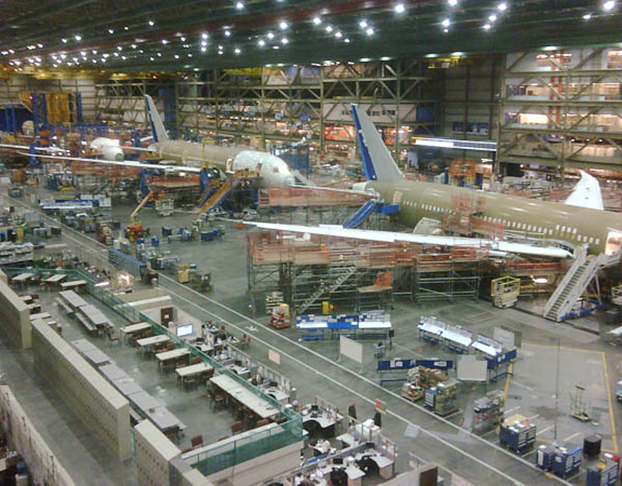
Boeing announced in June 2024 that it would buy Spirit Aerosystems, a company that the aircraft manufacturer spun off some of its operations to in 2005. Spirit made fuselages for Boeing but due to issues from in both companies’ operations, Boeing executives decided to re-integrate Spirit’s production line with its own. Boeing would regain, if not improve, its control of the supply chain of key components for its aircraft production lines.
Boeing prides itself with its efficient aircraft assembly lines but had unfortunately gotten entangled with high-profile quality & safety issues which resulted in damages to its reputation. Returning the operations it once outsourced to Spirit Aerosystems was part of Boeing’s effort to fix those issues and prevent them from happening again.
But it isn’t only vendors or outsourced service providers which observers blamed for problems with Boeing. Some of the company’s customers had requested for delays in deliveries of aircraft they ordered. Some even cancelled their orders, even though Boeing was close to finishing the planes. The changes in customers’ orders meant not only delays in deliveries but also Boeing getting stuck with unsold airplanes that, as an undesirable addition to its inventory, would tie up its cashflow.
The irony was Boeing had invested for years in establishing collaborative relationships with suppliers and customers. Boeing was once a model of customer-vendor harmony which could be cited as key to its competitive advantage versus its arch-rival, Airbus.
We manage our operations to make them as productive as possible and to ensure they perform to stakeholders’ strategic expectations. We can have automated manufacturing lines that can change over in seconds, state-of-the-art warehouse management systems which could store & retrieve items in minutes, and top-of-the-line artificially intelligent information technology (IT) planning networks which could provide real-time accurate reports and production, purchase, & distribution schedules.
But if our vendors don’t deliver critical materials or customers constantly change their minds about what they ordered, our operations would suffer significantly productivity-wise.
We can set the most optimal lot sizes for manufacturing to ensure fewer changeovers and minimise scrapping. But if batch quantities exceed what customers order, the extra production becomes inventory, and we as operations managers end up hoping customers will buy the remaining stock via new orders. In most cases, they don’t.
We can speedily arrange for the shipping of our products for export to other countries. But if shipping lines encounter delays due to unforeseen circumstances or suddenly upcharge freight rates, we lose not only the timeliness of deliveries to our customers but also find our profit margins getting hit as well. Just imagine if we were delivering Christmas trees that end up arriving at our customers’ doorsteps in January!
Shortcomings in vendor reliabilities and fickle customer demands had been common in industries. Despite the unproductivity it brings to our operations, many such challenges remain unresolved. We try to ‘manage’ them, that is, we try to adapt our operations, negotiate with (if not threaten) suppliers, streamline our responsiveness, invest in new technologies, or just work harder to plan better. We even hope that buzzwords like ‘resilience’ and ‘agility’ would spur instant transformation in our supply chains!
We don’t hire scientists or managers to solve problems although many executives for some reason do. Scientists aim to explain how our world and our universe work via drawing conclusions from them via observation and experimentation. Managers plan, organise, direct, and control people and resources to accumulate wealth, gain competitive advantage, build their enterprises’ esteem, and grow the business.
Scientists don’t solve problems. They try to figure out why they happen. Managers don’t solve problems; they instead work with they have to sustain and develop the businesses they have stewardship over.
Solving problems is the primary scope of engineers. To up the productivity of enterprises, we’d need to solve the problems which are in the way of accomplishing it. And that’s what engineers do.
Solving problems, however, is too simplistic a purpose for engineers. Engineers should not see themselves as passive professionals who obsequiously wait for people to give them problems to solve. Engineers should proactively seek problems on top of defining them, studying them, and solving them.
Barriers to better supply chain productivity remain because the problems underlying them remain unidentified and unsolved. Supply chain managers limit themselves to the boundaries of the enterprises which employ them, and they deal with vendors & customers only to further the interests of their employers.
Supply chain engineers don’t confine themselves to issues within the walls of individual enterprises. Doing so would defeat their aim to identify and solve supply chain problems. Supply chains represent operational links within and between enterprises and these links comprise the scope of supply chain engineers. As much as an individual enterprise may engage a supply chain engineer to solve issues within itself, supply chain engineers do not hesitate to work on problems that go beyond enterprises’ borders.
If vendors aren’t delivering on time, supply chain engineers will study the vendors’ and enterprise’s operations.
If customers are cancelling or changing their orders causing disruptions to an enterprise’s outbound logistics, supply chain engineers will examine both the enterprise’s systems and customers’ rationales for such issues.
Collaborations between vendors, enterprises, and customers result from all three solving supply chain problems together. And supply chain engineering offers the best help in solving those problems which would make such collaborations realities.
It is hoped that Boeing just doesn’t “manage” the operations of Spirit Aerosystems as it reintegrates the latter. Adapting wouldn’t be enough. Uniting systems or procedures wouldn’t necessarily be the ideal approach. It would be best if Boeing and Spirit lay bare their issues, define problems, fix them, and re-apply the process with Boeing’s vendors and customers as well.
 Ellery's Essays