Building the supply chain which we & our partners want begins with envisioning. We define a future state for the operational links between our enterprises and our suppliers, service providers, & customers in which we aim to achieve mutually beneficial strategic goals.
A vision for our supply chains is not only a narrative about what we want to become but also an outline of objectives. Envisioning is not like looking through a telescope at a far-off place, and then telling ourselves, “this is where we want to go.” It’s not just about what we want our operations to look like but also about how we want our supply chains to perform.
The following is an example of a five (5) year vision for a supply chain for steel products (e.g., I-beams ):
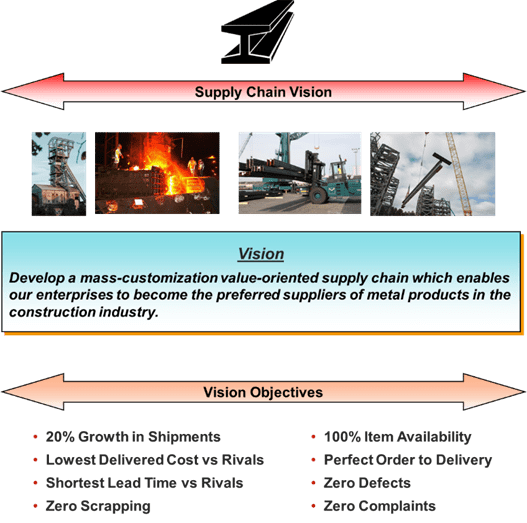
Note that the above vision describes a “mass-customisation value-oriented supply chain.” A supply chain vision communicates the doctrine we aim for our operations. It also expresses support for our enterprises’ overall missions, in which in this case is “to be the preferred suppliers of metal products in the construction industry.”
The vision statement narrates how we want our supply chain to operate. At the same time, via the vision’s objectives, it elaborates the results we want to expect. In the above example, this includes “20% growth in shipments, 100% item availability, perfect order deliveries, lowest cost versus rivals, zero scrapping, and zero defects quality.”
The purpose of envisioning is to imagine what we want our supply chains to become. Just like when we construct houses or facilities, a vision of our supply chain serves as a blueprint for how we & our partners will build our operations.
But again, just as in building houses or facilities, a supply chain vision is like an architectural plan, in which it is a broad picture of the future state of operations. We typically seek assistance from engineers to help us develop specific plans based on our visionary blueprint.
When we build houses or facilities, specific plans include electrical schematics, structural diagrams, and plumbing layouts. In supply chains, these would consist of detailed maps of operations.
We usually underestimate the time & effort we need to envision & plan the building of our supply chains. It’s a given in construction projects that we sometimes change our plans even when the facility is already halfway finished. We change plans not only because we noticed something we didn’t foresee but also because we were not thorough enough in finalising what we wanted in the first place.
We are only human therefore changes are often forthcoming. But it pays to keep changes to a minimum; changes are after all expensive and causes delays. We tend to rush sometimes through the envisioning and planning stage and thus, it becomes more likely we will make last-minute changes.
In envisioning supply chains, we require consensus among partners, which would be very challenging. The devil is in the details as we would likely need to spend much time & effort debating with our partners especially on the specifics of our supply chain vision.
But imagine the sense of accomplishment if we do finally agree to a shared supply chain vision which includes not only a broad plan but specifics as well. It would be a remarkable achievement, a manifestation of collaboration of stakeholders with different points of view to start with. Having a plan where everyone dedicates to would be a historic feat.
Envisioning, however, is only the first step in building the supply chain. We still would need to figure out how to get from where we are (the present state) to our vision (the future state).
We would need to develop a roadmap.
 Ellery's Essays
One thought on “A Supply Chain Vision with Specifics Would be a Remarkable Feat”