Supply chains span from sources to users, passing from one enterprise to the next. And we cannot manage supply chains on our own. We need to work together with vendors, customers, and service providers in procuring, producing, and delivering the goods & services.
We, perhaps, see supply chains and our individual place in them like this:
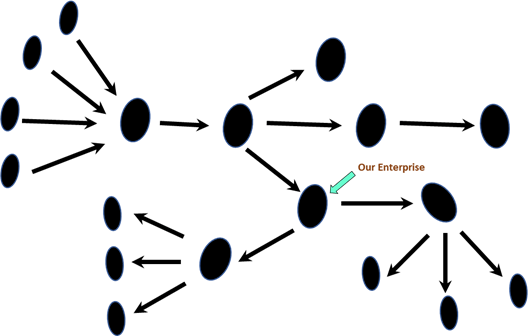
But even though we may see ourselves as small, insignificant cogs in the bigger supply chain realm*, we do add value to it. We must, because if we don’t, then we’ll either be left out or pushed out.
*(Some reputable gurus liken supply chains to ecosystems; but I don’t agree. Supply chains are composed of relationships which facilitate the flow of goods & services. Supply chains are more like societies than biological habitats).
Our operations add value not only to our products & services but also, directly & indirectly, to the merchandise & services that flow through and beyond our businesses’ borders. We make a difference for the whole from the parts we play.
To those of us who work as supply chain professionals in various enterprises, we probably picture our operations more like this:
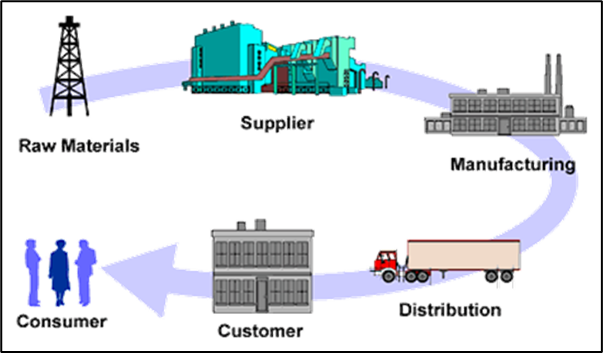
We may see ourselves as either vendor, manufacturer, transporter, distributor, or customer.
Or in the enterprise itself, we may see ourselves as managers or supervisors for purchasing, inbound logistics, storage & handling, inventory, production, customer services, and shipping.
We, who have long experiences in operations, know that supply chains are more than just the above Figure 2. It’s not only buy-make-transport-deliver, but also plan-source-order-operate.
To put it figuratively, our supply chains look more like this:
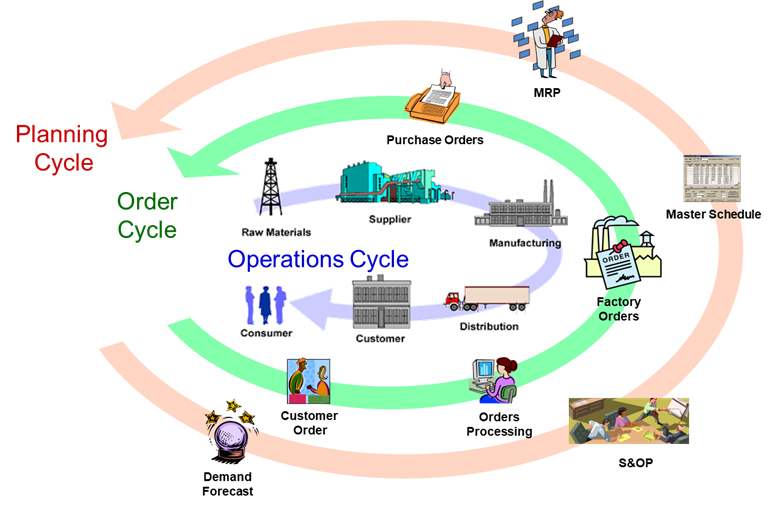
We execute three (3) cycles, formally or informally, in our supply chains:
- We plan (Planning Cycle)
We forecast demand, do Sales & Operations Planning (S&OP), and as a result formulate master production and material requirements plans.
- We serve orders (Order Cycle)
We gather customer orders, process them, i.e., screen them, allocate & pick items for them, and forward corresponding orders to manufacturing & purchasing to make up for any deficiencies.
- We operate (Operations Cycle)
We receive inbound items, store & handle them, use them for production, store & handle finished products, and ship them physically to customers. Customers who are middlemen like distributors & dealers sell our products to the final end-users.
We sometimes stress one cycle over the others. For instance, we invest thousands of dollars in Enterprise Resource Planning (ERP) software, thinking that integrating our planning cycle shall result in streamlined orders processing and optimised physical operations.
Or we emphasise the order system. For example, we may find ourselves switching from manual order taking to e-commerce. We, then, adapt our planning and physical operations to the online order-to-delivery environment. We reduce delivery lot sizes and engage couriers instead of truckers. We buy & deliver finished products directly from vendors to customers. We reduce inventories but expand our item list as we move to an e-commerce portfolio.
Success in one cycle naturally hinges on the success of the other two (2) cycles. A good ERP plan would only be known by how well we perform in serving orders and executing operations. E-commerce applications work when operations and planning synchronise with our processing of customer orders. We serve orders well if we planned inventories and anticipated demand and if our operations run reliably & responsively, with minimal or zero defects.
Synchronisation and integration are, therefore, challenges in the marrying of the three (3) cycles of planning, serving orders, and on-the-ground operations. It starts with us recognising and formalising our systems and structures to the cycles. These could be huge chores for some of us who are overwhelmed by the comprehensive activities of procurement, production, and logistics.
How do we set up our systems & structures to the three (3) cycles? What would be the ideal organisational structure? What systems should we have or how do we upgrade our existing systems?
Note that these questions aren’t far off from the ones we hear many executives ask.
- How do we forecast demand and plan inventories to serve orders better?
- How can we make our manufacturing more efficient and reliable without sacrificing customer service?
- How do we reduce costs, assure 100% quality assurance of our products, and serve orders quickly & completely at the same time?
Awareness of the three (3) cycles gives us a clearer view of our supply chain activities and therefore, some headway in answering these difficult questions of executives.
How, then & again, do we set up our systems & structures for the three (3) cycles?
First, we map our entire supply chain and make visible our enterprises’ internal structures & systems. You would need not only a single flow chart but probably also several diagrams which would describe in vivid detail organisational structures, physical operations, & document & data flows. The idea is to see & appreciate visibly, i.e., completely & clearly, what our operations look like to the nth magnification. The devil, after all, is in the details.
When we can see what our supply chains look like and do, we can then begin identifying opportunities. We can see from the maps and diagrams we created where there are bottlenecks and complexities to simplify. We probably would be able to mark would-be low-hanging fruits which could yield quick benefits.
Note that I don’t mention visioning or strategic planning. I surmise that would already be happening in your organisations and that most of us would have in-place operational goals and plans.
What I promote via the three (3) cycles is the identification of problems to solve. And by experience, there is no shortage of problems when it comes to supply chains. We will be able to see them via the supply chain maps we make.
Our jobs as supply chain professionals involve three (3) cycles: planning, serving orders, and the physical execution in operations. We make these cycles visible via charts & diagrams which are results of our mapping & describing the activities of our supply chains. The more detailed the maps, the better.
We then solve the problems we identify from the maps we made.
When it comes to supply chains, our jobs aren’t just about managing them, but solving the problems that come with them.
 Ellery's Essays
