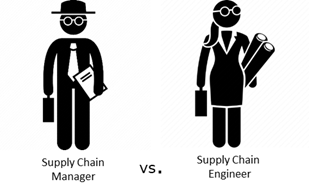
What’s the difference between supply chain management (SCM) and supply chain engineering (SCE)?
Supply chain management is the management of people, structures, & systems that underlie the relationships of functions which enable the flow of merchandise & services from their sources to their destinations and users.
SCMs work with existing systems & structures as they harness resources, negotiate with vendors & 3rd parties, and manage their teams to transform materials to products and serve their enterprises’ customers.
Supply chain engineering involves the building of those systems & structures SCMs manage. SCE’s tasks include setting up logistics networks, developing procurement & production systems, proposing & implementing additional capacity projects, erect new facilities, customising demand & inventory management systems, writing up methods & procedures, and improving the environments & conditions of workplaces.
SCMs plan, organise, direct and control existing systems, structures, & facilities.
SCE’s study, design, and construct new systems, structures, and facilities.
Both SCMs and SCEs overlap in that both manage the resources and people assigned to them. But each has its own exclusive aims.
Both SCMs and SCEs have huge scopes. Supply chains encompass activities from the acquisition of merchandise, the transformation of materials to finished products, the storage & handling of inventories, the dispatch & transportation of items, to finally the delivery of items & post-sales services. Supply chains extend beyond the borders of enterprises and thus require negotiation & collaboration with vendors and 3rd party service providers. It can be overwhelming for both SCMs & SCEs.
Supply chain management is related to operations management, a subject that falls under the business administration degrees in many colleges. It has become a visible and high-profile field brought on by the need to be perfect & productive in the competitive business world of the 21st century.
SCMs have merited a place in the upper echelons of organisations, in which more and more enterprises have welcomed chief supply chain officers as valuable members of the executive suite.
SCE, meanwhile, is a spin-off from Industrial Engineering (IE), which is concerned with the boosting of productivity via improvement of systems, methods, and the workplace. Industrial Engineering, however, is a not well-defined field and remains one where many do not see it as deserving as equal to other engineering disciplines.
It doesn’t help that IEs are constantly re-defining what Industrial Engineering is and thus, have not gained much recognition because they have not resolved their identities universally among enterprises and industries.
And since IEs are constantly trying to convince people who they are, even as they themselves try to figure it out, SCEs naturally would not have much of a starting chance for recognition themselves. Supply chain engineering is invisible, misunderstood, and unappreciated, and will remain so for some time.
Which is too bad.
Supply chain management has become a high-profile job. We have come to rely on supply chain managers to seek solutions to the causes of disruptions in the flows of our merchandise. We have elevated SCMs to critical roles to attaining the productivity we want in our operations. We see supply chain management as a hopeful avenue to enterprise success.
Well and fine for SCMs but unfortunately, SCMs are only as good given what they have.
Being managers, SCMs do a lot of work via their relationships with the people that report to them (e.g. procurement, logistics, planning, manufacturing), their peers in other departments (e.g. sales, R&D, finance, marketing, legal, personnel), their superiors (e.g. CEO, COO), and with customers, vendors & 3rd party service providers. It is through these relationships that SCMs get things done.
Managing relationships, however, has its limits. In relationships we work with what we have. We work within systems & structures. We make do with whatever resources we have available. Owners may give us budgets to augment our resources but SCMs usually just add to whatever they have, instead of changing how things are done.
For example, because of looming risks in sourcing via international trade, SCMs would seek vendors closer to their operations. They would opt to source from multiple vendors, rather than to just one or two. They add to their alternatives but don’t really change the system of procurement.
SCMs do get things done, however. SCMs succeed in serving the demands of customers and they make great strides in continuously improving the productivity of their operations.
But only to a certain extent.
When it comes to changing how things are done, supply chain managers aren’t the best fits. That job best goes to supply chain engineers.
Whereas SCMs work with what they have and who they relate with, SCEs change the structures & systems that underlie supply chain operations. SCEs change how things are done and the very platforms where they are done.
Going back to the example above about sourcing from vendors, whereas SCMs may source from multiple vendors closer to home, SCEs would study & develop changes to the procurement process altogether. SCEs would examine the system of sourcing and how the enterprise buys the merchandise it needs. They would look at better ways to improve the system; they would look for that one best way of procurement.
SCMs manage with what they have on hand to realise results. SCEs change systems & structures so that SCMs shall realise results further from what existing systems were capable of.
We see supply chain management becoming a highly recognised high-profile profession that has earned a key role in achieving enterprises’ strategic priorities.
It, however, can only do so much with existing systems & structures.
Supply chain engineering gives us the potential to change our supply chains to make them more capable and productive. SCE, however, is not a well-known field and lacks recognition in most, if not all, industries.
There are a lot of issues and challenges facing enterprises in their supply chains. We could use all the help we can get not only from supply chain managers but also from supply chain engineers as well.
If we are to tap our supply chains, we should not only manage them well, we should also change them. We would need to recognise the potentials of the supply chain engineer.
 Ellery's Essays