The enterprise sells, its customers order, and the enterprise delivers. This constitutes the basic process of demand fulfilment. As the enterprise creates demand through marketing & sales, it fulfils it.
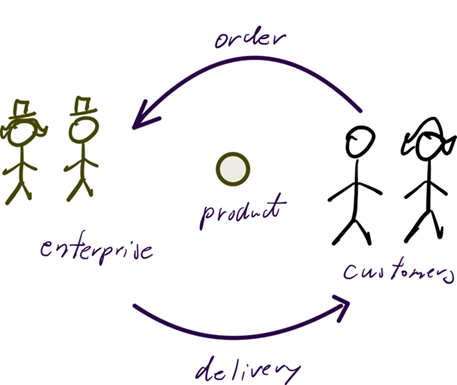
The enterprise and the customer agree on the terms and conditions of the latter’s order. Delivery of the order should arrive at the right place, at the right quantity, at the right quality, on schedule, and without any error whatsoever. Customers in turn pay the enterprise for what they received, as per the agreed terms & conditions.
Customers don’t really care how the enterprise delivers the orders. What matters is that the customers obtain the products they sought or asked for.
A product is made up of two parts:
- Its Core
- Its Surround
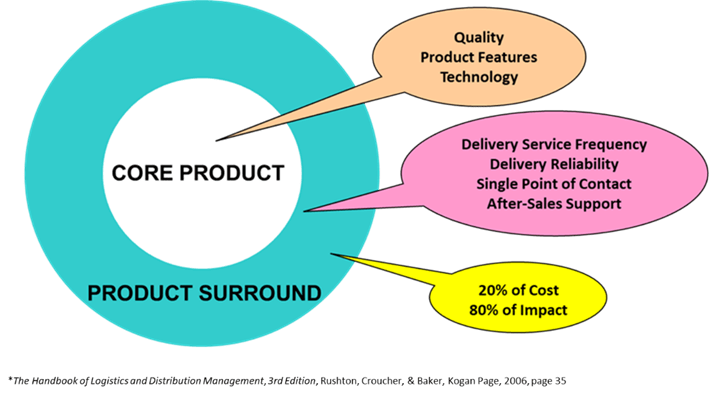
The Core is the product’s tangible characteristics made up by its characteristics (e.g., shape, weight, size) and features (e.g., functionality, technology).
The Surround is how the product is supported or presented, e.g., quality, service, availability, delivery and cost (price).
Entrepreneurs tend to focus a great deal on the Core of their products especially when they are starting their businesses. Executives would put more emphasis on the Surround as their businesses grow and compete for more market share.
There are many people who became famous for their product Cores. These include Johannes Gutenberg (movable type printing press), James Watt (steam engine), Thomas Edison (electric incandescent light bulb), Carl Benz (automobile), and Steve Jobs (Apple devices).
But how many famous people are there who created great product Surrounds?
One person who does come to mind is Jeff Bezos, founder of Amazon. At the onset of the Internet in the 1990’s, Mr. Bezos started a virtual bookstore which he developed into an e-commerce behemoth.
Amazon emphasised availability (its slogan: Everything from A to Z). It optimised the Surrounds of products it advertised and sold online. It offered customers a very user-friendly means to seek and order all types of products as it offered vendors a reliable platform to market and sell their wares.
Amazon also set the trend for online publications or e-books via its Kindle e-reader devices and applications. The company also forayed into streaming of online entertainment from movies to television series. Amazon also has become a leader in information technology, offering web services such as cloud computing, database storage, and content delivery.
No commercial product, whether it be physical or virtual, is out of reach from Amazon. And it’s all made possible from Amazon’s focus on providing outstanding Surrounds for the products it sells.
Because of Amazon’s success, others have emulated its Surround strategies, with its rivals offering their own e-commerce portals or upping their customer services.
Enterprises build and develop their products’ Cores from the talents and resources within their organisations. Organisations, however, must negotiate and collaborate with partners to build and develop their products’ Surrounds. Amazon marketed the Cores of products, but its success relied on contracts with sellers and transporters for the products’ availability and delivery to customers, which together comprised the essence of the product Surrounds Amazon was selling.
Amazon and its admirers boast how productive its supply chain is, but it wouldn’t be where it’s at today without its partners. Amazon’s success via its advantageous support of products’ Surrounds hinged on its partnership with the products’ owners and the service providers who delivered to customers.
This leads to what supply chains really are and that is they are not only an enterprise’s purchasing, manufacturing, & logistics activities; they are not only information-driven networks or systems; they are not only an integrated department within organisations. They are also relationships founded on partnerships that work together in supporting the final finished products.
True, Amazon has grown large enough to own a fleet of trucks, airplanes, & ships, distribution centres, and automated equipment & data centres. It, however, still relies on partnerships for its global market reach. As much it may dictate pricing & terms, Amazon still needs relationships to sustain its economic prowess.
Every product has its Core and Surround. Enterprises invent and build their products’ Cores but develop their products’ Surrounds via their supply chains and the relationships that are inherent in them.
 Ellery's Essays