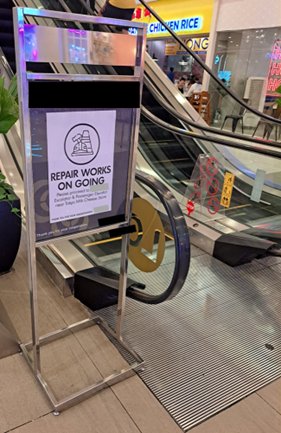
The escalator at the shopping mall was out of order for four (4) weeks. The mall managers perhaps didn’t think it was a big deal. Mall customers could still walk down the broken escalator from the ground floor to the lower level or take a nearby elevator. Never mind that any elderly person or parents with small children (or pets) would have had a hard time negotiating the steep steps.
The mall owners spent money to buy and install elevators and escalators for the convenience of mallgoers. When an escalator isn’t running, the mall owners aren’t getting their money’s worth. One may argue that one shut-down escalator won’t deter people from going to the mall but that’s beside the point.
Most elevator & escalator companies don’t provide prompt & satisfactory maintenance. It would sometimes take weeks, if not months, for these companies to repair an elevator or escalator. One major reason is that the companies avoid keeping inventories of spare parts.
To the companies, keeping stock of spare parts is a non-value adding activity; company executives see no benefit from having inventories of spare parts. Inventories tie up cash after all and faster repairs or maintenance don’t outright translate to significantly higher sales. Managers, therefore, would rather order parts only when needed, and that is such as when the elevators & escalators break down.
Clients like mall owners could keep stock but the elevator & escalator companies would insist that the clients advance cash for the spare parts. As many critical parts are imported, that would mean shouldering not only the purchase price but the shipping cost as well, not to mention disbursing the cash at the onset as importation typically requires the money (in the currency from the country of origin) up front.
Clients, therefore, find themselves stuck with the slow maintenance service. They perceive themselves being held hostage by the elevator & escalator company, as they have no other viable option other than wait a long time for the service.
Clients could replace their equipment outright but it’s costly. Getting another service company would be futile as most of them are no different in taking too long to repair equipment.
This dilemma occurs not only at shopping malls but with many high-rise buildings as well. Elevators break down; people wait very long to go up and down floors; maintenance takes too long and parts are expensive.
It’s a supply chain problem, as clients are unhappy with the delivery of services and service providing companies exert effort to avoid inventories and control costs. It’s a problem in which the first step towards a solution is for customers such as the shopping mall suffering from a long broken-down elevator to take the initiative to recognise, acknowledge, and define the problem.
Unfortunately, many don’t.
 Ellery's Essays