All businesses begin from entrepreneurship, in which creative individuals turn ideas into profitable realities. There had been many who tried their luck as entrepreneurs. Many failed; some succeeded.
It didn’t matter if the products or services entrepreneurs introduced seemed mundane or looked grandiose. What mattered was that entrepreneurs worked hard to develop their ideas into items which they could sell & prosper from.
Entrepreneurs need supply chains to ensure their products will be available to their targeted customers. It’s one thing to create demand with attractive products; it was another thing if entrepreneurs couldn’t fulfil demand with items absent from their markets.
Supply chains consist of the relationships which entrepreneurs establish between their operations front-liners and their vendors, customers, and service providers. Activities respective to each supply chain link drive the flow of goods from sources to customers.
Many entrepreneurs, unfortunately, ignore the importance of supply chains in their strategic planning. Whether it be because many entrepreneurs don’t want to bother with their supply chains’ step-by-step operations or because they’d rather focus on what they believe are more ‘important’ stuff, entrepreneurs tend to delegate supply chain management to other individuals or groups.
When entrepreneurs don’t recognise the importance of their supply chains, they unsurprisingly run into trouble immediately. Troubles include out-of-stock, runaway costs, shoddy quality, merchandise losses, and too much inventory. Entrepreneurs should focus on supply chains as much as they do the development of their products. This is because a product isn’t only what it’s made of and its features (i.e., its core) but also includes what surrounds it (e.g., delivery reliability, after-sales service):
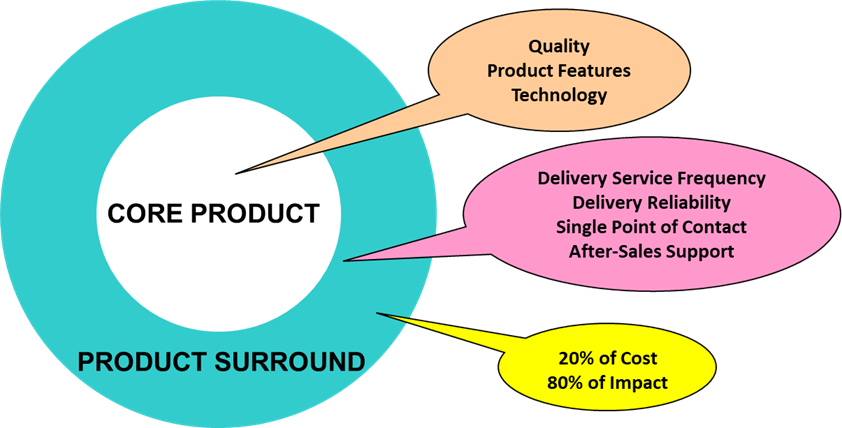
Whereas delivery and service may only take up 20% of a product’s total cost, 80& of its impact is in how it is made available to the enterprise’s customers. Supply chains are therefore crucial to the entrepreneur’s business.
Supply chains surpass the boundaries of enterprises. Enterprises are subsets of supply chains and not the other way around. Supply chains offer the awesome opportunity to build an enterprise’s business, even if entrepreneurs may get the impression they don’t have much clout, especially if they are small start-ups.
We who want to be entrepreneurs can utilise supply chains by starting with how we set up systems & structures in procurement, manufacturing, & logistics.
Our systems & structures, however, shouldn’t be focused inward but outward. We could invest in data & communication systems which allow for quick two-way sharing of information with vendors & customers. Our planning systems should begin not from the receipt of orders or from vague forecasts but from when we first anticipate customers’ interest in our products. We should define the processes of our manufacturing and inbound & outbound logistics operations. And we should have organisational structures which allow department heads to autonomously manage processes and at the same time invoke ownership of the end quality and total cost of our products.
It’s a bad idea to exclude supply chains when we as entrepreneurs plan and introduce our products. How we make available our products matters just as much, if not more than what they are, how much they cost, and what we can use them for. At the onset of beginning our businesses, we need to plan our supply chains as much as we develop our products.
Our starting points are the systems & structures we set up. We should always consider how they will relate with their total supply chains in which enterprises are the connections.
We shouldn’t downplay supply chains as mere operations internal to our enterprises.
 Ellery's Essays