
We see the sign in many railway stations around the world: mind the gap. It’s a reminder, if not a warning, for us to watch our step as we cross the space between the train from the platform. As much as we may take it for granted, if we don’t watch our step, we can fall into the gap and risk injury.
Gaps are the spaces that separate us from where we are and where we want to go. They can be small and easy to cross just like those between trains & platforms. But they can be large like rivers or oceans in which we would need to ride on ships or plans to pass over them.
Gaps, in the supply chain engineering context, are the disparities between the ideal and the present states of the structures & systems of our operations. Gaps represent the differences between the performances we want to achieve versus how we are currently doing. Gaps are the obstructions, divides, barriers, and adversities that stand in our way toward our ultimate objectives.
Gap analysis is the third (3rd) step in building supply chains. It follows the first step of envisioning, in which we define the future state, what we want our operations to be like. And it comes right after the reality check, in which we diagnose the present state of our supply chain operations.
In both the envisioning and the reality check, we actively collaborate with partners as much as we coordinate with our colleagues. In both steps, we seek consensus on the aspired future state as we acknowledge our present state.
In gap analysis, we compare both the future state and the present state. Even if it may seem obvious, the purpose of this step is to measure and appreciate the gaps between the present state of operations versus the activities we aspire for the future state.
We know what we want our supply chains to be. We envisioned it.
We know where we are currently, what is our present state, because we did a reality check.
We then identify and assess the gaps between the present state and the future state, we look at and figure out how to bridge the divides between both states.
Gaps could be small, or they could be large. Some may seem simple to resolve; some may seem overwhelming. Some may not be very clear, if not invisible, to observe.
To gauge the gaps between the present state and the future state, we first confirm what our goals are vis-à-vis our envisioning. We then assess our present state via our performances versus these goals.
The general manager of a high-end (i.e., luxury) furniture exporter firm is dissatisfied with the long order-to-delivery lead time to customers. The exporter sources raw materials & manufactures in Southeast Asia, and transports finished items to waiting clients in North America and Europe.
It can take up to three (3) months from the time customers place their orders to when they receive the products. Customers have complained that is too long and the general manager agreed.
The general manager observed that it takes up to one (1) month to manufacture an item at the firm’s factory in Southeast Asia. The GM, with the help of consultants, therefore, did a gap analysis.
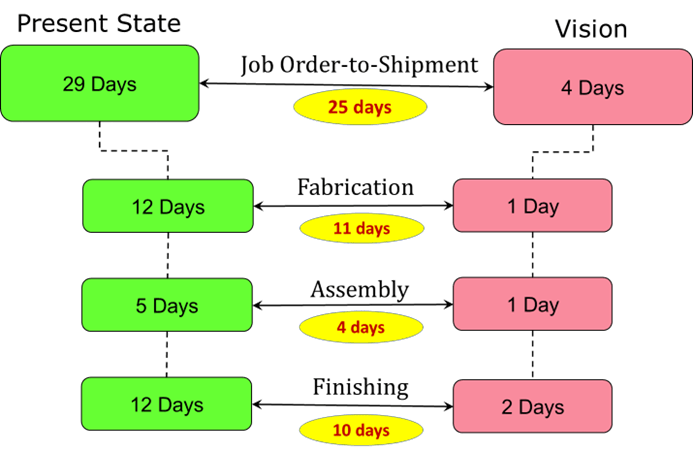
It takes up to twenty-nine (29) calendar days from the time the factory receives a job order (document requesting & authorising manufacture of a furniture item) to the time items are shipped (as in loaded on a container van & dispatched from the factory).
The general manager noted there was a lot of waiting time between production steps and saw that he could narrow down the factory job-order-to-shipment lead time to four (4) days.
He broke down the manufacturing process to three (3) major operations: fabrication, assembly, & finishing, and found that he could pinpoint gaps in each.
It then became a matter of identifying specific areas of improvement in each operation to shorten the lead manufacturing time. These identified areas of improvement would be up for problem-solving by supply chain engineers. We just have to figure out which ones we prioritise.
We face gaps wherever we go and in whatever we do. Many are small and easy to cross; some require intervention such as building bridges or booking transportation to cross large bodies of water.
Whether they be small or big, we mind the gaps we meet, otherwise, if we are careless, we risk falling into them and incurring injury or expense.
We analyse gaps as the third step in building our supply chains. We try to consider all of them in identifying where best to transform our operations for the better. The cumulative effect of closing the gaps in our supply chains do lead to better business results.
Once we know the gaps in our supply chains, we then figure out which ones we want to close or address from first to last. This sequence, if we would call it that, would be the basis for the fourth (4th)) step in building our supply chains: drawing the roadmap.
Meanwhile, let’s make sure we mind the gaps we run into.
 Ellery's Essays
3 thoughts on “Mind the Gap”