We use maps to guide us to a new destination. If we don’t have one, we’ll end up lost and asking people on the way for directions. We then would remember the route we took in case we’d return to where we went.
Thanks to apps like Waze, Google Maps, and Apple Maps, it’s easy to figure out the shortest & fastest routes to just about anywhere, whether we drive a car, bicycle, or scooter, or walk. Getting lost in the woods (or even lost at sea) is unlikely as long as we have a smartphone handset and mobile Wi-Fi connection.
We didn’t have these conveniences not so long ago (as in up to the turn of the 20th century) and our forefathers had it much rougher before then.
But we still follow most of the same routes our ancestors travelled many years ago.
We as people have been doing business with each other since the dawn of civilisation. Farmers & fisherfolk would sell their harvests & seafood to bakers, butchers, & artisans. The trading led to marketplaces and then to villages as populations grew. Villages would trade goods with others nearby, who would then trade with others further away. Before long, merchants would be shipping goods across seas and mountains.
Merchandise trading has been a business endeavour for generations. We sell minerals, livestock, & crops in exchange for items we hope would be of higher value, such as gold & garments (and weapons & human slaves, which in the past was not yet frowned upon socially, morally, or legally).
As the trading became more lucrative, merchants sought more stuff to buy & sell. The competition (which also in the past meant wars & conquests) got fiercer such that kingdoms & merchants encouraged explorers to go further out.
Explorers didn’t know where to go and had no idea who’d they meet. Their purpose was to discover and negotiate with any community they’d run into and obtain both supplies (i.e., food, water) and acquire items which may be of value to return home with.
It wasn’t easy. Some explorers died of disease on the way. Some were robbed, killed, or taken prisoner. Some got lost and never returned. Some fought among themselves and ended up stranded or missing.
For those explorers who did succeed, that is, met & established rapport with tribal chiefs and overlords of empires, trade agreements were established. Explorers returned with hefty cargoes of valuable merchandise. Merchants and kings, impressed with the new items and wanting for more, invested more ships & caravans to ply the new trade routes.
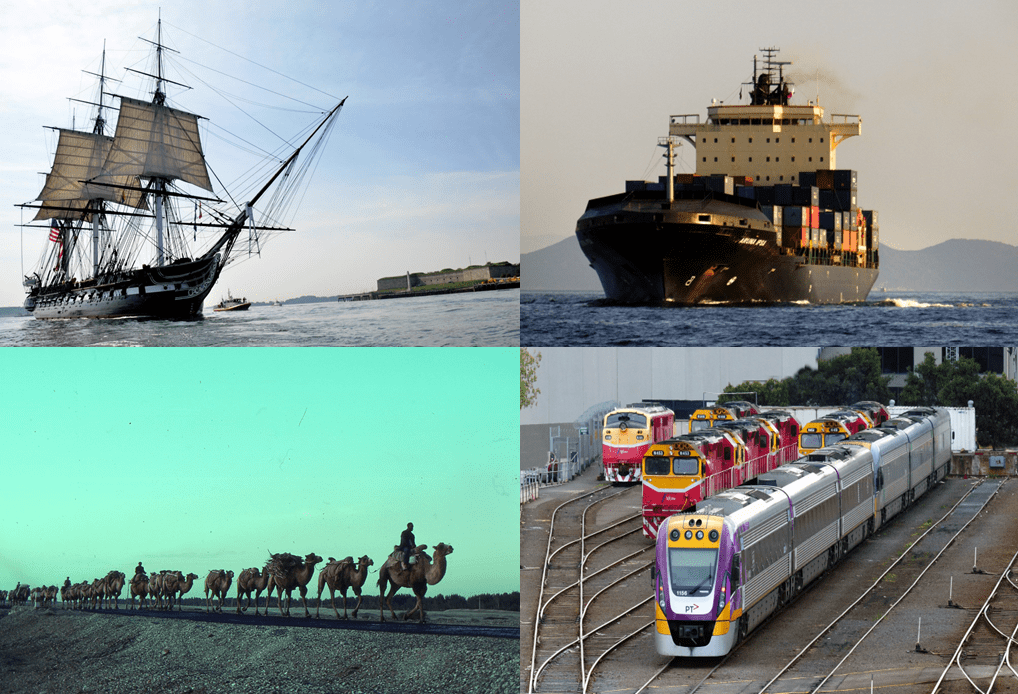
These trade routes became the springboards for the awesome global supply chains of our modern day & age. From caravans of camels & mules, we today have kilometre-long freight trains crisscrossing vast territories via elaborate railway networks. From galleons sailing for months across oceans, we have super-size ships laden with hundreds of steel container vans moving to & from continents in a matter of days. From the guilds & merchants who produced textiles & trinkets, we have sprawling factories churning electronics, appliances, automobiles, garments, petroleum, minerals, furniture, etc., by the millions. Jet-fuelled aeroplanes, large storage & handling facilities, computers, & apps, some unheard of as recent as the early years of the 21st century, complement the volumes of trade transactions that take place every day around the world.
We have resorted to advanced technologies to make our supply chains more efficient. We have automated manufacturing & logistics operations, applied artificial intelligence to our purchasing & order-to-delivery transactions, invented apps to guide our transportation vehicles (and inevitably make them self-driven), and integrated our planning & order-to-delivery information systems.
We have also made our supply chains more sustainable and governable. We had made our organisations more ethnically and gender diverse, had tapped renewable energy sources, and had become more compliant to ethical & socially accepted norms & regulations.
We benefit from present-day supply chains in that we can avail of so many products & services from almost anywhere in the world at short notice. Modern supply chains are a far cry from the trade routes of the past.
But, despite the technological advances and the availabilities of products & services in quantities unprecedented in human history, have our supply chains become more productive than the trade routes of the past?
If we define productivity as fulfilling customer or market demand within stipulated schedules, at specified quantities & qualities, and at values desired by stakeholders, we still have plenty of room for improvement.
Demand has grown in leaps & bounds as trade routes transformed into the complex supply chains of the 21st century. As we can get more, we want more. Our supply chains, therefore, are in a constant state of constraints in capacities & bottlenecks.
Relationships established via negotiations & agreements are the foundations of the trades that our supply chains operate from. It was like that in the past and it still is today. Despite how much of our trading has become complicated and big through time & globalisation, we continue to manage our supply chains based on terms & conditions of our contracts. How we run our operations depend a great deal on what we agreed with vendors, service providers, & customers.
Our contracts with our vendors and customers had largely focused on results. We settle & commit on prices, volumes, specifications, & schedules. How we will fulfil those contracts are entirely up to the individual enterprises; we don’t care how our vendors will supply us as long as they do.
It may be time that we confront this kind of thinking because it may be what has been impeding further improvement to supply chain productivity.
Despite the popularity of technologies, from automation, AI, to digital (whatever that means), supply chains have not gotten any better. On the other hand, supply chains in the 2020s have found themselves getting greater attention for shortages, delays, and higher costs. Our supply chains are stagnating. It’s no help that adversities (e.g. piracy, natural disasters, political wars) are dragging down our businesses as much as, if not worse, than they did in the past. Supply chain managers have been struggling to satisfy demand and at the same have been busy untangling messes caused by disruptions.
Collaboration with our partners (vendors, service providers, & customers) is key to unlocking more improvements in our supply chains. We need to tie in our enterprises’ operations with our partners as we establish common-ground targets in prices, volumes, specifications, & schedules.
How do we do that? It’s not that enterprises have tried to collaborate. As much as they have, it hadn’t seemed to work. It’s not only because partners hesitate to trust each other, but also because they have no idea how to interconnect their operations. We have become so accustomed to working within the boundaries of our businesses and leaving it up to others to source, serve, & deliver. We didn’t care and we saw no reason to, at least until our supply chains have plateaued in performance & growth.
We are realising collaboration does not just mean negotiating & fulfilling agreed contractual obligations on our own. It means actively cooperating in tying & optimising operations together to attain mutually beneficial results.
Optimising, however, is not included in the supply chain manager’s job description. Management is about planning, organising, directing, & controlling. Managers also improve systems & structures, but they don’t optimise them. This is because optimisation involves building systems & structures to attain loftier results.
Optimisation is the purview of engineers, not managers. Engineers build systems & structures to optimise facilities & operations to achieve the best possible results. We manage by working within systems & structures. We optimise by changing them.
To optimise our supply chains, we must, therefore, not rely on the management of supply chains but by building them.
Building our supply chains would be unprecedented for many of our enterprises. We never really did since the debut of the trade routes. It would be a break from the traditional negotiation-to-contract I-don’t-care-how-you-do-it process. We’d be working together with partners to create operating relationships that are mutually productive for every participant.
It’s not something we would expect many enterprise leaders to outright accept. As of the mid-2020s, executives, managers, and academics are stuck to the notions that management can optimise supply chains via advanced automation & digital technologies. Many stubbornly believe we can manage adversities, risks, & fickle external regulatory & economic environments.
We don’t just work with what we have when times change, we also undertake necessary changes to adapt to our evolving world. We also sometimes lead changes to our world when we proactively initiate changes.
We have many conveniences today that our ancestors (and we ourselves) didn’t have just not so long ago. Thanks to these conveniences, we can avail ourselves of items & services from just about anywhere in the world at almost a moment’s notice.
Greater convenience, however, has led to greater demand growth. And while we tackle adversities which have not really gone away since the early days of trading history, we find our supply chains stuck in a performance plateau.
Collaboration via contracts has not been satisfactory. We need to collaborate to tie interconnect and optimise operations. Optimisation means changing our existing systems & structures, not just working with what are already there. We would need engineering expertise to build our supply chains as management by itself wouldn’t be able to do it, as it was never part of its job in the first place.
It won’t be easy as many of us do not accept that the management of supply chains by itself won’t make them any better.
It wasn’t easy for explorers to discover the trade routes then. It won’t likewise be easy for today’s engineers to build the new supply chains of tomorrow.
 Ellery's Essays