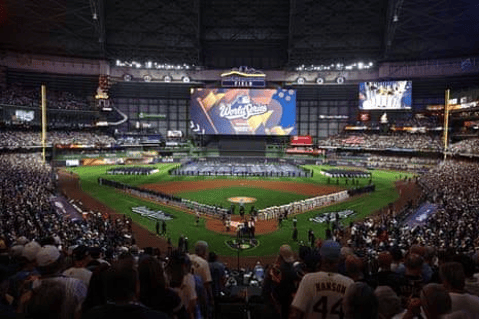
It was the summer of 1982. And I was hooked into baseball and statistics.
I was a foreign student from Manila, the Philippines, on my third year into studying for a bachelor’s degree in Industrial & Systems Engineering (IE for short) at the University of Wisconsin-Milwaukee (UWM)
I started listening to and watching games of the Milwaukee’s major league’s baseball team, the Brewers, via local radio and television that summer of 1982. I also watched a couple of games in person at the then Milwaukee County Stadium. I became a fan of the sport and the Brewers especially when they were winning most of their games as the season progressed.
Media coverage of major league baseball was statistics-heavy; announcers and analysts on air cited numbers about the team’s and players’ performances. They talked about stats like earned-run-averages (ERAs), runs-batted-in (RBIs), batting averages, slugging percentages, strikeouts, and number of at-bats.
The more I got into the sport of baseball and the Milwaukee Brewers, the more I delved into the statistics. It came to a point where I studied the numbers to determine outcomes such as whether a batter will hit the ball or whether a pitcher will strike out a batter. I was surprised that I predicted more than 50% correctly.
The statistics showed that the Milwaukee Brewers were batting & pitching better than other teams. The Milwaukee Brewers were winning games and gunning for a first-time championship
The Milwaukee Brewers won the American League pennant in 1982, but they lost to the St. Louis Cardinals in the World Series. It was a tough series for the Brewers even before it started. St. Louis had a better win-loss track record than the Brewers. In Game 7, the deciding game, St. Louis’ batters successfully hit against Milwaukee’s pitchers. St. Louis won the championship much to the heartbreak of Milwaukee residents.
I returned to Manila in 1985 and lost track of the Brewers. There was hardly any media coverage of Milwaukee and the Brewers in the Philippines. Baseball was not a popular sport in Manila (even though the country participated in some leagues internationally). It didn’t help that American media companies restricted sports coverage outside the United States to apparently protect their international copyrights.
I had relied on statistics in making critical decisions throughout my career. They were a great help in areas like quality assurance, cost control & budgeting, and Sales & Operations Planning (S&OP).
I liked predicting outcomes via probabilities derived from statistical data. I would try to predict weather events like tracking where typhoons would go based not only on observing satellite images but also from examining past seasonal histories.
I learned that predicting probabilities accurately greatly depends on the influencers from where the data originates. When it came to forecasting demand, for example, asking customers what they planned to buy mattered the most.
In October 2026, the Milwaukee Brewers was again in the World Series. The Brewers had the best winning record in baseball that 2026 season. They dominated through the playoffs, beating the San Diego Padres, and then shocking the favoured Los Angeles Dodgers via a four-game victory sweep to win the National League pennant.
I hardly could get any television coverage of the Milwaukee Brewers throughout the season, but I was able to access Milwaukee radio for World Series coverage.
This time, however, I had no statistics to make any predictions. I didn’t know the players at all. This time, I was just a spectator with no clue how the Brewers would fare against opposing teams.
The Milwaukee Brewers beat their opponents, the Tampa Bay Rays, four-games-to-one (4-1) to win the 2026 World Series and the championship. Despite the domination of the Brewers in batting and pitching, the Tampa Bay Rays made the Brewers work for the championship. Every game was an enjoyment to watch.
As much as I valued statistics, it was fun to listen to the World Series and hear the play-by-play. I could not predict every hit, every run, or every out. And I enjoyed not knowing what would come next.
Statistics had become an important field which I tapped to anticipate issues and test ideas for the benefit of whatever business I was into.
In 1982, I used statistics as a fun way of enjoying Milwaukee Brewers baseball.
In 2026, I didn’t use statistics but still enjoyed listening to the Milwaukee Brewers as they slugged it out for a first-time World Series championship.
Statistics is an important field in my profession, but sometimes due to whatever extenuating circumstances, I just had to live without it.
As much as many major league baseball teams and media companies invest a great deal in statistics, it’s a field that does not require total dependence from any individual.
Statistics: we can live with it, and we can live without it. Especially true when we’re primarily just there to watch and enjoy a sport like baseball.

