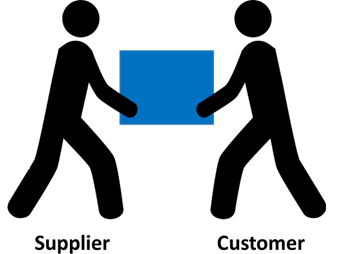
A supply chain essentially has two (2) ends: the suppliers (e.g., vendors, service providers) and the customers (e.g., clients, consumers, users). We who manage our businesses work both ends at the same time as our suppliers see us as customers and our customers see us as suppliers. We multitask as both suppliers and customers.
In our businesses, we buy and procure from our suppliers, and we convert what we receive into products & services which we market, sell, and deliver to our customers. Our operations are interlocked with our suppliers and customers, and we find room for improvement in how productive our relationships with them are.
Structures & systems are important in our operational relationships with suppliers & customers. Our business’s structure & systems should allow supply chain managers to multitask and work productively with suppliers & customers.
Our business’s internal operational functions should be able to work together seamlessly if we are to pursue productive relationships with suppliers & customers. Purchasing professionals should buy items that will not only lead to lower costs but also higher quality of finished products & services to customers. Planners should set inventory policies that would avoid last-minute swings in requisitions from suppliers and sudden shortages or surpluses of merchandise. Manufacturing should stick to schedules and perform to the reliability targets they agreed to. Quality Assurance and Logistics workers should not quarrel over what is acceptable to receive from suppliers and what can be released for deliveries to customers. There should be one leader for our operations, one executive who will oversee our business’s operations and its relationships with suppliers & customers.
A large consumer goods firm does not share this view. In its structure, the purchasing function is a stand-alone department that reports directly to the chief executive officer (CEO). The firm’s rationale for separating purchasing is to centralise procurement of all materials, supplies, and services. At the same time, the purchasing’s job is to buy at the lowest cost, such as availing of discounts via buying in bulk or in large quantities. The purchasing department also has its own internal control standards which are subject to audit. The CEO sees constant risk especially since purchasing accounts for over 80% of the total cost of the firm’s product portfolio.
The firm’s manufacturing operations also is under a separate department with its own top manager. It’s the mission of the firm’s manufacturing department to produce at the lowest cost and highest efficiency. Production line supervisors, therefore, push for longer continuous runs of one item at a time to avoid long shutdowns from changeovers.
It comes to no surprise that the supply chain executive of the consumer goods firm who’s left to manage the planning & logistics functions complained to a consultant that he has problems keeping inventories low and meeting on-time complete deliveries to customers. The supply chain executive practically has no control over purchasing and manufacturing which makes it virtually impossible for him to initiate improvements. Meanwhile, his boss, the CEO, insists that the supply chain executive should be accountable for inventories and delivery performance!
The productivities of supply chains depend on the progress of merchandise & the performance of services which flow from the sources to the final end-users. This requires that linked businesses along their respective supply chains to have structures & systems that allow, if not enhance, these flows.
The consumer goods firm with its structure of separate departments for purchasing & manufacturing does not help in the productive flow of merchandise through the supply chain it is connected to. Purchasers didn’t relate with the firm’s customers; manufacturing managers didn’t care about where their materials came from; and logistics professionals grumbled about having too much (or too little) inventories and receiving complaints from customers about late deliveries, out-of-stock items, and quality issues.
Operations managers are under pressure to ensure integrity and internal control. But they are also tasked to serve customers, control costs, and balance inventories. Trading off one for another is out of the question. We are given the responsibility to perform all adequately, not insufficiently.
Placing all internal supply chain operations (basically purchasing, manufacturing, logistics, planning) under one authority is key to a structure that would bring about total supply chain productivity. A supply chain organisation should have one leader that unites operations to one mission with a common set of goals.
Integrating the systems within and between operations is the other key to supply chain productivity. There should really be one set of systems underlying all operating functions which not only allows the firm’s supply chain executive to easily monitor performance but also provides a platform for managers to share one common schedule, one common database, and one operations strategy.
A business from day one of its existence already works with suppliers & customers. It is imperative that our businesses have systems & structures in place to manifest into reality whatever we negotiate and establish with our suppliers and customers. Needless to say, there is plenty of room for improvement in our relationships with suppliers and customers, which originate from imperfections in our internal systems & structures.
We are suppliers to our customers and we are customers to our suppliers. We who are operations managers multitask from both ends of our business’s supply chains. We need structures & systems which enhance, not mitigate, the flow of merchandise & services through the supply chains we are linked to. When we improve our operations with focus toward our relationships with suppliers and customers, we certainly can catapult our business’s competitive advantage and attain our goals.
 Ellery's Essays