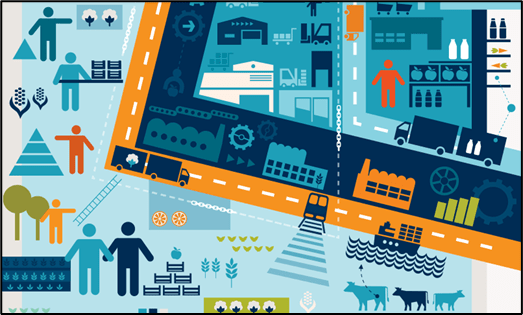
Supply chains consist of interdependent relationships within and between enterprises. No one enterprise dominates an entire supply chain, though many have tried. And because we who work in supply chains participate in these relationships, we need to learn to work with each other, if not together.
We, therefore, require a paradigm shift.
Most of us have the idea that managing supply chains means managing the operations within the walls of our enterprises. We call vendors and customers ‘partners,’ but they are outsiders to us. We treat vendors as sources we negotiate with so we can procure needed materials, ingredients, parts, or components. Customers are parties we aim to win over so that they will buy our products & services at profitable prices. Other than that, they are nothing more.
The paradigm of supply chain management is to improve the productivity of the enterprises we work in. Negotiation and collaboration are means to benefiting the ends of our enterprises. Good, if we get win-win results, but we wouldn’t care that much, if we ended up as winners and our partners did not. What’s important is we meet our targets, not so much theirs.
And this is why supply chains are far from perfect, which is an understatement.
Our supply chains are not optimal; they are far from productive. We can dare say they are dysfunctional. Or to put it more succinctly, they are all one downright mess.
Apple has been the model of supply chain management excellence. The company develops and rolls out iPhones, iPads, and Macs in seamless fashion from its vendors & contract manufacturers to its retail stores and direct buyers. Yet, Apple products are never 100% available. Buyers in some countries need to wait, sometimes for weeks.
Amazon, another supply chain ‘star,’ serves orders completely as fast as one day. Amazon’s order portal doesn’t allow us to order an item which is out of stock, so any demand for an unavailable item remains unfulfilled. We praise Amazon’s e-commerce excellence, but its supply chain doesn’t necessarily deliver what we want when we want it. It never fulfils demand.
We don’t get what we clamour for. We have either too much inventory somewhere or none someplace else. Products take too long from manufacturing to distribution. Customers complain about quality, and we do too to our vendors. High prices are constant headaches for everyone along the supply chain.
We blame our suppliers, logistics service providers, and freight transporters for delays and our customers finger-point us as well. On top of all these, we are at the mercy of government red-tape, seaport congestions, and all kinds of disruptions (e.g., calamities, labour strikes, wars, new competing products).
The paradigm of supply chain management is we work from within our enterprise’s operations. And as a result, we have impaired and unproductive supply chains.
The new paradigm is to work from without.
Ideally, that would mean we who are the links in our supply chains should work together starting with common goals; goals that would be shared from the sources to the final buyers.
In our real world, where we are under pressure to deliver for the enterprises we work for, such a paradigm shift would be a tall order.
But I believe it can be done.
We just have to start thinking from a different perspective.
 Ellery's Essays