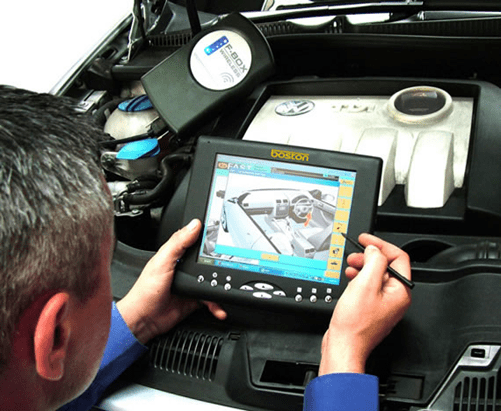
I brought my family’s passenger van for repairs at the car dealership where we bought it from. The van had trouble accelerating especially going uphill. It would sometimes stall.
The dealership’s engineer pulled out a portable device which he plugged into an electronic box under the van’s hood. When I asked what the device was, the engineer said it was a diagnostic computer which could detect and report whatever is wrong with the van’s engine.
After a few pushes of the computer’s buttons, the engineer reported that there was nothing wrong with the van. He also checked the oil and other fluids and said the van was okay. It might be the quality of the fuel I bought from the petrol station, he said.
But as soon as I made my exit from the dealership, the van again began to slow and stall.
When I went to the petrol station to ask about its fuel quality, the attendants showed me a very clear & clean sample from the pump. It was obvious that the fuel wasn’t the cause of my van’s stalling problem.
When I returned to the dealership to report my van was still stalling, the engineer gave the same diagnoses. There was nothing wrong with the van as per the diagnostic computer. It may be air in the fuel filter if not the fuel, he said. Or he implied that I have poor driving habits. If I asked if his diagnostic computer could be wrong, he said that was impossible.
We had a family driver, and he said it may be our exhaust muffler could be dirty and clogged. We pumped water into the muffler and plenty of black soot came out. We road-tested the van afterward and the acceleration was great! No more stalling! It turns out that the problem was a dirty muffler that needed to be cleaned. The dealership’s diagnostic computer didn’t sense the dirty muffler, and the engineer didn’t bother to check it in the first place. Anyway, I and the family driver solved the problem with no help of a so-called sophisticated device. I never went back to the dealership, nor did I ever bother to consider buying a vehicle from them ever again.
From the end of the 20th century through the 2020’s, there has been no end to advances in information technology (IT). We find ourselves often enthralled with new devices and their features, which tech firms frequently churned out.
IT not only astounds us with gadgets & apps but also impresses us with its specialised fields from code programming and computer equipment design & manufacture to cybersecurity and artificial intelligence.
Generation after generation of young people choose IT as their career paths. Even when hiring prospects are low, college students would opt for IT as their majors, as many believe the future will perpetually be bright for graduates with IT degrees.
The heart of IT is data. Data, which is the plural for datum, are the raw bits of stuff which we retrieve from whatever we are observing. Observation itself is a topic of interest. We not only gather data, but we also seek means to amplify it via tools & instruments, whether it be trivial (e.g., flashlights, earphones) or sophisticated (e.g., radar, sonar, electron microscopes).
IT is about the hardware and software we build and program respectively to process data. By process, we mean extract, refine, filter, organise, store, retrieve, secure, & analyse, for the purpose of reaping relevant and useful information. Data are the raw materials; information is the product.
Hence, there are many IT activities which have to do with data, such as data mining, data administration, programming, communications, identification, verification, and security. (There are also opposites to these activities such as theft, hacking, disinformation, and malware coding).
We have become capable of processing data to produce information fast and in large quantities. The availability of abundant information has given us opportunities to plan in real time and respond faster to changing situations. And thanks to portability and communications (i.e., Internet), we can access and share information from just about anywhere with real-time speed.
We can manage operations remotely, trade electronically without having to go face-to-face, get diagnosed & treated by doctors from far away, and conduct financial transactions via our tablets & smartphones.
On one hand, we can conclude that IT has made us more productive.
But has it, really?
By my experience with the car dealership, advances in IT do not necessarily translate to higher productivity. Aside from the very poor service I received, the result was a disaster, at least to my and my van’s productivity. My time was wasted; I was made to pay expenses the dealership charged me; and I was unable to use the van for some days.
It may be true that IT has helped us become more productive in many ways. We could do many tasks in minutes, if not seconds, which would have taken days, or even weeks, a hundred years ago. We can download documents instantly versus having to wait for them to be printed & mailed. We can buy and receive fast-food within an hour by ordering & paying online instead of driving to the nearest restaurant. We can book concert tickets, reserve seats, and walk straight into the venues without having to register at a counter. We can hail and wait for our rides at our doorsteps without having to walk and wait at a taxi stand. IT has been instrumental in providing us more conveniences in less time and at less cost.
But be that as they may, IT hasn’t been 100% foolproof in boosting productivity. At least, IT has far to go when it comes to supply chains.
Many enterprises engage IT professionals to improve supply chain productivity. For years, executives believed that computerisation was key to making supply chains more productive. Executives had been mesmerised with the bells & whistles of so-called state-of-the-art IT hardware & software, thinking that every new device and app is a potential silver bullet to optimising supply chains.
The dealership’s engineer thought I’d be impressed by his diagnostic computer, and I would gullibly accept whatever the computer said, that I would take any information from it as undisputed truth about what’s wrong with my family’s van.
It wasn’t a new lesson for me that IT, for whatever its worth, does not directly lead to improvements in operations. IT provides us information, not solutions. We, not IT, use information to solve problems. It is also we who decide if the information is useful in the first place.
Devices and apps the IT profession provides are tools or instruments which enable us to receive information in a timely and sufficient manner. No matter how advanced or how artificially intelligent IT has become, it will not decide how problems, especially supply chain problems, shall be solved.
There have been many problems with supply chains. Inventories are either too high, too low, or are in the wrong places. It takes quite long for some deliveries to arrive. Expenses are difficult to tame, and we experience unacceptable losses in merchandise in just about every supply chain step. Sales forecasts are often off and manufacturing departments either make too much or too few versus whatever elegant plans were agreed to.
The thinking of many executives of computerising operations is plainly naive. We can’t fix a family van with a so-called all-knowing diagnostic computer; we, therefore, shouldn’t logically depend on expensive IT hardware & software to automatically solve our supply chain problems.
Certainly, IT contributed to advancements in supply chain automation such as in industrial robots, automatic-guided vehicles (AGVs), warehouse management systems (WMS), computer-aided design (CAD) & manufacturing (CAM), blockchains & electronic trading, and radio-frequency identification (RFID).
But as much as we have built in IT infrastructure into our operations, and even brought in artificially intelligent automated decision-making programs, it’s unlikely we’ll see any progress in supply chain productivity unless we, the supply chain professionals & engineers, take the initiative to solve underlying problems.
The IT profession’s purpose is to provide useful information. The supply chain’s profession’s purpose, specifically the supply chain engineering profession’s purpose, is to solve problems to improve productivity. Ambitious IT professionals who thought they could solve supply chain problems singlehandedly had not been successful. Supply chains are frontiers of IT failures, because IT’s purpose is not about solving supply chain problems, but about producing useful information from abundant data.
 Ellery's Essays