
Executives of a dental laboratory asked a consultant fellow of mine to do time studies of their workers. The consultant and I, however, convinced the executives that we should first do an assessment of their operations.
When we presented our report, we recommended that the executives change the layout of their laboratory and focus on eliminating non-value-adding activities.
The executives were cool to our recommendations and years later, I realised what the executives wanted was an improvement in workmanship.
The mission of the dental laboratory was to make orthodontic sets (i.e., false teeth) which its customers, who were dentists, ordered for their patients. Every orthodontic set was unique; no two were alike as there is no such thing as a set of false teeth that would fit any mouth or cater to any patient’s aesthetic preferences.
Dentists would send moulds of their patients to the laboratory where lab planners would match them with job order numbers & instructions. Lab workers would then fabricate, assemble, & polish orthodontic sets per their corresponding job orders. The laboratory’s executives themselves would inspect every orthodontic set before they granted final approval to ship the finished sets to respective dentists.
The lab executives stressed quality above all in training & disciplining their workers in the production of each orthodontic set. What the executives lacked, however, were standards in labour productivity—they didn’t know how long it should take to manufacture each orthodontic set. The executives wanted efficiency on top of quality, and this was how they defined workmanship.
The dictionary defines workmanship as:
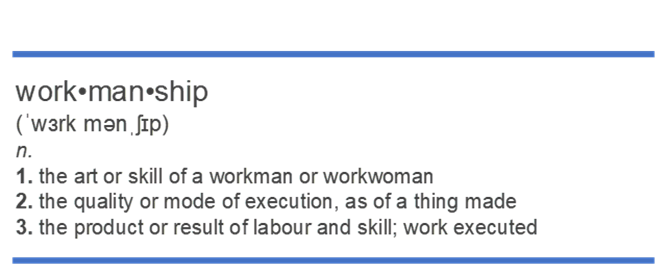
Going by this dictionary definition, we notice the following which stand out:
- Art or skill
- Quality or mode of execution
- Product or result
On one hand, workmanship sounds more like a subjective assessment than one we could scientifically measure. What one person may judge as satisfactory workmanship may not necessarily be the same from another.
On the other hand, the dictionary brings forth criteria for how we would assess workmanship, which are skill, quality, & result.
In industrial settings, we don’t hear much about workmanship as much as we do quality. We measure quality comprehensively in our factories, applying statistical methods as we emphasise detailed procedures & elaborate specifications.
Yet, we hear a lot about workmanship when we select jewellery, compare expensive watches, admire custom-made sports cars, browse fine kitchenware or silverware, order hand-made furniture, or try on bespoke business suits or dresses. We criticise the workmanship of contractors in the construction or renovation of our homes and in how well they repair our appliances and landscape our gardens.
We sometimes exchange workmanship with craftsmanship or for politically correct gender-neutral purposes: artisanship. Or, we just equate workmanship with quality or excellence but base either on our own biased standards.
We should not confuse workmanship with beauty. Beauty is how much an item appeals to our senses. Good music, works of art, and the fragrance of fine perfumes, for example, are objects we appreciate as beautiful to our ears, eyes, and noses.
Workmanship, however, is more like how well we feel a job was done or how a product’s characteristics meet our personal expectations. We appreciate the beauty of masterpieces artists create, whereas artists criticise the workmanship of their apprentices who assisted in making the masterpieces.
There is hardly any standard measure for workmanship. But it may be worth it to have one when we expect satisfactory results. The dental lab executives were on the right track; they saw both quality and efficiency in their definition of workmanship.
If we are to measure workmanship, we should at least have the following in mind:
1. A very clear vision of what we want
It’s not only a description but also an image of what we want our product to look like or what results we expect from a service or project. A picture is worth a thousand words. Both a narrative description and a vivid image would form our baseline for measuring workmanship.
2. A recipe or set of instructions
There must be a visible set of instructions on how products are to be manufactured and delivered. Instructions should be step-by-step and in sequence. And the more detailed, the better.
3. A timeline or schedule
Not only should there be a formal start date & time and deadline, but there should also be expected lengths of time for every step and a visible critical path of events. (The critical path is the longest path from the start to the end of the project, passing through all the essential tasks to the project’s completion. In other words, the longest sequence of tasks determines the minimum time needed to complete the project).
4. An agreement between stakeholders and participants
Both clients and suppliers should share a common vision, recipe, and timeline of the product or project. There should be a contract or a tangible agreement to foster an understanding between parties on these three (3) aspects. And everyone should keep in mind that there must be only one vision, recipe, and timeline.
Workmanship is therefore about how close or how far better a finished product or completed project is relative to what a client, designer, engineer, and contractor agreed to have done. It seems straightforward enough to measure a product or project against what we envisioned, how well we followed instructions, and if we met our schedule.
There would certainly still be qualitative judgments of workmanship no matter how clear our visions, recipes, timelines, and agreements are. We will always have our own opinions when we inspect products or assess results of projects. This becomes especially true when workmanship exceeds expectations; the lines sometimes blur between a job well done and a job that ended up more beautiful than we thought.
We can also conclude that workmanship is not only about quality but also about performance, i.e., how well and how efficient a product or project turned out. In another sense, workmanship is one tangible measure of productivity, an ideal we pursue for our personal and professional benefits.
 Ellery's Essays
Good point Ellery. This case highlights the difference between client’s wants and client’s needs. Deeper understanding of the problem is a good start in helping clients succeed. And what the client wants are not necessary what they need.
LikeLiked by 1 person