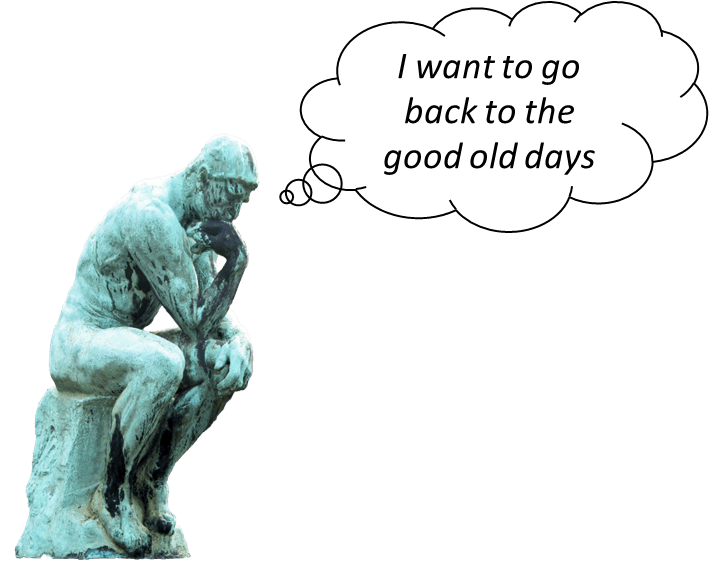
Back-to-basics is a line I had heard in just about every enterprise I worked with. Executives would say to subordinates, “we should go back to basics,” with me and the subordinates wondering if the executives knew what that even meant. Do the executives know what they were talking about?
When we say back-to-basics, we probably think of:
- Doing what succeeded sometime in the past
- Doing things strictly by the rules we had set some time ago (also known as going back to doing things ‘by the book.’)
#1 sounds easy. We just have to re-discover what we did in the past when times were good.
#2 requires some re-education on our part. We’d have to dust off those old rule books or standards which we haven’t read or referred to for so long.
The basics we want to go back to are what we think that worked well in the past. To put it another way, we want to go back to what it was like some time ago, to those good old days when it seemed we were doing better.
Back-to-basics is an ideal. It’s more like a fantasy, like a pot of gold at the end of a rainbow. It’s not only elusive, it also doesn’t exist, at least anymore. Whatever we may have experienced in the past cannot be fully repeated. As adults returning to their native lands would realise: we can’t go home again.
Back-to-basics is a yearning for better outcomes. If we recognise that we can’t go back to what we were doing in the past, maybe we could at least reset or re-engineer whatever structure or system we’re using today. Back-to-basics, thus, becomes a strategy to redo whatever we’re doing.
But do we really know what ‘basics’ we want to go back to? What, in the first place, do we mean by ‘basics?’
Executives would say they want their enterprises to go back and pursue what their original purposes were, what they (or the original founders) had in mind, and how they worked to get the desired results.
And when asked what those original purposes and desired results were, the executives would hesitate or draw a blank. They don’t know! They base the ‘back-to-basics’ on personal experiences or from stories from senior veterans who say that times were different and better then.
Some wanna-get-rich consultants exploit our dilemma of having not clear directions. Their favourite spiel is to tell executives to formulate visions, missions, objectives, & strategies (VMOS). Crooked consultants don’t care to solve what the real problems may be behind why we want to go ‘back-to-basics.’ They offer, instead, buzzwords and sounding-good themes that lead to profitable contracts that benefit them more than their clients.
We should admit when we’re stuck and don’t have answers. ‘Back-to-basics’ thinking is a defence mechanism, a rationalising response to conceal or escape the stress of being unable to overcome a challenge.
Rather than resign to whatever is giving us adverse results, we should face whatever is bugging us and solve it.
VMOS may be well and good in translating dreams into clearly defined goals and plans, but they are not meant to solve problems. When we are clueless to what we ought to be doing and we’re harking to go back to basics, it’s an indication that we need to confront whatever is making us think that. VMOS could be just another defence mechanism.
If we can’t hack it ourselves, then by all means, let’s ask people to help us. Let’s engage qualified credible consultants who will help us solve the problems, not offer silly teambuilding exercises or irrelevant proposals that don’t directly result to desired deliverables.
A leading 3rd party logistics provider, for instance, pitches consulting services to improve the supply chains of multinational companies. Its favourite approach to solving their clients’ problems, however, is to assign contracted personnel to run their clients’ operations. By taking over the clients’ operations, the 3PL promises better bottom-line results. But in most cases, it doesn’t happen. The clients still experience problems while the 3PL would blame & replace their own personnel for poor performance. The client, meanwhile, becomes over-dependent on the 3PL who bills & profits from the contracted personnel. The client remains clueless about what it should really be doing, which should be to face the problems and solve them.
Hearing executives mention back-to-basics indicates their frustration in overcoming pressing challenges. Back-to-basics is more of a fantasy which stems from us activating our ever-so-human defence mechanisms. We distract ourselves from the problems we can’t seem to tackle.
We should confront challenges & crises and solve them, not sweep them under the proverbial rug in the guise of telling our peers we should go back-to-basics. We should seek help if we can’t capably do it ourselves. We should just make sure that the people we engage with will really do help us, and not take advantage of us.
 Ellery's Essays