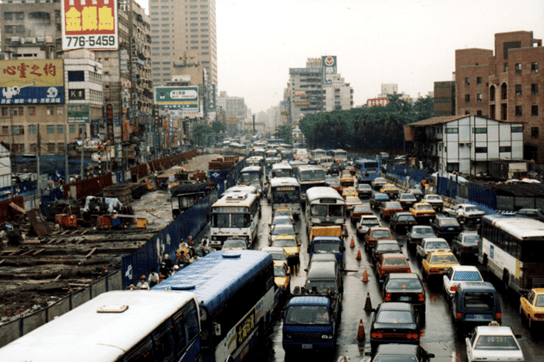
City traffic in Manila, the Philippines, is downright horrible. Driving a car in Manila is an adventure in patience and civility. It’s hard to be a nice person when we compete for road space in this city’s congested streets.
Metropolitan Manila, formally known as the National Capital Region, is the urban centre and capital of the Republic of the Philippines. It includes the old city of Manila itself and surrounding cities & towns. Many private and public organisations base their headquarters, offices, and operations in the NCR. Thus, it comes to no surprise that Metro Manila has a daytime population estimated of up to fifteen (15) million people. Metro Manila’s urban density is estimated at 42,857 people per square kilometre, much higher than that of Mumbai (23,000/sq km), Paris (20,150/sq km), and Tokyo. (10,100/sq km). (ref: https://worldpopulationreview.com/world-cities/manila-population)
Over the years, those of us who are Manila’s denizens have seen countless ideas put into play to solve the city’s traffic problem:
- The national government built new roads & bridges, and installed traffic lights, closed-circuit television cameras (CCTVs), & flood control equipment.
- The government’s lead agency, the Metropolitan Manila Development Authority (MMDA), introduced one scheme after another, consisting of ordinances & regulations, to enforce discipline among motorists. These include:
- a number coding law which banned private vehicles one day every week based on the last digit of their license plate number
- a ban on heavy trucks during morning & evening rush hours
- a ban on the use of mobile phones while driving
- Exclusive lanes for public buses at main roads and dedicated lanes for motorcycles & bicycles
- Deployment of hordes of traffic cops at busy intersections, who also were given authority to flag down & ticket motorists.
While politicians trumpeted these initiatives, they hardly made a dent on traffic. We still find ourselves spending up to four (4) hours a day driving an average of ten (10) kilometres to and from work. For those who take public transport, a commute that would take an hour or less would be negated by up to another hour of waiting in line at bus and train stations.
Traffic goes from inconvenience to nightmare when streets get flooded from heavy rains, lights fail due to power outages or glitches, or when enforcers simply give up directing traffic at busy intersections. The gridlocks that ensue result in we motorists getting stuck for more hours on the road and commuters stranded at stations or ending up walking up home.
Many of us believe enforcement is the best solution to Manila’s traffic problem. We point to undisciplined drivers for the cause of traffic. We get annoyed seeing cars parked where they’re not supposed to. We are irritated at motorists running through red lights. We shake our heads at drivers not stopping to allow pedestrians to cross. We scream at cars who block the flow of traffic at crossings. If only traffic cops would flag down these errant drivers, if only there would be enforcement of rules, we would be able to solve the traffic problem.
But somehow enforcement, no matter how much the politicians and the police try, does not seem to work. No matter how many enforcers are there, no matter how many tickets are served, the traffic gridlocks fester. We remain in despair that we will get stuck for hours whenever we foray into the city.
Authorities blame us for the traffic woes. We motorists are stubborn, undisciplined, disobedient, and disrespectful. We are accused of corrupting traffic cops and violating rules for our own ends. Those of us who are public transport drivers don’t follow road signs or stop at stations.
We should be threatened with higher penalties. Enforcement is too lax; it should be stricter and we should be punished whenever we violate the rules. More enforcement is therefore the answer, many pundits say.
And so it has been for Manila as traffic continues to worse, the MMDA enacts and applies more rules, more penalties, and more limits to discipline we ‘bad’ drivers.
As much as the national government has built new freeways & bridges and expanded train lines & river ferries, the traffic remains a mess. I’ve heard so-called self-proclaimed traffic experts agree with government leaders and authorities and label Manila’s motorists uneducated and immature. We point fingers at each other for the problem. Enforcement is very much needed.
Saying that enforcement is an ultimate fix to Manila’s traffic is an example of how misguided we are in solving problems. Solving problems doesn’t start with outright solutions. Problem solving is a process. It entails the following steps:
- Gathering information & understanding the issues
- Identifying root causes
- Establishing criteria to choose which root causes to address first
- Identifying the problem from the chosen root causes
- Laying out options as candidates for solutions
- Evaluating the candidate solutions via our established criteria
- Selecting the solution
- Developing the solution as in formulating strategies, plans, & roadmaps
- Designing the program or prototype
- Experimenting by running a pilot program or building a prototype
- Implementing the solution (‘going live’)
Because we clamour for fast outcomes to complaints, we tend to look for quick and simple fixes without first studying what’s going on and pinpointing what to prioritise. (Politicians, for instance, insist on making master plans without determining root causes and what the master plan will address). We can’t solve problems without first defining what they are and in the first place, deciding whether they’re the ones we should be addressing.
We can trace Manila’s traffic to numerous root causes:
- Overpopulation
- Too many private cars; inadequate public transport
- Not enough infrastructure (i.e., roads, bridges, sewage)
- Poorly trained or too few enforcers
- No formal zoning of urban districts
- Overlapping authority from too many government agencies
- Lack of road signs & traffic lights
- Too many undisciplined & unqualified drivers
And these are just a few. We can probably name more.
Enforcement, as much as it is a possible solution, should not be considered until we first clarify which root causes we want to address.
The problem we will define and solve is not necessarily the same as a root cause. Root causes are our jump-off point to gather & study data and as we get to understand what’s going on and evaluate versus our priorities, we sharpen our definition of the problem we intend to solve.
Defining the problem brings us almost halfway to finding the solution. When we have clarity as to the problem we want to solve, we find ourselves more creative and able to bring out ideas. We develop our solution from those ideas, again from our criteria. We experiment and invent. And we make our solution into reality.
We who drive and commute in Manila have become very impatient in seeking solutions. But we need to realise that solving the traffic problem requires stepping back, gathering information, and identifying & prioritising root causes to address before we can even study & evaluate ideas to mitigate the traffic mess.
Unfortunately, every problem-solving process takes time. We can surely insist that for the meantime, whoever is in authority should just work harder to enforce existing laws. But we need to understand that existing methods won’t likely lead to significant improvements. It would be better if we undertake a problem-solving process than to simply complain & demand for quick-fix solutions that won’t probably work.
And we who have lived in Manila for most of our lives know that quick-fix solutions never do really work. A problem-solving process would no doubt be the best way to untangle the traffic mess, if not other problems we also encounter every day.
 Ellery's Essays
2 thoughts on “Enforcement is Not Necessarily a Solution”