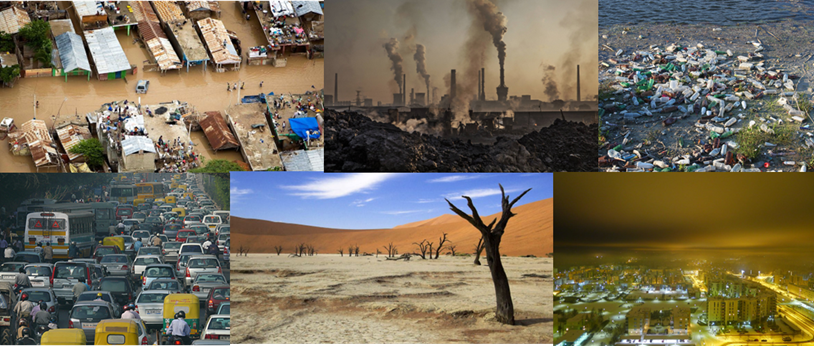
When I was in elementary school, I had an assignment to write & present a report on pollution. It was the 1970s and pollution was a global issue; politicians and the press were talking about it as a crisis that needed to be addressed.
My report to the class explained what pollution was and I made recommendations on how to mitigate it. I concluded that there were trade-offs in combating pollution; either we slowed the speed of economic progress or face the spectre of dirtier air, water, and land.
Pollution is the contamination of our environment, rendering natural resources as harmful for consumption or incompatible for utilisation.
In my school report, I named three types of pollution: air, water, & land. In the years after, we have included two (2) more: light pollution and noise pollution. Air, water, & land pollution directly impacts our natural resources, while light & noise pollution hinder our enjoyment of the environment.
These five (5) types of pollution as named are self-explanatory, but let’s look at each anyway:
Air pollution is the contamination of the atmosphere. Smoke, and its derivative, smog, are typical examples of air pollution. The release of noxious gases and radioactive fallout are more extreme examples. We consider air pollution as anything that makes it hard to breathe, causes the sky to become hazy, or brings about bad odour.
Water pollution is the contamination of aquatic systems, such as seas, rivers, and lakes. Examples of water pollution are oil slicks, untreated waste dumped into sewers, and plain dirty water. Anything that causes water to be less potable, less liveable for aquatic life, and not conducive for human enjoyment (e.g., swimming, boating, fishing) is water pollution.
Land pollution is the contamination of our planet’s solid natural ground. Examples are household trash scattered on streets, chemical seepages into the ground, and radioactive waste leaking from nuclear plants into adjacent land. Anything that results in less arable topsoil or leads to land no longer accessible for occupation or use is land pollution.
Light pollution is the unwanted illumination of the night sky, in which the brightness of urban lighting interferes with otherwise would be a dark and star-filled sky. Light pollution disrupts not only our astronomical observations of stars & other heavenly phenomena but also, basically, our sleep cycles. It’s hard to sleep when there is too much bright light.
Noise pollution is the incidences of undesirable sounds, which via volume or pitch, disturbs us. Noise disrupts what we would otherwise call peace & quiet interrupts whatever may be doing, hampering our productivity. Boom-box music, honking cars, jet planes taking off, or neighbours talking loudly constitute examples of noise pollution.
In the fifty years (50) since I presented my school report, nations had made progress against pollution. Governments around the world had passed stricter environmental protection laws. Cities have invested in measures which had led to cleaner air & water, and the preservation of natural lands. Local communities enforce ordinances against noisy automobiles and even ban landings & take-offs of aircraft after certain hours. Villages also have deliberately removed street lighting and banned neon-lighted billboards to preserve their dark skies at nights.
Starting in the 1980s, however, we shifted attention to climate change. We first called it global warming, in which some scientists guessed our planet was trapping heat and becoming like a greenhouse. It didn’t help a hole emerged in the ozone layer at the southern hemisphere which increased ultraviolet radiation (it thankfully closed years later).
We renamed global warming to climate change, so that we understand the issue covers not only rising temperatures but shifts in seasonal weather conditions.
Former United States Vice-President Al Gore put climate change on the forefront in his lead role in the documentary, An Inconvenient Truth, aired in 2006. The award-winning documentary highlighted man-made threats to our planet’s environment and the need for united action and solutions.
We don’t hear much about pollution anymore. Everyone is talking about climate change, in which politicians and the press alike say is a global crisis.
The problem of climate change isn’t identical to that of pollution. What we’re up against in climate change is deteriorating weather conditions, extreme temperature variations, and their effects on agriculture and habitats. Pollution is about the contamination of our environment and natural resources. Both pollution and climate change threaten the inhabitability of our neighbourhoods, but both are separate problems, requiring solutions catered specifically to each.
Which, then, is more important? Climate change or pollution?
We prioritise which problems to solve based on their urgency and their importance vis-à-vis what we value.
Citizens of Northern Europe and island residents at the Pacific Ocean would, for example, likely place more priority toward climate change, as they have been front-line witnesses to fast-melting ice packs and rising sea levels, respectively.
People living and working in big cities like Hong Kong, New York, and Los Angeles would probably demand more action against pollution, as they would be experiencing first-hand smog, smelly garbage, dirty water, noise, and constantly hazy and over-neon-lighted night skies.
We may try to solve both pollution and climate change simultaneously, but that approach would be in my view, wrong. It would be a mistake to solve both problems as if they were one, because when we do so, we’d inevitably end up with half-baked solutions.
To cite an example, registering one’s automobile here in the Philippines requires exhaust-emission testing before the government’s land transport office grants a renewal of vehicle registration. Yet, I would always see diesel-engine vehicles on the road spewing black sooty smoke from their exhaust pipes. Activists and politicians, meanwhile, clamour for action against climate change, demanding an end to fossil fuels as primary energy sources. Ending fossil fuels may indeed eliminate smoke-belching vehicles in the long run, but it doesn’t address the problem straight away. We who continue to ride or drive diesel- or gasoline-powered vehicles would not experience any immediate impact from climate change initiatives against fossil fuels. We’d still be breathing smoky exhausts while scientists or engineers experiment with alternative sources of energy for automobiles.
Solutions to the climate change problem don’t directly address the ones of pollution and vice-versa. Climate change’s causes are rooted in how our atmosphere is changing and affecting seasonal weather. Pollution’s causes are basically contaminants. We can stop contaminants leading to pollution and that may help mitigate climate change or we can minimise man-made contributions to the altering of our atmosphere which may also help versus pollution. Each approach may positively affect one or the other, but it does not really solve the other’s problem at least on target.
To stop pollution, I recommended in my school report that we should slow industrial progress. To stop climate change, we’d may need to do the same. But how we do it for each won’t be. On one hand, we can recycle to minimise land pollution from trash, clean & maintain our vehicles, upgrade our sewage systems, limit those garish neon lights at night, and turn down the volumes of the noises we make. On the other hand, we can promote renewable energies to reduce fossil fuel consumption and regulate the emissions of factories. We just need to keep in mind that one strategy for pollution doesn’t mean an ideal one too for climate change, and vice-versa.
Where we live and what we experience determine our priorities versus pollution and climate change. We won’t think about climate change if we’re living now with a lack of breathable air, potable water, proper sanitation, and peace & quiet. We may not be placing too much focus on pollution if we were seeing the weather changing every year, watching our farm crops wilt as a result, experiencing more floods from rising oceans, and observing glaciers melt faster.
We, however, can’t solve both problems simultaneously even if we may find common denominating issues in each. But we can solve both problems together, as in collaboration via teams or communities
Collaboration is not about compromise or trading off one’s priorities for another. It is about synergy and developing win-win solutions. It starts with sharing, such as information and assets, and requires open minds to other people’s views. Solutions come quicker when we join forces than work solo.
We may differ in our priorities toward either pollution or climate change. Both require unique solutions respectively and we can’t solve them at the same time optimally. But we can make progress if we take the initiative to work together.
 Ellery's Essays